

 Product
 Brand
Brand Articles
 Tools
Tools
Revolutionizing Semiconductor Manufacturing with New Plasma Power Technologies
The semiconductor industry is making strides towards angstrom-scale device features, driven by the need for speed, size, and complexity in chip designs. Vitaly Petrishchev, a lead engineer for plasma power applications at Advanced Energy, suggests that high-speed, precise and repeatable plasma power delivery with sophisticated controls is fundamental to process and device improvements. Over the past four decades, plasma power delivery has rapidly evolved in parallel with semiconductor devices. The earliest form of RF power delivery was based on linear power technology, which then evolved into switched-mode technology, offering greater efficiency, simplicity, and reliability. The industry then moved towards selectable fixed impedance matching systems, allowing for wider impedance ranges and multiple match positions. As the industry moves towards a new inflection, a new generation of RF technology has emerged to empower process innovation for sub-2 nm device architectures. This technology provides access to new energy regimes and distributions, increases process space, widens the stability window, and offers high-speed response and increased RF stability. The latest technologies also offer dynamically controllable multi-level pulsing, user-defined transition timing, dP/dZ stability with high-speed output response, programmable overshoot, high-speed, high-accuracy model-based frequency tuning with a wide frequency sweep range, and reliable ignition and RF stability independent of cable length. Moreover, these technologies provide actionable intelligence through high-resolution, high-bandwidth data acquisition and analysis platforms. This new generation of RF technology is setting the stage for future technology nodes, delivering another inflection point for the industry with the promise of even more powerful semiconductor devices. As process complexity grows, so do requirements for unprecedented precision, repeatability, and control. Ongoing developments in the field of RF generators and associated hardware and software will play a pivotal role in the success of next-generation processes.
 UTMEL
UTMEL
We are the professional distributor of electronic components, providing a large variety of products to save you a lot of time, effort, and cost with our efficient self-customized service. careful order preparation fast delivery service
 Power Semiconductor Procurement After the Nexperia Shake-Up—NXP for Stability, ON for Technology, or Nexperia for Value?UTMEL04 November 20254828
The recent supply chain turmoil surrounding Netherlands-based Nexperia has sent shockwaves through the global semiconductor industry, forcing procurement professionals to re-evaluate their sourcing strategies.
Read More AI Computing Power Gap: How Token Consumption is Reshaping Server Component SourcingUTMEL23 June 2026898
As global token consumption drives the transition to high-density 100kW+ AI data centers, power delivery networks require advanced Wide-Bandgap semiconductors (SiC/GaN) and high-capacitance MLCCs. This shift has triggered a component procurement crisis with lead times exceeding 24 weeks. To bypass shortages, hardware buyers must abandon just-in-time manufacturing and leverage independent global distributor networks to secure critical power and passive components.
Read More The BSPDN Revolution: Overcoming IR Drop in Sub-2nm GAAFET Nodes with Backside Power DeliveryUTMEL25 June 2026818
As semiconductor manufacturing enters the sub-2nm era, Backside Power Delivery Networks (BSPDN) are replacing traditional front-side routing to overcome critical IR drop bottlenecks. By separating power and signal delivery, chipmakers like Intel and TSMC drastically improve performance and density in GAAFET designs. However, this radical shift introduces manufacturing complexities, thermal challenges, and demands advanced packaging and power management solutions.
Read More Power Management ICs Trends 2026: AI Demand, Supply Risks, and Sourcing StrategiesUTMEL06 July 20261298
As AI server racks surpass 100kW by 2026, data centers are shifting toward wide-bandgap semiconductors like SiC and GaN. However, this demand has triggered a critical shortage of mature-node Power Management ICs (PMICs). To prevent production halts, sourcing teams must abandon 'just-in-time' models, implement proactive 'just-in-case' strategies, and rapidly qualify pin-to-pin alternative components to secure their supply chains.
Read More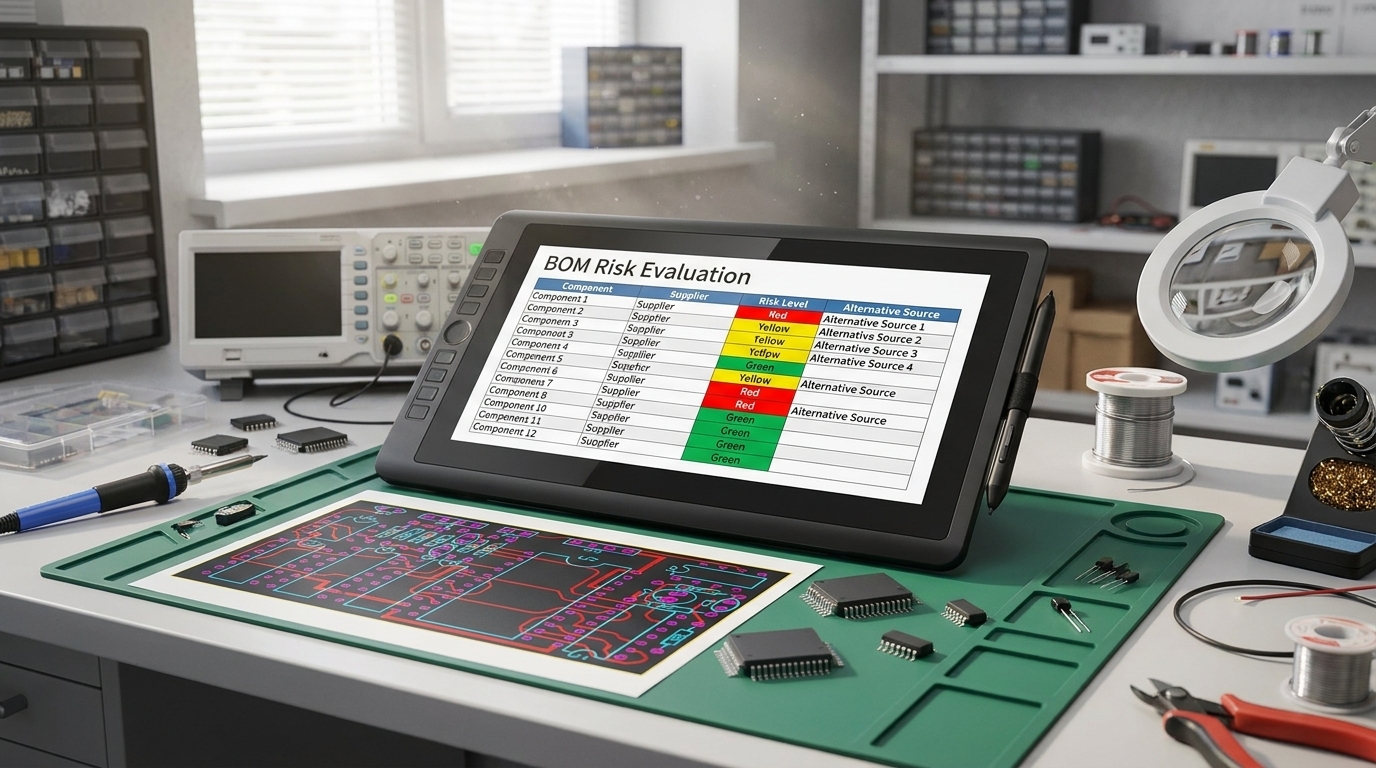 onsemi Synaptics Acquisition Impact: BOM Risk Checklist and Second-Source Strategy for Edge AI DesignsUTMEL27 July 2026296
The onsemi acquisition of Synaptics provides hardware program managers a 12-to-18-month window before potential product cancellations occur in mid-2027. This guide outlines how to audit BOM exposure across overlap and non-core product lines, calculate Last-Time-Buy volumes including hidden storage costs, establish proactive second-sourcing triggers, and implement supply chain monitoring to prevent line-down events.
Read More
Subscribe to Utmel !
![BLM18HE601SN1D]() BLM18HE601SN1D
BLM18HE601SN1DMurata Electronics
![CC1310F128RGZT]() CC1310F128RGZT
CC1310F128RGZTTexas Instruments
![NFM15PC435R0E3D]() NFM15PC435R0E3D
NFM15PC435R0E3DMurata Electronics
![NFM18PC104R1C3D]() NFM18PC104R1C3D
NFM18PC104R1C3DMurata Electronics
![PWT75]() PWT75
PWT75Panduit Corp
![PEC12R-2225F-N0024]() PEC12R-2225F-N0024
PEC12R-2225F-N0024Bourns Inc.
![BLM03BD471SN1D]() BLM03BD471SN1D
BLM03BD471SN1DMurata Electronics
![03453LS1HX020]() 03453LS1HX020
03453LS1HX020Littelfuse Inc.
![NFM21PC105B1C3D]() NFM21PC105B1C3D
NFM21PC105B1C3DMurata Electronics
![WC-620]() WC-620
WC-620JST Sales America Inc.


