

 Product
 Brand
Brand Articles
 Tools
Tools
AD9257 Octal ADC Integration Notes: FPGA Timing, VCM Handling, and Alternatives

14 Bit 0.5mm ADC AD9257 1.8V 64-WFQFN Exposed Pad
Unit Price: $199.250193
Ext Price: $199.25


14 Bit 0.5mm ADC AD9257 1.8V 64-WFQFN Exposed Pad
Explore the AD9257 14-bit octal ADC. Learn how to resolve FPGA timing issues, handle VCM power-down conflicts, and evaluate alternatives like the AD9637.
- Core Specifications and Engineering Tradeoffs
- Resolving FPGA Timing and DCO Phase Alignment
- Chop Mode and Frequency Translation Realities
- VCM Pin Power-Down Handling
- Target Applications and System Fit
- Alternatives, Upgrades, and Competitors
- Datasheet, Package, and Schematic Verification
- Frequently Asked Questions
- Specifications
- Datasheet PDF
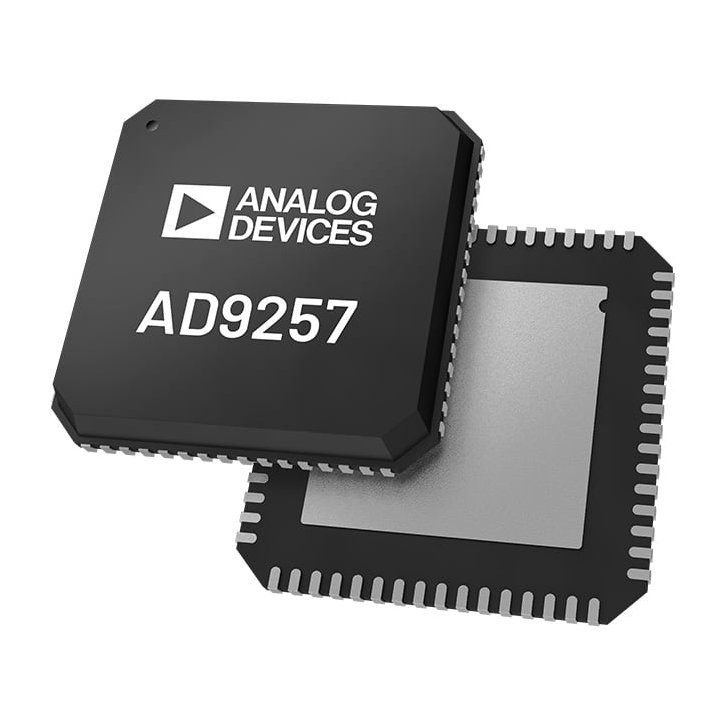
The AD9257 is an octal, 14-bit, 40 MSPS to 65 MSPS analog-to-digital converter (ADC) designed for high-density signal processing applications requiring precise dynamic performance and low power consumption. Featuring an on-chip sample-and-hold circuit, it is explicitly optimized for designs where PCB real estate is at a premium and thermal budgets are strictly capped.
When integrating eight high-speed data channels into a single package, engineers face a distinct set of challenges ranging from serial data alignment to crosstalk mitigation.
Market Position: A high-density, low-power solution for multi-channel acquisition.
Primary Interface: Serial LVDS (ANSI-644 default) with a reduced signal option.
Key Selection Factor: 55 mW per channel power consumption (at 65 MSPS) allows for tight packing in portable or enclosed systems.
Replacement Risk: While pin-compatible step-down options exist, moving to different architectures requires significant FPGA IP rewrites.
Core Specifications and Engineering Tradeoffs
Evaluating the AD9257 requires balancing its impressive dynamic performance against the physical realities of routing an octal ADC.
Resolution and Speed: 14-bit resolution operating between 40 MSPS and 65 MSPS.
Dynamic Performance: SNR of 75.5 dB and SFDR of 91.6 dBc (to Nyquist).
Power Consumption: 55 mW per channel at the maximum 65 MSPS rate, operating from a 1.8 V supply.
Input and Bandwidth: 2 V p-p input voltage range with a massive 650 MHz full power analog bandwidth.
The 650 MHz analog bandwidth is a double-edged sword. While it provides excellent headroom for undersampling applications and intermediate frequency (IF) processing, it heavily penalizes sloppy front-end design. Any broad-spectrum noise present at the inputs will alias down into your baseband unless aggressively band-limited. Engineers must implement stringent anti-aliasing filters and ensure pristine clock sources, as jitter on the sample clock will rapidly degrade the 75.5 dB SNR in high-frequency input scenarios.
Resolving FPGA Timing and DCO Phase Alignment
One of the most frequent integration hurdles with the AD9257 involves serial data capture at the receiving FPGA. Because the device multiplexes 14 bits of data per channel over Serial LVDS lines, the timing margins at 65 MSPS are exceptionally tight.
A common symptom of timing failure is the capture of bad data or corrupted digital test patterns when the input clock frequency is changed during development or dynamic operation. This occurs because the propagation delay through the ADC and the resulting phase relationship between the Data Clock Output (DCO) and the data lines shift.
To resolve this, engineers must actively manage the DCO phase. Instead of attempting complex delay-locked loop (DLL) adjustments entirely within the FPGA fabric, you can adjust the DCO phase directly at the ADC via SPI Register 0x16. Tuning this register shifts the DCO relative to the data frame, allowing you to center the clock edge squarely within the valid data eye. When shifting clock frequencies, always re-verify your test patterns (the AD9257 includes built-in and custom digital test pattern generation specifically for this purpose) and update Register 0x16 as needed to restore timing alignment.
Chop Mode and Frequency Translation Realities
The AD9257 includes a chop mode designed to mitigate low-frequency noise and offset anomalies, which is particularly useful in continuous-wave ultrasound or baseband receiver applications. However, there is a persistent misunderstanding regarding how chop mode interacts with the frequency spectrum.
Many engineers expect chop mode to shift the fundamental frequency spectrum line of their signal. This is incorrect. Chop mode does not translate fundamental frequencies if the signal resides entirely inside the first Nyquist zone. Spectrum lines will only translate via frequency folding if the input signal is outside the first Nyquist zone. If you are relying on chop mode to push 1/f noise away from a DC-coupled signal, ensure your digital down-conversion (DDC) or subsequent DSP stages are correctly configured to handle the specific folding behavior of your input band.
VCM Pin Power-Down Handling
The common-mode voltage (VCM) pin is critical for setting the DC bias of the analog inputs. The AD9257 provides an internal VCM reference, but many high-precision designs opt to drive this node with a low-noise external reference to match the front-end amplifier perfectly.
If you choose to use an external VCM source, there is a strict sequence required to avoid voltage conflicts and erratic power-draw behavior. You must promptly power down the internal VCM at start-up via SPI Register 0x102.
A frequent design error is treating the powered-down VCM pin exactly like an active one. When the internal VCM is powered down, the VCM pin does not need to be decoupled to ground. Leaving heavy decoupling capacitors on a disabled VCM pin while driving it externally can alter the startup time of your external reference and create unnecessary AC ground loops. Remove the local decoupling capacitors if the internal VCM is disabled.
Target Applications and System Fit
The AD9257’s combination of octal density and 55 mW/channel power draw naturally restricts it to specific, high-value applications where these traits justify the cost and layout complexity.
Medical Imaging and Ultrasound: Both non-destructive testing and portable medical ultrasound require massive channel counts (often 64 to 256 channels per probe head). The AD9257 allows designers to pack eight channels into a tiny footprint without exceeding the strict thermal limits of a handheld digital beam-forming system.
Quadrature and Diversity Radio Receivers: In phased array or MIMO communication setups, the phase coherence between the eight channels on a single die provides superior matching compared to synchronizing multiple discrete ADCs.
Optical Networking and Test Equipment: High-density instrumentation relies on the programmable clock and data alignment features to maintain channel-to-channel timing accuracy across complex backplanes.
Alternatives, Upgrades, and Competitors
When sourcing the AD9257 or designing a flexible BOM, evaluating alternatives is a mandatory step.
Pin-Compatible Downgrade:
The AD9637 is the most direct alternative. It is a pin-compatible 12-bit version of the AD9257. If your system's dynamic range requirements loosen, or if the 14-bit variant faces supply chain constraints, the AD9637 can be dropped into the exact same PCB footprint with minimal software changes, instantly reducing BOM cost.
Functional Competitors:
* AD9259 and AD9251: These are related Analog Devices converters. The AD9259 is a 14-bit quad ADC (50 MSPS), useful if you only need four channels and want to simplify routing.
* LTC2160, LTC2280, LTC2281: These Linear Technology (now Analog Devices) parts operate in similar resolution and speed tiers but feature different architectural tradeoffs, power profiles, and pinouts. Moving to an LTC part will require a complete PCB spin and an overhaul of the FPGA LVDS capture code.
Datasheet, Package, and Schematic Verification
Before finalizing your schematic capture, several critical physical and electrical parameters must be verified.
Thermal Pad Grounding: The AD9257 is packaged in a space-saving footprint that relies entirely on an exposed bottom paddle for thermal dissipation and electrical grounding. Confirm the exact thermal pad dimensions and via-stitching requirements in the latest spec sheet. A poorly soldered thermal pad will cause the device to overheat and degrade the SNR.
LVDS Termination: The device defaults to ANSI-644 standard LVDS. If your FPGA prefers a reduced signal swing to save power or reduce EMI, you must configure the ADC via SPI to use the reduced signal option. Ensure your 100-ohm differential termination resistors are placed as physically close to the FPGA receiver pins as possible.
Power Sequencing: Verify that the 1.8 V analog and digital supplies ramp smoothly. Since the device features both full-chip and individual channel power-down modes, ensure your microcontroller's startup routine does not inadvertently try to read data before the SPI configuration has fully awakened the required channels.
Frequently Asked Questions
Can I replace the AD9257 with the AD9637 without changing the PCB footprint?
Yes. The AD9637 is a pin-compatible 12-bit alternative. You can use the same PCB footprint and power supplies, though you will need to adjust your FPGA data parser to handle 12-bit words instead of 14-bit words.
Why is my FPGA capturing bad data frames when I change the ADC sample clock?
Changing the input clock frequency shifts the timing relationship between the serial data lines and the Data Clock Output (DCO). You must adjust the DCO phase via SPI register 0x16 to re-align the clock edge with the valid data eye for your specific frequency.
Do I need a decoupling capacitor on the VCM pin if I am using an external reference voltage?
No. If you are driving VCM externally, you must power down the internal VCM via SPI Register 0x102. Once powered down, the VCM pin does not require its own decoupling capacitor to ground.
Will chop mode shift the fundamental frequency of my input signal?
No. Chop mode does not translate fundamental frequencies within the first Nyquist zone. It only translates spectrum lines via frequency folding if your input signal sits outside the first Nyquist zone.
Specifications
Datasheet PDF
- Datasheets :
- ConflictMineralStatement :
 LM833N Operational Amplifier: Audio Amplifier, Datasheet, Pinout
30 December 20215253
 NJM4560 Dual OP-AMP: Datasheet, Equivalent and Circuit
03 November 202110236
 PIC18F46K22 Microcontroller: Features, Pinout, and Datasheet
27 October 20218367
 Si3865BDV Load Switch with Level-Shift: Datasheet, Pinout, Application
21 January 2022893
 bs250p MOSFET: Datasheet, Equivalent, Pinout, and Specifications
31 March 20225459
 AT24C01C I²C-Compatible Serial EEPROM: Pinout, Equivalent and Datasheet
25 February 20221247
![RP2040 VS ESP32[Video+FAQ]: Which one is better?](https://res.utmel.com/Images/Article/a7926785-e416-4bc7-a497-2b286c021b7c.jpg) RP2040 VS ESP32[Video+FAQ]: Which one is better?
RP2040 VS ESP32[Video+FAQ]: Which one is better?03 March 2022186976
 CL220 Regulator: Datasheet, Application, Circuit
06 September 2021623
 Step-by-Step Guide to 2.2 k Ohm Resistor Color Code in 2025
20 August 20254168
 An Overview of Bipolar Transistors
27 August 20209128
 Is Digital Radio Frequency Memory (DRFM) Suitable for Spoofing Interference?
12 November 20215419
 How do We Select Automotive Relays?
30 September 202010650
 Google Unveils LM-Nav, A Robotic Navigation System, In Association With Universities
03 August 20224997
 Substitute Part Validation: How to Cross-Reference and Verify Obsolete Components
04 June 2026217
 Detailed Analysis of Analog IC
22 November 20213946
 Basic Introduction to System on a Chip
02 December 20204780
Analog Devices Inc.
In Stock: 2714
Minimum: 1 Multiples: 1
Qty
Unit Price
Ext Price
1
$199.250193
$199.25
10
$187.971880
$1,879.72
100
$177.331962
$17,733.20
500
$167.294304
$83,647.15
1000
$157.824815
$157,824.82
Not the price you want? Send RFQ Now and we'll contact you ASAP.
Inquire for More Quantity
![ADV7513BSWZ]() ADV7513BSWZ
ADV7513BSWZAnalog Devices, Inc.
![AD9877ABSZ]() AD9877ABSZ
AD9877ABSZAnalog Devices, Inc.
![LTC2245CUH#TRPBF]() LTC2245CUH#TRPBF
LTC2245CUH#TRPBFLinear Technology/Analog Devices
![AD7791BRMZ-REEL]() AD7791BRMZ-REEL
AD7791BRMZ-REELAnalog Devices Inc.
![AD7799BRUZ-REEL]() AD7799BRUZ-REEL
AD7799BRUZ-REELAnalog Devices Inc.
![AD7190BRUZ-REEL]() AD7190BRUZ-REEL
AD7190BRUZ-REELAnalog Devices Inc.
![AD7705BRZ-REEL]() AD7705BRZ-REEL
AD7705BRZ-REELAnalog Devices Inc.
![AD7175-2BRUZ-RL7]() AD7175-2BRUZ-RL7
AD7175-2BRUZ-RL7Analog Devices Inc.
![AD7192BRUZ-REEL]() AD7192BRUZ-REEL
AD7192BRUZ-REELAnalog Devices Inc.
![AD9283BRSZ-RL100]() AD9283BRSZ-RL100
AD9283BRSZ-RL100Analog Devices Inc.


