

 Product
 Brand
Brand Articles
 Tools
Tools
HMC462LP5 Low Noise Amplifier: Datasheet, Pinout, Price

13dB General Purpose WIDE BAND LOW POWER Strip 2GHz~20GHz P1dB:14dBm 2.5dB Surface Mount


13dB General Purpose WIDE BAND LOW POWER Strip 2GHz~20GHz P1dB:14dBm 2.5dB Surface Mount
The HMC462LP5 is a GaAs MMIC pHEMT low noise distributed Amplifier. This article will unlock more details about HMC462LP5. There is a huge range of Semiconductors, Capacitors, Resistors and ICs in stock. Welcome RFQ!
HMC462LP5 Pinout
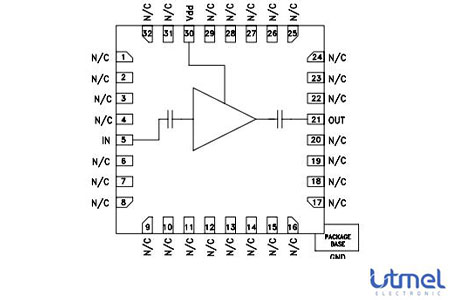
HMC462LP5 Pinout
HMC462LP5 CAD Model
Symbol
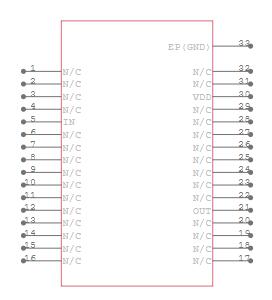
HMC462LP5 Symbol
Footprint
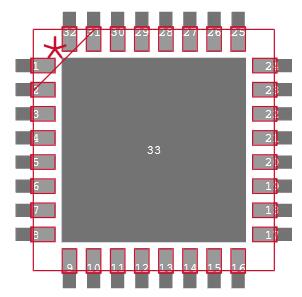
HMC462LP5 Footprint
3D Model
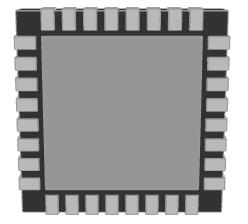
HMC462LP5 3D Model
HMC462LP5 Description
The HMC462LP5 is a GaAs  MMIC  pHEMT Low Noise Distributed Amplifier in leadless 5x5 mm surface-mount packages that operate between 2 and 20 GHz. The self-biased amplifier provides 13 dB of gain, 2.5 to 3.5 dB noise figure and +14.5 dBm of output power at 1 dB gain compression while requiring only 66 mA from a single +5V supply.
Gain flatness is excellent from 6 - 18 GHz making the HMC462LP5 & HMC462LP5E ideal for EW, ECM RADAR and test equipment applications. The wideband amplifier I/Os are internally matched to 50 Ohms and are internally DC blocked.
HMC462LP5 Feature
Noise Figure: 2.5 dB @ 10 GHz
Gain: 13 dB P1dB
Output Power: +14.5 dBm @ 10 GHz
Self-Biased: +5V @ 66mA
50 Ohm Matched Input/Output 2
5 mm 2 Leadless SMT Package
HMC462LP5 Application
• Telecom Infrastructure
• Microwave Radio & VSAT
• Military EW, ECM & C 3 I
• Test Instrumentation
• Fiber Optics
HMC462LP5 Alternatives
The alternative for HMC465LP5:
HMC462LP5
HMC462LP5E
Specifications
- TypeParameter
- Lifecycle Status
Lifecycle Status refers to the current stage of an electronic component in its product life cycle, indicating whether it is active, obsolete, or transitioning between these states. An active status means the component is in production and available for purchase. An obsolete status indicates that the component is no longer being manufactured or supported, and manufacturers typically provide a limited time frame for support. Understanding the lifecycle status is crucial for design engineers to ensure continuity and reliability in their projects.
PRODUCTION (Last Updated: 2 weeks ago) - Factory Lead Time20 Weeks
- Mounting Type
The "Mounting Type" in electronic components refers to the method used to attach or connect a component to a circuit board or other substrate, such as through-hole, surface-mount, or panel mount.
Surface Mount - Package / Case
refers to the protective housing that encases an electronic component, providing mechanical support, electrical connections, and thermal management.
32-VFQFN Exposed Pad - Surface Mount
having leads that are designed to be soldered on the side of a circuit board that the body of the component is mounted on.
YES - Number of Pins32
- Packaging
Semiconductor package is a carrier / shell used to contain and cover one or more semiconductor components or integrated circuits. The material of the shell can be metal, plastic, glass or ceramic.
Strip - JESD-609 Code
The "JESD-609 Code" in electronic components refers to a standardized marking code that indicates the lead-free solder composition and finish of electronic components for compliance with environmental regulations.
e0 - Pbfree Code
The "Pbfree Code" parameter in electronic components refers to the code or marking used to indicate that the component is lead-free. Lead (Pb) is a toxic substance that has been widely used in electronic components for many years, but due to environmental concerns, there has been a shift towards lead-free alternatives. The Pbfree Code helps manufacturers and users easily identify components that do not contain lead, ensuring compliance with regulations and promoting environmentally friendly practices. It is important to pay attention to the Pbfree Code when selecting electronic components to ensure they meet the necessary requirements for lead-free applications.
no - Part Status
Parts can have many statuses as they progress through the configuration, analysis, review, and approval stages.
Active - Moisture Sensitivity Level (MSL)
Moisture Sensitivity Level (MSL) is a standardized rating that indicates the susceptibility of electronic components, particularly semiconductors, to moisture-induced damage during storage and the soldering process, defining the allowable exposure time to ambient conditions before they require special handling or baking to prevent failures
1 (Unlimited) - Number of Terminations32
- ECCN Code
An ECCN (Export Control Classification Number) is an alphanumeric code used by the U.S. Bureau of Industry and Security to identify and categorize electronic components and other dual-use items that may require an export license based on their technical characteristics and potential for military use.
EAR99 - Terminal Finish
Terminal Finish refers to the surface treatment applied to the terminals or leads of electronic components to enhance their performance and longevity. It can improve solderability, corrosion resistance, and overall reliability of the connection in electronic assemblies. Common finishes include nickel, gold, and tin, each possessing distinct properties suitable for various applications. The choice of terminal finish can significantly impact the durability and effectiveness of electronic devices.
Tin/Lead (Sn/Pb) - Max Operating Temperature
The Maximum Operating Temperature is the maximum body temperature at which the thermistor is designed to operate for extended periods of time with acceptable stability of its electrical characteristics.
85°C - Min Operating Temperature
The "Min Operating Temperature" parameter in electronic components refers to the lowest temperature at which the component is designed to operate effectively and reliably. This parameter is crucial for ensuring the proper functioning and longevity of the component, as operating below this temperature may lead to performance issues or even damage. Manufacturers specify the minimum operating temperature to provide guidance to users on the environmental conditions in which the component can safely operate. It is important to adhere to this parameter to prevent malfunctions and ensure the overall reliability of the electronic system.
-40°C - Max Power Dissipation
The maximum power that the MOSFET can dissipate continuously under the specified thermal conditions.
3.25W - Number of Functions1
- Construction
Construction in electronic components refers to the design and materials used in the manufacturing of the components. It encompasses the physical structure, arrangement, and integration of various parts like substrates, conductors, and insulators. The construction impacts the performance, reliability, and thermal properties of the component, influencing how it interacts with electrical signals and other components in a circuit. Different construction techniques can also affect the size, weight, and cost of the electronic component.
COMPONENT - Reach Compliance Code
Reach Compliance Code refers to a designation indicating that electronic components meet the requirements set by the Registration, Evaluation, Authorization, and Restriction of Chemicals (REACH) regulation in the European Union. It signifies that the manufacturer has assessed and managed the chemical substances within the components to ensure safety and environmental protection. This code is vital for compliance with regulations aimed at minimizing risks associated with hazardous substances in electronic products.
not_compliant - Frequency
In electronic components, the parameter "Frequency" refers to the rate at which a signal oscillates or cycles within a given period of time. It is typically measured in Hertz (Hz) and represents how many times a signal completes a full cycle in one second. Frequency is a crucial aspect in electronic components as it determines the behavior and performance of various devices such as oscillators, filters, and communication systems. Understanding the frequency characteristics of components is essential for designing and analyzing electronic circuits to ensure proper functionality and compatibility with other components in a system.
2GHz~20GHz - Base Part Number
The "Base Part Number" (BPN) in electronic components serves a similar purpose to the "Base Product Number." It refers to the primary identifier for a component that captures the essential characteristics shared by a group of similar components. The BPN provides a fundamental way to reference a family or series of components without specifying all the variations and specific details.
HMC462 - Pin Count
a count of all of the component leads (or pins)
32 - Operating Supply Voltage
The voltage level by which an electrical system is designated and to which certain operating characteristics of the system are related.
5V - Power Supplies
an electronic circuit that converts the voltage of an alternating current (AC) into a direct current (DC) voltage.?
5V - Number of Channels1
- Test Frequency
a statistical procedure for assessing data that contain counts or the numbers of occurrences of various categories or classes.
10GHz - Current - Supply
Current - Supply is a parameter in electronic components that refers to the maximum amount of electrical current that the component can provide to the circuit it is connected to. It is typically measured in units of amperes (A) and is crucial for determining the power handling capability of the component. Understanding the current supply rating is important for ensuring that the component can safely deliver the required current without overheating or failing. It is essential to consider this parameter when designing circuits to prevent damage to the component and ensure proper functionality of the overall system.
66mA - Gain
In electronic components, "Gain" refers to the ratio of the output signal amplitude to the input signal amplitude. It is a measure of the amplification provided by the component, such as a transistor or operational amplifier. Gain is typically expressed in decibels (dB) or as a numerical value, indicating how much the signal is amplified by the component.A higher gain value indicates a greater amplification of the input signal, while a lower gain value indicates less amplification. Gain is an important parameter in designing and analyzing electronic circuits, as it determines the overall performance and functionality of the system. Different components have different gain characteristics, and understanding the gain of a component is crucial for achieving the desired signal processing or amplification in electronic systems.
13dB - RF/Microwave Device Type
The parameter "RF/Microwave Device Type" in electronic components refers to the specific type or category of devices designed to operate within the radio frequency (RF) and microwave frequency ranges. These devices are engineered to handle high-frequency signals and are commonly used in various applications such as wireless communication, radar systems, satellite communication, and more. Examples of RF/Microwave device types include amplifiers, filters, mixers, oscillators, antennas, and transceivers. Understanding the RF/Microwave device type is crucial for selecting the appropriate component that meets the requirements of a particular RF system or application.
WIDE BAND LOW POWER - RF Type
The rate of oscillation of electromagnetic radio waves in the range of 3 kHz to 3 GHz, as well as the alternating currents carrying the radio signals.
General Purpose - Characteristic Impedance
Characteristic impedance is a fundamental property of transmission lines and refers to the specific impedance that a transmission line presents to an electrical wave propagating along it. It is determined by the physical parameters of the transmission line, including its inductance and capacitance per unit length. When the line is terminated with a load that matches its characteristic impedance, maximum power transfer occurs, minimizing reflections and signal losses. In high-frequency applications, maintaining the characteristic impedance is crucial for signal integrity and performance.
50Ohm - Noise Figure
Noise figure (NF) and noise factor (F) are measures of degradation of the signal-to-noise ratio (SNR), caused by components in a signal chain.
2.5dB - P1dB
P1dB, or the 1-dB compression point, is a key parameter in electronic components, particularly in amplifiers and RF (radio frequency) devices. It indicates the output power level at which the gain of the device starts to decrease by 1 dB relative to the expected linear gain. At this point, the device is nearing saturation, and its ability to linearly amplify signals diminishes. Understanding P1dB is essential for designers to ensure that devices operate effectively within their linear region under typical operating conditions.
14dBm - RoHS Status
RoHS means “Restriction of Certain Hazardous Substances” in the “Hazardous Substances Directive” in electrical and electronic equipment.
Non-RoHS Compliant - Lead Free
Lead Free is a term used to describe electronic components that do not contain lead as part of their composition. Lead is a toxic material that can have harmful effects on human health and the environment, so the electronics industry has been moving towards lead-free components to reduce these risks. Lead-free components are typically made using alternative materials such as silver, copper, and tin. Manufacturers must comply with regulations such as the Restriction of Hazardous Substances (RoHS) directive to ensure that their products are lead-free and environmentally friendly.
Contains Lead
Parts with Similar Specs
- ImagePart NumberManufacturerPackage / CaseNumber of PinsFrequencyP1dBGainNoise FigureTest FrequencyOperating Supply CurrentView Compare
![HMC462LP5]()
HMC462LP5
32-VFQFN Exposed Pad
32
2GHz ~ 20GHz
14dBm
13dB
2.5dB
10GHz
66 mA
![HMC463LP5E]()
32-VFQFN Exposed Pad
32
2GHz ~ 20GHz
16dBm
12dB
3dB
6GHz ~ 18GHz
60 mA
![HMC565LC5TR]()
32-TFQFN Exposed Pad
32
6GHz ~ 20GHz
11dBm
18.5dB
2.5dB
12GHz ~ 20GHz
53 mA
![HMC463LP5ETR]()
32-VFQFN Exposed Pad
32
2GHz ~ 20GHz
16dBm
12dB
3dB
6GHz ~ 18GHz
60 mA


HMC462LP5 Package
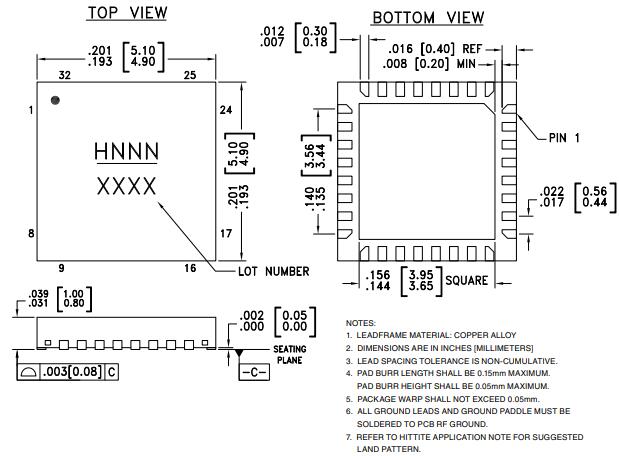
HMC462LP5 Package
HMC462LP5 Manufacturer
Analog Devices (NASDAQ: ADI) is a world leader in the design, manufacture, and marketing of a broad portfolio of high-performance analogue, mixed-signal, and digital signal processing (DSP) integrated circuits (ICs) used in virtually all types of electronic equipment. Since our inception in 1965, we have focused on solving the engineering challenges associated with signal processing in electronic equipment. Used by over 100,000 customers worldwide, our signal processing products play a fundamental role in converting, conditioning, and processing real-world phenomena such as temperature, pressure, sound, light, speed, and motion into electrical signals to be used in a wide array of electronic devices.
Datasheet PDF
- Datasheets :
- ConflictMineralStatement :
Trend Analysis
What is HMC462LP5?
The HMC462LP5 is a GaAs MMIC pHEMT Low Noise Distributed Amplifier in leadless 5x5 mm surface-mount packages that operate between 2 and 20 GHz. The self-biased amplifier provides 13 dB of gain, 2.5 to 3.5 dB noise figure and +14.5 dBm of output power at 1 dB gain compression while requiring only 66 mA from a single +5V supply. Gain flatness is excellent from 6 - 18 GHz making the HMC462LP5 & HMC462LP5E ideal for EW, ECM RADAR and test equipment applications. The wideband amplifier I/Os are internally matched to 50 Ohms and are internally DC blocked.
What is the difference between low noise amplifier and power amplifier?
The power amplifier is optimized for power gain. It does not have to be differential, for example. Types: audio amplifiers, video amplifiers, buffers, RF, etc. A low-noise amplifier (LNA) is optimized for low input noise, either voltage noise Vn or current noise In.
What is the ideal value of noise figure?
For ideal conditions, SNR at the input of an amplifier should be equal to SNR at the output of an amplifier because signal power and noise power, both get amplified. But in the actual case, the SNR at the output of the amplifier will be less than the SNR at the input.
 DRV8835DSSR: Pinout, Datasheet
18 March 20221394
 IR2104 Half-Bridge Driver:Datasheet, Schematic, Pinout
14 October 202116086
 What is the difference between IRF640 and IRF740: IRF640 vs. IRF740
08 December 20217184
 L7809CV Positive Voltage Regulator ICs: Pinout, Equivalent and Datasheet
28 February 20229009
 Exploring the Silicon Labs EFM8LB12F64ECQFN32 Microcontroller: A Comprehensive Analysis
29 February 2024228
 STM32F051C8T6 Microcontroller: Features, Applications and Datasheet
08 December 2023915
 ULQ2003 Darlington Array: Pinout, Features and Datasheet
29 November 20213981
![2N2907A Small Signal PNP Transistors: Pinout, Datasheet pdf and Equivalent [Video]](https://res.utmel.com/Images/Article/e3cebe8c-d535-40d4-af81-ca08b3da049a.jpg) 2N2907A Small Signal PNP Transistors: Pinout, Datasheet pdf and Equivalent [Video]
2N2907A Small Signal PNP Transistors: Pinout, Datasheet pdf and Equivalent [Video]15 December 20215485
 How Electric Fuses Work: Types, Ratings, and Selection Guide
14 July 202618255
 Lithium-ion Battery: Structure, Working Principle and Package
08 November 202527008
 How do Parking Sensors Work?
05 August 202638657
 How to Use the Oscilloscope's X-Y Display Correctly
19 September 202216370
 TinyML Takes a Major Step Forward as Israeli Company Releases New Chip
19 April 20221236
 PWM vs MPPT Solar Charge Controllers: A Complete Comparison Guide
06 June 20254846
 HDMI Cable Guide: Signal Path, Device Fit, and Selection Checks
14 July 20265900
 How to Select Stepper Motor Controllers for Precision
19 July 20251118
Analog Devices Inc.
In Stock
United States
China
Canada
Japan
Russia
Germany
United Kingdom
Singapore
Italy
Hong Kong(China)
Taiwan(China)
France
Korea
Mexico
Netherlands
Malaysia
Austria
Spain
Switzerland
Poland
Thailand
Vietnam
India
United Arab Emirates
Afghanistan
Åland Islands
Albania
Algeria
American Samoa
Andorra
Angola
Anguilla
Antigua & Barbuda
Argentina
Armenia
Aruba
Australia
Azerbaijan
Bahamas
Bahrain
Bangladesh
Barbados
Belarus
Belgium
Belize
Benin
Bermuda
Bhutan
Bolivia
Bonaire, Sint Eustatius and Saba
Bosnia & Herzegovina
Botswana
Brazil
British Indian Ocean Territory
British Virgin Islands
Brunei
Bulgaria
Burkina Faso
Burundi
Cabo Verde
Cambodia
Cameroon
Cayman Islands
Central African Republic
Chad
Chile
Christmas Island
Cocos (Keeling) Islands
Colombia
Comoros
Congo
Congo (DRC)
Cook Islands
Costa Rica
Côte d’Ivoire
Croatia
Cuba
Curaçao
Cyprus
Czechia
Denmark
Djibouti
Dominica
Dominican Republic
Ecuador
Egypt
El Salvador
Equatorial Guinea
Eritrea
Estonia
Eswatini
Ethiopia
Falkland Islands
Faroe Islands
Fiji
Finland
French Guiana
French Polynesia
Gabon
Gambia
Georgia
Ghana
Gibraltar
Greece
Greenland
Grenada
Guadeloupe
Guam
Guatemala
Guernsey
Guinea
Guinea-Bissau
Guyana
Haiti
Honduras
Hungary
Iceland
Indonesia
Iran
Iraq
Ireland
Isle of Man
Israel
Jamaica
Jersey
Jordan
Kazakhstan
Kenya
Kiribati
Kosovo
Kuwait
Kyrgyzstan
Laos
Latvia
Lebanon
Lesotho
Liberia
Libya
Liechtenstein
Lithuania
Luxembourg
Macao(China)
Madagascar
Malawi
Maldives
Mali
Malta
Marshall Islands
Martinique
Mauritania
Mauritius
Mayotte
Micronesia
Moldova
Monaco
Mongolia
Montenegro
Montserrat
Morocco
Mozambique
Myanmar
Namibia
Nauru
Nepal
New Caledonia
New Zealand
Nicaragua
Niger
Nigeria
Niue
Norfolk Island
North Korea
North Macedonia
Northern Mariana Islands
Norway
Oman
Pakistan
Palau
Palestinian Authority
Panama
Papua New Guinea
Paraguay
Peru
Philippines
Pitcairn Islands
Portugal
Puerto Rico
Qatar
Réunion
Romania
Rwanda
Samoa
San Marino
São Tomé & Príncipe
Saudi Arabia
Senegal
Serbia
Seychelles
Sierra Leone
Sint Maarten
Slovakia
Slovenia
Solomon Islands
Somalia
South Africa
South Sudan
Sri Lanka
St Helena, Ascension, Tristan da Cunha
St. Barthélemy
St. Kitts & Nevis
St. Lucia
St. Martin
St. Pierre & Miquelon
St. Vincent & Grenadines
Sudan
Suriname
Svalbard & Jan Mayen
Sweden
Syria
Tajikistan
Tanzania
Timor-Leste
Togo
Tokelau
Tonga
Trinidad & Tobago
Tunisia
Turkey
Turkmenistan
Turks & Caicos Islands
Tuvalu
U.S. Outlying Islands
U.S. Virgin Islands
Uganda
Ukraine
Uruguay
Uzbekistan
Vanuatu
Vatican City
Venezuela
Wallis & Futuna
Yemen
Zambia
Zimbabwe
![HMC287MS8ETR]() HMC287MS8ETR
HMC287MS8ETRAnalog Devices Inc.
![HMC326MS8GE]() HMC326MS8GE
HMC326MS8GEAnalog Devices Inc.
![AD8351ARMZ]() AD8351ARMZ
AD8351ARMZAnalog Devices Inc.
![AD8351ARMZ-REEL7]() AD8351ARMZ-REEL7
AD8351ARMZ-REEL7Analog Devices Inc.
![ADL5531ACPZ-R7]() ADL5531ACPZ-R7
ADL5531ACPZ-R7Analog Devices Inc.
![ADL5535ARKZ-R7]() ADL5535ARKZ-R7
ADL5535ARKZ-R7Analog Devices Inc.
![HMC451LP3E]() HMC451LP3E
HMC451LP3EAnalog Devices Inc.
![HMC441LP3E]() HMC441LP3E
HMC441LP3EAnalog Devices Inc.
![ADL5542ACPZ-R7]() ADL5542ACPZ-R7
ADL5542ACPZ-R7Analog Devices Inc.
![HMC451LP3ETR]() HMC451LP3ETR
HMC451LP3ETRAnalog Devices Inc.


