

 Product
 Brand
Brand Articles
 Tools
Tools
STSPIN32F0 BLDC Controller: Features, Applications and Datasheet

1mm mm 7mm mm Interface - UARTs (Universal Asynchronous Receiver Transmitter) 7mm mm 48 NOT SPECIFIED


1mm mm 7mm mm Interface - UARTs (Universal Asynchronous Receiver Transmitter) 7mm mm 48 NOT SPECIFIED
The inbuilt STM32 MCU of the STMicroelectronics STSPIN32F0 Advanced BLDC Controllers allows them to drive three-phase BLDC motors in a variety of driving modes. This article will introduce its features, applications and datasheet.
STSPIN32F0 Description
The inbuilt STM32 MCU of the STMicroelectronics STSPIN32F0 Advanced BLDC Controllers allows them to drive three-phase BLDC motors in a variety of driving modes. A triple half-bridge gate driver embedded in the STSPIN32F0 can drive power MOSFETs or IGBTs with a 600mA (source and sink) current capability. An incorporated interlocking mechanism prevents the high- and low-side switches of the same half-bridge from being pushed high at the same time.
The STMicroelectronics STSPIN32F0A has protections against overheating and undervoltage lockout. It also has the ability to be placed in standby mode to lower power usage. With a 5V tolerance, the device has 16 general-purpose I/O ports (GPIO). One 12-bit analog-to-digital converter with up to nine channels that can execute conversions in single-shot or scan modes is also included in the STSPIN32F0A. Five general-purpose timers can be synchronized by the device, which also has an intuitive debugging serial interface (SWD).
STSPIN32F0 Features
It has an extended operating voltage range from 8 to 45 V.
It has a 32-bit ARM Cortex-M0 core with up to 48 MHz clock frequency, 4-kByte SRAM with HW parity, and 32-kByte Flash memory with write/readout protection.
It has a 3.3 V DC/DC buck converter regulator and a 12 V LDO linear regulator with overcurrent, short-circuit, and thermal protection.
It has a three-phase gate driver with 600 mA sink/source current capability, integrated bootstrap diodes, and cross-conduction prevention.
It has 16 general-purpose I/O ports (GPIO) with 5 V tolerant capability, 5 general-purpose timers, 12-bit ADC converter with up to 9 channels, I2C, USART and SPI interfaces, and SWD debug support.
It has 4 rail-to-rail operation amplifiers for signal conditioning of the analog Hall-effect sensors and the shunt resistor signal, and a comparator for overcurrent protection with programmable threshold.
It has a 3FG open-drain output providing the decoded result of 3 Hall sensors inputs, and a standby mode for low power consumption.
It has UVLO protection on each power supply: VM, VDD, VREG and VBOOTx, and overtemperature protection.
It supports different driving modes, such as field-oriented control, 6-step sensorless, and other advanced algorithms, including the speed control loop.
It has an extended temperature range from -40 to +125 °C.
It comes in a tiny 7 mm x 7 mm QFN package134, delivering the flexibility and power of a microcontroller-based motor drive with the convenience, simplicity, and space-efficiency of a single IC.
Specifications
- TypeParameter
- Lifecycle Status
Lifecycle Status refers to the current stage of an electronic component in its product life cycle, indicating whether it is active, obsolete, or transitioning between these states. An active status means the component is in production and available for purchase. An obsolete status indicates that the component is no longer being manufactured or supported, and manufacturers typically provide a limited time frame for support. Understanding the lifecycle status is crucial for design engineers to ensure continuity and reliability in their projects.
ACTIVE (Last Updated: 7 months ago) - Factory Lead Time16 Weeks
- Mounting Type
The "Mounting Type" in electronic components refers to the method used to attach or connect a component to a circuit board or other substrate, such as through-hole, surface-mount, or panel mount.
Surface Mount - Package / Case
refers to the protective housing that encases an electronic component, providing mechanical support, electrical connections, and thermal management.
48-VFQFN Exposed Pad - Surface Mount
having leads that are designed to be soldered on the side of a circuit board that the body of the component is mounted on.
YES - Number of I/Os16
- Operating Temperature
The operating temperature is the range of ambient temperature within which a power supply, or any other electrical equipment, operate in. This ranges from a minimum operating temperature, to a peak or maximum operating temperature, outside which, the power supply may fail.
-40°C~125°C TJ - Packaging
Semiconductor package is a carrier / shell used to contain and cover one or more semiconductor components or integrated circuits. The material of the shell can be metal, plastic, glass or ceramic.
Tray - Series
In electronic components, the "Series" refers to a group of products that share similar characteristics, designs, or functionalities, often produced by the same manufacturer. These components within a series typically have common specifications but may vary in terms of voltage, power, or packaging to meet different application needs. The series name helps identify and differentiate between various product lines within a manufacturer's catalog.
STSPIN32F0 - Part Status
Parts can have many statuses as they progress through the configuration, analysis, review, and approval stages.
Active - Moisture Sensitivity Level (MSL)
Moisture Sensitivity Level (MSL) is a standardized rating that indicates the susceptibility of electronic components, particularly semiconductors, to moisture-induced damage during storage and the soldering process, defining the allowable exposure time to ambient conditions before they require special handling or baking to prevent failures
3 (168 Hours) - Number of Terminations48
- Applications
The parameter "Applications" in electronic components refers to the specific uses or functions for which a component is designed. It encompasses various fields such as consumer electronics, industrial automation, telecommunications, automotive, and medical devices. Understanding the applications helps in selecting the right components for a particular design based on performance, reliability, and compatibility requirements. This parameter also guides manufacturers in targeting their products to relevant markets and customer needs.
BLDC Controller - Voltage - Supply
Voltage - Supply refers to the range of voltage levels that an electronic component or circuit is designed to operate with. It indicates the minimum and maximum supply voltage that can be applied for the device to function properly. Providing supply voltages outside this range can lead to malfunction, damage, or reduced performance. This parameter is critical for ensuring compatibility between different components in a circuit.
8V~45V - Terminal Position
In electronic components, the term "Terminal Position" refers to the physical location of the connection points on the component where external electrical connections can be made. These connection points, known as terminals, are typically used to attach wires, leads, or other components to the main body of the electronic component. The terminal position is important for ensuring proper connectivity and functionality of the component within a circuit. It is often specified in technical datasheets or component specifications to help designers and engineers understand how to properly integrate the component into their circuit designs.
QUAD - Terminal Form
Occurring at or forming the end of a series, succession, or the like; closing; concluding.
NO LEAD - Peak Reflow Temperature (Cel)
Peak Reflow Temperature (Cel) is a parameter that specifies the maximum temperature at which an electronic component can be exposed during the reflow soldering process. Reflow soldering is a common method used to attach electronic components to a circuit board. The Peak Reflow Temperature is crucial because it ensures that the component is not damaged or degraded during the soldering process. Exceeding the specified Peak Reflow Temperature can lead to issues such as component failure, reduced performance, or even permanent damage to the component. It is important for manufacturers and assemblers to adhere to the recommended Peak Reflow Temperature to ensure the reliability and functionality of the electronic components.
NOT SPECIFIED - Terminal Pitch
The center distance from one pole to the next.
0.5mm - Time@Peak Reflow Temperature-Max (s)
Time@Peak Reflow Temperature-Max (s) refers to the maximum duration that an electronic component can be exposed to the peak reflow temperature during the soldering process, which is crucial for ensuring reliable solder joint formation without damaging the component.
NOT SPECIFIED - Base Part Number
The "Base Part Number" (BPN) in electronic components serves a similar purpose to the "Base Product Number." It refers to the primary identifier for a component that captures the essential characteristics shared by a group of similar components. The BPN provides a fundamental way to reference a family or series of components without specifying all the variations and specific details.
STSPIN - JESD-30 Code
JESD-30 Code refers to a standardized descriptive designation system established by JEDEC for semiconductor-device packages. This system provides a systematic method for generating designators that convey essential information about the package's physical characteristics, such as size and shape, which aids in component identification and selection. By using JESD-30 codes, manufacturers and engineers can ensure consistency and clarity in the specification of semiconductor packages across various applications and industries.
S-XQCC-N48 - Output Voltage
Output voltage is a crucial parameter in electronic components that refers to the voltage level produced by the component as a result of its operation. It represents the electrical potential difference between the output terminal of the component and a reference point, typically ground. The output voltage is a key factor in determining the performance and functionality of the component, as it dictates the level of voltage that will be delivered to the connected circuit or load. It is often specified in datasheets and technical specifications to ensure compatibility and proper functioning within a given system.
3.3V - Interface
In electronic components, the term "Interface" refers to the point at which two different systems, devices, or components connect and interact with each other. It can involve physical connections such as ports, connectors, or cables, as well as communication protocols and standards that facilitate the exchange of data or signals between the connected entities. The interface serves as a bridge that enables seamless communication and interoperability between different parts of a system or between different systems altogether. Designing a reliable and efficient interface is crucial in ensuring proper functionality and performance of electronic components and systems.
I2C, SPI, UART/USART - RAM Size
RAM size refers to the amount of random access memory (RAM) available in an electronic component, such as a computer or smartphone. RAM is a type of volatile memory that stores data and instructions that are actively being used by the device's processor. The RAM size is typically measured in gigabytes (GB) and determines how much data the device can store and access quickly for processing. A larger RAM size allows for smoother multitasking, faster loading times, and better overall performance of the electronic component. It is an important factor to consider when choosing a device, especially for tasks that require a lot of memory, such as gaming, video editing, or running multiple applications simultaneously.
4K x 8 - Output Current
The rated output current is the maximum load current that a power supply can provide at a specified ambient temperature. A power supply can never provide more current that it's rated output current unless there is a fault, such as short circuit at the load.
18mA - uPs/uCs/Peripheral ICs Type
The parameter "uPs/uCs/Peripheral ICs Type" refers to the classification of various integrated circuits used in electronic devices. It encompasses microprocessors (uPs), microcontrollers (uCs), and peripheral integrated circuits that provide additional functionalities. This classification helps in identifying the specific type of chip used for processing tasks, controlling hardware, or interfacing with other components in a system. Understanding this parameter is essential for selecting the appropriate electronic components for a given application.
MICROPROCESSOR CIRCUIT - Core Processor
The term "Core Processor" typically refers to the central processing unit (CPU) of a computer or electronic device. It is the primary component responsible for executing instructions, performing calculations, and managing data within the system. The core processor is often considered the brain of the device, as it controls the overall operation and functionality. It is crucial for determining the speed and performance capabilities of the device, as well as its ability to handle various tasks and applications efficiently. In modern devices, core processors can have multiple cores, allowing for parallel processing and improved multitasking capabilities.
ARM® Cortex®-M0 - Program Memory Type
Program memory typically refers to flash memory when it is used to hold the program (instructions). Program memory may also refer to a hard drive or solid state drive (SSD). Contrast with data memory.
FLASH (32kB) - Controller Series
Controller Series in electronic components refers to a specific line or family of controllers that are designed to perform a particular function or set of functions within a system. These controllers are typically integrated circuits that manage and regulate the operation of various components in a device or system. The series may include different models or versions of controllers with varying features, capabilities, and performance specifications to suit different applications. Engineers and designers often choose a controller series based on factors such as compatibility, functionality, and performance requirements for their specific project.
STM32F031x6x7 - Length7mm
- Height Seated (Max)
Height Seated (Max) is a parameter in electronic components that refers to the maximum allowable height of the component when it is properly seated or installed on a circuit board or within an enclosure. This specification is crucial for ensuring proper fit and alignment within the overall system design. Exceeding the maximum seated height can lead to mechanical interference, electrical shorts, or other issues that may impact the performance and reliability of the electronic device. Manufacturers provide this information to help designers and engineers select components that will fit within the designated space and function correctly in the intended application.
1mm - Width7mm
- RoHS Status
RoHS means “Restriction of Certain Hazardous Substances” in the “Hazardous Substances Directive” in electrical and electronic equipment.
ROHS3 Compliant
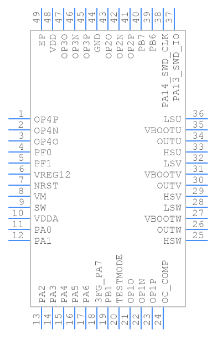
STSPIN32F0 Pinout

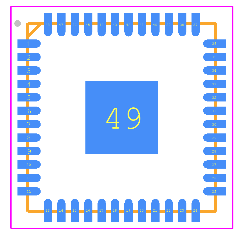
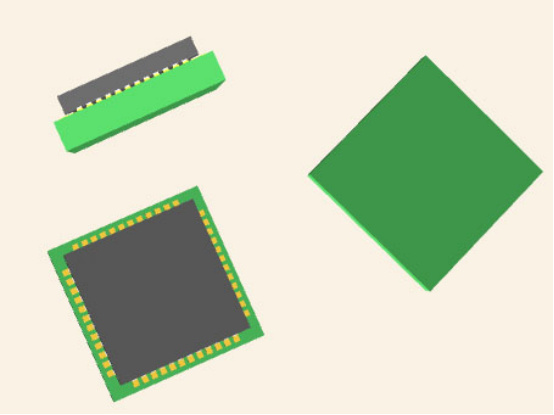
STSPIN32F0 CAD Model
Symbol
Footprint
3D Model
STSPIN32F0 Applications
Kitchen robots, such as food processors, blenders, mixers, and juicers.
Portable vacuum cleaners, such as handheld, stick, and robot vacuums.
Hand dryers and air purifiers, such as those used in public restrooms, hotels, and offices.
Drones and aero. modeling, such as quadcopters, helicopters, and planes.
Power tools, such as drills, saws, and sanders.
Industrial and educational robots, such as robotic arms, grippers, and wheels.
Home appliance and air-con. fans, such as ceiling, table, and tower fans.
STSPIN32F0 Manufacturer
STMicroelectronics is a global leader in creating products and solutions for smart mobility, extreme versatility, power and energy, and IoT and connectivity. It is a multinational corporation and technology company of French-Italian origin headquartered in Plan-les-Ouates near Geneva, Switzerland. It develops, manufactures and markets semiconductors (integrated circuits) for various applications, such as automotive, industrial, consumer, medical, and communication. It has one of the industry’s broadest technology portfolios, and its products are found in today’s most innovative electronics solutions. It has offices, sales offices, distributors, and manufacturing facilities in 35 countries around the world. It is listed on the New York Stock Exchange, on the Euronext Paris in Paris (CAC 40) and on the Borsa Italiana in Milan (FTSE MIB)
Parts with Similar Specs
Datasheet PDF
- Datasheets :
What is the STSPIN32F0?
The STSPIN32F0 is a device that combines a 32-bit ARM Cortex-M0 microcontroller and a three-phase gate driver in a single package. It is designed for low-voltage brushless DC motor applications, such as fans, drones, and power tools.
How does the STSPIN32F0 work?
The STSPIN32F0 controls the power switches of a three-phase bridge using different driving modes, such as field-oriented control, 6-step sensorless, and other advanced algorithms. It also provides various features, such as current sensing, overcurrent protection, voltage regulation, and communication interfaces.
What are the benefits of the STSPIN32F0?
The STSPIN32F0 offers a compact, integrated, and flexible solution for motor control. It reduces the number of external components, simplifies the PCB design, and enables the customization of the motor control algorithm. It also supports a wide range of operating voltages and temperatures.
 Panasonic ERJ-2RKF1002X vs Yageo 0402 Resistors
19 September 2025365
 SN74AXC8T245RJWR Bus Transceiver: Schematic, Pinout, and Datasheet
06 April 20222594
 Unlocking the Details of the onsemi SB360 Datasheet
04 September 2025203
 AO4466 30V N-Channel MOSFET, 10A 8SOIC, AO4466 Datasheet pdf
11 February 20224778
 LM2904N Operational Amplifier: Datasheet, Pinout, and Circuit
26 August 20215332
 LTC6605CDJC-10#TRPBF Active Filter: Product Overview and Applications
06 March 2024131
 Where to use B280 High Voltage SCHOTTKY Barrier Rectifier
08 April 2022650
 What is BD139?
04 August 20215932
 Introduction to Coupling Capacitor
04 February 20216202
 What is a Thyristor?
11 December 202012129
 BSNPC Inverters in Photovoltaic Applications Using SiC and GaN
04 January 20234405
 What is IMU: Definition, Features and Prospects
12 April 20224196
 Comprehensive Analysis of Each Functional Circuit of Switching Power Supply
06 May 20225684
 Exploring the Advancements in Storage Technologies and Grid Architecture of Electric Vehicle Charging Systems
18 October 20232504
 Logic - Translators, Level Shifters: A Semiconductor Device on A Circuit
22 February 20233417
 The Introduction to USB Type-C Pin Signal and PCB Layout
03 December 202126798
STMicroelectronics
In Stock
United States
China
Canada
Japan
Russia
Germany
United Kingdom
Singapore
Italy
Hong Kong(China)
Taiwan(China)
France
Korea
Mexico
Netherlands
Malaysia
Austria
Spain
Switzerland
Poland
Thailand
Vietnam
India
United Arab Emirates
Afghanistan
Åland Islands
Albania
Algeria
American Samoa
Andorra
Angola
Anguilla
Antigua & Barbuda
Argentina
Armenia
Aruba
Australia
Azerbaijan
Bahamas
Bahrain
Bangladesh
Barbados
Belarus
Belgium
Belize
Benin
Bermuda
Bhutan
Bolivia
Bonaire, Sint Eustatius and Saba
Bosnia & Herzegovina
Botswana
Brazil
British Indian Ocean Territory
British Virgin Islands
Brunei
Bulgaria
Burkina Faso
Burundi
Cabo Verde
Cambodia
Cameroon
Cayman Islands
Central African Republic
Chad
Chile
Christmas Island
Cocos (Keeling) Islands
Colombia
Comoros
Congo
Congo (DRC)
Cook Islands
Costa Rica
Côte d’Ivoire
Croatia
Cuba
Curaçao
Cyprus
Czechia
Denmark
Djibouti
Dominica
Dominican Republic
Ecuador
Egypt
El Salvador
Equatorial Guinea
Eritrea
Estonia
Eswatini
Ethiopia
Falkland Islands
Faroe Islands
Fiji
Finland
French Guiana
French Polynesia
Gabon
Gambia
Georgia
Ghana
Gibraltar
Greece
Greenland
Grenada
Guadeloupe
Guam
Guatemala
Guernsey
Guinea
Guinea-Bissau
Guyana
Haiti
Honduras
Hungary
Iceland
Indonesia
Iran
Iraq
Ireland
Isle of Man
Israel
Jamaica
Jersey
Jordan
Kazakhstan
Kenya
Kiribati
Kosovo
Kuwait
Kyrgyzstan
Laos
Latvia
Lebanon
Lesotho
Liberia
Libya
Liechtenstein
Lithuania
Luxembourg
Macao(China)
Madagascar
Malawi
Maldives
Mali
Malta
Marshall Islands
Martinique
Mauritania
Mauritius
Mayotte
Micronesia
Moldova
Monaco
Mongolia
Montenegro
Montserrat
Morocco
Mozambique
Myanmar
Namibia
Nauru
Nepal
New Caledonia
New Zealand
Nicaragua
Niger
Nigeria
Niue
Norfolk Island
North Korea
North Macedonia
Northern Mariana Islands
Norway
Oman
Pakistan
Palau
Palestinian Authority
Panama
Papua New Guinea
Paraguay
Peru
Philippines
Pitcairn Islands
Portugal
Puerto Rico
Qatar
Réunion
Romania
Rwanda
Samoa
San Marino
São Tomé & Príncipe
Saudi Arabia
Senegal
Serbia
Seychelles
Sierra Leone
Sint Maarten
Slovakia
Slovenia
Solomon Islands
Somalia
South Africa
South Sudan
Sri Lanka
St Helena, Ascension, Tristan da Cunha
St. Barthélemy
St. Kitts & Nevis
St. Lucia
St. Martin
St. Pierre & Miquelon
St. Vincent & Grenadines
Sudan
Suriname
Svalbard & Jan Mayen
Sweden
Syria
Tajikistan
Tanzania
Timor-Leste
Togo
Tokelau
Tonga
Trinidad & Tobago
Tunisia
Turkey
Turkmenistan
Turks & Caicos Islands
Tuvalu
U.S. Outlying Islands
U.S. Virgin Islands
Uganda
Ukraine
Uruguay
Uzbekistan
Vanuatu
Vatican City
Venezuela
Wallis & Futuna
Yemen
Zambia
Zimbabwe
![STSPIN32F0TR]() STSPIN32F0TR
STSPIN32F0TRSTMicroelectronics
![STSPIN32F0B]() STSPIN32F0B
STSPIN32F0BSTMicroelectronics
![STSPIN32F0A]() STSPIN32F0A
STSPIN32F0ASTMicroelectronics
![STSPIN32F0ATR]() STSPIN32F0ATR
STSPIN32F0ATRSTMicroelectronics
![STA2064N2]() STA2064N2
STA2064N2STMicroelectronics
![STA2065N2]() STA2065N2
STA2065N2STMicroelectronics
![STA1052S1]() STA1052S1
STA1052S1STMicroelectronics
![STM8SPLNB1M6]() STM8SPLNB1M6
STM8SPLNB1M6STMicroelectronics
![STM32W108CBU63TR]() STM32W108CBU63TR
STM32W108CBU63TRSTMicroelectronics


