

 Product
 Brand
Brand Articles
 Tools
Tools
AD811 2500 V/µs High-Speed Op-Amp: Datasheet, Pinout, and Performance Analysis

16 Terminations ±4.5V~18V 16 Pin AD811 Video Amps Modules 1 Functions 2500V/μs Min -55°C Max 125°C
Unit Price: $15.000232
Ext Price: $15.00


16 Terminations ±4.5V~18V 16 Pin AD811 Video Amps Modules 1 Functions 2500V/μs Min -55°C Max 125°C
Optimize video systems with the AD811 high-speed op-amp. 2500 V/µs slew rate & 140 MHz bandwidth. Explore the AD811 datasheet and pinout for your next design.
- Executive Summary: What is the AD811?
- 1. Technical Specifications & Performance Analysis
- 2. Pinout, Package, and Configuration
- 3. Design & Integration Guide (For Engineers & Makers)
- 4. Typical Applications & Use Cases
- 5. Alternatives and Cross-Reference Guide
- 6. Frequently Asked Questions (FAQ)
- 7. Resources
- Specifications
- Parts with Similar Specs
- Datasheet PDF
Executive Summary: What is the AD811?
The AD811 is a wideband current-feedback operational amplifier designed for broadcast-quality video systems and high-speed applications where transient response is critical. It is engineered by Analog Devices to provide exceptional signal integrity in demanding professional environments.
Market Position: High-performance, professional-grade analog component.
Top Features: 2500 V/µs slew rate, 140 MHz bandwidth (G=+1), and ultra-low differential gain/phase (0.01%/0.01°).
Primary Audience: Ideal for broadcast video engineers, medical imaging designers, and high-speed data acquisition specialists.
Supply Status: Active (Widely available through major electronics distributors).
1. Technical Specifications & Performance Analysis
The AD811 stands out in the "Spec Warrior" category due to its extreme speed and power handling, making it a staple for high-fidelity signal processing.
1.1 Core Architecture: Current-Feedback Power
Unlike traditional voltage-feedback amplifiers, the AD811 utilizes a current-feedback architecture. This choice allows the device to maintain a relatively constant bandwidth regardless of gain, making it the "brain" of choice for systems requiring high gain without sacrificing frequency response.
1.2 Key Electrical Characteristics
The AD811 is optimized for dual-rail power supplies, offering a wide operating range for maximum headroom.
Supply Voltage: Flexible operation from ±4.5 V to ±18 V.
Slew Rate: A massive 2500 V/µs, ensuring minimal distortion in pulsed applications.
Output Current: Capable of delivering 100 mA, allowing it to drive multiple video cables directly.
Noise Performance: Low voltage noise of 1.9 nV/√Hz, essential for medical ultrasound and sensitive imaging.
1.3 Interfaces and Connectivity
While an analog component, the AD811 serves as the critical interface for: * ADC/DAC Buffering: Providing the high-speed drive required for modern converters. * Video Distribution: Driving 75Ω coaxial loads with ease.
2. Pinout, Package, and Configuration
Understanding the physical layout is crucial for PCB design and signal integrity management.
2.1 Pin Configuration Guide
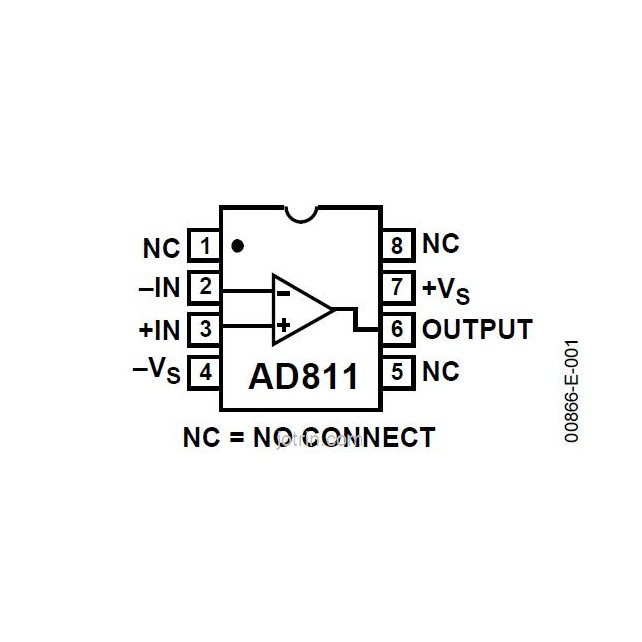
The AD811 typically follows the standard 8-pin op-amp configuration but requires specific attention to the feedback loop:
NC: No Connection.
-IN: Inverting Input (Current-feedback node).
+IN: Non-Inverting Input.
-Vs: Negative Supply Rail.
NC: No Connection.
OUTPUT: High-current output.
+Vs: Positive Supply Rail.
NC: No Connection.
2.2 Naming Convention & Ordering Codes
AD811AN: Plastic Dual-in-Line Package (PDIP), ideal for prototyping.
AD811AR: Small Outline Integrated Circuit (SOIC), for machine-assembled production.
AD811JR: Commercial temperature grade variant.
2.3 Available Packages
| Package Type | Dimensions | Common Use Case |
|---|---|---|
| 8-Lead PDIP | 9.27mm x 6.35mm | Hand-soldering, breadboarding, and legacy repairs. |
| 8-Lead SOIC | 4.90mm x 3.90mm | Compact professional video equipment. |
| 20-Lead LCC | Various | High-reliability/Military-grade applications. |
3. Design & Integration Guide (For Engineers & Makers)
Pro Tip: Always use a ground plane when working with the AD811. At 140 MHz, stray inductance on traces can lead to significant signal degradation.
3.1 Hardware Implementation
Bypass Capacitors: Use a combination of 10 µF tantalum and 0.1 µF ceramic capacitors placed as close to the power pins as possible.
Feedback Resistor (Rf): For current-feedback amps, the value of Rf is critical for stability. For the AD811, a value between 909 Ω and 1000 Ω is recommended.
Thermal Management: Because this chip can drive 100 mA at ±15V, it generates significant heat.
3.2 Common Design Challenges
Issue: Overheating during continuous operation.
Fix: Ensure the PCB has large copper pours connected to the supply pins to act as a heatsink. In high-ambient environments, use a clip-on DIP heatsink or forced-air cooling.
Issue: High-Frequency Oscillation.
Fix: Avoid any capacitance on the inverting input. Keep feedback traces extremely short. Ensure the feedback resistor matches the datasheet recommendation for your specific gain.
4. Typical Applications & Use Cases
Watch Tutorial: AD811
4.1 Real-World Example: Multimedia Broadcast Switcher
In a professional video crosspoint switcher, the AD811 acts as the Video Line Driver. Its 0.01% differential gain ensures that the color saturation of the video signal remains perfect even when the signal is split across multiple monitors. By utilizing the 100 mA output, a single AD811 can drive two 75Ω back-terminated video loads simultaneously without signal sagging.
5. Alternatives and Cross-Reference Guide
If the AD811 is unavailable or doesn't perfectly fit your BOM requirements, consider these alternatives:
LM7171 (Texas Instruments): A very high-speed voltage-feedback alternative. It offers similar speed but different stability requirements.
AD844 (Analog Devices): Another current-feedback amp that is often used in specialized audio and video circuits; it allows access to the internal compensation node.
LM6181: A common pin-compatible alternative for lower-cost video applications.
AD812: If you need two amplifiers in a single package, the AD812 is the dual version of the AD811.
6. Frequently Asked Questions (FAQ)
Q: What is the difference between AD811 and LM7171?
A: The AD811 is a current-feedback amplifier, whereas the LM7171 is a voltage-feedback amplifier. The AD811 generally offers better bandwidth consistency across different gain settings.
Q: Can AD811 be used in Automotive applications?
A: While technically possible, ensure the operating temperature and vibration requirements meet automotive AEC-Q100 standards; the standard AD811 is primarily for industrial/commercial use.
Q: Where can I find the AD811 datasheet and library files?
A: Datasheets are available on the Analog Devices website. CAD symbols for Altium, KiCad, and Eagle are typically found on SnapEDA or Ultra Librarian.
Q: Is AD811 suitable for battery-operated devices?
A: Generally no. Its high quiescent current and power requirements make it better suited for mains-powered professional equipment.
Q: How do I stop my AD811 from oscillating?
A: Check your feedback resistor value. If it is too low, the circuit will become unstable. Ensure you have no capacitive load directly on the output without a small isolation resistor.
7. Resources
Evaluation Boards: Look for the "Universal Precision Op Amp Evaluation Board" from Analog Devices.
Software: Use LTspice for high-fidelity simulation of AD811 circuits before PCB fabrication.
Specifications
Parts with Similar Specs
- ImagePart NumberManufacturerPackage / CaseNumber of PinsSlew RateInput Offset Voltage (Vos)Power Supply Rejection Ratio (PSRR)Common Mode Rejection RatioSupply VoltageOperating Supply CurrentView Compare
![AD811ARZ-16-REEL7]()
AD811ARZ-16-REEL7
16-SOIC (0.295, 7.50mm Width)
16
2500V/μs
3 mV
70 dB
60 dB
15 V
16 mA
![LMH6503MA/NOPB]()
16-SOIC (0.295, 7.50mm Width)
16
2000V/μs
50 μV
108 dB
100 dB
15 V
6.5 mA
![AD844JRZ-16]()
16-SOIC (0.295, 7.50mm Width)
16
2000V/μs
50 μV
108 dB
100 dB
15 V
6.5 mA
![AD844JRZ-16-REEL7]()
14-SOIC (0.154, 3.90mm Width)
14
1800V/μs
370 mV
57 dB
67 dB
5 V
-
![AD844JR-16]()
16-SOIC (0.295, 7.50mm Width)
16
2000V/μs
50 μV
108 dB
100 dB
15 V
6.5 mA


Datasheet PDF
- Datasheets :
- ConflictMineralStatement :
 STM32F302VEH6 Microcontroller: 72MHz, 100-UFBGA, Pinout and Features
19 January 2022361
 A1015: PNP Transistor Introduction
29 March 20223238
 SM712-02HTG Asymmetrical TVS Diode: System, Pinout, and Datasheet
22 February 20226369
 LM1458 Dual Op-Amp : Pinout, Applications and Datasheet
10 August 20214263
 Arduino Uno R4 WiFi: Description, Features and applications
06 October 20237339
 RP2040 VS ESP8266 VS ESP32 VS STM32
20 April 202210439
![ATMEGA1284P-PU--Datasheet, Pinout and Equivalent[FAQ+Video]](https://res.utmel.com/Images/Article/a7a5bedc-1a5d-438d-80db-a3e11216cd7f.jpg) ATMEGA1284P-PU--Datasheet, Pinout and Equivalent[FAQ+Video]
ATMEGA1284P-PU--Datasheet, Pinout and Equivalent[FAQ+Video]07 April 20224075
 1054500101 USB Connector TYPEC 24P SMD: Datasheet, Advantages, and Equivalents
15 February 20224644
 What is a Thermoelectric Cooler?
08 April 20217193
 LDR/Light Dependent Resistor: Working Principle, Types and Applications
19 January 202634547
 All About Video Connectors and Their Uses in Today’s Technology
02 July 20253276
 Introduction to DC Amplifier
07 November 202519851
 A New Way of Thinking About the "Trolley Problem" of Artificial Intelligence
27 May 20221897
 DIP Switch: Introduction and Classification
20 January 202117566
 IoT Chips Lead Time 2026: Navigating MCU, PMIC, and Sensor Shortages
15 July 20261041
 Effect Of Target Physical Properties And Energetic Ions When Doping Thin-Body Semiconductor
19 October 20222634
Analog Devices Inc.
In Stock: 16
Minimum: 1 Multiples: 1
Qty
Unit Price
Ext Price
1
$15.000232
$15.00
10
$14.151162
$141.51
100
$13.350153
$1,335.02
500
$12.594484
$6,297.24
1000
$11.881589
$11,881.59
Not the price you want? Send RFQ Now and we'll contact you ASAP.
Inquire for More Quantity
![AD810ARZ]() AD810ARZ
AD810ARZAnalog Devices Inc.
![AD8075ARUZ]() AD8075ARUZ
AD8075ARUZAnalog Devices Inc.
![AD829JRZ-REEL7]() AD829JRZ-REEL7
AD829JRZ-REEL7Analog Devices Inc.
![AD8013ARZ-14]() AD8013ARZ-14
AD8013ARZ-14Analog Devices Inc.
![AD829JNZ]() AD829JNZ
AD829JNZAnalog Devices Inc.
![AD828ARZ]() AD828ARZ
AD828ARZAnalog Devices Inc.
![AD829ARZ]() AD829ARZ
AD829ARZAnalog Devices Inc.
![AD812ARZ]() AD812ARZ
AD812ARZAnalog Devices Inc.
![AD829JRZ]() AD829JRZ
AD829JRZAnalog Devices Inc.
![AD818ARZ]() AD818ARZ
AD818ARZAnalog Devices Inc.


