

 Product
 Brand
Brand Articles
 Tools
Tools
AD708 Dual Precision Op Amp: DC Performance Analysis and Modern Replacement Notes

12.5mA per Channel 500pA 140 dB Instrumentational OP Amps 0.004μA ±3V~18V AD708 8-CDIP (0.300, 7.62mm)


12.5mA per Channel 500pA 140 dB Instrumentational OP Amps 0.004μA ±3V~18V AD708 8-CDIP (0.300, 7.62mm)
Evaluate the AD708 dual precision bipolar op amp for instrumentation. Review microvolt offset specs, dual-supply trade-offs, and modern OPA2277 replacements.
- Deconstructing the DC Precision Specifications
- Amplifier Matching: The Core Advantage for Bridge Sensors
- The Engineering Trade-Off: Bipolar Input Bias Currents
- Power Management in Modern Systems
- Legacy Packaging and Footprint Verification
- AD708 Alternatives and Modern Replacement Paths
- Core Application Environments
- Specific Design FAQs
- Specifications
- Parts with Similar Specs
- Datasheet PDF
The AD708 is an ultrahigh precision, dual monolithic bipolar operational amplifier designed for high-precision DC amplification and critical instrumentation circuitry. While modern analog design often leans heavily toward CMOS and JFET architectures, bipolar precision amplifiers like the AD708 remain relevant for specific use cases where microvolt-level DC accuracy and exceptional channel-to-channel matching are non-negotiable.
For design engineers and procurement managers evaluating this component, the primary considerations revolve around balancing its elite DC precision against its legacy power requirements and bipolar input characteristics.
Deconstructing the DC Precision Specifications
The defining characteristic of the AD708 is its ability to extract microvolt-level signals from noisy environments without introducing internal DC errors. The raw specifications dictate its use in high-end measurement equipment rather than general-purpose signal conditioning:
Maximum Offset Voltage: Capped at 30 μV, minimizing the need for external offset nulling hardware.
Maximum Offset Voltage Drift: Guaranteed at 0.3 μV/°C, ensuring that calibration holds across varying thermal environments.
Minimum Open-Loop Gain: An extraordinary 5,000,000 V/V (5 million V/V), which virtually eliminates gain error in closed-loop configurations.
Low Frequency Noise: Specified at 0.35 μV p-p in the 0.1 Hz to 10 Hz band, critical for slow-moving DC measurements like weigh scales or temperature sensors.
When integrating this component, the 5 million V/V open-loop gain requires careful attention to PCB layout. Minute parasitic feedback paths can easily compromise the stability of such a high-gain device, making tight decoupling and guarded trace layouts essential.
Amplifier Matching: The Core Advantage for Bridge Sensors
Having two precision op amps in a single package is standard; having them exceptionally matched is what sets the AD708 apart. In discrete designs, engineers often spend significant time sorting and binning op amps to achieve symmetry. The AD708 eliminates this by guaranteeing a maximum offset voltage match of 30 μV and a minimum Common-Mode Rejection Ratio (CMRR) match of 130 dB between the two amplifiers.
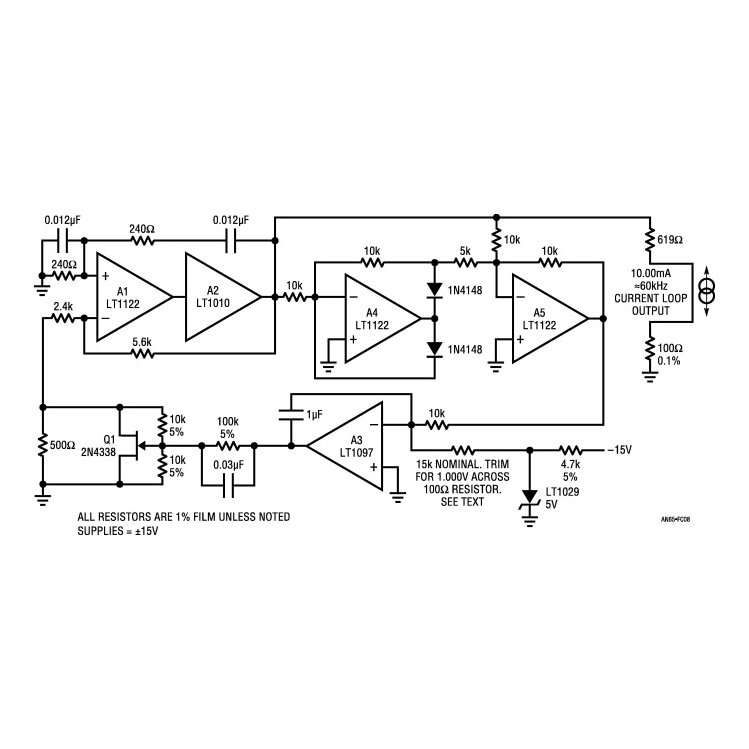
This matching is strictly required in discrete instrumentation amplifier designs. When building a three-op-amp in-amp or a two-op-amp bridge receiver, any mismatch in CMRR between the input buffers translates directly into differential error. The 130 dB minimum CMRR (and equivalent matching) ensures that common-mode noise—such as 50/60 Hz power-line interference—is heavily attenuated before it can be amplified.
The Engineering Trade-Off: Bipolar Input Bias Currents
The most critical integration challenge with the AD708 stems directly from the architecture that gives it such high precision. Because it utilizes a bipolar input stage, the amplifier relies on actual base current to operate the input transistors.
This results in noticeably higher input bias currents compared to modern precision JFET or CMOS op amps. If the AD708 is driven by a high-impedance source, this bias current flows through the source resistance, creating an $I_B \times R_{source}$ voltage drop. This drop appears as a DC offset at the amplifier's input. In a high-impedance circuit, this newly induced offset can easily exceed the op amp’s native 30 μV offset, entirely defeating the purpose of selecting an ultrahigh precision part.
Design Mitigation: To preserve the precision of the AD708, source impedances must be kept low. Furthermore, the impedance seen by the inverting and non-inverting inputs must be carefully balanced so that the bias current errors cancel each other out. If your application inherently involves very high-impedance sources (such as pH probes or certain photodiode circuits), the AD708 is likely the wrong choice, and substituting a precision JFET/CMOS amplifier is the correct engineering path.
Power Management in Modern Systems
A significant pain point for modern integration is the AD708's dual supply requirement. Legacy bipolar designs typically expect symmetric power rails, ranging from ±5V to ±15V.
In contemporary systems dominated by 3.3V or 5V single-supply digital logic, generating a clean negative rail adds BOM cost, consumes PCB real estate, and introduces switching noise. If you are committed to the AD708 for its DC specs, you will likely need to implement a dedicated charge pump or an inverting switching regulator to generate the required negative voltage. The output of this negative supply must be heavily filtered, as any switching ripple can couple into the amplifier and degrade the 0.35 μV p-p noise performance.
Legacy Packaging and Footprint Verification
Because the AD708 is an older architecture, it is frequently encountered in larger, legacy through-hole packages such as PDIP (Plastic Dual In-line Package) and CERDIP (Ceramic Dual In-line Package).
Before finalizing a BOM, procurement teams and layout engineers must strictly verify package availability. While through-hole components are excellent for prototyping and high-reliability military/aerospace applications (particularly CERDIP), they disrupt automated surface-mount (SMT) assembly lines. Thermal resistance also varies significantly between ceramic and plastic packages, so checking the manufacturer's specific thermal derating curves is an absolute necessity before finalizing your layout, especially if operating near the upper limits of the ±15V rails where quiescent power dissipation is highest.
AD708 Alternatives and Modern Replacement Paths
Due to the power supply constraints and legacy packaging, many teams actively look to migrate away from the AD708 in new designs. When evaluating replacements, the goal is to find a device that maintains microvolt precision while offering lower quiescent power and surface-mount packaging.
Direct competitors and alternative upgrade paths include:
Analog Devices OP2177: A highly recommended modern update. It provides exceptional precision with significantly lower power consumption and is widely available in standard SMT packages.
Texas Instruments OPA2277: Another excellent precision bipolar dual op amp. It is highly competitive in offset and drift, often serving as a go-to replacement for legacy high-precision duals.
Linear Technology (now ADI) LT1002 / LT1013: These are classic precision alternatives. The LT1013, in particular, offers single-supply capability, which solves the negative rail pain point, though a careful comparison of the offset matching is required to ensure it meets the specific system's error budget.
When replacing the AD708, always verify the pinout of the replacement device. While many dual op amps share a standard 8-pin configuration, precision devices sometimes utilize "No Connect" (NC) pins for internal trimming or guarding, which can cause layout conflicts if your PCB routes traces through those seemingly empty pads.
Core Application Environments
The AD708 is purpose-built for environments where DC accuracy dictates system performance:
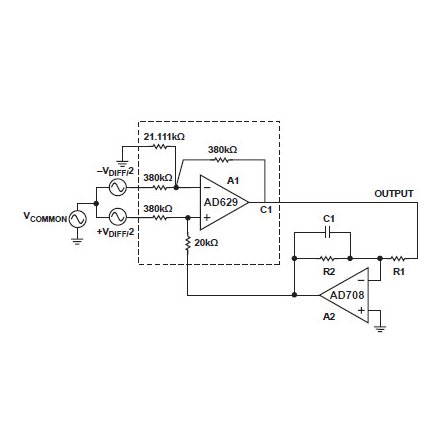
ECG Sensor Circuitry: Specifically used in right leg drive circuits where extracting microvolt cardiac signals requires massive CMRR (120 dB minimum PSRR and 130 dB minimum CMRR) to reject the noise of the human body acting as an antenna.
Bridge Amplifiers and Strain Gauges: The exceptional matching characteristics ensure that the differential signal from a mechanical strain gauge is amplified without common-mode distortion.
Guard Drivers: Used to drive the shields of high-impedance coaxial cables in instrumentation setups, matching the voltage of the inner conductor to eliminate leakage currents.
Specific Design FAQs
Can I run the AD708 on a single 5V supply?No, not directly. The AD708 typically requires a dual power supply (e.g., ±5V to ±15V). Attempting to run it on a single 5V supply will violate its input common-mode range and output swing limitations. You must implement a negative voltage rail using an inverter or charge pump.
Why is my AD708 circuit exhibiting a much higher offset than the specified 30 μV?This is almost certainly an input bias current issue. Because the AD708 uses a bipolar input stage, it draws base current. If your source impedances are high and unbalanced, this current induces a voltage drop that manifests as an offset error, easily dwarfing the 30 μV hardware specification. Balance your input resistors to cancel this effect.
What is the best surface-mount replacement to reduce power consumption?The OP2177 (Analog Devices) and OPA2277 (Texas Instruments) are modern, lower-power precision dual op amps that maintain excellent DC accuracy and are readily available in SMT packages, making them ideal upgrade paths to resolve legacy architecture constraints.
Watch Tutorial: AD708
Specifications
Parts with Similar Specs
- ImagePart NumberManufacturerPackage / CaseNumber of PinsSlew RateInput Offset Voltage (Vos)Power Supply Rejection Ratio (PSRR)Common Mode Rejection RatioSupply VoltageOperating Supply CurrentView Compare
![AD708SQ/883B]()
AD708SQ/883B
8-CDIP (0.300, 7.62mm)
8
0.3V/μs
30 μV
130 dB
140 dB
15 V
5.5 mA
![LM158JGB]()
CDIP
8
0.3 V/μs
5 mV
65 dB
70 dB
5 V
-
![OP27AZ/883C]()
CDIP
8
0.3 V/μs
5 mV
-
70 dB
5 V
-
![LM158JG]()
8-CDIP (0.300, 7.62mm)
8
2.8V/μs
25 μV
114 dB
120 dB
15 V
5.7 mA
![5962-8771002PA]()
CDIP
8
0.3 V/μs
2 mV
-
70 dB
5 V
-


Datasheet PDF
- Datasheets :
- PCN Assembly/Origin :
- ConflictMineralStatement :
 ISL80103IRAJZ Linear Regulator: Diagram, Pinout, and Datasheet
28 February 2022849
 CD4071 Dual Input OR Gate IC: Datasheet, Pinout and Equivalents
23 October 20216882
![LM317 Voltage Regulator[Video+FAQ]: Pinout, Circuit, LM317 VS LM7805 and Datasheet](https://res.utmel.com/Images/Article/1d33c68c-5ca5-4e96-a14d-1f10a89d8866.jpg) LM317 Voltage Regulator[Video+FAQ]: Pinout, Circuit, LM317 VS LM7805 and Datasheet
LM317 Voltage Regulator[Video+FAQ]: Pinout, Circuit, LM317 VS LM7805 and Datasheet27 April 202215451
 BC847 Transistor: Features, Pinout, and Datasheet
11 October 20216088
 A Comprehensive Guide to LTC6946IUFD-1 Clock/Frequency Synthesizer
06 March 2024333
 AD7878BQ Converter:Pinout, Specification, Datasheet
28 May 2021547
 PAM8610 Audio Power Amplifier: Schematic, Specification and Datasheet
21 July 202121861
 A Comprehensive Guide to LTC7138MPMSE#TRPBF DC-DC Switching Regulator
06 March 2024376
 A Comprehensive Guide to FPGA Development Boards
07 September 202622727
 Several Steps to Choose a Microcontroller MCU
17 June 20224893
 3-D Printing as Part of the Next Industrial Revolution
15 November 20191730
 Magnetic Sensors for Position Detection: Hall Effect vs. AMR vs. TMR Engineering Guide
21 August 2026496
 What are Quantum Sensors?
27 October 20212677
 Tantalum Capacitors Explained: How They Work, Where They Fit, and How to Use Them Safely
14 July 202613860
 The Different Types of Circuit Breakers and Their Applications
11 April 20236995
 Dynamic On-Resistance and its Impact on Power Converters
28 August 20232944
Analog Devices Inc.
In Stock
United States
China
Canada
Japan
Russia
Germany
United Kingdom
Singapore
Italy
Hong Kong(China)
Taiwan(China)
France
Korea
Mexico
Netherlands
Malaysia
Austria
Spain
Switzerland
Poland
Thailand
Vietnam
India
United Arab Emirates
Afghanistan
Åland Islands
Albania
Algeria
American Samoa
Andorra
Angola
Anguilla
Antigua & Barbuda
Argentina
Armenia
Aruba
Australia
Azerbaijan
Bahamas
Bahrain
Bangladesh
Barbados
Belarus
Belgium
Belize
Benin
Bermuda
Bhutan
Bolivia
Bonaire, Sint Eustatius and Saba
Bosnia & Herzegovina
Botswana
Brazil
British Indian Ocean Territory
British Virgin Islands
Brunei
Bulgaria
Burkina Faso
Burundi
Cabo Verde
Cambodia
Cameroon
Cayman Islands
Central African Republic
Chad
Chile
Christmas Island
Cocos (Keeling) Islands
Colombia
Comoros
Congo
Congo (DRC)
Cook Islands
Costa Rica
Côte d’Ivoire
Croatia
Cuba
Curaçao
Cyprus
Czechia
Denmark
Djibouti
Dominica
Dominican Republic
Ecuador
Egypt
El Salvador
Equatorial Guinea
Eritrea
Estonia
Eswatini
Ethiopia
Falkland Islands
Faroe Islands
Fiji
Finland
French Guiana
French Polynesia
Gabon
Gambia
Georgia
Ghana
Gibraltar
Greece
Greenland
Grenada
Guadeloupe
Guam
Guatemala
Guernsey
Guinea
Guinea-Bissau
Guyana
Haiti
Honduras
Hungary
Iceland
Indonesia
Iran
Iraq
Ireland
Isle of Man
Israel
Jamaica
Jersey
Jordan
Kazakhstan
Kenya
Kiribati
Kosovo
Kuwait
Kyrgyzstan
Laos
Latvia
Lebanon
Lesotho
Liberia
Libya
Liechtenstein
Lithuania
Luxembourg
Macao(China)
Madagascar
Malawi
Maldives
Mali
Malta
Marshall Islands
Martinique
Mauritania
Mauritius
Mayotte
Micronesia
Moldova
Monaco
Mongolia
Montenegro
Montserrat
Morocco
Mozambique
Myanmar
Namibia
Nauru
Nepal
New Caledonia
New Zealand
Nicaragua
Niger
Nigeria
Niue
Norfolk Island
North Korea
North Macedonia
Northern Mariana Islands
Norway
Oman
Pakistan
Palau
Palestinian Authority
Panama
Papua New Guinea
Paraguay
Peru
Philippines
Pitcairn Islands
Portugal
Puerto Rico
Qatar
Réunion
Romania
Rwanda
Samoa
San Marino
São Tomé & Príncipe
Saudi Arabia
Senegal
Serbia
Seychelles
Sierra Leone
Sint Maarten
Slovakia
Slovenia
Solomon Islands
Somalia
South Africa
South Sudan
Sri Lanka
St Helena, Ascension, Tristan da Cunha
St. Barthélemy
St. Kitts & Nevis
St. Lucia
St. Martin
St. Pierre & Miquelon
St. Vincent & Grenadines
Sudan
Suriname
Svalbard & Jan Mayen
Sweden
Syria
Tajikistan
Tanzania
Timor-Leste
Togo
Tokelau
Tonga
Trinidad & Tobago
Tunisia
Turkey
Turkmenistan
Turks & Caicos Islands
Tuvalu
U.S. Outlying Islands
U.S. Virgin Islands
Uganda
Ukraine
Uruguay
Uzbekistan
Vanuatu
Vatican City
Venezuela
Wallis & Futuna
Yemen
Zambia
Zimbabwe
![AD826AR-REEL7]() AD826AR-REEL7
AD826AR-REEL7Analog Devices Inc.
![AD8062ARM]() AD8062ARM
AD8062ARMAnalog Devices Inc.
![AD8532ARU-REEL]() AD8532ARU-REEL
AD8532ARU-REELAnalog Devices Inc.
![OP113ES]() OP113ES
OP113ESAnalog Devices Inc.
![SSM2142P]() SSM2142P
SSM2142PAnalog Devices, Inc.
![LTC1050CS8]() LTC1050CS8
LTC1050CS8Linear Technology/Analog Devices
![AMP02EPZ]() AMP02EPZ
AMP02EPZAnalog Devices Inc.
![AD822ARZ-REEL7]() AD822ARZ-REEL7
AD822ARZ-REEL7Analog Devices Inc.
![OP2177ARZ-REEL7]() OP2177ARZ-REEL7
OP2177ARZ-REEL7Analog Devices Inc.
![AD8066ARZ-R7]() AD8066ARZ-R7
AD8066ARZ-R7Analog Devices Inc.


