Product
 Brand
Brand Articles
 Tools
Tools
CR1632 Battery: Equivalent, Pinout and Application


CR STANDARD
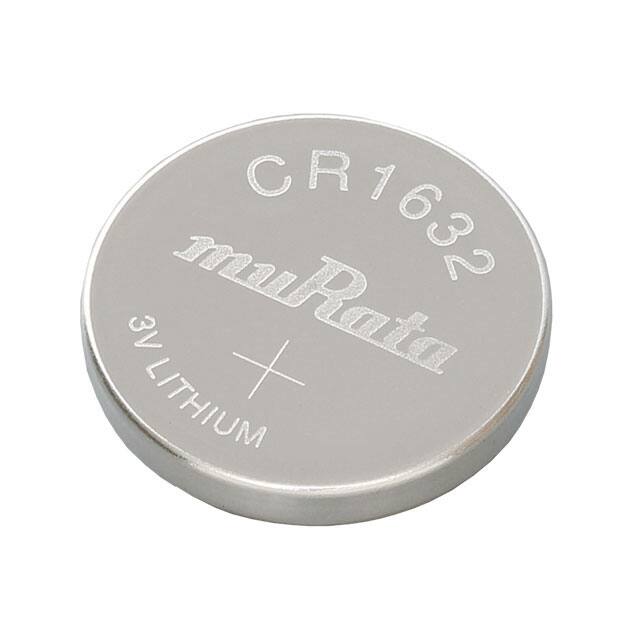
Hello everyone, I am Rose. Today I will introduce CR1632 to you. CR1632 is a lithium coin cell battery. This article mainly introduces equivalent, pinout, application, and other detailed information about Murata Electronics CR1632.
Can Amazon Basics CR2032 Battery Beat Energizer or Duracell? I Have The Answer!
CR1632 Description
The battery is a device that is used to store electrical energy in form of chemical energy. CR1632 lithium coin cell battery Scaling Up The size is the primary limiting factor for any battery. The higher the capacity, the more power the battery can store.
A lithium coin cell battery has a capacity of 1.6 Volt which is the same for every lithium battery but capacity goes up with voltage rating and the series number. It is commonly used in portable electronics gadgets which consume low power like watches, different toys, RFID readers, etc.
CR1632 Pinout

Pinout

Pin Description
CR1632 CAD Model

Symbol

Footprint
CR1632 Features
• Good pulse capability
• High discharge characteristics
• Stable voltage level during discharge
• Long-term reliability
• Non-rechargeable weight:1.8 grams.
• Capacity: one thirty milliampere hours.
• Operating volts: three volts.
• Current value: 0.19 millimeters.
Specifications
- TypeParameter
- Factory Lead Time15 Weeks
- Voltage Rated
RATED voltage is the voltage on the nameplate - the "design point" for maximum power throughput and safe thermal operation.
3V - Usage LevelCommercial grade
- Size / Dimension
In electronic components, the parameter "Size / Dimension" refers to the physical dimensions of the component, such as its length, width, and height. These dimensions are crucial for determining how the component will fit into a circuit or system, as well as for ensuring compatibility with other components and the overall design requirements. The size of a component can also impact its performance characteristics, thermal properties, and overall functionality within a given application. Engineers and designers must carefully consider the size and dimensions of electronic components to ensure proper integration and functionality within their designs.
0.63Dia x 0.13 H 16.0mmx3.2mm - Part Status
Parts can have many statuses as they progress through the configuration, analysis, review, and approval stages.
Active - Moisture Sensitivity Level (MSL)
Moisture Sensitivity Level (MSL) is a standardized rating that indicates the susceptibility of electronic components, particularly semiconductors, to moisture-induced damage during storage and the soldering process, defining the allowable exposure time to ambient conditions before they require special handling or baking to prevent failures
Not Applicable - Termination Style
"Termination style" in electronic components refers to the method used to connect the component to a circuit board or other electronic devices. It determines how the component's leads or terminals are designed for soldering or mounting onto the circuit board. Common termination styles include through-hole, surface mount, and wire lead terminations.Through-hole components have leads that are inserted through holes in the circuit board and soldered on the other side. Surface mount components have flat terminals that are soldered directly onto the surface of the circuit board. Wire lead terminations involve attaching wires to the component for connection.The choice of termination style depends on factors such as the type of component, the manufacturing process, and the space available on the circuit board. Different termination styles offer various advantages in terms of ease of assembly, reliability, and space efficiency in electronic designs.
Requires Holder - Storage/Refrigeration Temperature
The parameter "Storage/Refrigeration Temperature" in electronic components refers to the recommended temperature range at which the components should be stored to maintain their integrity and functionality. This parameter indicates the temperature limits within which the components can be safely stored without risking damage or degradation. Storage temperature is crucial for preserving the performance and reliability of electronic components over time, especially for sensitive components such as integrated circuits and semiconductors. Refrigeration temperature may be specified for certain components that require lower temperatures to prevent degradation or prolong shelf life. It is important to adhere to the recommended storage/refrigeration temperature guidelines to ensure the longevity and proper functioning of electronic components.
50°F~77°F 10°C~25°C - Battery Chemistry
A battery is a device that stores chemical energy, and converts it to electricity. This is known as electrochemistry and the system that underpins a battery is called an electrochemical cell. A battery can be made up of one or several (like in Volta's original pile) electrochemical cells.
Lithium Manganese Dioxide - Battery Cell Size
The most common lithium-ion cell is the 18650 (the numbers define the physical dimensions and shape as follows: 18mm in diameter, 65mm long and the 0 means it has a round cross-section) which is due to its widespread use in laptop battery packs.
Coin 16.0mm - Capacity
In electronic components, "Capacity" typically refers to the maximum amount of electrical charge that a component can store. It is measured in units called farads (F). Capacitors are the most common components that have a capacity rating. The capacity of a capacitor determines how much energy it can store and release when connected in a circuit. Higher capacity capacitors can store more charge and are often used in applications requiring larger energy storage or filtering capabilities. It is important to select a capacitor with the appropriate capacity to ensure proper functioning of the circuit.
140mAh - Discharge Rate
The "Discharge Rate" in electronic components refers to the rate at which a component can release stored energy or power. This parameter is particularly important in devices that use batteries or capacitors, as it determines how quickly these components can discharge their stored energy. A high discharge rate means that the component can release energy quickly, while a low discharge rate indicates a slower release of energy. Understanding the discharge rate of electronic components is crucial for designing circuits and systems that require specific power delivery characteristics.
200μA - RoHS Status
RoHS means “Restriction of Certain Hazardous Substances” in the “Hazardous Substances Directive” in electrical and electronic equipment.
Non-RoHS Compliant
CR1632 Equivalent
●DL1632
●ECR1632
CR1632 VS CR2032
The CR1632 battery is very similar to CR2032 or CR2025 but they are not interchangeable because of their dimensions. CR2032 is 20 millimeters wide and 3.2 millimeters thick. CR1632 is 16 millimeters wide and 3.2 millimeters thick. The CR2016 is thinner than the CR2032 It is rated for 3V and 130mAh capacity.
CR2032 Safety Warnings
(1) Keep out of reach of children.
(2) Battery compartment design.
CR1632 Applications
■Used in Wireless doorbell for the house.
■Used in Electronic Toys
■Used in Portable electronics
■Used in Digital thermometers
■Used in Digital altimeter
■Used in Cyclocomputers
■Used in Heart rate monitors
■Used in Watches, small PDA devices, etc used this module
CR1632 Dimensions

Dimensions
CR1632 Manufacturer
Murata Manufacturing Co., Ltd. (株式会社村田製作所, Kabushiki-Kaisha Murata Seisakusho) is a Japanese manufacturer of electronic components, based in Nagaokakyo, Kyoto. Murata Manufacturing is primarily involved in the manufacturing of ceramic passive electronic components, primarily capacitors, and has an overwhelming market share worldwide in ceramic filters, high-frequency parts, and sensors. As of March 31, 2013, Murata Manufacturing has 24 subsidiaries in Japan.
Datasheet PDF
- Datasheets :
- Environmental Information :
1.What is the difference between CR1632 and CR2032? Interchangeable?
1632 and 2032 are the dimensions (models) of the two-button batteries. 1632 means the maximum diameter is 16mm and the thickness is 3.2mm; 2032 means the maximum diameter is 20mm and the thickness is 3.2mm; the voltage of the two batteries is the same, the shape is similar, the biggest difference is The diameter is different. This kind of battery needs to be equipped with a special battery holder when installation. The size is fixed, and only a certain fixed size (model) can be installed. It is not universal and cannot be interchanged.
2.If two CR1632 button batteries are used overlappingly, does the power double?
Button batteries are the same as other batteries. When they are connected in series, the voltage is added and the current is unchanged; when they are connected in parallel, the voltage is unchanged and the current is added. For overlapping use, it should be connected in series, with the voltage doubled and the current unchanged.
3.Can button battery CR1632 replace CR1620?
It cannot be replaced because the sizes of the two different types of button batteries are different. The voltage of the two-button batteries is 3V, but the specifications and capacities are different, depending on the product used.
The size and capacity of the two batteries:
(1) CR1620 size: 16.0 * 2.0MM, capacity: 70 mA
(2) CR1632 size: 16.0 * 3.2MM, capacity: 120 mA.
 AD8421 Amplifier:Pinout, Datasheet, Schematic
26 October 20215858
 A Comprehensive Guide to LTC6802IG-1#TRPBF Battery Management PMIC
06 March 2024245
 STM8S103F3 VS ATmega328p: Which microcontroller is better ?
01 March 20226604
 TDA7377 Class AB Car Radio Amplifier: Pinout, Datasheet pdf and Circuit
07 December 202127379
 LM4041 Bandgap Circuit: Pinout, Features and Datasheet
05 November 20211116
 LSM6DS3 Accelerometer/ Gyroscope: Datasheet, Pinout and Features
19 August 20217612
 ULN2803A Transistor Array: Pinout, Circuit, and Datasheet
15 June 202122048
 A1222 Sensor: Datasheet, Application, Function
23 August 2021760
 Does the Terminal Resistance of the CAN Bus Have to be 120Ω?
19 April 202237548
 What are the Testing Method and Types of Transistors?
21 October 202515011
 Silicon Carbide Semiconductor Devices at Ultra-high Voltages and their Applications
04 January 20232214
 A Guide to Selecting the Ideal Microphone for Your Audio Needs
15 May 20232265
 What is a Variable Resistor?
10 June 202632888
 Toggle Switches: Features, Types and Applications
23 January 202111476
 Analysis of Semiconductor Wafers
22 October 202517580
 What is Instrument Transformer?
08 January 20227993
Murata Electronics
In Stock
United States
China
Canada
Japan
Russia
Germany
United Kingdom
Singapore
Italy
Hong Kong(China)
Taiwan(China)
France
Korea
Mexico
Netherlands
Malaysia
Austria
Spain
Switzerland
Poland
Thailand
Vietnam
India
United Arab Emirates
Afghanistan
Åland Islands
Albania
Algeria
American Samoa
Andorra
Angola
Anguilla
Antigua & Barbuda
Argentina
Armenia
Aruba
Australia
Azerbaijan
Bahamas
Bahrain
Bangladesh
Barbados
Belarus
Belgium
Belize
Benin
Bermuda
Bhutan
Bolivia
Bonaire, Sint Eustatius and Saba
Bosnia & Herzegovina
Botswana
Brazil
British Indian Ocean Territory
British Virgin Islands
Brunei
Bulgaria
Burkina Faso
Burundi
Cabo Verde
Cambodia
Cameroon
Cayman Islands
Central African Republic
Chad
Chile
Christmas Island
Cocos (Keeling) Islands
Colombia
Comoros
Congo
Congo (DRC)
Cook Islands
Costa Rica
Côte d’Ivoire
Croatia
Cuba
Curaçao
Cyprus
Czechia
Denmark
Djibouti
Dominica
Dominican Republic
Ecuador
Egypt
El Salvador
Equatorial Guinea
Eritrea
Estonia
Eswatini
Ethiopia
Falkland Islands
Faroe Islands
Fiji
Finland
French Guiana
French Polynesia
Gabon
Gambia
Georgia
Ghana
Gibraltar
Greece
Greenland
Grenada
Guadeloupe
Guam
Guatemala
Guernsey
Guinea
Guinea-Bissau
Guyana
Haiti
Honduras
Hungary
Iceland
Indonesia
Iran
Iraq
Ireland
Isle of Man
Israel
Jamaica
Jersey
Jordan
Kazakhstan
Kenya
Kiribati
Kosovo
Kuwait
Kyrgyzstan
Laos
Latvia
Lebanon
Lesotho
Liberia
Libya
Liechtenstein
Lithuania
Luxembourg
Macao(China)
Madagascar
Malawi
Maldives
Mali
Malta
Marshall Islands
Martinique
Mauritania
Mauritius
Mayotte
Micronesia
Moldova
Monaco
Mongolia
Montenegro
Montserrat
Morocco
Mozambique
Myanmar
Namibia
Nauru
Nepal
New Caledonia
New Zealand
Nicaragua
Niger
Nigeria
Niue
Norfolk Island
North Korea
North Macedonia
Northern Mariana Islands
Norway
Oman
Pakistan
Palau
Palestinian Authority
Panama
Papua New Guinea
Paraguay
Peru
Philippines
Pitcairn Islands
Portugal
Puerto Rico
Qatar
Réunion
Romania
Rwanda
Samoa
San Marino
São Tomé & Príncipe
Saudi Arabia
Senegal
Serbia
Seychelles
Sierra Leone
Sint Maarten
Slovakia
Slovenia
Solomon Islands
Somalia
South Africa
South Sudan
Sri Lanka
St Helena, Ascension, Tristan da Cunha
St. Barthélemy
St. Kitts & Nevis
St. Lucia
St. Martin
St. Pierre & Miquelon
St. Vincent & Grenadines
Sudan
Suriname
Svalbard & Jan Mayen
Sweden
Syria
Tajikistan
Tanzania
Timor-Leste
Togo
Tokelau
Tonga
Trinidad & Tobago
Tunisia
Turkey
Turkmenistan
Turks & Caicos Islands
Tuvalu
U.S. Outlying Islands
U.S. Virgin Islands
Uganda
Ukraine
Uruguay
Uzbekistan
Vanuatu
Vatican City
Venezuela
Wallis & Futuna
Yemen
Zambia
Zimbabwe