

 Product
 Brand
Brand Articles
 Tools
Tools
STM8S103F3 VS ATmega328p: Which microcontroller is better ?

32KB 16K x 16 FLASH AVR 8-Bit Microcontroller AVR® ATmega Series ATMEGA328 28 Pin 20MHz 5V 28-DIP (0.300, 7.62mm)


32KB 16K x 16 FLASH AVR 8-Bit Microcontroller AVR® ATmega Series ATMEGA328 28 Pin 20MHz 5V 28-DIP (0.300, 7.62mm)
This article compares the ATmega and STM32 microcontrollers so you can pick the ideal one for your own tech project, taking into account total cost, system cost, and upward migration path.

STM8S103F3 vs ATmega328p
- Overview of STM8S103F3
- Overview of ATmega328p
- STM8S103F3 VS ATmega328p Features
- STM8S103F3 VS ATmega328p Block Diagram
- STM8S103F3 VS ATmega328p CAD Model
- STM8S103F3 VS ATmega328p Specifications
- Comparison between the STM8S103F3 and ATmega328p
- Conclusion:
- STM8S103F3 VS ATmega328p Package information
- ATMEGA328P-AU Manufacturer
- Datasheet PDF
- Popularity by Region
- Parts with Similar Specs
Overview of STM8S103F3
The 8-bit microcontrollers on the STM8S103F3 access line have an 8-Kbyte Flash program memory and an inbuilt true data EEPROM. Devices in this family are referred to as low-density in the STM8S microcontroller family reference manual (RM0016). Performance, robustness, and lower system costs are among the advantages they give. Advanced core and peripherals created with cutting-edge technology, a 16 MHz clock frequency, strong I/Os, independent watchdogs with distinct clock sources, and a clock security system ensure device performance and reliability.
Due to an integrated real data EEPROM with up to 300 k write/erase cycles and a high system integration level with internal clock oscillators, watchdog, and brown-out reset, the system cost is lowered. A comprehensive set of documentation is available, as well as a diverse set of development tools.
Overview of ATmega328p
The ATmega328p is a CMOS 8-bit microcontroller based on the AVR ® improved RISC architecture with low power consumption. The devices achieve CPU throughput approaching one million instructions per second (MIPS) per megahertz by executing instructions in a single clock cycle, allowing the system designer to optimize power consumption versus processing performance.
STM8S103F3 VS ATmega328p Features
STM8S103F3 Features
Core:
Advanced STM8 core with Harvard architecture and 3-stage pipeline running at 16 MHz
Extensive collection of instructions
Memories:
Data retention 20 years at 55 °C after 10 cycles; program memory: 8 Kbyte Flash
Data memory is a 640-byte true data EEPROM with 300-cycle durability.
1 KByte of RAM
Management of the clock, the reset, and the supply chain:
Operating voltage: 2.95 to 5.5 V
4 master clock sources, flexible clock control
Oscillator with a low-power crystal resonator
The input of an external clock
Internal 16 MHz RC with user-trimmable frequency
Internal 128 kHz low-power RC
A clock security system with a clock monitor is available.
Managing energy
Modes with low power consumption (wait, active-halt, halt)
Individually turn off peripheral clocks.
Power-on and power-down resets that are permanently active and low-consumption
Interrupt management:
32 interrupts nested interrupt controller
up to 27 external interrupts on 6 vectors
timers
advanced control timer: 16-bit, 4 CAPCOM channels, 3 complementary outputs, dead-time insertion, and flexible synchronization
16-bit general-purpose timer, with 3 CAPCOM channels (IC, OC, or PWM)
8-bit basic timer with 8-bit Prescaler
Auto wake-up timer
window watchdog and independent watchdog timers
Communication interfaces:
UART with clock output for synchronous operation, SmartCard, IrDA, LIN master mode
SPI interface up to 8 Mbit/s
I2C interface up to 400 kbit/s
Analog to digital converter (ADC):
10-bit, ±1 LSB ADC with up to 5 multiplexed channels, scan mode, and analog watchdog
I/Os:
up to 28 I/Os on a 32-pin package including 21 high sink outputs
highly robust I/O design, immune against current injection
Unique ID:
96-bit unique key for each device
ATmega328p Features
High Performance, Low Power AVR® 8-Bit Microcontroller Family
Advanced RISC Architecture
131 Powerful Instructions – Most Single Clock Cycle Execution
32 x 8 General Purpose Working Registers
Fully Static Operation
Up to 20 MIPS Throughput at 20MHz
On-chip 2-cycle Multiplier
High Endurance Non-volatile Memory Segments
4/8/16/32KBytes of In-System Self-Programmable Flash program memory
256/512/512/1KBytes EEPROM
512/1K/1K/2KBytes Internal SRAM
Write/Erase Cycles: 10,000 Flash/100,000 EEPROM
Data retention: 20 years at 85°C/100 years at 25°C(1)
Optional Boot Code Section with Independent Lock Bits
In-System Programming by On-chip Boot Program
True Read-While-Write Operation
Programming Lock for Software Security
QTouch® library support
Capacitive touch buttons, sliders, and wheels
QTouch and QMatrix™ acquisition
Up to 64 sense channels
Peripheral Features
Two 8-bit Timer/Counters with Separate Prescaler and Compare Mode
One 16-bit Timer/Counter with Separate Prescaler, Compare Mode, and Capture Mode
Real-Time Counter with Separate Oscillator
Six PWM Channels
8-channel 10-bit ADC in TQFP and VQFN package
Temperature Measurement
6-channel 10-bit ADC in SPDIP Package
Temperature Measurement
Programmable Serial USART
Master/Slave SPI Serial Interface
Byte-oriented 2-wire Serial Interface (Philips I2C compatible)
Programmable Watchdog Timer with Separate On-chip Oscillator
On-chip Analog Comparator
Interrupt and Wake-up on Pin Change
Special Microcontroller Features
Power-on Reset and Programmable Brown-out Detection
Internal Calibrated Oscillator
External and Internal Interrupt Sources
Six Sleep Modes: Idle, ADC Noise Reduction, Power-save, Power-down, Standby, and Extended Standby
I/O and Packages
23 Programmable I/O Lines
28-pin SPDIP, 32-lead TQFP, 28-pad VQFN, and 32-pad VQFN
Operating Voltage:
1.8 - 5.5V
Temperature Range:
-40°C to 85°C
Speed Grade:
0 - 4MHz@1.8 - 5.5V, 0 - 10MHz@2.7 - 5.5.V, 0 - 20MHz @ 4.5 - 5.5V
Power Consumption at 1MHz, 1.8V, 25°C
Active Mode: 0.2mA
Power-down Mode: 0.1µA
Power-save Mode: 0.75µA (Including 32kHz RTC)
STM8S103F3 VS ATmega328p Block Diagram
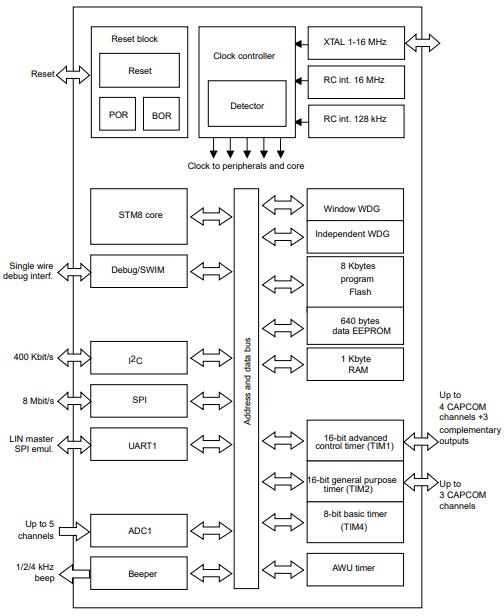
STM8S103F3 Block Diagram
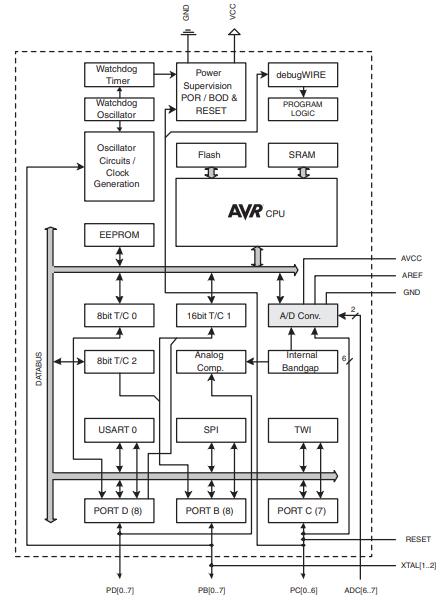
ATmega328p Block Diagram
STM8S103F3 VS ATmega328p CAD Model
STM8S103F3 CAD Model
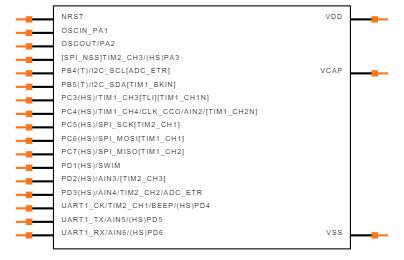
STM8S103F3 Symbol
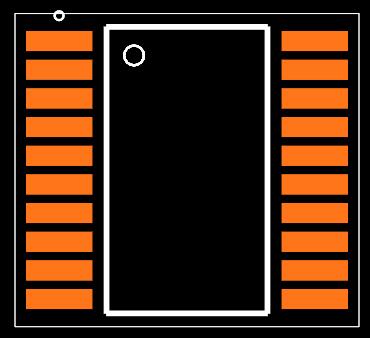
STM8S103F3 Footprint
ATmega328p CAD Model
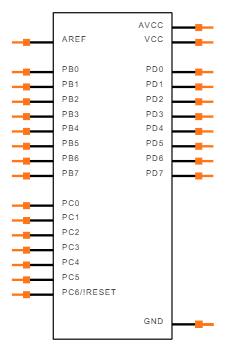
ATmega328p Symbol
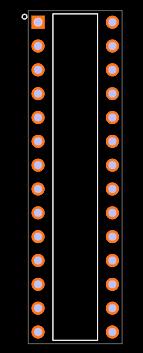
ATmega328p Footprint
STM8S103F3 VS ATmega328p Specifications
| ATmega328p | STM8S103F3 | |
| Clock Frequency (MHz) | 20 max. | 48 max. |
| Flash size (KB) | 32 | 32 |
| SRAM size (Bytes) | 2048 | 4096 |
| EEPROM SIZE (Bytes) | 1024 | None. |
| CART | 1 | 1 |
| SPI | 2 | 1 |
| I 2 C | 1 | 1 |
| Timers | 1 x 16-bit, 2 x 8-bit | 4 x 16-bit |
| ADC | 8 x 10bit (TQFP Package) | 10 x 12-bit |
| GPIO | 23 (shared with other peripherals) | 26 (shared with other peripherals) |
| Internal ADC reference | Yes | Yes |
Comparison between the STM8S103F3 and ATmega328p
While most of this section is about deciding between ATmega and STM32 microcontrollers from a hardware standpoint, it also pertains to 8-bit vs. 32-bit microcontrollers. Here are some points to consider:
In general, the ATmega microcontroller has a lower quiescent current than the STM microcontroller. This is especially true if the STM32 has a large number of unused peripherals that the firmware cannot disable. They simply consume power without providing any value to the user application. Of course, this is a very essential, if not the most important, aspect.
The majority of ATmega microcontroller s can operate at 5V, however, STM32 microcontroller s only have 5V tolerant inputs. Without any regulators, the ATmega can happily run off three 1.5V series-connected batteries and continue to run until the batteries are completely spent. 3.3V LDO s are required for STM32 s, and they will go out of regulation if the battery voltage falls below the LDO's dropout limit.
ATmegas resist electrostatic discharge (ESD) better than STM32 s due to the bigger feature size of their internal transistors. In other words, they have a far higher chance of surviving ESD.
In some situations, the 5V logic provides a significant benefit in terms of electrical noise immunity.
When compared to STM32 s, ATmega s have better drive capability, reducing the need for external hardware drivers.
Some of the peripherals on ATmega microcontroller s, such as the ADCs, are actually superior to those on STM32 microcontrollers.
True EEPROM is available on ATmega s. Bytes can be written or erased individually. In its Flash, STM 32s can imitate EEPROM capabilities. While it is possible to make it transparent to the user, it does require an additional layer of firmware, and the number of erase cycles is reduced.
All that is required in simple applications is the ATmega microcontroller alone.
Conclusion:
The STM32 can accomplish everything an ATmega does, plus a lot more. In some cases, however, it makes more sense to utilize an ATmega instead of an STM32, just as it makes more sense to drive to fetch groceries rather than take a helicopter. It's easier to create apps for, and it's also easier to use. That is all that matters in some cases.
STM8S103F3 VS ATmega328p Package information

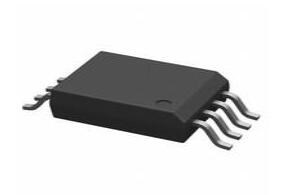
STM8S103F3 Package information
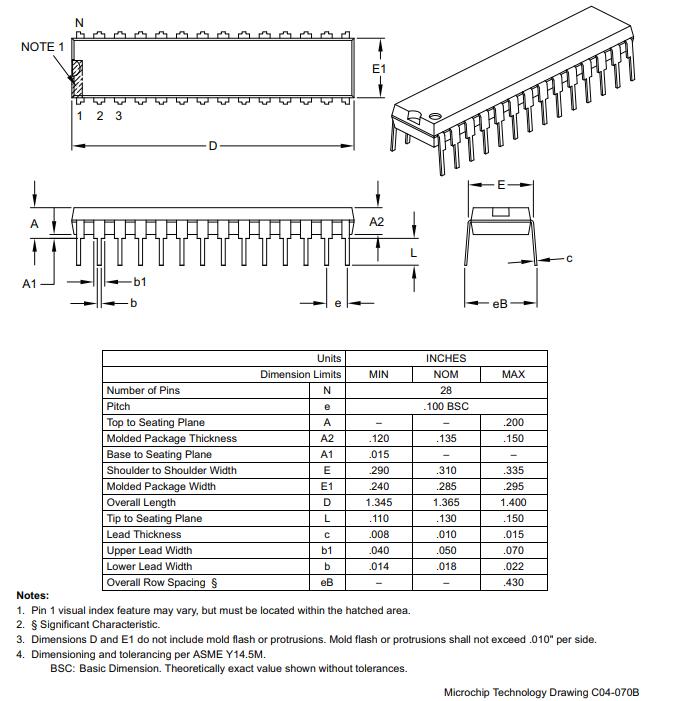
ATmega328p Package information
ATMEGA328P-AU Manufacturer
Microchip Technology Inc. is a leading provider of microcontroller and analog semiconductors, delivering low-risk product development, reduced overall system cost, and faster time to market to thousands of customers across the world. Microchip, based in Chandler, Arizona, provides excellent technical support as well as consistent delivery and quality.
Datasheet PDF
- PCN Obsolescence/ EOL :
- PCN Design/Specification :
- PCN Packaging :
- ConflictMineralStatement :
- Datasheets :
Popularity by Region
Parts with Similar Specs
- ImagePart NumberManufacturerPackage / CaseNumber of PinsData Bus WidthNumber of I/OInterfaceMemory SizeSupply VoltagePeripheralsView Compare
![ATMEGA328-PU]()
ATMEGA328-PU
28-DIP (0.300, 7.62mm)
28
8 b
23
2-Wire, I2C, SPI, UART, USART
32 kB
5 V
Brown-out Detect/Reset, POR, PWM, WDT
![ATMEGA88PA-PU]()
28-DIP (0.300, 7.62mm)
28
8 b
23
I2C, SPI, UART, USART
4 kB
5 V
Brown-out Detect/Reset, POR, PWM, WDT
![ATMEGA48A-PU]()
28-DIP (0.300, 7.62mm)
28
8 b
23
2-Wire, I2C, SPI, UART, USART
8 kB
5 V
Brown-out Detect/Reset, POR, PWM, WDT
![ATMEGA88A-PU]()
28-DIP (0.300, 7.62mm)
28
8 b
23
I2C, SPI, UART, USART
8 kB
5 V
Brown-out Detect/Reset, POR, PWM, WDT

What is the difference between ATMEGA328 and ATmega328P?
Except for power, there are no significant functional differences between them. This type of microcontroller is commonly seen in Arduino boards. The Atmega 328 performs the same functions as the Atmega 328p, however, the 328p consumes much fewer power thanks to ATMEL's PicoPower features. As a result, P stands for PicoPower.
What is ATMEGA328P?
The Atmega328P is at the center of every Arduino Uno board and acts as the 8-bit microcontroller that controls and interacts with sensors, motors, relays, and other electronic devices.
Why is STM32 so popular?
Furthermore, they are well suited to low-power applications, with STM having a low-power series that uses current as low as nanoamps in deep sleep mode. There are numerous reasons why the STM32 is superior. Because of Arduino boards, the ATMEGA series controllers are now commonly utilized among hobbyists.
What is stm8s103f3?
The STM8S103F2/x3 access line 8-bit microcontrollers offer 8 Kbyte Flash program memory, plus integrated true data EEPROM.
 AMC1311 Reinforced Isolated Amplifiers: Datasheet, Applications and Equivalents
09 April 20227956
 MC68HC705C8ACFNE: Trusted Sourcing Guide for Microcontroller Components
07 June 2025345
 STP9NK60ZFP Power MOSFET: Pinout, Datasheet, and Features
11 September 20212867
 A Comprehensive Guide to the RV-8803 Real-Time Clock Module
11 March 20242135
 TXS0108ERGYR Translators: Features, Applications and Datasheet
19 December 2023613
 IRF610 Power MOSFET: Equivalent, Pinout and Datasheet
01 September 20213622
 How to program STM32F030F4P6TR microcontroller: A complete tutorial
24 July 20251853
 Microchip PIC18LF67K40IMR Technical Overview
29 February 2024148
 What Is An Intrinsic Semiconductor?
03 November 202011677
 SiC Power Conversion Devices at High Ambient Temperatures
14 March 20232689
 What is a High-pass Filter?
10 March 202114852
 CR123A vs 123A Batteries Explained for 2025
27 May 20254540
 What is Wi-Fi 7?
20 August 20215760
 The Comprehensive Guide to MOSFETs: Principles, Types, and Parameters (2026 Edition)
16 January 202620033
 What are Comparators?
03 December 20206054
 Arduino and Bluetooth Based Home Automation
29 August 20238182
Microchip Technology
In Stock
United States
China
Canada
Japan
Russia
Germany
United Kingdom
Singapore
Italy
Hong Kong(China)
Taiwan(China)
France
Korea
Mexico
Netherlands
Malaysia
Austria
Spain
Switzerland
Poland
Thailand
Vietnam
India
United Arab Emirates
Afghanistan
Åland Islands
Albania
Algeria
American Samoa
Andorra
Angola
Anguilla
Antigua & Barbuda
Argentina
Armenia
Aruba
Australia
Azerbaijan
Bahamas
Bahrain
Bangladesh
Barbados
Belarus
Belgium
Belize
Benin
Bermuda
Bhutan
Bolivia
Bonaire, Sint Eustatius and Saba
Bosnia & Herzegovina
Botswana
Brazil
British Indian Ocean Territory
British Virgin Islands
Brunei
Bulgaria
Burkina Faso
Burundi
Cabo Verde
Cambodia
Cameroon
Cayman Islands
Central African Republic
Chad
Chile
Christmas Island
Cocos (Keeling) Islands
Colombia
Comoros
Congo
Congo (DRC)
Cook Islands
Costa Rica
Côte d’Ivoire
Croatia
Cuba
Curaçao
Cyprus
Czechia
Denmark
Djibouti
Dominica
Dominican Republic
Ecuador
Egypt
El Salvador
Equatorial Guinea
Eritrea
Estonia
Eswatini
Ethiopia
Falkland Islands
Faroe Islands
Fiji
Finland
French Guiana
French Polynesia
Gabon
Gambia
Georgia
Ghana
Gibraltar
Greece
Greenland
Grenada
Guadeloupe
Guam
Guatemala
Guernsey
Guinea
Guinea-Bissau
Guyana
Haiti
Honduras
Hungary
Iceland
Indonesia
Iran
Iraq
Ireland
Isle of Man
Israel
Jamaica
Jersey
Jordan
Kazakhstan
Kenya
Kiribati
Kosovo
Kuwait
Kyrgyzstan
Laos
Latvia
Lebanon
Lesotho
Liberia
Libya
Liechtenstein
Lithuania
Luxembourg
Macao(China)
Madagascar
Malawi
Maldives
Mali
Malta
Marshall Islands
Martinique
Mauritania
Mauritius
Mayotte
Micronesia
Moldova
Monaco
Mongolia
Montenegro
Montserrat
Morocco
Mozambique
Myanmar
Namibia
Nauru
Nepal
New Caledonia
New Zealand
Nicaragua
Niger
Nigeria
Niue
Norfolk Island
North Korea
North Macedonia
Northern Mariana Islands
Norway
Oman
Pakistan
Palau
Palestinian Authority
Panama
Papua New Guinea
Paraguay
Peru
Philippines
Pitcairn Islands
Portugal
Puerto Rico
Qatar
Réunion
Romania
Rwanda
Samoa
San Marino
São Tomé & Príncipe
Saudi Arabia
Senegal
Serbia
Seychelles
Sierra Leone
Sint Maarten
Slovakia
Slovenia
Solomon Islands
Somalia
South Africa
South Sudan
Sri Lanka
St Helena, Ascension, Tristan da Cunha
St. Barthélemy
St. Kitts & Nevis
St. Lucia
St. Martin
St. Pierre & Miquelon
St. Vincent & Grenadines
Sudan
Suriname
Svalbard & Jan Mayen
Sweden
Syria
Tajikistan
Tanzania
Timor-Leste
Togo
Tokelau
Tonga
Trinidad & Tobago
Tunisia
Turkey
Turkmenistan
Turks & Caicos Islands
Tuvalu
U.S. Outlying Islands
U.S. Virgin Islands
Uganda
Ukraine
Uruguay
Uzbekistan
Vanuatu
Vatican City
Venezuela
Wallis & Futuna
Yemen
Zambia
Zimbabwe
![ATMEGA8515L-8AU]() ATMEGA8515L-8AU
ATMEGA8515L-8AUMicrochip Technology
![DSPIC30F6014A-30I/PF]() DSPIC30F6014A-30I/PF
DSPIC30F6014A-30I/PFMicrochip Technology
![ATMEGA32A-AU]() ATMEGA32A-AU
ATMEGA32A-AUMicrochip Technology
![ATXMEGA128A1U-AU]() ATXMEGA128A1U-AU
ATXMEGA128A1U-AUMicrochip Technology
![PIC18F46K20-I/PT]() PIC18F46K20-I/PT
PIC18F46K20-I/PTMicrochip Technology
![PIC18F6722-I/PT]() PIC18F6722-I/PT
PIC18F6722-I/PTMicrochip Technology
![PIC16F883-I/SS]() PIC16F883-I/SS
PIC16F883-I/SSMicrochip Technology
![PIC16F877-20I/PT]() PIC16F877-20I/PT
PIC16F877-20I/PTMicrochip Technology
![ATMEGA8535L-8AU]() ATMEGA8535L-8AU
ATMEGA8535L-8AUMicrochip Technology
![PIC18F4685-I/PT]() PIC18F4685-I/PT
PIC18F4685-I/PTMicrochip Technology


