

 Product
 Brand
Brand Articles
 Tools
Tools
LT1028 0.85nV/√Hz Ultra-Low Noise Op-Amp: Performance Analysis, Pinout, and Stability Guide


Instrumentational OP Amps LT1028 8-CDIP (0.300, 7.62mm)
The LT1028 is an ultra-low noise (0.85nV/√Hz) op-amp for precision designs. Explore specs, pinout, and stability fixes in our guide. Buy now or download the datasheet.
- Executive Summary: What is the LT1028?
- 1. Technical Specifications & Performance Analysis
- 2. Pinout, Package, and Configuration
- 3. Design & Integration Guide (For Engineers & Makers)
- 4. Typical Applications & Use Cases
- 5. Alternatives and Cross-Reference Guide
- 6. Frequently Asked Questions (FAQ)
- 7. Resources
- Specifications
- Datasheet PDF
Executive Summary: What is the LT1028?
The LT1028 is a high-speed, ultra-low noise precision operational amplifier designed for applications where signal integrity and minimal background noise are the primary design constraints. It currently stands as a gold standard in the industry for voltage noise performance.
Market Position: High-performance precision analog; widely regarded as one of the lowest-noise bipolar op-amps available.
Top Features: Industry-leading 0.85nV/√Hz noise density, 75MHz gain-bandwidth product, and exceptional 30 million V/V large-signal voltage gain.
Primary Audience: Ideal for high-end audio designers, medical instrumentation engineers, and physics researchers working with low-output sensors.
Supply Status: Active (Available in various packages including SOIC and PDIP).
1. Technical Specifications & Performance Analysis
The LT1028 is a bipolar operational amplifier that breaks the traditional trade-off between low noise and high speed.
1.1 Core Architecture
The LT1028 utilizes a specialized bipolar input stage to achieve its record-breaking noise floor. Unlike standard op-amps, the architecture is optimized for high gain-bandwidth (75MHz), making it suitable for high-frequency signal conditioning without sacrificing DC precision.
1.2 Key Electrical Characteristics
Engineers must account for the following critical parameters during the BOM selection process:
- Voltage Noise Density: 0.85 nV/√Hz at 1kHz (Typical).
- Supply Voltage Range: Operates from ±5V to ±18V, offering flexibility for industrial and lab-grade power rails.
- Slew Rate: 11 V/µs, ensuring the device can handle rapid signal transitions in high-speed data acquisition.
- Input Offset Voltage: Extremely low 10 µV typical, which minimizes error in precision DC circuits.
- Input Bias Current: 25 nA, which is relatively low for a bipolar part but requires consideration in high-impedance circuits.
1.3 Interfaces and Connectivity
As a purely analog component, the LT1028 does not feature digital buses like I2C or SPI. However, it provides:
- Offset Nulling Pins: Allows for manual trimming of input offset voltage for ultra-precise DC applications.
- Standard 8-Pin Footprint: Compatible with most precision analog layouts.
2. Pinout, Package, and Configuration
Understanding the physical layout is essential for PCB design and troubleshooting.
2.1 Pin Configuration Guide
The LT1028 typically follows the standard single op-amp pinout but includes specific pins for frequency compensation and offset nulling:
Vos Trim / Comp: Used for offset nulling or external compensation.
-IN: Inverting Input.
+IN: Non-Inverting Input.
V-: Negative Supply Rail.
Over-Comp: External compensation for stability.
OUT: Signal Output.
V+: Positive Supply Rail.
Vos Trim: Offset nulling.
2.2 Naming Convention & Ordering Codes
LT1028CN8: Plastic DIP package, commercial temperature range.
LT1028CS8: SOIC-8 surface mount package.
LT1028AMH: TO-5 metal can (High reliability/Military grade).
Suffix 'PBF': Denotes Lead-Free/RoHS compliance.
2.3 Available Packages
| Package Type | Dimensions | Common Use Case |
|---|---|---|
| PDIP-8 | 9.27mm x 6.35mm | Prototyping and through-hole industrial boards. |
| SOIC-8 | 4.90mm x 3.90mm | Standard surface-mount production. |
| CERDIP | 9.60mm x 6.67mm | High-temperature or high-reliability environments. |
3. Design & Integration Guide (For Engineers & Makers)
Pro Tip: The LT1028 is NOT unity-gain stable. If you need a voltage follower (Gain = 1), you must use its sibling, the LT1128.
3.1 Hardware Implementation
Bypass Capacitors: Due to its high 75MHz bandwidth, the LT1028 is prone to oscillation if power rails are not properly decoupled. Place a 0.1µF ceramic capacitor in parallel with a 10µF tantalum capacitor as close to the V+ and V- pins as possible.
PCB Layout: Use a solid ground plane. Keep input traces as short as possible to prevent the ultra-low noise floor from being compromised by EMI/RFI.
Thermal Management: While the device doesn't usually require a heatsink, the SOIC version can warm up during high-load conditions. Ensure adequate copper area around the power pins.
3.2 Common Design Challenges
Issue: Unity Gain Instability
Fix: The LT1028 is stable only at gains of -1 or +2 and higher. For unity-gain applications, swap the part for the LT1128 or add an external RC compensation network across the feedback loop.
Issue: Distortion with Low Impedance Loads
Fix: If driving 16Ω or 32Ω headphones, the LT1028 may struggle. Use a discrete transistor buffer (like a BUF634) on the output to maintain linearity.
Issue: Noise from Source Resistance
Fix: At 0.85nV/√Hz, the resistor noise (Johnson noise) can easily exceed the op-amp noise. Keep source resistances below 50Ω to fully utilize the LT1028’s performance.
4. Typical Applications & Use Cases
🎬 Watch Tutorial: LT1028
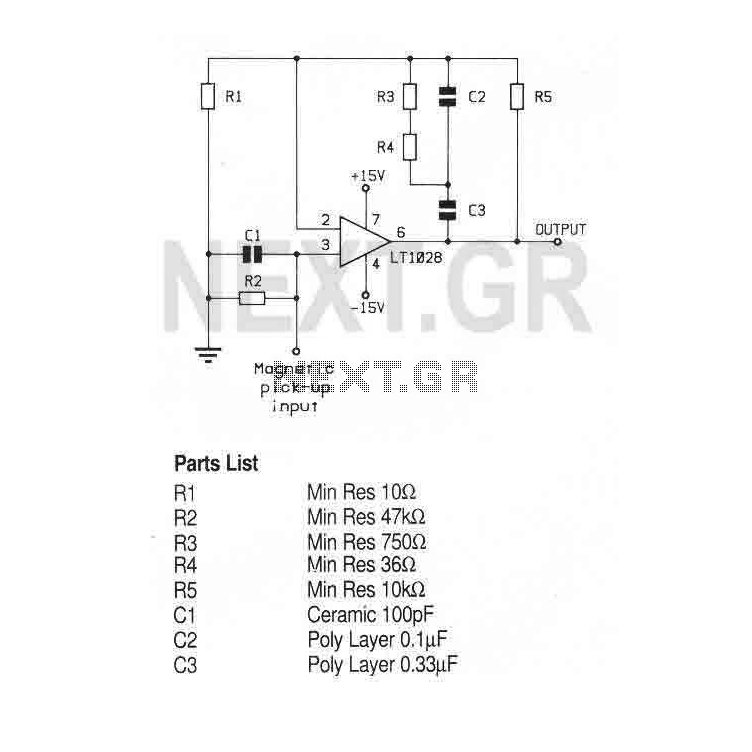
4.1 Real-World Example: High-End Audio Preamplifier
In a Moving Coil (MC) phono preamplifier, the signal levels are exceptionally low (often <0.5mV). The LT1028 is used here as the first gain stage because its voltage noise is lower than the thermal noise of many sensors. By using the LT1028, designers can achieve a signal-to-noise ratio that was previously impossible with standard parts like the NE5534.
5. Alternatives and Cross-Reference Guide
If the LT1028 is out of stock or does not meet specific stability needs, consider these alternatives:
LT1128: The unity-gain stable version of the LT1028. Same noise specs, slightly lower bandwidth.
AD797: The primary competitor from Analog Devices. Offers similar noise performance and is often preferred in ultra-low distortion audio circuits.
OPA211: A modern TI alternative that offers excellent noise-to-power consumption ratios.
LT6018: A newer generation part with even lower 1/f noise, ideal for DC-precision applications.
6. Frequently Asked Questions (FAQ)
Q: What is the difference between LT1028 and LT1128?
A: The LT1028 is optimized for high speed and is stable at gains ≥ 2. The LT1128 is internally compensated to be stable at a gain of 1 (unity gain).
Q: Can LT1028 be used in Automotive applications?
A: Yes, provided the temperature range and qualification (e.g., AEC-Q100) of the specific part number meet the project requirements.
Q: Where can I find the datasheet and library files for LT1028?
A: The official datasheet is available on the Analog Devices website. CAD symbols are available via Ultra Librarian or SnapEDA.
Q: Is LT1028 suitable for battery-operated devices?
A: It is not a "low power" op-amp. With a typical supply current of 7-10mA, it may drain small batteries quickly compared to micropower alternatives.
7. Resources
Development Tools: LTspice (Highly recommended for simulating the stability of LT1028 circuits).
Evaluation Boards: DC1304A (General purpose op-amp evaluation board).
Specifications
Datasheet PDF
- Datasheets :
 MC34164 Micropower Undervoltage Sensing Circuits: Pinout, Equivalent and Datasheet
10 March 2022941
 LM2678 High Efficiency 5A Step-down Voltage Regulator: Datasheet, Pinout and Circuit
06 December 20214302
 2N5486 Transistor: 2N5486 vs. MPF102, Equivalent, Datasheet
18 April 20225124
 STM32F407ZGT6 Microcontroller: Feature, Pinout and Datasheet
21 October 202112396
 LM78L Linear Regulator: Features, Speicifications and Applications
26 May 20212757
 Introduction to Texas Instruments MSP430G2x53 Microcontroller
29 February 2024230
 A Comprehensive Guide to the PICASO Microcontroller by 4D Systems
07 March 2024627
 IR2112 Driver IC: Circuit, Pinout and Datasheet
11 September 202113396
 SiC Power Conversion Devices at High Ambient Temperatures
14 March 20232800
 Advancements and Challenges of High Frequency Converters
19 June 20232352
 Chinese Chip Equipment Makers Thrive Amid US Restrictions
24 October 20232576
 Introduction to FinFET
18 March 202131483
 What is a Motherboard Chipset? A Guide to 2026 Architecture
12 June 20267833
 Aluminum Electrolytic Capacitor: Structure and Features
19 December 20205259
 Battery Management System (BMS) Implementation Form and Chip Performance Analysis
28 April 20224502
 A $39 Billion Investment Wave Expected to Boost AI and Semiconductor Stocks
26 September 20232749
Linear Technology/Analog Devices
In Stock: 15
United States
China
Canada
Japan
Russia
Germany
United Kingdom
Singapore
Italy
Hong Kong(China)
Taiwan(China)
France
Korea
Mexico
Netherlands
Malaysia
Austria
Spain
Switzerland
Poland
Thailand
Vietnam
India
United Arab Emirates
Afghanistan
Åland Islands
Albania
Algeria
American Samoa
Andorra
Angola
Anguilla
Antigua & Barbuda
Argentina
Armenia
Aruba
Australia
Azerbaijan
Bahamas
Bahrain
Bangladesh
Barbados
Belarus
Belgium
Belize
Benin
Bermuda
Bhutan
Bolivia
Bonaire, Sint Eustatius and Saba
Bosnia & Herzegovina
Botswana
Brazil
British Indian Ocean Territory
British Virgin Islands
Brunei
Bulgaria
Burkina Faso
Burundi
Cabo Verde
Cambodia
Cameroon
Cayman Islands
Central African Republic
Chad
Chile
Christmas Island
Cocos (Keeling) Islands
Colombia
Comoros
Congo
Congo (DRC)
Cook Islands
Costa Rica
Côte d’Ivoire
Croatia
Cuba
Curaçao
Cyprus
Czechia
Denmark
Djibouti
Dominica
Dominican Republic
Ecuador
Egypt
El Salvador
Equatorial Guinea
Eritrea
Estonia
Eswatini
Ethiopia
Falkland Islands
Faroe Islands
Fiji
Finland
French Guiana
French Polynesia
Gabon
Gambia
Georgia
Ghana
Gibraltar
Greece
Greenland
Grenada
Guadeloupe
Guam
Guatemala
Guernsey
Guinea
Guinea-Bissau
Guyana
Haiti
Honduras
Hungary
Iceland
Indonesia
Iran
Iraq
Ireland
Isle of Man
Israel
Jamaica
Jersey
Jordan
Kazakhstan
Kenya
Kiribati
Kosovo
Kuwait
Kyrgyzstan
Laos
Latvia
Lebanon
Lesotho
Liberia
Libya
Liechtenstein
Lithuania
Luxembourg
Macao(China)
Madagascar
Malawi
Maldives
Mali
Malta
Marshall Islands
Martinique
Mauritania
Mauritius
Mayotte
Micronesia
Moldova
Monaco
Mongolia
Montenegro
Montserrat
Morocco
Mozambique
Myanmar
Namibia
Nauru
Nepal
New Caledonia
New Zealand
Nicaragua
Niger
Nigeria
Niue
Norfolk Island
North Korea
North Macedonia
Northern Mariana Islands
Norway
Oman
Pakistan
Palau
Palestinian Authority
Panama
Papua New Guinea
Paraguay
Peru
Philippines
Pitcairn Islands
Portugal
Puerto Rico
Qatar
Réunion
Romania
Rwanda
Samoa
San Marino
São Tomé & Príncipe
Saudi Arabia
Senegal
Serbia
Seychelles
Sierra Leone
Sint Maarten
Slovakia
Slovenia
Solomon Islands
Somalia
South Africa
South Sudan
Sri Lanka
St Helena, Ascension, Tristan da Cunha
St. Barthélemy
St. Kitts & Nevis
St. Lucia
St. Martin
St. Pierre & Miquelon
St. Vincent & Grenadines
Sudan
Suriname
Svalbard & Jan Mayen
Sweden
Syria
Tajikistan
Tanzania
Timor-Leste
Togo
Tokelau
Tonga
Trinidad & Tobago
Tunisia
Turkey
Turkmenistan
Turks & Caicos Islands
Tuvalu
U.S. Outlying Islands
U.S. Virgin Islands
Uganda
Ukraine
Uruguay
Uzbekistan
Vanuatu
Vatican City
Venezuela
Wallis & Futuna
Yemen
Zambia
Zimbabwe
![AD826AR-REEL7]() AD826AR-REEL7
AD826AR-REEL7Analog Devices Inc.
![AD8062ARM]() AD8062ARM
AD8062ARMAnalog Devices Inc.
![AD8532ARU-REEL]() AD8532ARU-REEL
AD8532ARU-REELAnalog Devices Inc.
![OP113ES]() OP113ES
OP113ESAnalog Devices Inc.
![SSM2142P]() SSM2142P
SSM2142PAnalog Devices, Inc.
![LTC1050CS8]() LTC1050CS8
LTC1050CS8Linear Technology/Analog Devices
![AMP02EPZ]() AMP02EPZ
AMP02EPZAnalog Devices Inc.
![AD822ARZ-REEL7]() AD822ARZ-REEL7
AD822ARZ-REEL7Analog Devices Inc.
![OP2177ARZ-REEL7]() OP2177ARZ-REEL7
OP2177ARZ-REEL7Analog Devices Inc.
![AD8066ARZ-R7]() AD8066ARZ-R7
AD8066ARZ-R7Analog Devices Inc.


