

 Product
 Brand
Brand Articles
 Tools
Tools
AVR® ATtiny 4KB 8-bit MCU: Datasheet, Pinout, and Performance Deep Dive

4KB 2K x 16 FLASH AVR 8-Bit Microcontroller AVR® ATtiny Series ATTINY45 8 Pin 10MHz 8-SOIC (0.209, 5.30mm Width)
Unit Price: $7.505655
Ext Price: $7.51


4KB 2K x 16 FLASH AVR 8-Bit Microcontroller AVR® ATtiny Series ATTINY45 8 Pin 10MHz 8-SOIC (0.209, 5.30mm Width)
Discover the AVR® ATtiny 8-bit MCU. Featuring 4KB Flash, 20MHz speed, and 1.8V-5.5V range. Perfect for compact IoT designs. View specs and design resources today!
- Executive Summary: What is the AVR® ATtiny?
- 1. Technical Specifications & Performance Analysis
- 2. Pinout, Package, and Configuration
- 3. Design & Integration Guide (For Engineers & Makers)
- 4. Typical Applications & Use Cases
- 5. Alternatives and Cross-Reference Guide
- 6. Frequently Asked Questions (FAQ)
- 7. Resources
- Specifications
- Parts with Similar Specs
- Datasheet PDF
Executive Summary: What is the AVR® ATtiny?
The AVR® ATtiny is a high-performance, low-power 8-bit RISC microcontroller designed for space-constrained applications requiring minimal power and high efficiency. It provides a robust architecture for engineers who need to execute complex logic within a minimal physical footprint.
Market Position: A low-cost, industry-standard series known for its reliability in both legacy systems and modern IoT "edge" nodes.
Top Features: 4KB In-System Programmable Flash, 20 MHz maximum operating frequency, and a wide 1.8V to 5.5V operating voltage.
Primary Audience: Ideal for IoT designers, procurement managers sourcing for high-volume consumer goods, and advanced hobbyists building wearable tech.
Supply Status: Active; widely supported by Microchip Technology and global distributors.
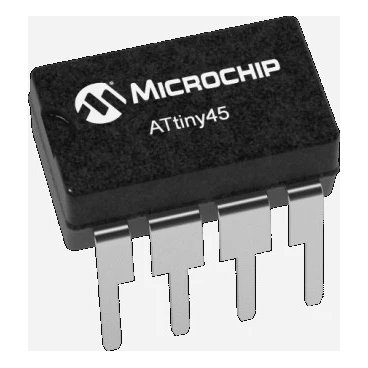
1. Technical Specifications & Performance Analysis
The AVR® ATtiny series is engineered to maximize work-per-clock cycle, achieving throughputs approaching 1 MIPS per MHz. This allows designers to optimize power consumption versus processing speed.
1.1 Core Architecture (CPU/Logic/Power)
Based on the AVR® enhanced RISC architecture, this MCU features a powerful instruction set and 32 general-purpose working registers. By executing powerful instructions in a single clock cycle, the ATtiny balances high processing speed with reduced power consumption—a critical factor for Bill of Materials (BOM) optimization in battery-operated devices.
1.2 Key Electrical Characteristics
The device is designed for flexibility across various power rails:
- Operating Voltage: 1.8V to 5.5V, making it compatible with both 3.3V CMOS and 5V TTL logic.
- Speed Grades: Up to 20 MHz at 4.5V - 5.5V.
- Low Power Modes: Includes Idle, ADC Noise Reduction, and Power-down modes to extend battery life in remote sensor applications.
1.3 Interfaces and Connectivity
Despite its small pin count, the ATtiny is highly integrated:
- USI (Universal Serial Interface): Provides hardware support for SPI and I2C (Wire) communication.
- Analog-to-Digital Converter (ADC): A 10-bit ADC with 4 channels, allowing for precise sensor interfacing.
- Debug System: Integrated debugWIRE for on-chip debugging, simplifying the firmware development cycle.
2. Pinout, Package, and Configuration
The ATtiny's popularity stems largely from its compact 8-pin form factor, which saves significant PCB real estate.
2.1 Pin Configuration Guide
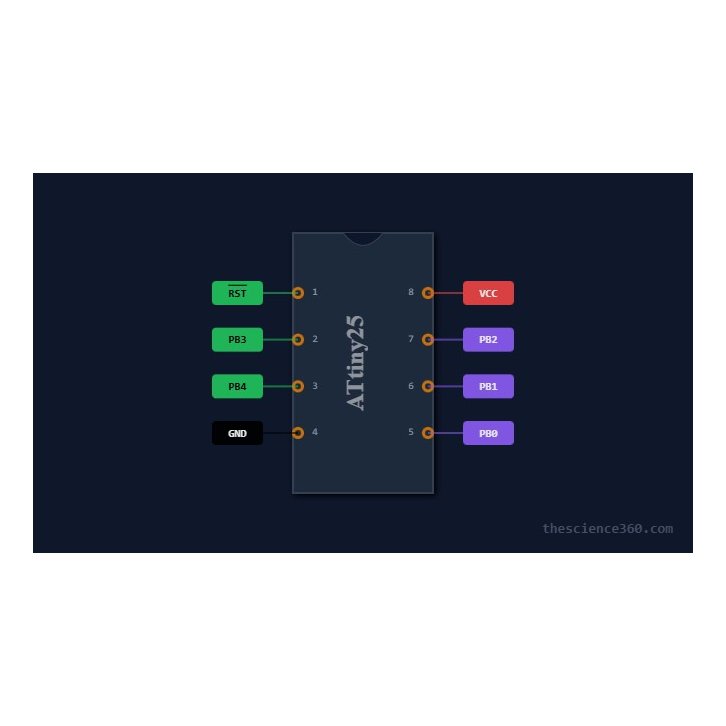
VCC/GND: Power supply pins.
Port B (PB0–PB5): 6 general-purpose I/O pins.
Special Functions: Pins are multiplexed with functions such as External Interrupts, PWM outputs, and ADC inputs. Note that PB5 is typically the Reset pin.
2.2 Naming Convention & Ordering Codes
Understanding Microchip's suffixes is vital for procurement:
-PU: PDIP package (Through-hole, ideal for prototyping).
-SU/SN: SOIC package (Surface mount, standard for mass production).
-20: Indicates the 20MHz speed grade.
2.3 Available Packages
| Package Type | Dimensions | Common Use Case |
|---|---|---|
| 8-pin PDIP | 0.300" Wide | Breadboarding and hand-soldering friendly. |
| 8-pin SOIC | 150/208 mil | High-density SMT machine assembly. |
3. Design & Integration Guide (For Engineers & Makers)
Pro Tip: When using the internal oscillator, ensure you calibrate the OSCCAL register if your application requires precise timing for serial communication.
3.1 Hardware Implementation
Bypass Capacitors: Place a 0.1µF ceramic capacitor as close to the VCC and GND pins as possible to filter high-frequency noise.
PCB Layout: Keep analog signal traces away from high-speed digital lines to maintain 10-bit ADC accuracy.
Thermal Management: With its low power draw, a heatsink is not required; however, ensure the copper pour is sufficient if driving high-current LEDs via PWM.
3.2 Common Design Challenges
Issue: Limited I/O Pins -> Fix: If you need more than 6 I/O, use a 74HC595 shift register for output expansion or consider using the Reset pin (PB5) as I/O (requires HVSP programming).
Issue: No Hardware UART -> Fix: Implement a "Software Serial" bit-banging approach or utilize the USI hardware to emulate UART.
Issue: Memory Constraints -> Fix: With only 256 Bytes of SRAM, avoid using large libraries (like standard Arduino String classes). Use
PROGMEMto store constant data in Flash.
4. Typical Applications & Use Cases
🎬 Watch Tutorial: ATTINY45
4.1 Real-World Example: Smart LED Driver
In a smart lighting application, the ATtiny reads an ambient light sensor via the 10-bit ADC and adjusts the brightness of an LED string using High-Speed PWM. Its small size allows it to be embedded directly inside the bulb housing or a small wearable device.
5. Alternatives and Cross-Reference Guide
If the ATtiny does not meet your specific memory or I/O requirements, consider these alternatives:
Direct Replacements: ATtiny85 (Same pinout, but doubles Flash to 8KB and SRAM to 512B).
Better Performance: ATtiny412 (Newer 1-series architecture with improved peripherals and faster ADC).
Cost-Effective Alternatives: Microchip PIC12F1572 or the STMicroelectronics STM8S003 for high-volume cost reduction.
6. Frequently Asked Questions (FAQ)
Q: What is the difference between AVR® ATtiny and ATmega?
A: ATtiny focuses on small pin counts (8-32 pins) and lower costs, whereas ATmega (like the ATmega328P) offers more memory, I/O, and dedicated hardware peripherals like multiple UARTs.
Q: Can AVR® ATtiny be programmed with an Arduino?
A: Yes, by using the "Arduino as ISP" sketch, you can use an Arduino Uno to program the ATtiny series.
Q: Is AVR® ATtiny suitable for battery-operated devices?
A: Absolutely. Its "picoPower" technology and wide voltage range make it ideal for coin-cell (CR2032) applications.
Q: How do I implement I2C on this chip?
A: Use the USI (Universal Serial Interface) hardware. Libraries like
TinyWireMare specifically optimized for this.
7. Resources
Datasheet: Download the official Microchip AVR® ATtiny PDF.
Development Tools: Microchip Studio (Atmel Studio 7) or Arduino IDE with ATTinyCore.
Library Files: GitHub repositories for TinyWire and SoftwareSerial.
Specifications
Parts with Similar Specs
- ImagePart NumberManufacturerPackage / CaseNumber of PinsData Bus WidthNumber of I/OInterfaceMemory SizeSupply VoltagePeripheralsView Compare
![ATTINY45V-10SUR]()
ATTINY45V-10SUR
8-SOIC (0.209, 5.30mm Width)
8
8 b
6
SPI
3.5 kB
3 V
Brown-out Detect/Reset, POR, PWM, WDT
![ATTINY85V-10SU]()
8-SOIC (0.209, 5.30mm Width)
8
8 b
6
SPI
1 kB
3 V
Brown-out Detect/Reset, POR, PWM, WDT
![ATTINY25V-10SU]()
8-SOIC (0.209, 5.30mm Width)
8
8 b
6
SPI
2 kB
3 V
Brown-out Detect/Reset, POR, PWM, WDT
![ATTINY13V-10SU]()
8-SOIC (0.209, 5.30mm Width)
8
8 b
6
SPI
8 kB
3 V
Brown-out Detect/Reset, POR, PWM, WDT

Datasheet PDF
- Datasheets :
- PCN Design/Specification :
- PCN Assembly/Origin :
- PCN Packaging :
- ConflictMineralStatement :
 A Comprehensive Guide to LTC7852EUFD-1#PBF DC-DC Switching Controller
06 March 2024217
 LM1458N Operational Amplifier: Pinout, Datasheet, and Schematic Diagram
09 August 20214007
![LRS-350-24 AC DC Converters Output 24V 14.6A[Video]: Datasheet, Wiring Diagram, and Features](https://res.utmel.com/Images/Article/ceb816d2-89eb-4eaa-a176-8b309e61b0b9.png) LRS-350-24 AC DC Converters Output 24V 14.6A[Video]: Datasheet, Wiring Diagram, and Features
LRS-350-24 AC DC Converters Output 24V 14.6A[Video]: Datasheet, Wiring Diagram, and Features31 March 20229146
![ATMEGA32 AVR Microcontroller: Pins, Datasheet and Using Atmega32 with Arduino IDE [VIDEO]](https://res.utmel.com/Images/Article/f0b5cd37-f149-4353-abe3-2ebd354bab5c.jpg) ATMEGA32 AVR Microcontroller: Pins, Datasheet and Using Atmega32 with Arduino IDE [VIDEO]
ATMEGA32 AVR Microcontroller: Pins, Datasheet and Using Atmega32 with Arduino IDE [VIDEO]09 December 20216015
 PESD2CAN TVS Diode: SOT-23, CAN Bus, Datasheet and Pinout
16 February 20225038
![AT89C2051-24PU 8-bit Microcontroller: Circuit Diagram, Pinout, and Datasheet [Video&FAQ]](https://res.utmel.com/Images/Article/789f3a55-d7a1-41ca-9784-35cc175f9498.png) AT89C2051-24PU 8-bit Microcontroller: Circuit Diagram, Pinout, and Datasheet [Video&FAQ]
AT89C2051-24PU 8-bit Microcontroller: Circuit Diagram, Pinout, and Datasheet [Video&FAQ]16 February 202215441
 Texas Instruments TMUX1574RSVR: Steps to Solve Common Issues
16 August 2025392
 Introduction to NXP KL28Z Microcontroller
28 February 2024275
 Semiconductor R&D Spending: Top 12 Countries
20 September 20233930
 Introduction to Step-up Transformer
01 March 20216756
 Three-Level Integration of Circuits
05 May 20224175
 Power Semiconductors Shortage Outlook 2026: Supply, Lead Times, and Sourcing Options
04 July 20264059
 Advanced Aircraft Power Electronics Systems and Influence of Simulation, Standards, and Wide Band-Gap Devices
18 February 20243079
 Electric Car Rechargeable Batteries: How Long Do They Last?
13 April 20234313
 Trimmer Resistors: From Principles to Selection and Applications
11 August 20254230
 How to Increase Laptop Battery Life
03 July 20213704
Microchip Technology
In Stock: 4000
Minimum: 1 Multiples: 1
Qty
Unit Price
Ext Price
1
$7.505655
$7.51
10
$7.080807
$70.81
100
$6.680006
$668.00
500
$6.301893
$3,150.95
1000
$5.945182
$5,945.18
Not the price you want? Send RFQ Now and we'll contact you ASAP.
Inquire for More Quantity
![ATMEGA8515L-8AU]() ATMEGA8515L-8AU
ATMEGA8515L-8AUMicrochip Technology
![DSPIC30F6014A-30I/PF]() DSPIC30F6014A-30I/PF
DSPIC30F6014A-30I/PFMicrochip Technology
![ATMEGA32A-AU]() ATMEGA32A-AU
ATMEGA32A-AUMicrochip Technology
![ATXMEGA128A1U-AU]() ATXMEGA128A1U-AU
ATXMEGA128A1U-AUMicrochip Technology
![PIC18F46K20-I/PT]() PIC18F46K20-I/PT
PIC18F46K20-I/PTMicrochip Technology
![PIC18F6722-I/PT]() PIC18F6722-I/PT
PIC18F6722-I/PTMicrochip Technology
![PIC16F883-I/SS]() PIC16F883-I/SS
PIC16F883-I/SSMicrochip Technology
![PIC16F877-20I/PT]() PIC16F877-20I/PT
PIC16F877-20I/PTMicrochip Technology
![ATMEGA8535L-8AU]() ATMEGA8535L-8AU
ATMEGA8535L-8AUMicrochip Technology
![PIC18F4685-I/PT]() PIC18F4685-I/PT
PIC18F4685-I/PTMicrochip Technology


