

 Product
 Brand
Brand Articles
 Tools
Tools
AD8421 10MHz Instrumentation Amplifier: Low-Noise Precision for High-Speed Signal Chains

65mA per Channel 1nA 94 dB Instrumentational OP Amps 5V~36V ±2.5V~18V AD8421 8-TSSOP, 8-MSOP (0.118, 3.00mm Width)


65mA per Channel 1nA 94 dB Instrumentational OP Amps 5V~36V ±2.5V~18V AD8421 8-TSSOP, 8-MSOP (0.118, 3.00mm Width)
Optimize your signal chain with the AD8421 Instrumentation Amplifier. Features 3.2nV/√Hz noise and 10MHz bandwidth. Ideal for medical and vibration analysis. Buy now!
- Executive Summary: What is the AD8421?
- 1. Technical Specifications & Performance Analysis
- 2. Pinout, Package, and Configuration
- 3. Design & Integration Guide (For Engineers & Makers)
- 4. Typical Applications & Use Cases
- 5. Alternatives and Cross-Reference Guide
- 6. Frequently Asked Questions (FAQ)
- 7. Resources
- Specifications
- Parts with Similar Specs
- Datasheet PDF
Executive Summary: What is the AD8421?
The AD8421 is a high-speed, low-power instrumentation amplifier (In-Amp) designed by Analog Devices for precision signal conditioning where low noise and high bandwidth are critical. It serves as a high-performance bridge between low-level sensor signals and high-speed analog-to-digital converters (ADCs).
Market Position: High-performance precision amplifier; balances extreme speed with ultralow noise.
Top Features: 10 MHz bandwidth (G=1), 3.2 nV/√Hz input voltage noise, and 35 V/µs slew rate.
Primary Audience: Ideal for medical device designers, vibration analysis engineers, and high-end audio equipment manufacturers.
Supply Status: Active (Widely available for new designs).
1. Technical Specifications & Performance Analysis
The AD8421 stands out in the Analog Devices portfolio by breaking the traditional trade-off between power consumption and speed.
1.1 Core Architecture
The AD8421 utilizes a classic 3-op-amp architecture but is optimized for high-speed performance. Unlike traditional In-Amps that struggle with bandwidth at high gain, the AD8421 maintains significant speed across its gain range, making it suitable for multiplexed systems where fast settling time is required.
1.2 Key Electrical Characteristics
For engineers managing a strict power budget or high-precision requirements, the following specs are critical:
- Input Voltage Noise: Only 3.2 nV/√Hz at 1 kHz, ensuring that the amplifier does not mask low-level signals.
- High Speed: A 10 MHz bandwidth (at G=1) and a 35 V/µs slew rate allow the part to handle fast transients and high-frequency AC signals.
- Low Power: Despite its speed, it consumes a maximum of only 2.3 mA, making it viable for high-density boards.
- Input Protection: The device is robust, with inputs protected up to 40 V from the opposite supply rail, reducing the need for external clamping diodes.
1.3 Interfaces and Connectivity
The AD8421 is an analog-in, analog-out component. It interfaces seamlessly with:
- High-Resolution ADCs: Its fast settling time makes it an ideal driver for SAR and Delta-Sigma ADCs.
- Bipolar Supplies: Operates on ±2.5 V to ±18 V, providing flexibility for industrial or battery-powered rails.
2. Pinout, Package, and Configuration
Understanding the physical layout is the first step toward a successful PCB design.
2.1 Pin Configuration Guide
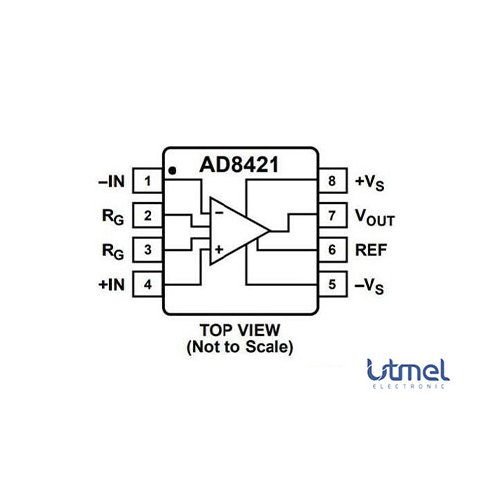
The AD8421 typically uses an industry-standard 8-lead configuration:
- -IN / +IN: Differential inputs for the sensor signal.
- RG (Pins 1 & 8): Gain setting pins. A single external resistor sets the gain from 1 to 10,000.
- REF: Reference pin; defines the output voltage level for a zero differential input.
- V+ / V-: Power supply pins.
- OUT: The amplified output signal.
2.2 Naming Convention & Ordering Codes
When ordering, look for suffixes like AD8421ARMZ (MSOP package) or AD8421ARZ (SOIC package). The "R" usually denotes the temperature range (-40°C to +85°C), and "Z" indicates RoHS compliance.
2.3 Available Packages
| Package Type | Dimensions | Common Use Case |
|---|---|---|
| 8-Lead SOIC | 4.9mm x 3.9mm | General purpose, easy prototyping/hand-soldering. |
| 8-Lead MSOP | 3.0mm x 3.0mm | Space-constrained medical or portable devices. |
3. Design & Integration Guide (For Engineers & Makers)
Pro Tip: Always place a 0.1µF ceramic capacitor as close as possible to the supply pins to minimize high-frequency noise.
3.1 Hardware Implementation
Bypass Capacitors: Use a combination of 10µF tantalum and 0.1µF ceramic capacitors to ensure stability.
PCB Layout: Keep the traces to the gain resistor (Rg) as short as possible. Any parasitic capacitance or inductance in the Rg loop will degrade the Common-Mode Rejection Ratio (CMRR) and introduce noise.
3.2 Common Design Challenges
Issue: Noise Coupling in Rg Loop: Users often see noise spikes when using a MUX.
Fix: Minimize the loop area between the RG pins and the resistor. If using a MUX to switch gains, place it physically adjacent to the AD8421.
Issue: Simulation Gain Errors: LTspice models may fail if the input common-mode voltage is floating.
Fix: Ensure your simulation schematic provides a DC path to ground for the inputs.
Issue: Output Saturation: Floating sources (like a battery) can cause the output to drift to the rails.
Fix: Install 10MΩ resistors from each input to ground to provide a bias current return path.
4. Typical Applications & Use Cases
📺 Recommended Video Tutorial:
👉 Click to Watch "AD8421" Guide on YouTube
4.1 Real-World Example: Vibration Analysis
In industrial predictive maintenance, piezoelectric accelerometers generate high-frequency, low-voltage signals. The AD8421’s 10 MHz bandwidth allows it to capture high-frequency harmonics of machine vibration, while its low noise ensures that the subtle "signature" of a failing bearing isn't lost in the background hiss.
5. Alternatives and Cross-Reference Guide
If the AD8421 is unavailable or doesn't perfectly fit your BOM, consider these alternatives:
Texas Instruments INA849: A direct competitor offering even lower noise (1 nV/√Hz) but potentially higher power consumption.
Texas Instruments INA821: A good alternative for lower-speed applications where cost-efficiency is prioritized over bandwidth.
Texas Instruments INA118: A legacy alternative; use this only if you are maintaining an older design, as the AD8421 outperforms it in almost every precision metric.
6. Frequently Asked Questions (FAQ)
Q: What is the difference between AD8421 and INA118?A: The AD8421 is significantly faster (10 MHz vs 800 kHz) and has lower noise, making it a modern upgrade for high-speed signal conditioning.
Q: Can AD8421 be used in Automotive applications?A: While it has robust input protection, check for AEC-Q100 qualification specifically if the design is for under-the-hood automotive use.
Q: Where can I find the datasheet and library files for AD8421?A: Datasheets are available on the Analog Devices website. Symbols and footprints can be found on UltraLibrarian or SnapEDA for Altium, KiCad, and Eagle.
Q: Is AD8421 suitable for battery-operated devices?A: Yes. With a maximum supply current of 2.3 mA, it is highly efficient for the level of speed and precision it provides.
7. Resources
Evaluation Boards: EVAL-INAMP-82RZ for quick SOIC prototyping.
Software: Use ADIsimDesign or LTspice for circuit simulation and stability analysis.
Specifications
Parts with Similar Specs
- ImagePart NumberManufacturerPackage / CaseNumber of PinsSlew RateInput Offset Voltage (Vos)Common Mode Rejection RatioSupply VoltageOperating Supply CurrentNumber of TerminationsView Compare
![AD8421TRMZ-EP-R7]()
AD8421TRMZ-EP-R7
8-TSSOP, 8-MSOP (0.118, 3.00mm Width)
8
35V/μs
25 μV
94 dB
15 V
2.3 mA
8
![AD8421ARMZ-R7]()
8-TSSOP, 8-MSOP (0.118, 3.00mm Width)
8
27V/μs
30 μV
114 dB
15 V
3.6 mA
8
![AD8421BRMZ-R7]()
8-TSSOP, 8-MSOP (0.118, 3.00mm Width)
-
35V/μs
-
-
15 V
-
8
![AD8421BRMZ-RL]()
8-TSSOP, 8-MSOP (0.118, 3.00mm Width)
8
35V/μs
25 μV
94 dB
15 V
2.3 mA
8
![OPA211AIDGKT]()
8-TSSOP, 8-MSOP (0.118, 3.00mm Width)
8
35V/μs
25 μV
94 dB
15 V
2.3 mA
8


Datasheet PDF
- Datasheets :
- ConflictMineralStatement :
 LM7805CT Voltage Regulator: Feature, Specification, and Datasheet
16 June 20215278
 TPS54331DR Converter: Pinout, Alternatives, Datasheet
30 November 20235572
 IRF540 N-Channel MOSFET: Circuit, Datasheet, and Pinout
06 August 202119542
 NCP1117 Voltage Regulator: Pinout, Equivalent and Datasheet
27 October 20215927
 SN6505BDBVR Transformer Driver: Datasheet, Pinout, Alternative
22 December 20223424
 AD9361 RF Agile Transceiver: 70 MHz to 6.0 GHz RF Chip, AD9361 CSPBGA and Datasheet
08 January 20228843
 SP2526A USB Power Distribution Switch: Pinout, Equivalent and Datasheet
15 March 2022633
 OPA2604 Amplifiers: Schematic, Replacement and Datasheet
18 August 20217713
 What is a Digital Potentiometer?
08 January 20269053
 Unveiling the Potential of GaN Semiconductor-Enabled Three-Phase Propulsion Inverters for Enhanced EV Performance
09 August 20231707
 Spiral wrap choices that keep hoses damage free
15 July 20251427
 What is Field Programmable Gate Array?
29 September 20204062
 What are the Commonly Used Anti-Jamming Technologies for Sensors?
27 December 20211639
 Introduction to Types of Motion Sensors
24 October 202510477
 2026 Memory: Strategic Sourcing Tactics for DRAM & NAND Price Hikes
07 July 20262721
 CR1220 Battery User Reviews on Leading Brands
21 August 20252757
Analog Devices Inc.
In Stock
United States
China
Canada
Japan
Russia
Germany
United Kingdom
Singapore
Italy
Hong Kong(China)
Taiwan(China)
France
Korea
Mexico
Netherlands
Malaysia
Austria
Spain
Switzerland
Poland
Thailand
Vietnam
India
United Arab Emirates
Afghanistan
Åland Islands
Albania
Algeria
American Samoa
Andorra
Angola
Anguilla
Antigua & Barbuda
Argentina
Armenia
Aruba
Australia
Azerbaijan
Bahamas
Bahrain
Bangladesh
Barbados
Belarus
Belgium
Belize
Benin
Bermuda
Bhutan
Bolivia
Bonaire, Sint Eustatius and Saba
Bosnia & Herzegovina
Botswana
Brazil
British Indian Ocean Territory
British Virgin Islands
Brunei
Bulgaria
Burkina Faso
Burundi
Cabo Verde
Cambodia
Cameroon
Cayman Islands
Central African Republic
Chad
Chile
Christmas Island
Cocos (Keeling) Islands
Colombia
Comoros
Congo
Congo (DRC)
Cook Islands
Costa Rica
Côte d’Ivoire
Croatia
Cuba
Curaçao
Cyprus
Czechia
Denmark
Djibouti
Dominica
Dominican Republic
Ecuador
Egypt
El Salvador
Equatorial Guinea
Eritrea
Estonia
Eswatini
Ethiopia
Falkland Islands
Faroe Islands
Fiji
Finland
French Guiana
French Polynesia
Gabon
Gambia
Georgia
Ghana
Gibraltar
Greece
Greenland
Grenada
Guadeloupe
Guam
Guatemala
Guernsey
Guinea
Guinea-Bissau
Guyana
Haiti
Honduras
Hungary
Iceland
Indonesia
Iran
Iraq
Ireland
Isle of Man
Israel
Jamaica
Jersey
Jordan
Kazakhstan
Kenya
Kiribati
Kosovo
Kuwait
Kyrgyzstan
Laos
Latvia
Lebanon
Lesotho
Liberia
Libya
Liechtenstein
Lithuania
Luxembourg
Macao(China)
Madagascar
Malawi
Maldives
Mali
Malta
Marshall Islands
Martinique
Mauritania
Mauritius
Mayotte
Micronesia
Moldova
Monaco
Mongolia
Montenegro
Montserrat
Morocco
Mozambique
Myanmar
Namibia
Nauru
Nepal
New Caledonia
New Zealand
Nicaragua
Niger
Nigeria
Niue
Norfolk Island
North Korea
North Macedonia
Northern Mariana Islands
Norway
Oman
Pakistan
Palau
Palestinian Authority
Panama
Papua New Guinea
Paraguay
Peru
Philippines
Pitcairn Islands
Portugal
Puerto Rico
Qatar
Réunion
Romania
Rwanda
Samoa
San Marino
São Tomé & Príncipe
Saudi Arabia
Senegal
Serbia
Seychelles
Sierra Leone
Sint Maarten
Slovakia
Slovenia
Solomon Islands
Somalia
South Africa
South Sudan
Sri Lanka
St Helena, Ascension, Tristan da Cunha
St. Barthélemy
St. Kitts & Nevis
St. Lucia
St. Martin
St. Pierre & Miquelon
St. Vincent & Grenadines
Sudan
Suriname
Svalbard & Jan Mayen
Sweden
Syria
Tajikistan
Tanzania
Timor-Leste
Togo
Tokelau
Tonga
Trinidad & Tobago
Tunisia
Turkey
Turkmenistan
Turks & Caicos Islands
Tuvalu
U.S. Outlying Islands
U.S. Virgin Islands
Uganda
Ukraine
Uruguay
Uzbekistan
Vanuatu
Vatican City
Venezuela
Wallis & Futuna
Yemen
Zambia
Zimbabwe
![AD826AR-REEL7]() AD826AR-REEL7
AD826AR-REEL7Analog Devices Inc.
![AD8062ARM]() AD8062ARM
AD8062ARMAnalog Devices Inc.
![AD8532ARU-REEL]() AD8532ARU-REEL
AD8532ARU-REELAnalog Devices Inc.
![OP113ES]() OP113ES
OP113ESAnalog Devices Inc.
![SSM2142P]() SSM2142P
SSM2142PAnalog Devices, Inc.
![LTC1050CS8]() LTC1050CS8
LTC1050CS8Linear Technology/Analog Devices
![AMP02EPZ]() AMP02EPZ
AMP02EPZAnalog Devices Inc.
![AD822ARZ-REEL7]() AD822ARZ-REEL7
AD822ARZ-REEL7Analog Devices Inc.
![OP2177ARZ-REEL7]() OP2177ARZ-REEL7
OP2177ARZ-REEL7Analog Devices Inc.
![AD8066ARZ-R7]() AD8066ARZ-R7
AD8066ARZ-R7Analog Devices Inc.


