

 Product
 Brand
Brand Articles
 Tools
Tools
ADS1115IDGSR Converter: Pinout, Applications and Datasheet


16 Bit 0.5mm Gold ADC ADS1115 10-TFSOP, 10-MSOP (0.118, 3.00mm Width)
The ADS1115IDGSR is a 16-bit analog-to-digital converter (ADC) from Texas Instruments. This article will introduce its pinout, applications and datasheet.
ADS1115IDGSR Description
The ADS1115IDGSR is a 16-bit analog-to-digital converter (ADC) from Texas Instruments. It is a low-power, delta-sigma ADC with an I2C interface. It has a programmable gain amplifier (PGA) and a selectable address. The ADS1115 operates in either continuous-conversion mode or single-shot mode. In single-shot mode, the devices automatically power down after one conversion, which reduces power consumption during idle periods.
ADS1115IDGSR Features
Ultra-small X2QFN package: 2 mm × 1.5 mm × 0.4 mm
Wide supply range: 2.0 V to 5.5 V
Low current consumption: 150 µA in continuous-conversion mode
Programmable data rate
Single-cycle settling
Internal low-drift voltage reference
Internal oscillator
I2C interface: Four pin-selectable addresses
Specifications
- TypeParameter
- Factory Lead Time6 Weeks
- Surface Mount
having leads that are designed to be soldered on the side of a circuit board that the body of the component is mounted on.
YES - Package / Case
refers to the protective housing that encases an electronic component, providing mechanical support, electrical connections, and thermal management.
10-TFSOP, 10-MSOP (0.118, 3.00mm Width) - Mounting Type
The "Mounting Type" in electronic components refers to the method used to attach or connect a component to a circuit board or other substrate, such as through-hole, surface-mount, or panel mount.
Surface Mount - Contact Plating
Contact plating (finish) provides corrosion protection for base metals and optimizes the mechanical and electrical properties of the contact interfaces.
Gold - Number of Pins10
- Packaging
Semiconductor package is a carrier / shell used to contain and cover one or more semiconductor components or integrated circuits. The material of the shell can be metal, plastic, glass or ceramic.
Tape & Reel (TR) - Operating Temperature
The operating temperature is the range of ambient temperature within which a power supply, or any other electrical equipment, operate in. This ranges from a minimum operating temperature, to a peak or maximum operating temperature, outside which, the power supply may fail.
-40°C~125°C - JESD-609 Code
The "JESD-609 Code" in electronic components refers to a standardized marking code that indicates the lead-free solder composition and finish of electronic components for compliance with environmental regulations.
e4 - Pbfree Code
The "Pbfree Code" parameter in electronic components refers to the code or marking used to indicate that the component is lead-free. Lead (Pb) is a toxic substance that has been widely used in electronic components for many years, but due to environmental concerns, there has been a shift towards lead-free alternatives. The Pbfree Code helps manufacturers and users easily identify components that do not contain lead, ensuring compliance with regulations and promoting environmentally friendly practices. It is important to pay attention to the Pbfree Code when selecting electronic components to ensure they meet the necessary requirements for lead-free applications.
yes - Part Status
Parts can have many statuses as they progress through the configuration, analysis, review, and approval stages.
Active - Moisture Sensitivity Level (MSL)
Moisture Sensitivity Level (MSL) is a standardized rating that indicates the susceptibility of electronic components, particularly semiconductors, to moisture-induced damage during storage and the soldering process, defining the allowable exposure time to ambient conditions before they require special handling or baking to prevent failures
2 (1 Year) - Number of Terminations10
- ECCN Code
An ECCN (Export Control Classification Number) is an alphanumeric code used by the U.S. Bureau of Industry and Security to identify and categorize electronic components and other dual-use items that may require an export license based on their technical characteristics and potential for military use.
EAR99 - Voltage - Supply
Voltage - Supply refers to the range of voltage levels that an electronic component or circuit is designed to operate with. It indicates the minimum and maximum supply voltage that can be applied for the device to function properly. Providing supply voltages outside this range can lead to malfunction, damage, or reduced performance. This parameter is critical for ensuring compatibility between different components in a circuit.
3.3V - Terminal Position
In electronic components, the term "Terminal Position" refers to the physical location of the connection points on the component where external electrical connections can be made. These connection points, known as terminals, are typically used to attach wires, leads, or other components to the main body of the electronic component. The terminal position is important for ensuring proper connectivity and functionality of the component within a circuit. It is often specified in technical datasheets or component specifications to help designers and engineers understand how to properly integrate the component into their circuit designs.
DUAL - Terminal Form
Occurring at or forming the end of a series, succession, or the like; closing; concluding.
GULL WING - Peak Reflow Temperature (Cel)
Peak Reflow Temperature (Cel) is a parameter that specifies the maximum temperature at which an electronic component can be exposed during the reflow soldering process. Reflow soldering is a common method used to attach electronic components to a circuit board. The Peak Reflow Temperature is crucial because it ensures that the component is not damaged or degraded during the soldering process. Exceeding the specified Peak Reflow Temperature can lead to issues such as component failure, reduced performance, or even permanent damage to the component. It is important for manufacturers and assemblers to adhere to the recommended Peak Reflow Temperature to ensure the reliability and functionality of the electronic components.
260 - Number of Functions1
- Terminal Pitch
The center distance from one pole to the next.
0.5mm - Base Part Number
The "Base Part Number" (BPN) in electronic components serves a similar purpose to the "Base Product Number." It refers to the primary identifier for a component that captures the essential characteristics shared by a group of similar components. The BPN provides a fundamental way to reference a family or series of components without specifying all the variations and specific details.
ADS1115 - Polarity
In electronic components, polarity refers to the orientation or direction in which the component must be connected in a circuit to function properly. Components such as diodes, capacitors, and LEDs have polarity markings to indicate which terminal should be connected to the positive or negative side of the circuit. Connecting a component with incorrect polarity can lead to malfunction or damage. It is important to pay attention to polarity markings and follow the manufacturer's instructions to ensure proper operation of electronic components.
Bipolar - Power Supplies
an electronic circuit that converts the voltage of an alternating current (AC) into a direct current (DC) voltage.?
3.3V - Configuration
The parameter "Configuration" in electronic components refers to the specific arrangement or setup of the components within a circuit or system. It encompasses how individual elements are interconnected and their physical layout. Configuration can affect the functionality, performance, and efficiency of the electronic system, and may influence factors such as signal flow, impedance, and power distribution. Understanding the configuration is essential for design, troubleshooting, and optimizing electronic devices.
MUX-PGA-ADC - Power Dissipation
the process by which an electronic or electrical device produces heat (energy loss or waste) as an undesirable derivative of its primary action.
900μW - Number of Bits16
- Supply Current-Max
Supply Current-Max refers to the maximum amount of current that an electronic component or circuit can draw from its power supply under specified operating conditions. It is a critical parameter that determines the power consumption and thermal performance of the device. Exceeding this limit can lead to overheating, potential damage, or failure of the component. Knowing the Supply Current-Max helps in designing circuits that ensure proper operation and reliability.
0.3mA - Input Type
Input type in electronic components refers to the classification of the signal or data that a component can accept for processing or conversion. It indicates whether the input is analog, digital, or a specific format such as TTL or CMOS. Understanding input type is crucial for ensuring compatibility between different electronic devices and circuits, as it determines how signals are interpreted and interacted with.
Differential, Single Ended - Architecture
In electronic components, the parameter "Architecture" refers to the overall design and structure of the component. It encompasses the arrangement of internal components, the layout of circuitry, and the physical form of the component. The architecture of an electronic component plays a crucial role in determining its functionality, performance, and compatibility with other components in a system. Different architectures can result in variations in power consumption, speed, size, and other key characteristics of the component. Designers often consider the architecture of electronic components carefully to ensure optimal performance and integration within a larger system.
Sigma-Delta - Number of Inputs2, 4
- Converter Type
The parameter "Converter Type" in electronic components refers to the classification of devices that convert one form of energy or signal to another. This includes devices such as analog-to-digital converters (ADCs), digital-to-analog converters (DACs), and various types of signal converters used in communication, power management, and measurement systems. Each converter type is designed to facilitate the manipulation or transformation of signals to meet specific application requirements. The choice of converter type typically depends on factors such as the signal characteristics, required accuracy, and conversion speed.
ADC, DELTA-SIGMA - Supply Type
Supply Type in electronic components refers to the classification of power sources used to operate the component. It indicates whether the component requires DC or AC power, and if DC, specifies the voltage levels such as low, medium, or high. Different supply types can affect the performance, compatibility, and application of the component in electronic circuits. Understanding the supply type is crucial for proper component selection and integration into electronic designs.
Single - Reference Type
a code object that is not stored directly where it is created, but that acts as a kind of pointer to a value stored elsewhere.
Internal - Data Interface
A Data Interface in EDQ is a template of a set of attributes representing a given entity, used to create processes that read from, or write to, interfaces rather than directly from or to sources or targets of data.
I2C - Resolution
Resolution in electronic components refers to the smallest increment of measurement or change that can be detected or represented by the component. It is a crucial specification in devices such as sensors, displays, and converters, as it determines the level of detail or accuracy that can be achieved. For example, in a digital camera, resolution refers to the number of pixels that make up an image, with higher resolution indicating a greater level of detail. In analog-to-digital converters, resolution is the number of discrete values that can be represented in the digital output, determining the precision of the conversion process. Overall, resolution plays a significant role in determining the performance and capabilities of electronic components in various applications.
2 B - Sampling Rate
often described in the context of signal processing as the number of samples per time.
860 sps - Voltage - Supply, Analog
Voltage - Supply, Analog is a parameter in electronic components that specifies the range of voltage levels required to power the analog circuitry within the component. This parameter indicates the minimum and maximum voltage levels that the component can accept for proper operation of its analog functions. It is crucial to ensure that the voltage supplied to the component falls within this specified range to prevent damage and ensure optimal performance. Understanding and adhering to the "Voltage - Supply, Analog" parameter is essential for the proper functioning of analog circuits in electronic components.
2V~5.5V - Voltage - Supply, Digital
Voltage - Supply, Digital is a parameter that specifies the voltage level required to power the digital circuitry within an electronic component, such as an integrated circuit or a microcontroller. This parameter is crucial for ensuring proper operation of the digital components, as supplying the correct voltage level is essential for reliable performance. The specified voltage range typically includes both minimum and maximum values within which the component can operate safely and efficiently. It is important to adhere to the recommended voltage supply range to prevent damage to the component and to maintain the integrity of the digital signals being processed.
2V~5.5V - Number of Analog In Channels4
- Sampling Rate (Per Second)
The sampling rate (per second) in electronic components refers to the frequency at which an analog signal is measured or sampled to convert it into a digital signal. It is typically expressed in Hertz (Hz) and indicates how many times per second the analog signal is sampled. A higher sampling rate allows for better representation of the original signal, capturing more detail and reducing distortion during the conversion process. In audio applications, for example, common sampling rates include 44.1 kHz for CD-quality audio and 48 kHz for video production.
860 - Output Bit Code
Output Bit Code refers to the digital representation of the output signal of an electronic component, typically in binary form. It indicates the specific combination of bits that represent the output value of the component. The output bit code is crucial for interpreting and processing the output data accurately in digital systems. By understanding the output bit code, engineers can design appropriate circuits and algorithms to manipulate and utilize the output information effectively.
2'S COMPLEMENT BINARY - Integral Nonlinearity (INL)
Integral Nonlinearity (INL) is a measure of the deviation of a transfer function from a straight line when considering the entire output range of a device, such as a digital-to-analog converter or an analog-to-digital converter. It is quantified as the maximum deviation of the actual output from the ideal output across the entire input range, expressed as a percentage of the full-scale output. INL indicates how closely the output follows a linear model, influencing the accuracy of the signal representation in electronic components. A lower INL value signifies better linearity and higher precision in signal processing applications.
1 LSB - Number of A/D Converters1
- Conversion Rate
the number of conversions divided by the total number of visitors.
860 sps - Analog Input Voltage-Max
Analog Input Voltage-Max refers to the maximum voltage level that can be safely applied to the input of an electronic component, such as an integrated circuit or sensor, without causing damage. This parameter is crucial for ensuring the proper functioning and longevity of the component. Exceeding the specified maximum input voltage can lead to overloading, overheating, or even permanent damage to the component. It is important for designers and engineers to carefully consider and adhere to this parameter when designing circuits or systems to prevent potential failures and ensure reliable operation.
4.096V - Output Format
Output formats are used to determine which data is exported and how data is displayed in many areas of OLIB.
SERIAL - Max Supply Voltage (DC)
The parameter "Max Supply Voltage (DC)" in electronic components refers to the maximum voltage that can be safely applied to the component without causing damage. This specification is crucial for ensuring the reliable operation and longevity of the component within a given circuit. Exceeding the maximum supply voltage can lead to overheating, breakdown of internal components, or even permanent damage. It is important to carefully adhere to this specification when designing or using electronic circuits to prevent potential failures and ensure the safety of the components.
5.5V - Min Supply Voltage (DC)
The parameter "Min Supply Voltage (DC)" in electronic components refers to the minimum voltage level required for the component to operate properly. It indicates the lowest voltage that can be safely applied to the component without causing damage or malfunction. This parameter is crucial for ensuring the reliable and stable operation of the component within its specified operating range. It is important for designers and engineers to adhere to the specified minimum supply voltage to prevent potential issues such as erratic behavior, reduced performance, or permanent damage to the component.
2V - Analog Input Voltage-Min
Analog Input Voltage-Min refers to the minimum voltage level that an electronic component or device can accept as an input signal in analog form. This parameter is crucial for ensuring proper functionality and performance of the component, as providing a voltage below this minimum level may result in inaccurate readings, errors, or even damage to the device. Designers and engineers need to consider this specification when designing circuits or systems to ensure that the input voltage provided falls within the acceptable range for reliable operation. It is important to adhere to the specified minimum input voltage to prevent any potential issues and maintain the integrity of the electronic component.
-4.096V - Voltage - Supply (Max)
Voltage - Supply (Max) is a parameter in electronic components that specifies the maximum voltage that can be safely applied to the component for proper operation. This parameter is crucial for ensuring the component's longevity and preventing damage due to overvoltage conditions. Exceeding the maximum supply voltage can lead to component failure, reduced performance, or even permanent damage. Designers must carefully consider this parameter when selecting components and designing circuits to ensure reliable and safe operation within the specified voltage limits.
5.5V - Voltage - Supply (Min)
Voltage - Supply (Min) is a parameter in electronic components that specifies the minimum voltage required for the component to operate within its specified performance range. This parameter indicates the lowest voltage level that can be safely applied to the component without causing malfunctions or damage. It is crucial to ensure that the supply voltage provided to the component is equal to or higher than the specified minimum voltage to guarantee proper functionality and reliability. Failure to meet this requirement may result in erratic behavior, reduced performance, or even permanent damage to the component.
2V - Features
In the context of electronic components, the term "Features" typically refers to the specific characteristics or functionalities that a particular component offers. These features can vary depending on the type of component and its intended use. For example, a microcontroller may have features such as built-in memory, analog-to-digital converters, and communication interfaces like UART or SPI.When evaluating electronic components, understanding their features is crucial in determining whether they meet the requirements of a particular project or application. Engineers and designers often look at features such as operating voltage, speed, power consumption, and communication protocols to ensure compatibility and optimal performance.In summary, the "Features" parameter in electronic components describes the unique attributes and capabilities that differentiate one component from another, helping users make informed decisions when selecting components for their electronic designs.
PGA, Selectable Address - Width3mm
- Length3mm
- Height1.07mm
- Thickness
Thickness in electronic components refers to the measurement of how thick a particular material or layer is within the component structure. It can pertain to various aspects, such as the thickness of a substrate, a dielectric layer, or conductive traces. This parameter is crucial as it impacts the electrical, mechanical, and thermal properties of the component, influencing its performance and reliability in electronic circuits.
1.02mm - RoHS Status
RoHS means “Restriction of Certain Hazardous Substances” in the “Hazardous Substances Directive” in electrical and electronic equipment.
ROHS3 Compliant - Radiation Hardening
Radiation hardening is the process of making electronic components and circuits resistant to damage or malfunction caused by high levels of ionizing radiation, especially for environments in outer space (especially beyond the low Earth orbit), around nuclear reactors and particle accelerators, or during nuclear accidents or nuclear warfare.
No - REACH SVHC
The parameter "REACH SVHC" in electronic components refers to the compliance with the Registration, Evaluation, Authorization, and Restriction of Chemicals (REACH) regulation regarding Substances of Very High Concern (SVHC). SVHCs are substances that may have serious effects on human health or the environment, and their use is regulated under REACH to ensure their safe handling and minimize their impact.Manufacturers of electronic components need to declare if their products contain any SVHCs above a certain threshold concentration and provide information on the safe use of these substances. This information allows customers to make informed decisions about the potential risks associated with using the components and take appropriate measures to mitigate any hazards.Ensuring compliance with REACH SVHC requirements is essential for electronics manufacturers to meet regulatory standards, protect human health and the environment, and maintain transparency in their supply chain. It also demonstrates a commitment to sustainability and responsible manufacturing practices in the electronics industry.
No SVHC - Lead Free
Lead Free is a term used to describe electronic components that do not contain lead as part of their composition. Lead is a toxic material that can have harmful effects on human health and the environment, so the electronics industry has been moving towards lead-free components to reduce these risks. Lead-free components are typically made using alternative materials such as silver, copper, and tin. Manufacturers must comply with regulations such as the Restriction of Hazardous Substances (RoHS) directive to ensure that their products are lead-free and environmentally friendly.
Lead Free
ADS1115IDGSR Pinout
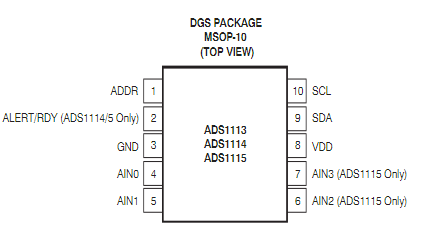
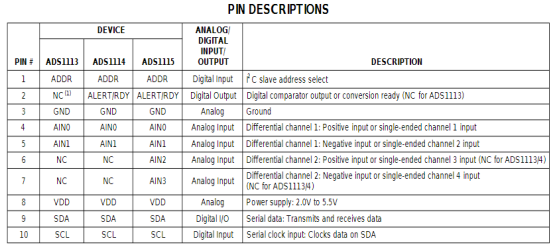
ADS1115IDGSR CAD Model
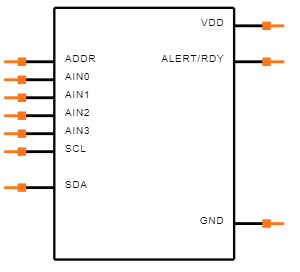
Symbol
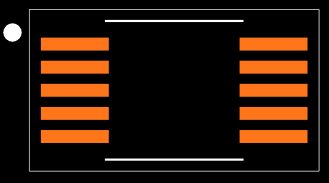
Footprint
3D Model
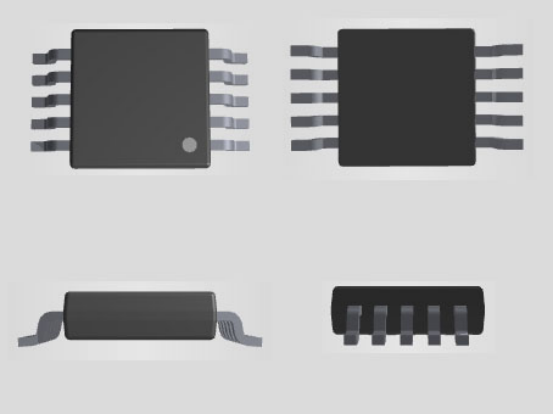
ADS1115IDGSR Alternatives
Part Number | Description | Manufacturer |
ADS1115IDGST | 16-bit, 860-SPS, 4-channel, delta-sigma ADC with PGA, oscillator, VREF, comparator and I2C 10-VSSOP -40 to 125 | Texas Instruments |
ADS1115QDGSRQ1 | Automotive 16-Bit 860SPS 4-Ch Delta-Sigma ADC With PGA, Oscillator, VREF, Comparator, and I2C 10-VSSOP -40 to 125 | Texas Instruments |
ADS1115IDGSR Applications
High-precision instrumentation
Automotive electronics
Battery voltage collection
ADS1115IDGSR Manufacturer
Texas Instruments is a global semiconductor company that designs, manufactures, tests and sells analog and embedded processing chips for various markets. It was founded in 1930 as Geophysical Service Incorporated, a company that provided seismic exploration services for the oil industry. In 1951, it changed its name to Texas Instruments and entered the field of electronics, producing the first commercial silicon transistor in 1954. Since then, it has been a pioneer in many fields, such as integrated circuits, calculators, microprocessors, digital signal processors, and wireless communication. Today, it has more than 80,000 products that help its customers efficiently manage power, accurately sense and transmit data, and provide the core control or processing in their designs. Its products go into markets such as industrial, automotive, personal electronics, communications equipment and enterprise systems. It has a vision to create a better world by making electronics more affordable through semiconductors, and a mission to engineer progress by innovating and creating differentiated analog and embedded processing products.
Parts with Similar Specs
- ImagePart NumberManufacturerPackage / CaseNumber of InputsNumber of PinsNumber of BitsSampling RatePolarityIntegral Nonlinearity (INL)Number of A/D ConvertersMin Supply VoltageMin Supply Voltage (DC)Supply VoltageMax Supply VoltageView Compare
![ADS1115IDGSR]()
ADS1115IDGSR
10-TFSOP, 10-MSOP (0.118, 3.00mm Width)
2, 4
10
16
860 sps
Bipolar
1 LSB
1
2 V
2 V
3.3 V
5.5 V
![ADS1114IDGST]()
10-TFSOP, 10-MSOP (0.118, 3.00mm Width)
1, 2
10
16
860 sps
Bipolar
1 LSB
-
2 V
2 V
3.3 V
5.5 V
![ADS1113IDGST]()
10-TFSOP, 10-MSOP (0.118, 3.00mm Width)
1, 2
10
16
860 sps
Bipolar
1 LSB
-
2 V
2 V
3.3 V
5.5 V
![ADS1115QDGSRQ1]()
10-TFSOP, 10-MSOP (0.118, 3.00mm Width)
2, 4
10
16
860 sps
Bipolar
1 LSB
-
2 V
2 V
3.3 V
5.5 V

Datasheet PDF
- Datasheets :
- PCN Design/Specification :
Where can we use Texas Instruments ADS1115IDGSR?
The ADS1115IDGSR is well suited for sensor measurement applications that are limited by space and power. The ADS1115's input multiplexer (MUX) allows for two differential or four single-ended input measurements. The digital comparator can be used for under- and overvoltage detection.
 SI4133 Integrated Circuit: Pinout, Features and Datasheet
24 December 20211391
![TIP3055 NPN transistor:Datasheet, Equivalent, Pinout[Video+FAQ]](https://res.utmel.com/Images/Article/cf4babfd-fead-448d-b8db-9d6481d31760.jpg) TIP3055 NPN transistor:Datasheet, Equivalent, Pinout[Video+FAQ]
TIP3055 NPN transistor:Datasheet, Equivalent, Pinout[Video+FAQ]08 April 202214926
 LT1083CK Voltage Regulator: Feature, Specification, and Datasheet
02 July 20211728
 Panasonic ERJ-6GEY0R00V 0-Ohm Resistor: 5 Key Applications in Modern Electronics
11 October 20251506
 Texas Instruments TMUX1574RSVR: Steps to Solve Common Issues
16 August 2025396
 OP177 Operational Amplifiers: Pinout, Features and Datasheet
16 August 20246042
 OPA2134 VS NE5532 How to differentiate the OPA2134 and NE5532
25 March 202215191
 A Comprehensive Guide to LTC6804HG-2#3ZZPBF Battery Management PMIC
06 March 2024211
 Application Specific Trade-offs for WBG SIC, GaN and High End SI Power Switch Technologies
22 November 20221703
 13 kinds of sensors in mobile phones and what are recorded by the sensors
10 June 2026131220
 Detecting Wafer Patterns using Semi-Supervised Learning
21 October 20221503
 2026 Passive Components Market Update: Sourcing Tactics Amid Price Hikes and Lead Time Extensions
15 June 20266730
 Google Co-releases SayCan Model for Bots to Give Sensible Answers
30 August 20223997
 MLCC: Applications and Future Development
20 December 202110549
 Japan's Three-Stage Strategy to Revive the Semiconductor Industry
01 April 20228510
 LPDDR5 Memory 2026: Lead Times, HBM Impact, and Procurement Strategies
17 July 20263816
Texas Instruments
In Stock: 10000
United States
China
Canada
Japan
Russia
Germany
United Kingdom
Singapore
Italy
Hong Kong(China)
Taiwan(China)
France
Korea
Mexico
Netherlands
Malaysia
Austria
Spain
Switzerland
Poland
Thailand
Vietnam
India
United Arab Emirates
Afghanistan
Åland Islands
Albania
Algeria
American Samoa
Andorra
Angola
Anguilla
Antigua & Barbuda
Argentina
Armenia
Aruba
Australia
Azerbaijan
Bahamas
Bahrain
Bangladesh
Barbados
Belarus
Belgium
Belize
Benin
Bermuda
Bhutan
Bolivia
Bonaire, Sint Eustatius and Saba
Bosnia & Herzegovina
Botswana
Brazil
British Indian Ocean Territory
British Virgin Islands
Brunei
Bulgaria
Burkina Faso
Burundi
Cabo Verde
Cambodia
Cameroon
Cayman Islands
Central African Republic
Chad
Chile
Christmas Island
Cocos (Keeling) Islands
Colombia
Comoros
Congo
Congo (DRC)
Cook Islands
Costa Rica
Côte d’Ivoire
Croatia
Cuba
Curaçao
Cyprus
Czechia
Denmark
Djibouti
Dominica
Dominican Republic
Ecuador
Egypt
El Salvador
Equatorial Guinea
Eritrea
Estonia
Eswatini
Ethiopia
Falkland Islands
Faroe Islands
Fiji
Finland
French Guiana
French Polynesia
Gabon
Gambia
Georgia
Ghana
Gibraltar
Greece
Greenland
Grenada
Guadeloupe
Guam
Guatemala
Guernsey
Guinea
Guinea-Bissau
Guyana
Haiti
Honduras
Hungary
Iceland
Indonesia
Iran
Iraq
Ireland
Isle of Man
Israel
Jamaica
Jersey
Jordan
Kazakhstan
Kenya
Kiribati
Kosovo
Kuwait
Kyrgyzstan
Laos
Latvia
Lebanon
Lesotho
Liberia
Libya
Liechtenstein
Lithuania
Luxembourg
Macao(China)
Madagascar
Malawi
Maldives
Mali
Malta
Marshall Islands
Martinique
Mauritania
Mauritius
Mayotte
Micronesia
Moldova
Monaco
Mongolia
Montenegro
Montserrat
Morocco
Mozambique
Myanmar
Namibia
Nauru
Nepal
New Caledonia
New Zealand
Nicaragua
Niger
Nigeria
Niue
Norfolk Island
North Korea
North Macedonia
Northern Mariana Islands
Norway
Oman
Pakistan
Palau
Palestinian Authority
Panama
Papua New Guinea
Paraguay
Peru
Philippines
Pitcairn Islands
Portugal
Puerto Rico
Qatar
Réunion
Romania
Rwanda
Samoa
San Marino
São Tomé & Príncipe
Saudi Arabia
Senegal
Serbia
Seychelles
Sierra Leone
Sint Maarten
Slovakia
Slovenia
Solomon Islands
Somalia
South Africa
South Sudan
Sri Lanka
St Helena, Ascension, Tristan da Cunha
St. Barthélemy
St. Kitts & Nevis
St. Lucia
St. Martin
St. Pierre & Miquelon
St. Vincent & Grenadines
Sudan
Suriname
Svalbard & Jan Mayen
Sweden
Syria
Tajikistan
Tanzania
Timor-Leste
Togo
Tokelau
Tonga
Trinidad & Tobago
Tunisia
Turkey
Turkmenistan
Turks & Caicos Islands
Tuvalu
U.S. Outlying Islands
U.S. Virgin Islands
Uganda
Ukraine
Uruguay
Uzbekistan
Vanuatu
Vatican City
Venezuela
Wallis & Futuna
Yemen
Zambia
Zimbabwe
![ADC0848BCV]() ADC0848BCV
ADC0848BCVTexas Instruments
![ADC102S101CIMMX]() ADC102S101CIMMX
ADC102S101CIMMXTexas Instruments
![ADC08832IMMX]() ADC08832IMMX
ADC08832IMMXTexas Instruments
![ADS1110A0IDBVR]() ADS1110A0IDBVR
ADS1110A0IDBVRTexas Instruments
![ADC124S021CIMM/NOPB]() ADC124S021CIMM/NOPB
ADC124S021CIMM/NOPBTexas Instruments
![ADC121S101CIMF/NOPB]() ADC121S101CIMF/NOPB
ADC121S101CIMF/NOPBTexas Instruments
![ADS1247IPWR]() ADS1247IPWR
ADS1247IPWRTexas Instruments
![ADS1114IDGST]() ADS1114IDGST
ADS1114IDGSTTexas Instruments
![ADS1255IDBR]() ADS1255IDBR
ADS1255IDBRTexas Instruments
![ADCS7476AIMF/NOPB]() ADCS7476AIMF/NOPB
ADCS7476AIMF/NOPBTexas Instruments


