

 Product
 Brand
Brand Articles
 Tools
Tools
2026 Passive Components Market Update: Sourcing Tactics Amid Price Hikes and Lead Time Extensions
The Q2-Q3 2026 passive components market is currently defined by a severe structural shortage and sweeping price hikes. Procurement managers and hardware engineers are facing a dual-front crisis: skyrocketing demand from high-power AI infrastructure and relentless raw material inflation. High-capacity Multi-Layer Ceramic Capacitors (MLCCs) specifically designed for AI servers have seen spot price jumps of 50% to 60%, while standard commodity components are experiencing 15% to 20% price increases driven by silver and copper costs. With lead times extending up to 16 to 24 weeks, sourcing teams must pivot from just-in-time purchasing to strategic buffering, aggressive forecasting, and rigorous secondary brand qualification to protect production lines.
Why the 2026 Shortage is Structural
Industry experts frequently compare the modern electronics supply chain to a Jenga tower. Decades of aggressive cost engineering—where OEMs squeezed supplier margins and minimized idle capacity—created a highly efficient but fragile system. It stands perfectly fine until a massive demand shock pulls out a critical block.
In 2026, that shock is the AI computing revolution. Top global manufacturers have confirmed that the current supply deficit will likely surpass the 2018 super cycle in both duration and magnitude, extending well into 2027.
A common misconception among procurement teams is the fallacy of generic capacity—the belief that if one supplier is full, orders can simply be shifted to another factory with similar machines. In reality, manufacturing capacity for advanced passives is highly inelastic. Ramping up production requires specialized tooling and massive capital expenditures (CapEx). Currently, equipment lead times for MLCC capacity expansion are stretching up to 1.5 years, creating a severe bottleneck that prevents manufacturers from quickly resolving the shortage.
AI Infrastructure: The 600,000 MLCC Vacuum
The primary catalyst draining global inventory is the deployment of next-generation AI data centers. Advanced AI accelerators, such as modern GPUs and TPUs, draw immense power—often between 700W and 1,000W per chip. To preserve signal integrity at high switching speeds, engineers must surround these processors with hundreds of high-capacitance MLCCs for decoupling and noise suppression.
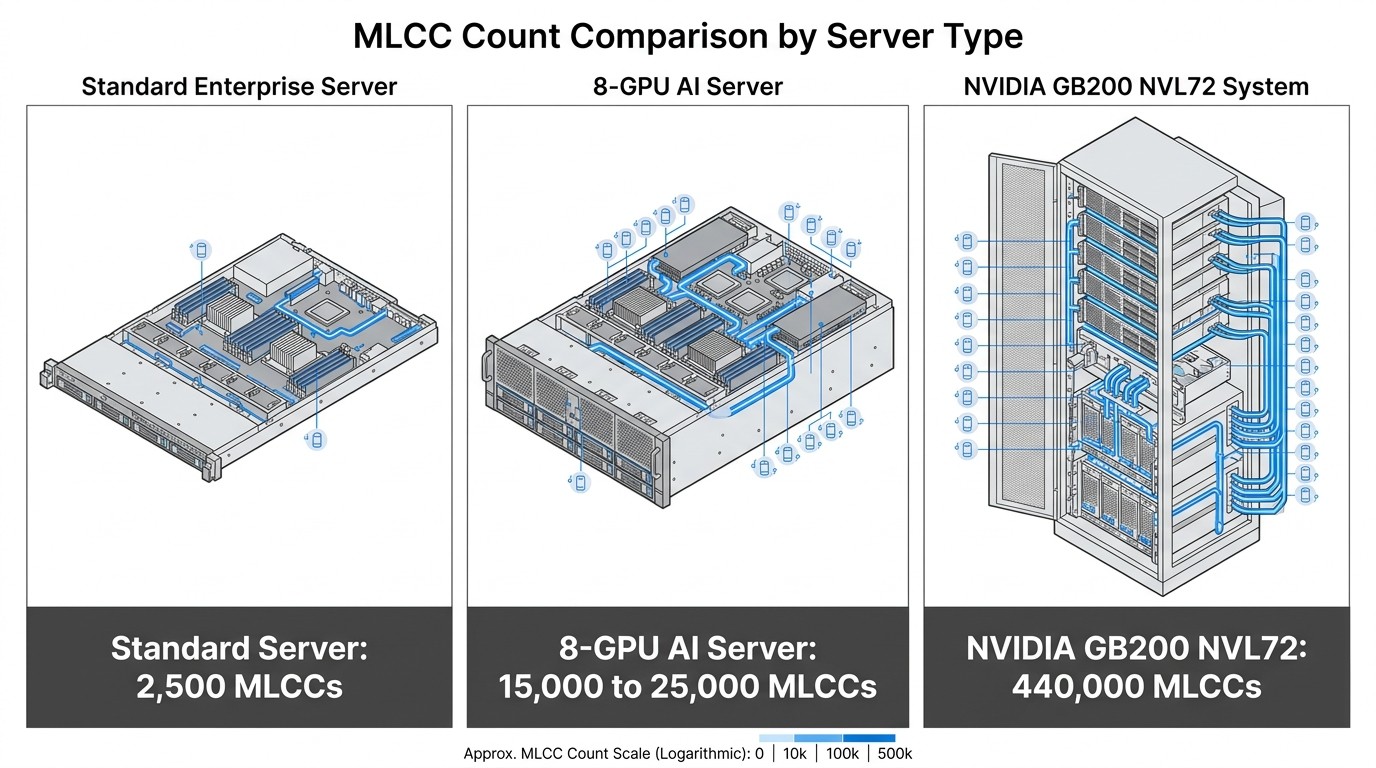
The sheer volume of components required is staggering. While a standard enterprise server uses approximately 2,500 MLCCs, an 8-GPU AI server requires between 15,000 and 25,000. Scaling up to rack-level architecture, a single NVIDIA GB200 NVL72 cabinet consumes roughly 440,000 MLCCs. Understanding why NVIDIA Rubin racks require over 600,000 capacitors is critical for buyers trying to forecast the global ceramic capacitors market trajectory.
This demand extends beyond capacitors. AI servers are driving a structural leap in inductor requirements, shifting designs from traditional ferrite inductors to Trans-Inductor Voltage Regulators (TLVR). A next-generation Rubin GPU card utilizes 48 to 56 TLVR inductors, compared to just 22 on the GB200. Consequently, the total rack inductor BOM (Bill of Materials) cost has surged by over 217%, with Average Selling Prices (ASPs) jumping from $3 to the $8–$15 range.
Raw Material Inflation: Silver and Copper Squeeze Commodity Parts
While high-end MLCCs face capacity constraints, standard commodity components are experiencing "segmented allocation tension" driven entirely by raw material costs. Procurement teams tracking 2026 semiconductor and electronic components price trends must account for unprecedented inflation in base metals.
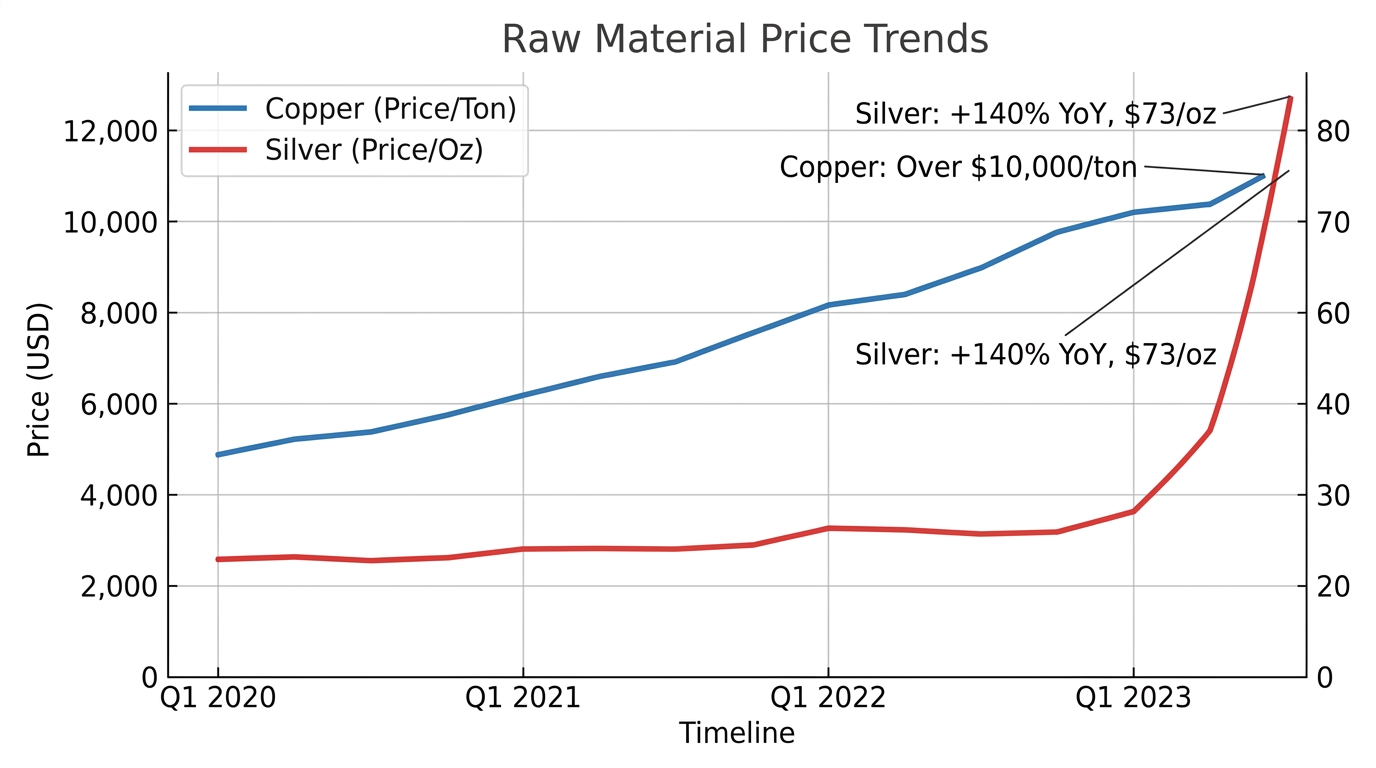
By mid-2026, global copper prices exceeded $10,000 per metric ton, heavily impacting PCB traces, lead frames, and passive components. More severely, silver futures surged by over 140% year-on-year, crossing $73 per ounce. Because silver is a primary conductive material in thick-film resistors and MLCC terminations, this spike caused a cost inversion for low-end capacity, a trend reflected in structural market reports from the China Electronic Components Association (CECA).
As a result, major manufacturers announced 15% to 20% price increases on mainstream resistor series (such as RC0402 and RC0603). Buyers evaluating carbon film vs metal film resistors will find that material surcharges are being applied across the board. Similarly, major connector manufacturers initiated price hikes of 5% to 30% in July 2026, forcing engineers to rethink the classification and selection of industrial connectors to optimize costs.
Sourcing Tactics: 4 Strategies for Procurement Managers
To navigate 16-to-24-week lead times and continuous price hikes, sourcing specialists must adapt their procurement frameworks.
Forecast 12 to 24 Weeks Ahead: The era of 4-week lead times is over. Procurement teams must segment their passives by criticality and monitor lead times for strategic families, issuing purchase orders at least 4 to 6 months in advance for high-capacitance MLCCs and TLVR inductors.
Lock In 8 to 10 Weeks of Safety Stock: To hedge against sudden spot market spikes, buyers should buffer selected items. Maintaining an 8-to-10-week safety stock of critical components acts as an insurance policy against the bullwhip effect caused by AI infrastructure orders.
Qualify Secondary and Domestic Brands: Design decisions dictate supply flexibility. Hardware engineers must document second and third sources using widely adopted case sizes. Aggressively qualifying alternative brands is the most effective way to bypass allocation bottlenecks.
Evaluate Total Cost of Ownership (TCO): When sourcing alternatives, look beyond the unit price. Factor in the costs of potential board redesigns, testing, and failure rates. A cheaper component that requires a PCB layout change may ultimately cost more than paying a premium for a drop-in replacement.
📺 The 2026 Supplier Readiness Playbook - Cutting Through the Noise Ep. 7
Decision Matrix: Qualifying Alternative Passive Component Brands
When lead times force a shift to secondary suppliers, use this matrix to evaluate alternative brands safely.
| Evaluation Criteria | Warning Signs (High Risk) | Best Practices (Low Risk) |
|---|---|---|
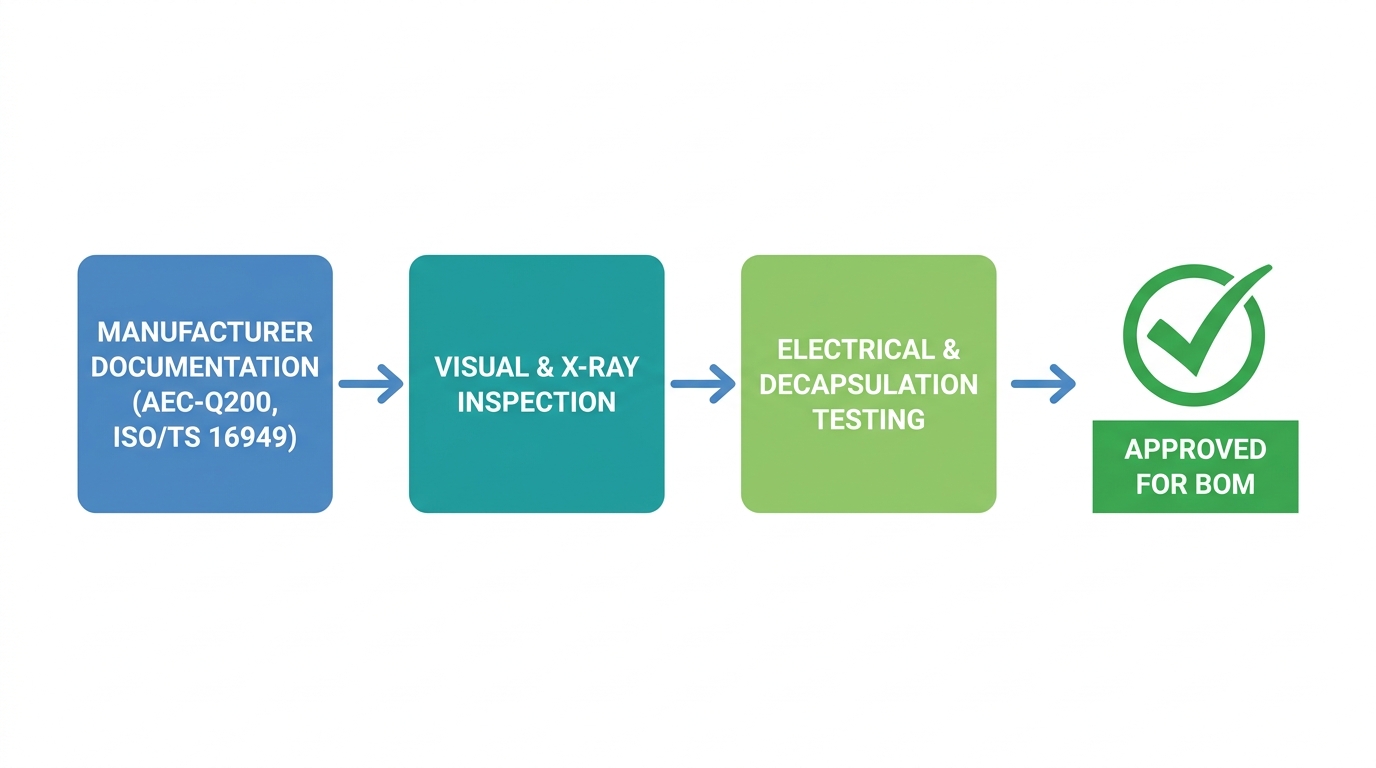
| Certifications | Claims "automotive equivalent" without official documentation. | Provides verifiable AEC-Q200 test reports and ISO/TS 16949 certification. |
| Traceability | Vague date codes; inability to provide original factory CoC (Certificate of Conformity). | Full lot traceability; transparent supply chain documentation. |
| Testing & Validation | Relies solely on basic visual inspection. | Utilizes third-party testing (X-ray, decapsulation, electrical characterization). |
| Financial Resilience | Demands 100% upfront payment with no flexibility. | Offers stable payment terms, indicating sufficient cash flow to fund their own CapEx. |
| Technical Support | No local FAE (Field Application Engineer) support. | Provides detailed cross-reference guides and direct engineering support for BOM integration. |
Mitigating Risk with UTMEL's Global Inventory
In a market defined by allocation tension, partnering with a distributor that holds physical inventory is a strategic necessity. UTMEL serves as a critical buffer against supply chain volatility, offering extensive off-the-shelf stock of capacitors, resistors, and connectors from world-leading brands.
Rather than waiting 16 weeks for factory allocations, procurement managers can leverage UTMEL's robust inventory to secure immediate stock. With competitive pricing, zero Minimum Order Quantities (MOQ), and instant global shipping, UTMEL enables EMS buyers to maintain their 8-to-10-week safety buffers without tying up excessive capital. Furthermore, UTMEL’s B2B BOM optimization services assist engineering teams in identifying viable, in-stock alternative components, ensuring production lines keep moving even when primary brands are unavailable.
What to Ignore in the 2026 Market
As the shortage dominates industry news, procurement teams must filter out noise that leads to poor purchasing decisions:
Stock Market Hype: Ignore articles focusing on the stock prices, limit-up trading days, or unbanning of shares for major component manufacturers. Financial market performance does not correlate with immediate component availability on the factory floor.
The Myth of "Instant" Capacity: Disregard claims that smaller manufacturers can instantly absorb the overflow from top-tier suppliers. As observed in supply chain analyses, specialized manufacturing is not commoditized; tooling and CapEx take months to deploy.
"Fake" Automotive Grades: Be highly skeptical of brokers offering "industrial/automotive grade" components at consumer-grade prices. During shortages, the risk of counterfeit or refurbished parts skyrockets. Always demand AEC-Q200 certifications and utilize third-party testing.
Frequently Asked Questions (FAQs)
Why are standard resistor prices increasing if AI servers mostly need MLCCs?
While AI servers drive the volume shortage for MLCCs, standard resistors are facing price hikes due to raw material inflation. Silver, a key material in resistor terminations, surged over 140% in 2025, forcing manufacturers to pass these costs down to buyers.
What is a TLVR inductor, and why is it causing supply bottlenecks?
Trans-Inductor Voltage Regulators (TLVR) are advanced inductors required to handle the massive, rapid power transients of modern AI GPUs (like the NVIDIA Rubin). Because they are more complex to manufacture than traditional ferrite inductors, capacity is highly constrained.
How long will the current passive component shortage last?
Top manufacturers indicate this is a structural shortage, not a short-term pulse. Due to the 1.5-year lead time for new manufacturing equipment and sustained AI data center build-outs, constraints are expected to last into 2027.
Is it safe to use alternative MLCC brands for high-power applications?
Yes, provided they undergo rigorous qualification. Engineers must verify that the alternative brand meets the exact capacitance, voltage rating, ESR (Equivalent Series Resistance), and temperature coefficient (e.g., X7R, X5R) requirements, backed by official testing data.
How can procurement teams avoid counterfeit components during a shortage?
Avoid unauthorized brokers. Source from established distributors with transparent traceability, demand original Certificates of Conformity (CoC), and utilize third-party testing methods like X-ray inspection and decapsulation for high-risk batches.
References
NVIDIA Contributes NVIDIA GB200 NVL72 Designs to Open Compute Project — NVIDIA
全球MLCC市场规模数据与预测 — 中国电子元件行业协会 (CECA)
 UTMEL
UTMEL
We are the professional distributor of electronic components, providing a large variety of products to save you a lot of time, effort, and cost with our efficient self-customized service. careful order preparation fast delivery service
 Power Semiconductor Procurement After the Nexperia Shake-Up—NXP for Stability, ON for Technology, or Nexperia for Value?UTMEL04 November 20254807
The recent supply chain turmoil surrounding Netherlands-based Nexperia has sent shockwaves through the global semiconductor industry, forcing procurement professionals to re-evaluate their sourcing strategies.
Read More AI Computing Power Gap: How Token Consumption is Reshaping Server Component SourcingUTMEL23 June 2026889
As global token consumption drives the transition to high-density 100kW+ AI data centers, power delivery networks require advanced Wide-Bandgap semiconductors (SiC/GaN) and high-capacitance MLCCs. This shift has triggered a component procurement crisis with lead times exceeding 24 weeks. To bypass shortages, hardware buyers must abandon just-in-time manufacturing and leverage independent global distributor networks to secure critical power and passive components.
Read More The BSPDN Revolution: Overcoming IR Drop in Sub-2nm GAAFET Nodes with Backside Power DeliveryUTMEL25 June 2026791
As semiconductor manufacturing enters the sub-2nm era, Backside Power Delivery Networks (BSPDN) are replacing traditional front-side routing to overcome critical IR drop bottlenecks. By separating power and signal delivery, chipmakers like Intel and TSMC drastically improve performance and density in GAAFET designs. However, this radical shift introduces manufacturing complexities, thermal challenges, and demands advanced packaging and power management solutions.
Read More Power Management ICs Trends 2026: AI Demand, Supply Risks, and Sourcing StrategiesUTMEL06 July 20261265
As AI server racks surpass 100kW by 2026, data centers are shifting toward wide-bandgap semiconductors like SiC and GaN. However, this demand has triggered a critical shortage of mature-node Power Management ICs (PMICs). To prevent production halts, sourcing teams must abandon 'just-in-time' models, implement proactive 'just-in-case' strategies, and rapidly qualify pin-to-pin alternative components to secure their supply chains.
Read More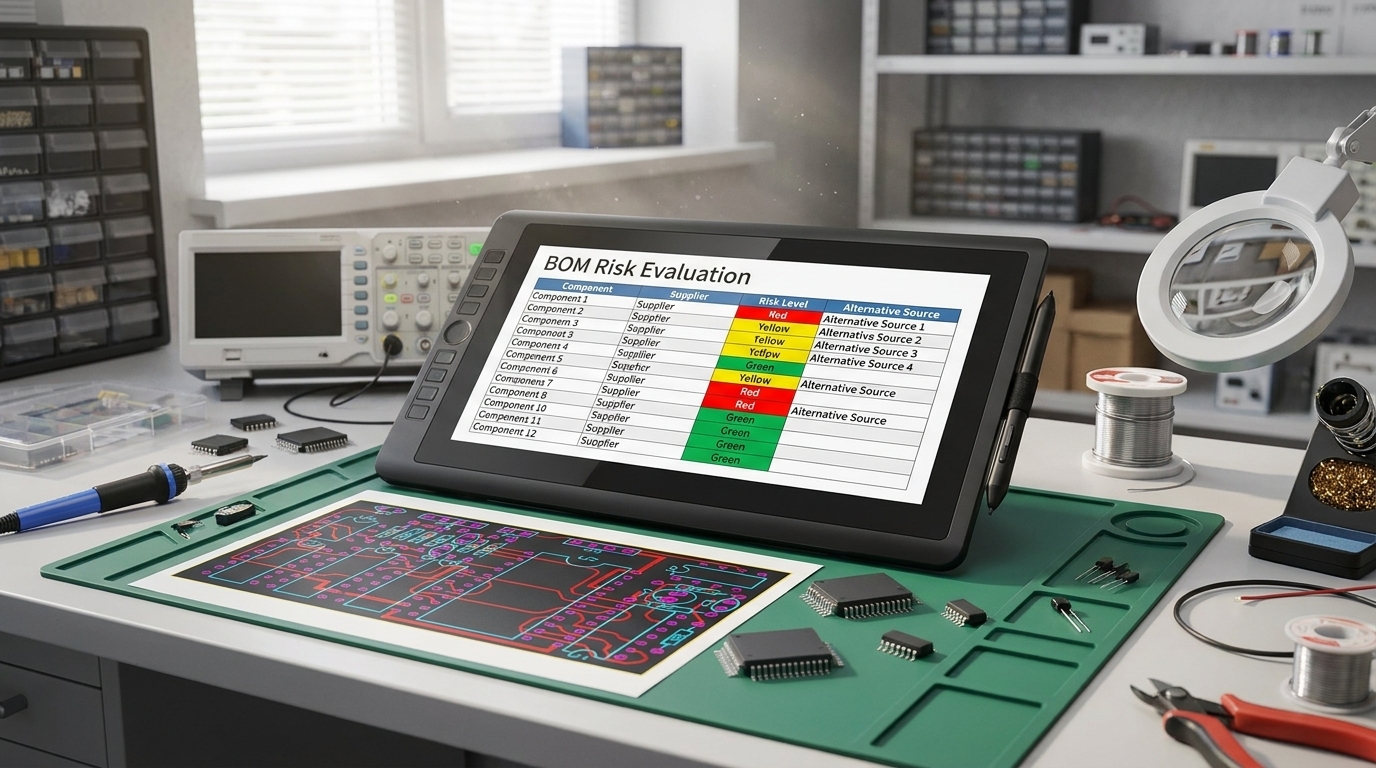 onsemi Synaptics Acquisition Impact: BOM Risk Checklist and Second-Source Strategy for Edge AI DesignsUTMEL27 July 2026287
The onsemi acquisition of Synaptics provides hardware program managers a 12-to-18-month window before potential product cancellations occur in mid-2027. This guide outlines how to audit BOM exposure across overlap and non-core product lines, calculate Last-Time-Buy volumes including hidden storage costs, establish proactive second-sourcing triggers, and implement supply chain monitoring to prevent line-down events.
Read More
Subscribe to Utmel !
![7T.81.0.000.2403]() 7T.81.0.000.2403
7T.81.0.000.2403Finder Relays, Inc.
![03450101H]() 03450101H
03450101HLittelfuse Inc.
![AL5809-15QP1-7]() AL5809-15QP1-7
AL5809-15QP1-7Diodes Incorporated
![110060025]() 110060025
110060025Seeed Technology Co., Ltd
![AVRH10C101KT1R1NE8]() AVRH10C101KT1R1NE8
AVRH10C101KT1R1NE8TDK Corporation
![120PSB-]() 120PSB-
120PSB-Visual Communications Company - VCC
![122701-1]() 122701-1
122701-1TE Application Tooling
![BLM03AG800SN1D]() BLM03AG800SN1D
BLM03AG800SN1DMurata Electronics
![GTS06G24-2SZ-116]() GTS06G24-2SZ-116
GTS06G24-2SZ-116Amphenol
![ACS05E24-26P-003-B30]() ACS05E24-26P-003-B30
ACS05E24-26P-003-B30Amphenol


