

 Product
 Brand
Brand Articles
 Tools
Tools
How to Generate Negative Voltage: 5V to -5V Circuit Analysis & Schemes

Negative Voltages are more important than you think! So here is how to make them! EB#52
Article Summary (Updated for 2026)
In modern electronics design, while most components operate on positive voltage rails (e.g., 3.3V or 5V), negative voltage remains critical for specific applications such as operational amplifiers, RS232 communication, and GaN (Gallium Nitride) transistor biasing. This guide explores the fundamental principles of generating negative voltage from a positive source, analyzes standard circuit diagrams, and reviews practical schemes using classic components like the MC34063 and ICL7660.
Ⅰ. The Principle of Generating Negative Voltage Circuits
Electronic circuits frequently require negative voltages to function correctly. A common scenario involves powering operational amplifiers (op-amps) or providing bias voltages for signal processing. This section illustrates the conversion process from a positive +5V supply to a negative -5V output.
While dedicated negative voltage generation chips like the ICL7660 (Charge Pump) or the LT1054 are industry standards, cost constraints sometimes drive engineers toward other solutions. The MC34063 remains a widely used, versatile chip in 2025 due to its low cost and availability. However, before examining integrated circuits, it is essential to understand the fundamental method of generating negative voltage using a microcontroller's PWM (Pulse Width Modulation) signal, often referred to as a discrete charge pump.

Figure. 1
Modern microcontrollers (MCUs) universally support PWM output. Since the direct PWM signal cannot be used as a power rail, we can utilize it to drive a discrete component circuit to generate negative voltage.
The circuit shown above is one of the simplest methods for this task. It requires minimal components: a few capacitors and diodes. The MCU provides a square wave (typically around 1 kHz to 100 kHz). It is important to note that this specific discrete circuit has a limited load capacity. As the current draw increases, the voltage drop becomes significant, making this suitable only for low-power bias applications.
To improve performance, the circuit can be refined as shown below:
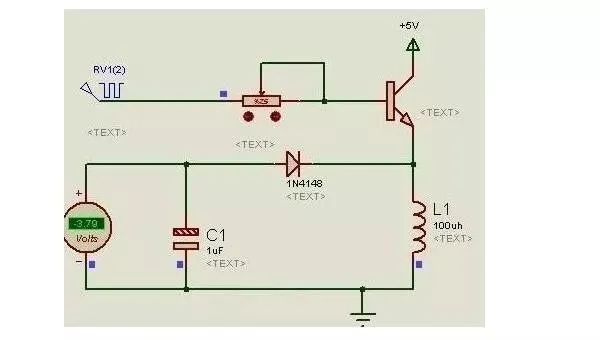
Figure. 2
Ⅱ. Analysis of Negative Voltage Generation Circuit
To understand how these circuits work, we must revisit the definition of voltage. Voltage, or electric potential difference, represents the difference in electric potential energy between two points. Conventionally, we define the negative terminal of our main power source as "Ground" (0V). Therefore, the supply voltage ($V_{CC}$) is the potential difference relative to this ground.
The Concept of Relative Potential:
If we want to generate a "negative" voltage, we essentially need a point in the circuit that has a lower potential than our reference Ground. One conceptual way to achieve this is by connecting two power sources in series.
Imagine two 5V batteries. If we connect the positive terminal of Battery B to the negative terminal of Battery A (which is our system Ground), the negative terminal of Battery B will read -5V relative to the system Ground.

Figure. 3
In a single-supply electronic system, we cannot simply add a second battery. Instead, we use a capacitor to act as a temporary battery. By charging a capacitor and then switching its connection points (effectively "flipping" it), we can create a point with negative potential relative to Ground.

Figure. 4
Step-by-Step Operation:
1. Charging Phase:
The charging path flows from $V_{CC}$ through transistor Q2, Capacitor C1, and Diode D2 to Ground. When the PWM signal is Low, Q2 turns ON and Q1 turns OFF. This allows $V_{CC}$ to charge C1. The left side of C1 becomes positive, and the right side becomes negative (referencing the capacitor's internal polarity).

Figure. 5
2. State Change:
Once charged, Capacitor C1 effectively holds a potential difference of 5V across its plates.

Figure. 6
3. Discharging/Inversion Phase:
When the PWM signal goes High, Q2 turns OFF and Q1 turns ON. This action connects the positive plate of C1 directly to Ground. Since the voltage across a capacitor cannot change instantaneously, the potential at the other plate of C1 is pushed down to -5V.
This negative voltage then discharges through Diode D1 into the output capacitor C2. After several cycles, C2 maintains a steady negative voltage (approximately -5V minus diode drops).

Figure. 7
Ⅲ. Scheme for Generating Negative Voltage (-5V)

Figure. 8
Addressing Output Limitations:
Classic switched-capacitor chips like the ICL7660 and MAX232 are convenient, but they have limited current output capabilities (typically 10mA to 20mA). For applications requiring higher current—such as driving high-speed operational amplifiers or small displays—a single chip may be insufficient.
Parallel Configuration:
To increase current drive, engineers often place two ICL7660 chips in parallel. This effectively doubles the available output current while maintaining the same voltage inversion characteristics.
DC/DC Switching Regulators:
For significantly higher currents (100mA to 1A+), standard charge pumps are inadequate. In these cases, switching regulators like the MC34063 (configured in an inverting topology) are superior. While they introduce more ripple than linear regulators, adding an LC (Inductor-Capacitor) filter at the output can smooth this ripple to acceptable levels for most analog applications.
Grounding Considerations (Critical for Signal Integrity):
When generating negative voltages for mixed-signal systems (containing both digital logic and sensitive analog signals), grounding is paramount.
Digital Ground vs. Analog Ground: Digital circuits are noisy due to rapid switching. If this noise couples into the analog negative rail, it can corrupt sensor readings or audio signals.
Solution: The digital and analog grounds should be kept separate on the PCB layout and connected at only one single point (often called a "star ground" or "Mecca ground") near the power supply. This prevents digital return currents from flowing through the sensitive analog ground path.
Ⅳ. The Meaning and Application of Negative Voltage
Why do we still need negative voltage in 2025? Despite the prevalence of single-supply logic (3.3V/1.8V), negative rails remain essential for:
1. Telecommunications Standards (-48V)
The legacy telephone system and modern Power over Ethernet (PoE) often utilize negative voltage (typically -48V). This historical standard was chosen to prevent galvanic corrosion on underground copper lines. By making the lines negative with respect to the earth, ions flow towards the ground rather than away from the wire, preserving the copper integrity.
2. Communication Interfaces (RS-232)
The RS-232 serial communication protocol requires negative voltage to define logic states. A "Logic 1" is represented by -3V to -15V, while a "Logic 0" is +3V to +15V. Interface chips like the MAX232 include internal charge pumps specifically to generate this negative voltage from a single +5V supply.
3. Operational Amplifiers (Dual Supply)
While "Rail-to-Rail" op-amps are common today, high-performance analog circuits often still require dual supplies (e.g., ±5V or ±12V).
Reason: Standard single-supply op-amps may distort signals near 0V (Ground). A negative supply allows the signal to swing cleanly through 0V without clipping or distortion, which is critical for high-fidelity audio and precision instrumentation.
4. Biasing Modern Power Transistors (GaN & SiC)
A critical modern application involves driving Gallium Nitride (GaN) and Silicon Carbide (SiC) power transistors. To ensure these fast-switching devices turn off completely and do not accidentally turn back on due to noise (Miller effect), gate drivers often apply a negative bias voltage (e.g., -3V or -5V) to the gate during the "OFF" state. This improves the safety and reliability of power supplies in Electric Vehicles (EVs) and servers.
 UTMEL
UTMEL
We are the professional distributor of electronic components, providing a large variety of products to save you a lot of time, effort, and cost with our efficient self-customized service. careful order preparation fast delivery service
1. How to detect negative voltage current?
The same as the positive voltage and current measurement method, connect the ammeter in series to the circuit to be measured, the difference is that the polarity of the ammeter is reversed.
2. How is the negative voltage in the power supply generated?
In fact, the power supply does not have positive and negative, it is a problem of setting the reference point. A power supply of 5V, with the negative pole as the reference "zero point", the positive pole is +5v; with the positive pole as the reference "zero point", the negative pole is -5V.
3. What is the difference between negative voltage and negative potential?
A point in the circuit is set as the reference point, and the potential of the reference point is zero. For example, the earth is set as the reference point for ~ 220V, and the chassis is set as the reference point for general instruments.
The voltage value of a point to the reference point is the potential of that point. Such as Va, Vb.
Voltage is the potential difference like Uab = Va - Vb.
Negative potential means that the voltage of the point to the reference point is negative. For example, the positive electrode of a 3V battery is grounded, and the negative electrode potential is - 3V.
Negative voltage means that the potential difference between two points is negative. Such as Uab = -6V, it means Vb is 6V higher than Va.
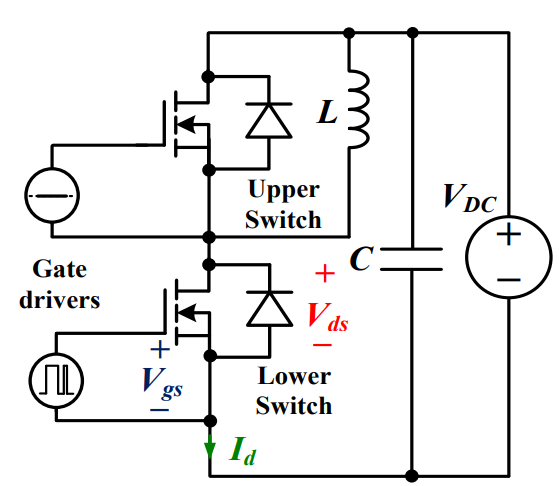 Discovering New and Advanced Methodology for Determining the Dynamic Characterization of Wide Bandgap DevicesSaumitra Jagdale15 March 20242536
For a long era, silicon has stood out as the primary material for fabricating electronic devices due to its affordability, moderate efficiency, and performance capabilities. Despite its widespread use, silicon faces several limitations that render it unsuitable for applications involving high power and elevated temperatures. As technological advancements continue and the industry demands enhanced efficiency from devices, these limitations become increasingly vivid. In the quest for electronic devices that are more potent, efficient, and compact, wide bandgap materials are emerging as a dominant player. Their superiority over silicon in crucial aspects such as efficiency, higher junction temperatures, power density, thinner drift regions, and faster switching speeds positions them as the preferred materials for the future of power electronics.
Read More A Comprehensive Guide to FPGA Development BoardsUTMEL11 September 202517279
This comprehensive guide will take you on a journey through the fascinating world of FPGA development boards. We’ll explore what they are, how they differ from microcontrollers, and most importantly, how to choose the perfect board for your needs. Whether you’re a seasoned engineer or a curious hobbyist, prepare to unlock new possibilities in hardware design and accelerate your projects. We’ll cover everything from budget-friendly options to specialized boards for image processing, delve into popular learning paths, and even provide insights into essential software like Vivado. By the end of this article, you’ll have a clear roadmap to navigate the FPGA landscape and make informed decisions for your next groundbreaking endeavor.
Read More Applications of FPGAs in Artificial Intelligence: A Comprehensive GuideUTMEL29 August 20254081
This comprehensive guide explores FPGAs as powerful AI accelerators that offer distinct advantages over traditional GPUs and CPUs. FPGAs provide reconfigurable hardware that can be customized for specific AI workloads, delivering superior energy efficiency, ultra-low latency, and deterministic performance—particularly valuable for edge AI applications. While GPUs excel at parallel processing for training, FPGAs shine in inference tasks through their adaptability and power optimization. The document covers practical implementation challenges, including development complexity and resource constraints, while highlighting solutions like High-Level Synthesis tools and vendor-specific AI development suites from Intel and AMD/Xilinx. Real-world applications span telecommunications, healthcare, autonomous vehicles, and financial services, demonstrating FPGAs' versatility in mission-critical systems requiring real-time processing and minimal power consumption.
Read More 800G Optical Transceivers: The Guide for AI Data CentersUTMEL24 December 20255661
The complete guide to 800G Optical Transceiver standards (QSFP-DD vs. OSFP). Overcome supply shortages and scale your AI data center with Utmel Electronic.
Read More The 2026 Engineer’s Guide: Choosing the Right MCU for Your Next IoT & New Energy ProjectUTMEL30 April 2026403
A comprehensive comparison of 2026's leading MCUs from ST, NXP, and Microchip across power efficiency, processing performance, connectivity, and ecosystems to help engineers select the optimal chip for next-gen IoT and new energy projects.
Read More
Subscribe to Utmel !
![MOC3073SR2M]() MOC3073SR2M
MOC3073SR2MON Semiconductor
![FM31278-GTR]() FM31278-GTR
FM31278-GTRCypress Semiconductor Corp
![HCS410/P]() HCS410/P
HCS410/PMicrochip Technology
![L9654TR]() L9654TR
L9654TRSTMicroelectronics
![AT88SC6416C-MJTG]() AT88SC6416C-MJTG
AT88SC6416C-MJTGMicrochip Technology
![MOC3062SVM]() MOC3062SVM
MOC3062SVMON Semiconductor
![HCS512T-I/SO]() HCS512T-I/SO
HCS512T-I/SOMicrochip Technology
![LZ9FC23]() LZ9FC23
LZ9FC23Sharp Microelectronics
![HCS370/ST]() HCS370/ST
HCS370/STMicrochip Technology
![MCS3142-I/ST]() MCS3142-I/ST
MCS3142-I/STMicrochip Technology


