

 Product
 Brand
Brand Articles
 Tools
Tools
SiC and GaN in 2026:How SiC and GaN Power Devices are Redefining AI Data Centers and 800V EVs
The power electronics industry in 2026 has reached a critical inflection point. As AI data center server racks push past 120kW and electric vehicles (EVs) standardize on 800V architectures, legacy silicon components are hitting physical thermal and switching limits. To break through this "power wall," hardware R&D managers and power supply design engineers are executing a massive shift toward wide-bandgap (WBG) semiconductors. By increasing the efficiency through wide-bandgap semiconductors like SiC and GaN, engineers are fundamentally redesigning how power is distributed, converted, and managed in high-stress environments.
This article synthesizes the latest engineering consensus on how SiC and GaN power devices are being deployed in 2026, detailing hybrid topologies, cross-pollinating innovations between EVs and data centers, and the critical sourcing strategies required to build reliable high-power systems.
The "AI Power Wall" and the Death of AC Rack Distribution
AI workloads are fundamentally different from traditional predictable CPU loads. The massive, highly transient power spikes generated by AI accelerators are forcing a complete architectural overhaul of data center power delivery.
Expert architectural mapping of next-generation data centers reveals that traditional AC distribution within the rack is becoming obsolete. As rack power density scales toward 300kW, the industry is shifting to 400V or even 800V High-Voltage Direct Current (HVDC) distribution directly to the racks to save space and reduce copper I²R (resistive) losses.
Furthermore, the physical limits of motherboards have been reached. When load currents exceed 1,000 amperes, lateral power distribution across a printed circuit board (PCB) suffers from severe trace resistance. To solve this, 2026 designs are implementing vertical "backside power delivery," where power flows directly up from the underside of the motherboard into the processor, minimizing the physical distance current must travel.
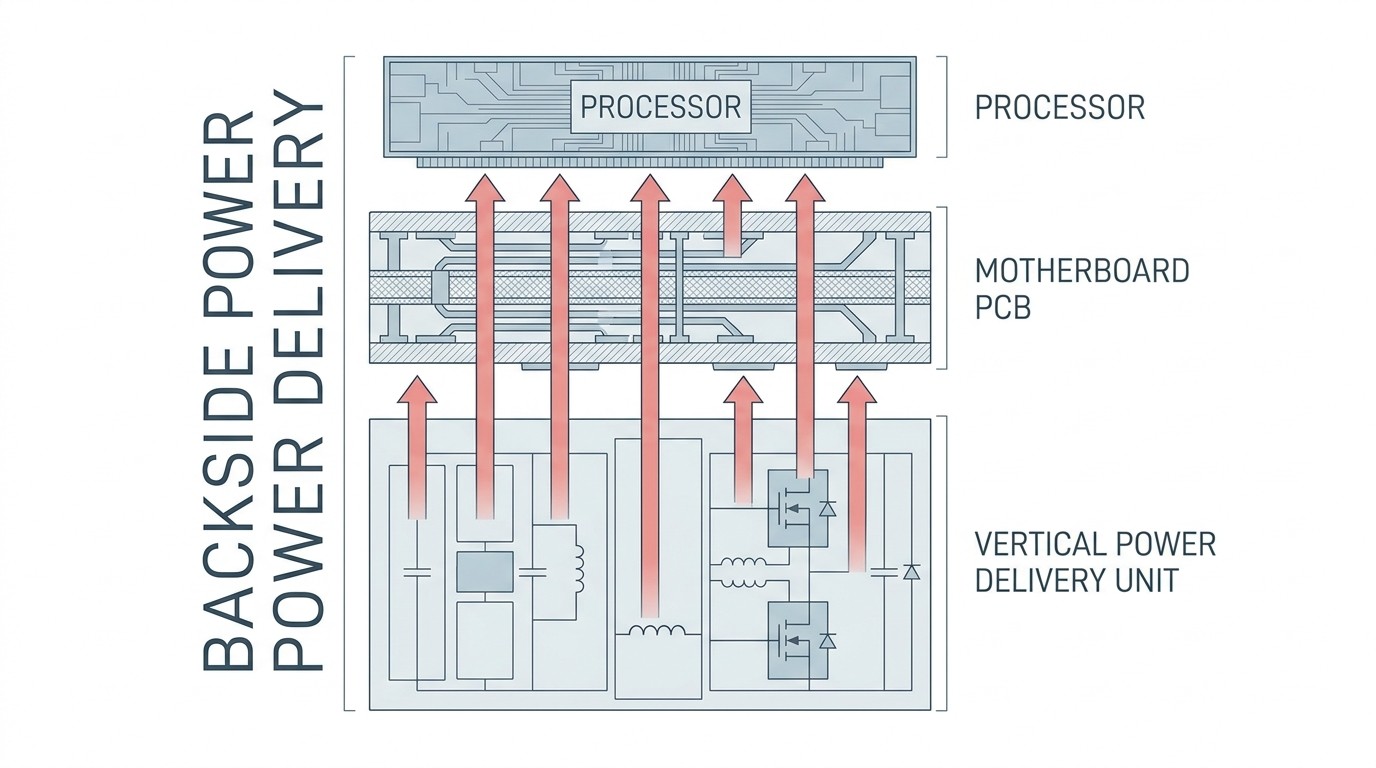
This extreme power density also changes how backup power is handled. The traditional centralized battery room is vanishing. Instead, Lithium-ion battery backup units (BBUs) are slotted directly into the server racks. These BBUs no longer just wait for blackouts; they are used for active "peak shaving." When AI GPUs cause nanosecond power spikes, the rack's BBUs actively discharge to support the AC/DC power supplies. Managing the thermal output of these dense, high-power racks is increasingly requiring advanced techniques, including cryogenic cooling technology using SiC and GaN devices.
800V EV Innovations Cross-Pollinating with Data Center Architectures
The push for 800V platforms in the EV sector—driven by the need for faster charging, reduced cabling weight, and lower resistive losses—has matured Silicon Carbide (SiC) manufacturing and driven down wafer costs. In 2026, these automotive innovations are directly cross-pollinating into AI data center designs.
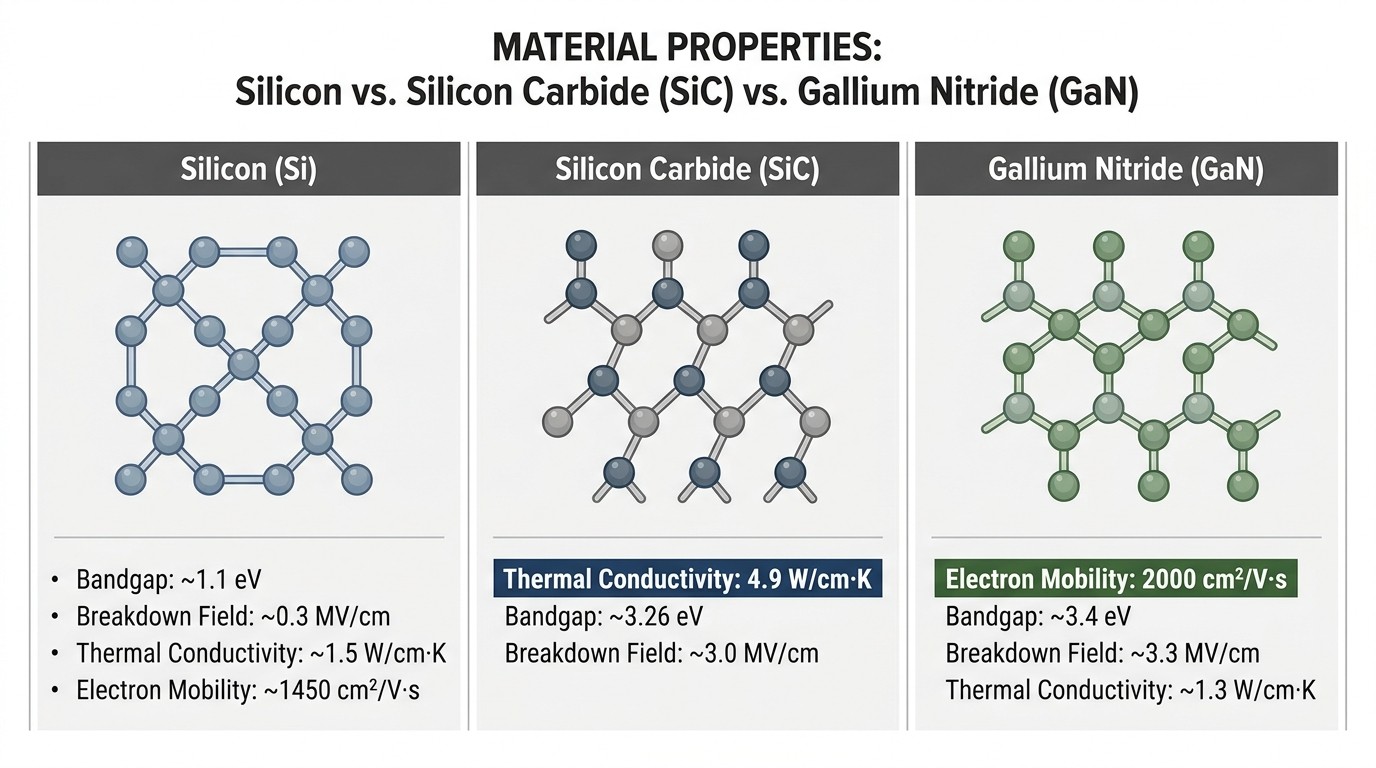
Traditional silicon IGBTs are fundamentally limited by thermal constraints and lower switching frequencies. A direct MOSFET vs IGBT characteristics and market analysis shows why legacy silicon is being phased out of high-voltage applications. SiC, with its superior breakdown electric field and thermal conductivity (4.9 W/cm·K), easily handles the 650V to 1200V+ range required for both EV traction inverters and data center HVDC transformers.
Simultaneously, AI transient loads require bidirectional power architectures to recycle energy—a concept directly borrowed from EV regenerative braking. Instead of dissipating transient energy as heat, modern data centers use bidirectional GaN switches. A single bidirectional GaN switch can now replace a traditional four-MOSFET full-bridge circuit, drastically simplifying the design and boosting efficiency.
The Heavy Lifter vs. The Sprinter: SiC and GaN in Hybrid Topologies
SiC and GaN are no longer viewed strictly as competitors; they are complementary tools used synergistically in hybrid designs.
The Heavy Lifter (SiC): Silicon Carbide is the default choice for high-voltage, high-temperature applications. It dominates the multi-kV solid-state transformer stage at the grid level and the EV traction inverter space.
The Sprinter (GaN): Gallium Nitride features exceptionally high electron mobility (2000 cm²/V·s, roughly twice that of SiC), making it the master of the 100V to 650V "golden zone." Its sub-nanosecond switching speeds allow engineers to drastically shrink passive components (magnetics) and heatsinks.
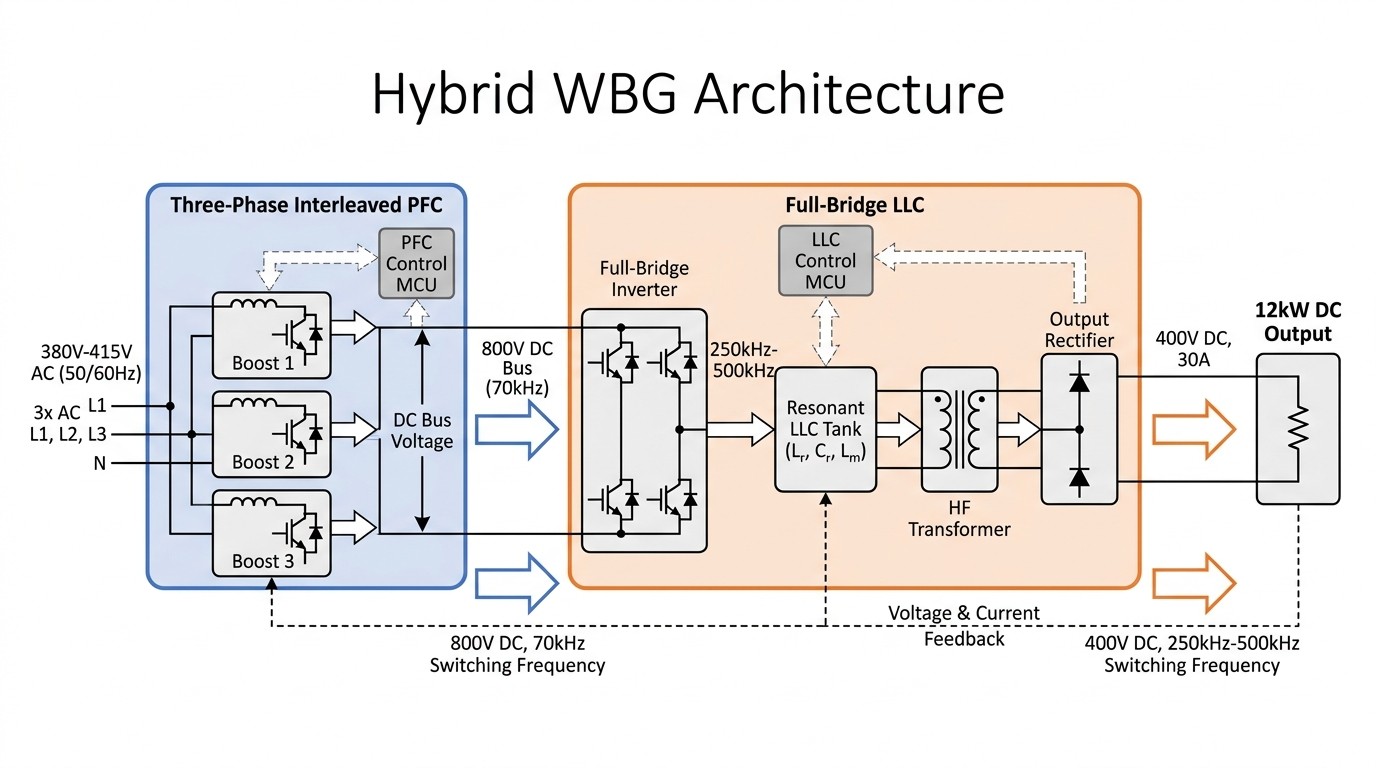
In 2026, cutting-edge 12kW power supply reference designs for AI server racks utilize a hybrid WBG approach. SiC MOSFETs are deployed in the Three-Phase Interleaved (TP-PFC) topology to handle high input voltages and temperatures. Meanwhile, GaN power ICs are utilized in the high-frequency Full-Bridge LLC (FB-LLC) topology to maximize power density. Engineers are also achieving high-frequency WBG power devices using cascode GaN/SiC configurations to further optimize switching losses in these hybrid setups.
Engineering Challenges: Gate Driving, Parasitics, and Sourcing
Adopting WBG materials requires overcoming strict engineering challenges, particularly regarding electromagnetic interference (EMI), parasitics, and gate driving complexity.
For SiC, the primary challenge centers on switching transients. High dv/dt causes severe EMI and the Miller effect, which can lead to accidental turn-on. This requires gate drivers capable of negative voltage turn-off and ultra-fast DESAT (desaturation) protection. Understanding SiC MOSFET power modules and ensuring short-circuit safety is paramount, especially in mission-critical EV inverters.
For GaN, the challenges are parasitic inductance and narrow drive voltage windows (typically 0-6V). Extreme di/dt means that even minor PCB layout flaws or parasitic inductance can cause ringing and device failure.
📺 The power of efficiency: the sweet spot for Si, SiC, and GaN in data centers | Infineon
Because of these tight tolerances, the quality of the components and the precision of the Gate Driver ICs dictate the success of the system. Manufacturing yield and crystal lattice defectivity in WBG materials mean that sourcing counterfeit or sub-par components will result in catastrophic system failures.
This is where strategic sourcing becomes as critical as the engineering itself. Hardware R&D managers must secure components from trusted distributors. UTMEL provides 100% original, high-performance SiC MOSFETs, GaN HEMTs, Gate Driver ICs, and Power Modules from premier global manufacturers. With immediate stock availability, flexible MOQs, and comprehensive technical datasheets, UTMEL ensures that engineers have the exact, reliable components needed to navigate narrow drive windows and implement robust DESAT protection.
Decision Matrix: Selecting WBG Devices for 2026 Power Topologies
| Application Stage | Voltage Range | Primary Requirement | Optimal Device Choice | Key Engineering Focus |
|---|---|---|---|---|
| EV Traction Inverter | 800V - 1200V+ | Extreme thermal robustness, high power handling | SiC MOSFETs / Power Modules | DESAT protection, negative gate drive voltage, Miller clamp. |
| Data Center AC/DC (PFC Stage) | 400V - 800V | High voltage tolerance, efficiency | SiC MOSFETs | Managing high dv/dt and EMI mitigation. |
| Data Center DC/DC (LLC Stage) | 400V to 48V | Ultra-high frequency, miniaturization | GaN HEMTs | Minimizing parasitic inductance, precise 0-6V gate driving. |
| AI Point-of-Load (PoL) | 48V to <1V | Extreme transient response, high current (>1000A) | Low-Voltage GaN / Silicon | Vertical backside power delivery, advanced thermal packaging. |
| EV On-Board Charger (OBC) | 400V - 800V | High power density, bidirectional flow | Hybrid (SiC + GaN) | Synchronizing hybrid gate drivers, bidirectional energy recycling. |
What to Ignore in 2026 WBG Trends
To maintain focus on viable, commercialized technologies, engineers and sourcing specialists should filter out the following noise:
Ignore Ultra-Wide Bandgap (UWBG) Hype for Now: While materials like Diamond and Gallium Oxide show incredible theoretical promise, they remain largely experimental in 2026. Focus your supply chain and R&D on mature SiC and GaN devices.
Ignore the "AC/DC Efficiency Obsession": A common mistake is focusing all R&D on the initial AC/DC conversion stage. Industry consensus notes that AC/DC is already hitting ~97.8% efficiency—a point of diminishing returns. The real "negative space" where power is bled off is at the Point-of-Load (PoL) stage, which currently runs at only ~90% efficiency.
Ignore 12V Intermediate Buses for AI: While the industry is moving to a 48V distribution bus, dropping that directly to the sub-1V processor level is inefficient. Ignore legacy 12V intermediate steps; the 2026 consensus is that the intermediate bus voltage must drop to a 6V-8V range to maximize the efficiency of the final PoL converter.
Frequently Asked Questions
1. Why are bidirectional GaN switches replacing traditional MOSFET bridges in AI data centers?
AI workloads create extreme, nanosecond transient loads. Bidirectional GaN switches allow data centers to recycle this transient energy (similar to regenerative braking in EVs) rather than dissipating it as heat. A single GaN bidirectional switch can replace a complex four-MOSFET full-bridge circuit, saving space and reducing switching losses.
2. How do battery backup units (BBUs) function differently in 2026 AI server racks?
Instead of sitting idle in a centralized room waiting for a grid blackout, modern Lithium-ion BBUs are slotted directly into the server racks. They actively discharge during massive AI computational spikes to support the AC/DC power supplies, a process known as "peak shaving."
3. What is the "golden zone" for GaN vs. SiC?
While vertical GaN (vGaN) is pushing boundaries, the general 2026 engineering consensus places GaN's "golden zone" in the 100V to 650V range for ultra-high-frequency applications. SiC is the undisputed champion for the 650V to 1200V+ range where extreme thermal robustness is required.
4. Why is "backside power delivery" becoming necessary for AI processors?
As AI processors draw currents exceeding 1,000 amperes, traditional lateral power distribution across a motherboard's copper traces creates massive resistive (I²R) losses. Backside power delivery routes power vertically from beneath the motherboard directly into the processor, minimizing travel distance and power loss.
5. How do SiC and GaN gate driving requirements differ?
SiC requires robust gate drivers capable of managing high dv/dt, mitigating the Miller effect (often requiring negative turn-off voltages), and providing ultra-fast DESAT protection. GaN requires highly precise gate drivers to manage its narrow drive voltage window (typically 0-6V) and extreme sensitivity to parasitic inductance. Both require high-quality, original components to prevent catastrophic failure.
References
Scaling AI Data Center Power Delivery with Si, SiC, and GaN — Infineon Technologies
Impact of Wide Bandgap Semiconductors (SiC/GaN) on Next-Generation EV Power Electronics — ResearchGate
为AI数据中心供电:氮化镓(GaN)正成为焦点 — Renesas Electronics
 UTMEL
UTMEL
We are the professional distributor of electronic components, providing a large variety of products to save you a lot of time, effort, and cost with our efficient self-customized service. careful order preparation fast delivery service
 LLC Converter with Planar Matrix Transformer for High-Current-High-Power ApplicationsSaumitra Jagdale15 March 20245244
The rise of data centres in recent years, driven by cloud computing and big data, has caused a significant increase in electricity consumption. In the United States alone, it exceeded 70 billion kWh by 2014, making up 1.8% of total national electricity usage.
Read More Norton's Theorem: Working Principle, Circuit Design, and Modern ApplicationsUTMEL27 May 20261012
Norton's theorem simplifies complex linear electrical networks into an equivalent circuit containing a single current source in parallel with a resistor. This article explains the essential five-step workflow for calculating Norton parameters, compares it to its dual, Thévenin's theorem, and explores modern applications in power distribution networks, electric vehicle battery management, and fault diagnosis.
Read More SiC and GaN in 2026:How SiC and GaN Power Devices are Redefining AI Data Centers and 800V EVsUTMEL16 June 20263560
As AI data centers and 800V EVs hit physical thermal limits, the power electronics industry is shifting toward wide-bandgap semiconductors like SiC and GaN. This article explores how these materials are deployed in hybrid topologies to redefine power distribution, detailing high-voltage direct current architectures, engineering challenges in gate driving, and strategic sourcing solutions to build highly efficient, reliable modern power systems.
Read More Enhancing Frequency Stability in Modern Distributed Power SystemsRakesh Kumar, Ph.D.21 September 20244518
The article discusses the importance of primary frequency regulation in maintaining grid stability. It also explores battery energy storage systems, virtual synchronous generators, and advanced control strategies to enhance frequency stability in power systems.
Read More The Impact of SMPS on LED Lighting and Diverse IndustriesUTMEL05 June 20252837
Switched-Mode Power Supplies (SMPS) enhance LED lighting and industries by improving energy efficiency, reliability, and sustainability across diverse applications.
Read More
Subscribe to Utmel !
![ARS15A4H]() ARS15A4H
ARS15A4HPanasonic Electric Works
![2903301]() 2903301
2903301Phoenix Contact
![RGC2A60A40KGE]() RGC2A60A40KGE
RGC2A60A40KGECarlo Gavazzi Inc.
![2947718]() 2947718
2947718Phoenix Contact
![DRA3P48E2R]() DRA3P48E2R
DRA3P48E2RSensata-Crydom
![LY2ZF-AC24]() LY2ZF-AC24
LY2ZF-AC24Omron Automation and Safety
![RGC1A60A42KGE]() RGC1A60A42KGE
RGC1A60A42KGECarlo Gavazzi Inc.
![CAP120ASANG]() CAP120ASANG
CAP120ASANGTE Connectivity Aerospace, Defense and Marine
![2834261]() 2834261
2834261Phoenix Contact
![RGC1A23A62KGU]() RGC1A23A62KGU
RGC1A23A62KGUCarlo Gavazzi Inc.


