

 Product
 Brand
Brand Articles
 Tools
Tools
Commonly Used Sensitive Resistor Type Foundation and Circuit Application

Thermistors - NTC & PTC - Thermal Resistors - Temperature Sensors & Resettable Fuses
| Topics covered in this article: |
| Ⅰ. Thermistor type |
| Ⅱ. Application in thermistor circuit |
| Ⅲ. Specific application in the circuit |
| Ⅳ. The basis of photoresistor and its application in circuit |
Ⅰ. Thermistor type
According to temperature coefficient, thermistor has two categories: positive temperature coefficient (PTC) and negative temperature coefficient (NTC). The resistance value of the positive temperature coefficient thermistor increases with the increase of temperature, and the resistance value of the negative temperature coefficient thermistor decreases with the increase of temperature.
Ⅱ. Application in thermistor circuit
(1) PTC thermistor degaussing circuit
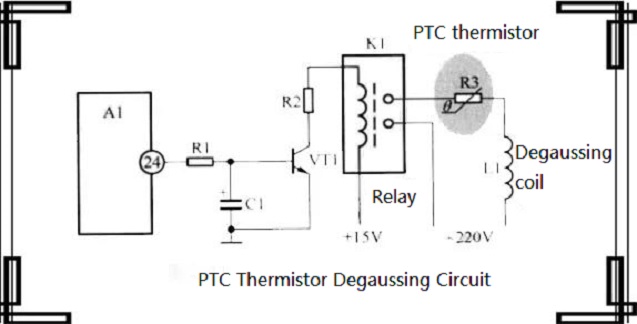
A degaussing circuit composed of PTC thermistors is commonly used in color TVs. In the circuit shown below, R3 is the PTC degaussing resistance, L1 is the degaussing coil , K1 is the relay that controls the degaussing circuit, VT1 is the drive transistor of the relay, and A1 is the control processor.
During the working process of the degaussing circuit, after booting, the pin of the microprocessor A1 outputs a high-level signal, which is added to the base of VT1 through the resistor R1. A capacitor C1 is connected between the base of VT1 and the ground. Because the voltage across the capacitor C1 cannot change suddenly , C1 has no internal charge, so that the base of VT1 is still 0V at the moment of power-on, VT1 still remains in the off state, and the normally closed contact switch of relay K1 still remains in the on state, so that the degaussing coil L1 and degaussing resistor R3 loop flow through the AC The degaussing current starts to degauss.
As the degaussing current flows through the PTC thermistor R3, its temperature increases, and the resistance increases, and the higher the temperature of R3, the greater the resistance, so that the amplitude of the current flowing through the degaussing coil L1 attenuates from large to small, completing the alignment Degaussing work when the picture tube is turned on.
(2) NTC thermistor surge suppression circuit
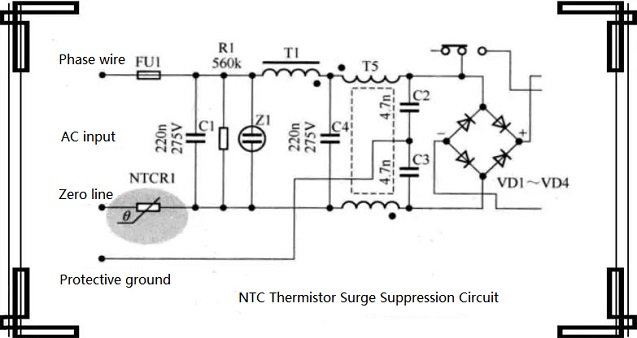
The NTC thermistor has a negative temperature coefficient, and the resistance decreases after the temperature rises. The following circuit is the application in the NTC thermistor circuit. A large inrush current will be generated when starting up, that is, AC 220v voltage will give a large startup inrush current, This large startup inrush current may burn the power supply and the internal circuit of the host. For this purpose, a Circuit that suppresses surges.
In the working process of the surge suppression circuit, NTCR1 is connected in series in the 220v power supply loop as a part of the 220v AC point load. When the circuit is cold-started, because the resistance of NTCR1 is relatively large at room temperature, this limits the current of the 220v loop when it is turned on, so that it cannot be too large.
After turning on the NTCR1, current flows through NTCR1 to increase its temperature, and its resistance value begins to decrease. After turning on for a short time, the temperature of the NTCR1 resistor rises to the working range, and its structure drops to a very low value, which can be ignored. Regardless, the 220v mains power supply enters the normal state at this time.
Varistor basics and applications in circuits. Varistors are also more sensitive resistors used in electronic circuits. The resistance of a varistor changes with the voltage applied to both ends of the resistor. It is added to the varistor . When the voltage across both ends is small and a certain value, the resistance of the varistor is large. When the voltage across it reaches a certain level, the resistance of the varistor decreases rapidly.
According to the main characteristics of varistor. it can be used in various AC and DC circuits as voltage stabilization, overvoltage protection, surge current suppression, spike absorption, amplitude limiting, high voltage arc extinguishing, absorption loop, lightning protection, etc. .
In the overvoltage protection of the circuit, the varistor will not be damaged if the normal working theory is listed. However, because the varistor has to withstand the power supply voltage for a long time, the transient overvoltage in the circuit and the over-energy overvoltage randomly continuously impact the absorption circuit. The energy storage element releases energy, so the varistor will also be damaged.
Ⅲ. Specific application in the circuit.
(1) Switching power supply AC input circuit instantly suppresses varistor application circuit
The following is the application circuit of the varistor in the transient suppressor of the AC input loop of the switching power supply. In the circuit, R1 is a varistor, There will be more switching pulse phenomena in the switching power supply circuit.
When a voltage spike appears in the 220v AC voltage, R1 can suppress it. Its working principle is: when the spike voltage reaches a certain value, the resistance of R1 decreases rapidly, suppressing the spike voltage, and reaching the suppression of the 220v AC mains voltage The purpose of the spike voltage.

Ⅳ. The basis of photoresistor and its application in circuit
The photoresistor is made according to the photoconductivity effect. When a certain substance receives light, the concentration of carriers increases to increase the conductivity. This is the photoconductivity effect.
The resistance value of the photoresistor changes with the change of light intensity. When the incident light is strong, the resistance decreases, and the incident light is weak, and the resistance increases. The photoresistor has no polarity and is just a resistor controlled by light intensity. Whether the photoresistor is used in a DC circuit or an AC circuit, it has the same function in the circuit, which is the same as an ordinary resistor.
Application in Photoresistor Circuit
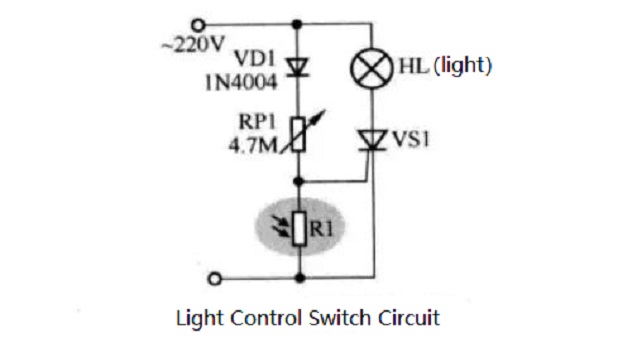
This is a light-controlled switch circuit, which can be used in some public places such as corridors and street lights. Through the photoresistor, it will automatically turn on the light when it is dark, and automatically turn off when it is dawn. In the circuit, VS1 is a thyristor, and R1 is a photoresistor.
When the light is bright, the resistance value of the photoresistor R1 is small, and the unidirectional pulsed DC voltage after the 220v AC voltage is rectified by VD1 is small after RP1 and R1 are divided, and the voltage of the control pole of the thyristor VS1 is small, at this time the thyristor VS1 cannot be turned on, so there is no current in the HL circuit of the lamp, and the lamp does not light up.
When the light is dark, the resistance of the photoresistor R1 is large, the voltage after RP1 and R1 is divided, and the voltage added to the control pole of the thyristor VS1 is large, then the thyristor VS1 enters the conducting state, so the lamp HL circuit has current flowing , The light is on.
Adjusting the resistance of the variable resistor RP1 can change the output voltage of the divided voltage of RP1 and R1, so that the trigger voltage of the thyristor VS1 can be changed. This can adjust the degree to which the thyristor VS1 turns on when the light is dimmed, that is, the dark point is realized. Adjustment of lighting.
If the resistance of RP1 is increased, a larger resistance of R1 (darker light) is needed to make the thyristor VS1 light up. On the contrary, if the resistance of RP1 is reduced, the light can be lit when the light is not very dark.
 UTMEL
UTMEL
We are the professional distributor of electronic components, providing a large variety of products to save you a lot of time, effort, and cost with our efficient self-customized service. careful order preparation fast delivery service
1. What is a thermistor?
It is the resistance whose resistance value changes as the temperature changes. It is mainly used for simple control of heating equipment. As the temperature increases, the resistance increases or decreases, so that the current passing through the heating equipment decreases, so as to achieve the effect of controlling the temperature.
2. What is a varistor?
A "varistor" is a resistive device with non-linear volt-ampere characteristics. It is mainly used to clamp the voltage when the circuit is subjected to overvoltage and absorb excess current to protect sensitive devices.
3. What is a photoresistor?
The photoresistor is a kind of resistor made by the photoelectric effect of semiconductor, whose resistance value changes with the intensity of incident light; when the incident light is strong, the resistance decreases, and the incident light is weak, and the resistance increases.
 What are the Differences Between Pull up and Pull down Resistors?UTMEL22 October 202538082
Pull up is to clamp an uncertain signal to a high level with a resistor, and the resistor also acts as a current limiter. In the same way, pull down means to clamp the uncertain signal to a low level through a resistor. To pull up is to input current to the device, and the pull-down is to output the current.
Read More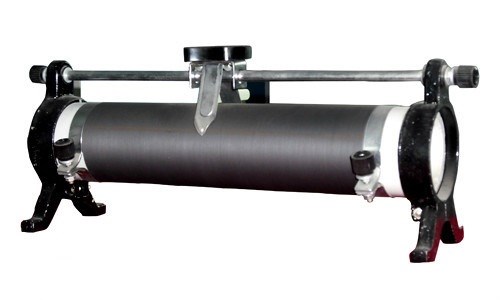 Rheostat Basics: Types, Principle and FunctionsUTMEL25 December 202517834
A rheostat is a device that can adjust the size of the resistance and can be connected to the circuit to adjust the size of the current. A general rheostat is composed of a wire with a larger resistance and a device that can change the contact point to adjust the effective length of the resistance wire. Rheostat can limit the current and protect the circuit, and change the voltage distribution in the circuit.
Read More Basic Introduction to Metal Film ResistorUTMEL28 August 202013756
Metal film resistors are a kind of film resistors. Metal film resistors are resistors in which special metals or alloys are used as resistor materials, and the resistor film layer is basically formed on ceramic or glass by vacuum evaporation or sputtering.
Read More Varistor: Definition, Function, Working and TestingUTMEL03 April 202583291
A varistor is a device with a non-linear volt-ampere characteristic. When the voltage applied to the varistor is lower than its threshold value, the current flowing through it is extremely small, which is equivalent to a resistor with infinite resistance, vice versa. The most common varistor is a metal oxide varistor (MOV).
Read More Photoresistor Basics: Types, Principles and ApplicationsUTMEL16 October 202545407
The article introduces the photoresistor’s main characteristics and principles including the working principle and structural principle. There are three types of photoresistor: ultraviolet photoresistors, infrared photoresistors, visible light photoresistors. Dimming circuit and light switch are the two applications of the photoresistor.
Read More
Subscribe to Utmel !
![TDA7705TR]() TDA7705TR
TDA7705TRSTMicroelectronics
![AD607ARSZ-REEL]() AD607ARSZ-REEL
AD607ARSZ-REELAnalog Devices Inc.
![LMV221SDX/NOPB]() LMV221SDX/NOPB
LMV221SDX/NOPBTexas Instruments
![HMC942LP4E]() HMC942LP4E
HMC942LP4EAnalog Devices Inc.
![CC1150RGVT]() CC1150RGVT
CC1150RGVTTexas Instruments
![TRF372017IRGZR]() TRF372017IRGZR
TRF372017IRGZRTexas Instruments
![SST12LP17E-XX8E]() SST12LP17E-XX8E
SST12LP17E-XX8EMicrochip Technology
![TDA7786CTR]() TDA7786CTR
TDA7786CTRSTMicroelectronics
![TRF3722IRGZT]() TRF3722IRGZT
TRF3722IRGZTTexas Instruments
![ATA5746C-PXQW-1]() ATA5746C-PXQW-1
ATA5746C-PXQW-1Microchip Technology


