Product
 Brand
Brand Articles
 Tools
Tools
Substitute Part Validation: How to Cross-Reference and Verify Obsolete Components
Finding an obsolete module alternate on a distributor's website takes seconds; proving it will not cause a thermal runaway or a dead board requires rigorous engineering validation. Validating a substitute electronic component requires moving beyond automated "direct replacement" labels. Engineers must use the Form-Fit-Function (FFF) framework to manually verify mechanical fit, electrical parameters, and regulatory compliance before updating the Bill of Materials (BOM).
This guide details how to decode distributor substitution tiers, apply the FFF gate-check system, spot hidden datasheet traps, bench-test obsolete module alternates, and handle regulated BOM requirements.
Decoding Distributor Substitution Tiers
Automated cross-reference tools categorize alternate components into distinct tiers. Understanding the engineering implications of these tiers is the first step in preventing manufacturing failures.
Direct Replacement Specifications
A true direct replacement, or drop-in replacement, possesses identical electrical and mechanical specifications to the original part, requiring zero modifications to the PCB or manufacturing process.
Users on community forums often report that automated tools label parts as direct replacements based solely on top-level specifications, such as voltage and capacitance, while ignoring critical mechanical differences. Relying on this label without manual datasheet verification frequently leads to footprint mismatches during PCB assembly.
Parametric Equivalent Specifications
Parametric equivalents match the core electrical specifications of the original component but may differ in packaging, pinout, or temperature range.
When a distributor tool outputs a parametric equivalent, the core logic or power handling will function correctly, but the physical integration requires review. For example, substituting a Thin Shrink Small Outline Package (TSSOP) for a Shrink Small Outline Package (SSOP) provides identical electrical performance but fails to align with the existing PCB land pattern.
Similar and Functional Equivalents
Similar components share a basic function but possess parameter variances, such as a lower voltage rating or a different logic family, that necessitate a circuit redesign.
For rapid prototyping where board space is flexible, functional equivalents remain a strong choice because engineers can easily adapt the breadboard to accommodate different pinouts or voltage requirements. However, for a finalized PCB layout requiring strict adherence to an existing footprint, relying on a functional equivalent is inefficient, as it forces a costly board re-spin.
The Form-Fit-Function Validation Framework
To systematically validate a cross-referenced obsolete part, component engineers utilize the Form-Fit-Function (FFF) methodology. This framework separates the validation process into three objective categories.
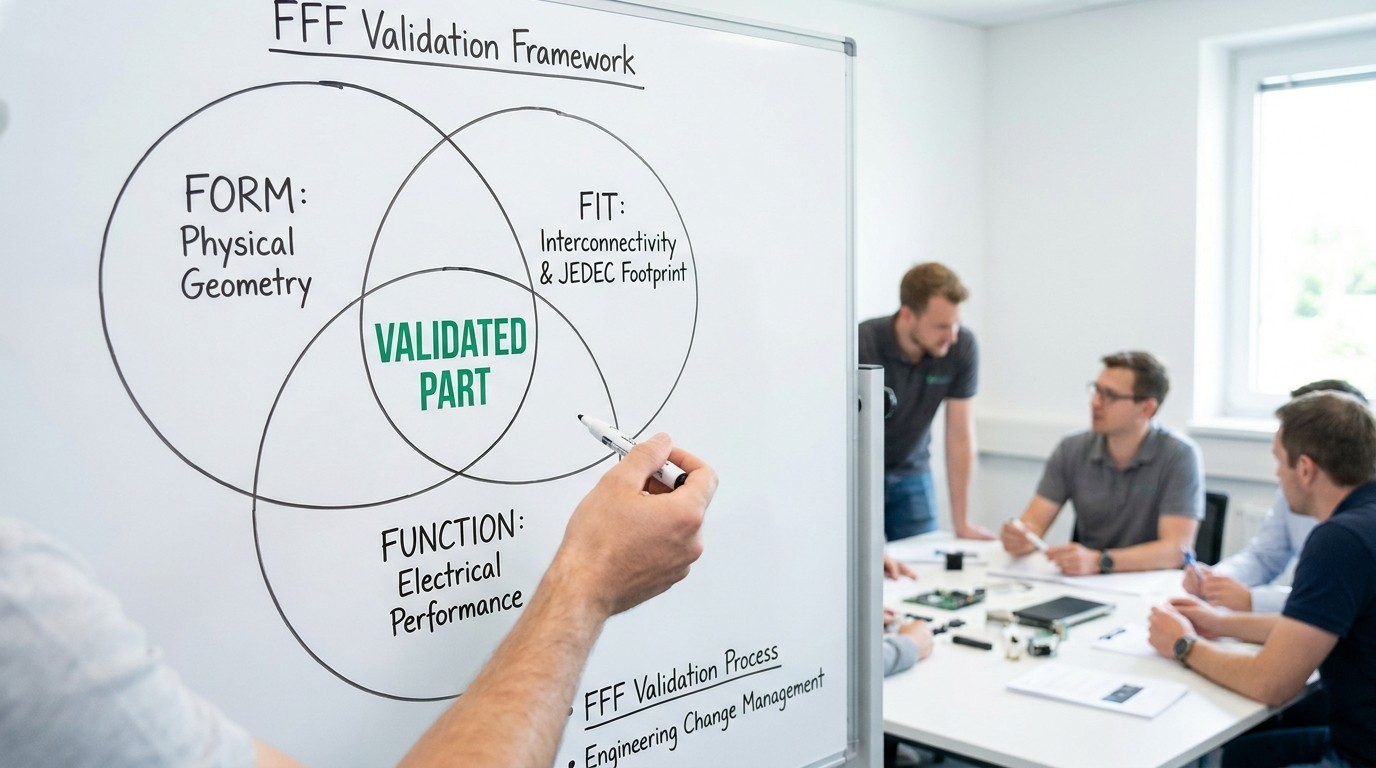
Form: Physical Characteristics and Geometry
ASME Y14.100 officially defines "Form" as the physical characteristics of a part, including its dimensions, mass, shape, and material composition. Validating form ensures that the substitute component physically fits within the spatial constraints of the enclosure and does not alter the center of gravity or weight distribution of the final assembly.
Fit: Interconnectivity and PCB Footprint
"Fit" is the ability of the component to physically interface or connect with the existing system. JEDEC Publication 95 (managed by the JC-11 committee) dictates the exact mechanical standardization outlines for solid-state packages.
To guarantee mechanical fit, engineers must check the exact JEDEC outline numbers on both the original and substitute datasheets. A mismatch in the JEDEC registration indicates that the substitute will not align with the existing PCB land pattern, regardless of its electrical compatibility.
Function: Electrical Performance
"Function" represents the designed action and electrical performance of the component. Validating function requires matching voltage tolerances, current limits, impedance, thermal resistance, and timing characteristics across the full operating temperature range.
The FFF Validation Checklist
Use the following structured decision aid to gate-check potential substitutes before approving a BOM update.
| Parameter | Original Specification | Substitute Specification | Validation Status (Pass/Fail/Deviate) |
|---|---|---|---|
| JEDEC Package Outline | TO-220AB | TO-220F | Deviate (Requires isolated mounting check) |
| Pinout Configuration | Standard | Mirrored | Fail (Requires PCB re-spin) |
| Thermal Resistance (θJA) | 65°C/W | 50°C/W | Pass (Superior thermal dissipation) |
| Logic Level Thresholds | 3.3V CMOS | 3.3V TTL | Deviate (Requires noise margin review) |
Hidden Datasheet Traps in Parametric Equivalents
Even when a component passes the basic FFF gate-check, secondary specifications buried in the datasheet can disrupt manufacturing or degrade long-term reliability.
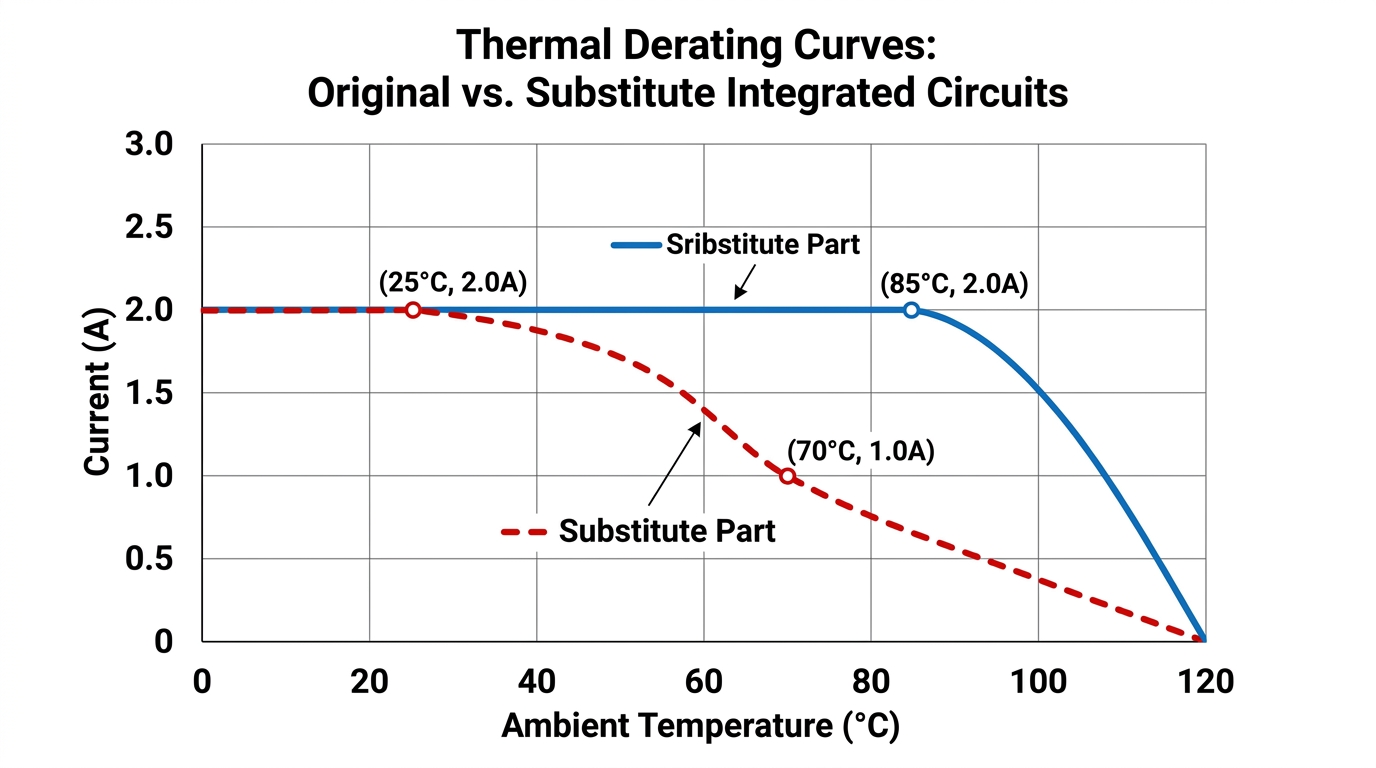
Thermal Derating Curves and Power Dissipation
Two integrated circuits with identical functional specifications can possess vastly different thermal pads or junction temperature limits. A substitute part might handle the required 2A current at 25°C, but its thermal derating curve may show a steep drop-off, limiting it to 1A at 70°C. Engineers must overlay the thermal derating curves of both components to ensure the substitute survives the specific ambient temperature of the application.
Packaging and Automated Assembly Mismatches
Component packaging dictates how the part is fed into automated pick-and-place machines. A parametric equivalent supplied in a tube or tray cannot directly replace a part supplied on tape-and-reel without retooling the assembly line. This mechanical mismatch halts automated manufacturing, even if the component itself is a perfect drop-in replacement.
Moisture Sensitivity Levels
Moisture Sensitivity Levels (MSL) dictate how long a component can be exposed to ambient factory humidity before it absorbs enough moisture to crack during reflow soldering.
Moisture Sensitivity Levels are strictly governed by the IPC/JEDEC J-STD-020 standard. MSL 1 allows unlimited floor life at ≤30°C/85% RH, whereas MSL 3 is limited to 168 hours, and MSL 6 requires a mandatory bake before reflow soldering. Substituting a part with a different MSL rating can halt a manufacturing line, as it fundamentally changes the required baking and reflow soldering profiles on the factory floor.
Bench-Testing Obsolete Module Alternates
Datasheet validation must be paired with physical bench-testing, especially when replacing complex power modules or safety components.
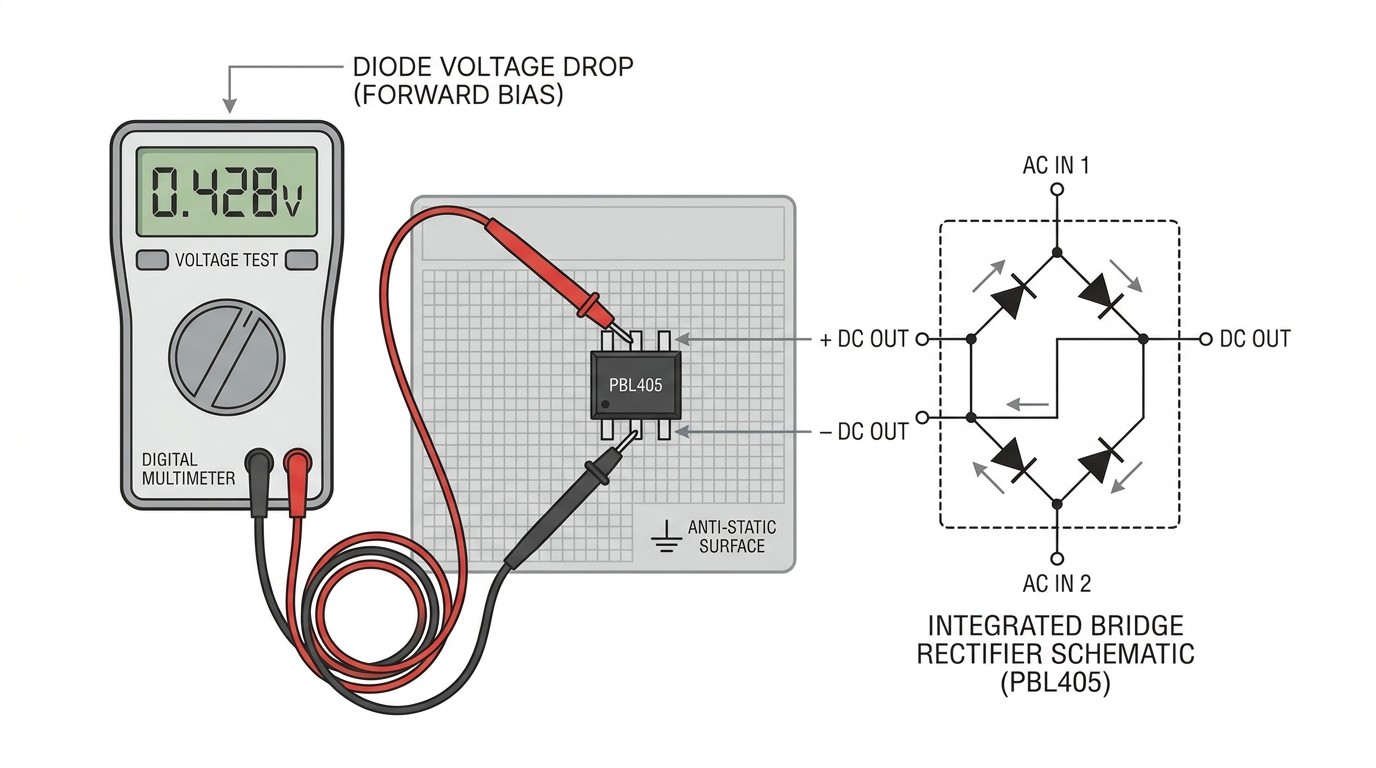
Translating Discrete Layouts to Integrated Modules
In visual stress tests and bench teardowns, experts point out that obsolete discrete layouts can often be substituted with integrated modules. For example, a power supply board utilizing four discrete bridge rectifier diodes can be successfully replaced by a single 4-pin IC package (such as the PBL405). Understanding that the IC contains the exact same four-diode bridge configuration allows engineers to validate the integrated module using discrete testing principles.
Double Reading Multimeter Testing
When validating an integrated bridge rectifier substitute, engineers utilize a specific off-board multimeter test to verify internal structural integrity. By placing the multimeter in diode mode, connecting the black probe to the positive (+) terminal, and the red probe to the negative (-) terminal, a healthy component will show a "double reading." This reading visualizes the voltage drop across two diodes in series (typically around 428mV). This methodology instantly validates the substitute's internal structure without requiring the engineer to check all four individual diode paths.
📺 Electronic Components Testing Explained in 5 Minutes
Preventing Chain Reactions in Power Modules
Class-X (X2) safety capacitors are "across the line" (Line to Neutral) components designed to filter electromagnetic interference. When subjected to severe overvoltage, they typically fail short.
Visual inspection of PCB traces confirms that X2 capacitors bridge the main Phase and Neutral AC input lines. Consequently, a shorted X2 capacitor creates a direct short across the mains, blows the main fuse, and results in a "dead board." Beginners often misinterpret capacitor continuity testing; a failed, shorted X2 capacitor will trigger a multimeter continuity beep, whereas a good one shows absolute silence (open loop). Substituting just the blown fuse without bench-testing the downstream X2 capacitor will lead to repeated board failures.
Regulated Bill of Materials Requirements
In highly regulated industries, functional equivalence is insufficient. A substitute component must carry the exact certifications required by the governing body to maintain the product's legal compliance.
Automotive and Industrial Standards
The Automotive Electronics Council (AEC) standards dictate that AEC-Q100 is the specific stress-test qualification standard for Integrated Circuits (active components), while AEC-Q200 is the standard for Passive Components (resistors, capacitors, inductors).
A commercial-grade parametric equivalent cannot be used in an automotive BOM without the specific AEC-Q100 or AEC-Q200 qualification, even if it is a perfect FFF match. The lack of this specific stress-test certification disqualifies the component, as it has not been proven to withstand the extreme temperature cycling and vibration inherent in automotive environments.
Medical and Environmental Compliance
Medical devices governed by FDA regulations or ISO 13485 standards require strict documentation for any component deviation. Furthermore, substitute components must match the environmental compliance of the original BOM. Replacing a RoHS-compliant (Restriction of Hazardous Substances) component with a non-compliant alternate instantly invalidates the environmental certification of the entire product, preventing it from being sold in specific global markets.
Next Steps for Component Validation
Substitute part validation is a manual engineering process that utilizes distributor cross-reference tools as a starting point, not a final verdict. By applying the Form-Fit-Function framework, verifying JEDEC outlines, and bench-testing critical modules, engineers can safely navigate component obsolescence. To streamline this process, engineers can source verified datasheets and evaluate alternate components through the Utmel Electronic Components Online Platform.
Frequently Asked Questions
How do I test a substitute component before approving it for mass production?
Procure a small sample batch and solder the substitutes onto existing bare boards. Run these populated boards through full functional testing, thermal imaging under load, and electromagnetic compatibility (EMC) pre-compliance checks to verify they perform identically to the original units.
Do I need to re-certify my product if I change a power module?
If the substitute power module alters the isolation barrier, leakage current, or EMI emissions, safety agencies (such as UL, CE, or FCC) typically require a Class II permissive change or a partial re-evaluation to ensure the product remains compliant.
How do I update my CAD library when an alternate part has a slightly different footprint?
Create a new component footprint in your ECAD software based on the substitute's specific JEDEC outline. Link this new footprint to the alternate part number in your PLM (Product Lifecycle Management) system, ensuring the PCB layout team uses the updated geometry for future board revisions.
What is the standard procedure for documenting a component deviation?
Engineers must file an Engineering Change Order (ECO) detailing the reason for the substitution, the FFF validation results, thermal derating comparisons, and proof of regulatory compliance (e.g., AEC-Q100). This document must be approved by the quality assurance team before the BOM is officially updated.
Why does my multimeter beep when testing a substitute X2 capacitor?
A continuity beep indicates a direct short circuit. Because X2 safety capacitors sit across the Phase and Neutral lines, a good capacitor will show an open loop (silence) on a multimeter. A beep means the substitute is internally shorted and invalid for use.
 UTMEL
UTMEL
We are the professional distributor of electronic components, providing a large variety of products to save you a lot of time, effort, and cost with our efficient self-customized service. careful order preparation fast delivery service
 Modeling Wide Band-Gap Semiconductors for Enhanced PerformanceRakesh Kumar, Ph.D.31 January 20243877
The article delves into the challenges faced by silicon-based power electronic devices and highlights the potential of wide band-gap semiconductors. It also emphasizes the importance of modeling power semiconductor devices and provides insights into various models. For electrical energy conversion to be dependable and effective, power electronics and semiconductor device technologies are essential.
Read More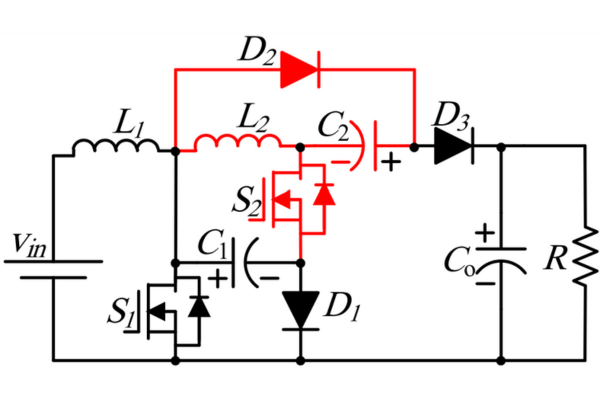 Optimizing Energy Management with Non-Isolated DC-DC ConvertersRakesh Kumar, Ph.D.04 February 20243506
The article classifies DC-DC converters and discusses the benefits and limitations of them. It proposes a modified DC-DC converter topology that combines the Cuk and Positive Output Super Lift Luo topologies to achieve a higher voltage gain with fewer components.
Read More ‘6G Networks’ - Pioneering the Next Era of Connectivity And InnovationRakesh Kumar, Ph.D.18 March 20243839
The article provides a comprehensive overview of the evolving landscape of mobile networks, the requirements that will shape the future of mobile communication, and the innovative technologies driving the transition to 6G.
Read More Review of IoT-Based Smart Home Security Systems- Part 1Rakesh Kumar, Ph.D.28 March 20244314
The article discusses the evolution of IoT-based smart home security systems, integrating advanced technologies like Raspberry Pi, PIR sensors, and voice recognition for enhanced user experience and efficiency.
Read More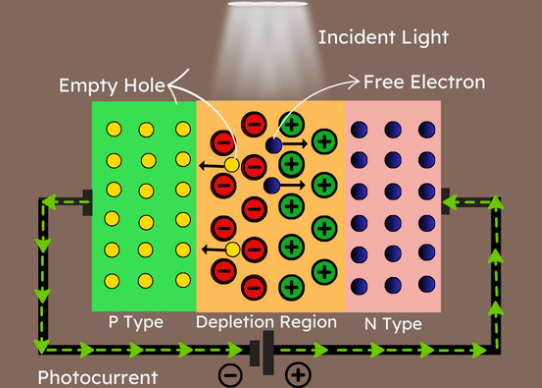 Understanding Photodiodes: Working Principles and Applications - Part 2Rakesh Kumar, Ph.D.24 May 20245578
The article provides a comprehensive overview of photodiodes, focusing on their operational principles, key factors affecting their efficiency, advantages, and disadvantages, and highlights their diverse applications.
Read More
Subscribe to Utmel !
![60210]() 60210
60210Brady Corporation
![17531]() 17531
17531Brady Corporation
![17533]() 17533
17533Brady Corporation
![5-1193606-3]() 5-1193606-3
5-1193606-3TE Connectivity
![MAX6505UTP015 T]() MAX6505UTP015 T
MAX6505UTP015 TAnalog Devices
![346656-000]() 346656-000
346656-000TE Connectivity
![D18609-000]() D18609-000
D18609-000TE Connectivity
![SO175-5-00]() SO175-5-00
SO175-5-00TE Connectivity
![EJ3514-000]() EJ3514-000
EJ3514-000TE Connectivity
![MAX6505UTP020 T]() MAX6505UTP020 T
MAX6505UTP020 TAnalog Devices