Product
 Brand
Brand Articles
 Tools
Tools
Understanding Electronic Speed Controllers (ESCs): Working Principles, Key Specifications, and Sourcing Guide
The Technical Decision Framework: Brushed vs. Brushless ESCs
When specifying or replacing an ESC, your first decision point is matching the controller to the physical motor architecture [3, 7]. Choosing the wrong type will result in complete system inoperability or electrical damage [7].
| Feature / Metric | Brushed ESC | Brushless ESC (BLDC) |
|---|---|---|
| Compatible Motor Type | Two-wire brushed DC motors [1, 7] | Three-wire brushless DC (BLDC) motors [1, 7] |
| Output Wires | 2 wires (Positive, Negative) [1] | 3 phase wires (U, V, W) [1] |
| Speed Regulation Method | Varies average DC voltage via PWM [1] | Converts DC to 3-phase AC; controls frequency [1, 2] |
| Commutation Mechanism | Mechanical (handled by motor brushes/commutator) | Electronic (handled actively by ESC firmware) [1] |
| Internal Complexity | Low (simple H-bridge transistor array) | High (Microcontroller, Gate Drivers, 3-Phase bridge) [2] |
| Efficiency & Lifespan | Lower (due to brush friction and electrical arcing) | Significantly higher; limited only by bearing wear |
| Sensing Capabilities | Sensorless only | Sensored (Hall-effect) or Sensorless (Back-EMF feedback) [2] |
| Typical Applications | Legacy RC toys, low-cost robotics, basic pumps [1] | Drones, high-performance RC, EVs, industrial automation [1, 6] |
1. How an Electronic Speed Controller Works (The Internal Anatomy)
An ESC does not merely restrict current like a variable resistor; instead, it operates as a sophisticated, high-speed switching power supply [1]. To understand how it regulates a motor under dynamic loads, we must look at its core internal components [3]:
+------------------------------------------------------------------------+
|                                  ESC                                   |
|                                                                        |
|  +--------------+       +------------------+      +-----------------+  |
|  |              |       |                  |      |                 |  |
|  |              |------>|   Gate Drivers   |----->|   MOSFET Bank   |--+--+
|  |              |       |                  |      |                 |  |  |
|  |              |       +------------------+      +-----------------+  |  | 3-Phase
|  |  Processor/  |                                                      |  | Power
|  |     MCU      |<-----------------------------------------------------+  | Out
|  |              |              Back-EMF Sensing Feedback Loop          |  |
|  |              |                                                      |  |
|  +--------------+                                                      |  |
+-------^----------------------------------------------------------------+  |
        |                                                                   |
        | Control Signal (PWM / DShot)                                      |
        |                                                                   v
+-------+---------------+                                              +----+----+
|                       |                                              |         |
|   Flight Controller   |                                              | 3-Phase |
|     or Receiver       |                                              |  Motor  |
|                       |                                              |         |
+-----------------------+                                              +---------+
The Microcontroller (MCU)
The MCU is the "brain" of the ESC. It continuously monitors incoming control signals (such as a 50 Hz PWM throttle signal or a high-speed digital DShot packet) and calculates the exact timing required to switch the motor phases [1, 2].
Gate Drivers and MOSFETs
Because MCUs operate at low currents and voltages (typically 3.3V or 5V), they cannot directly switch the massive currents flowing from the battery to the motor [2]. The MCU signals the Gate Drivers, which act as voltage amplifiers [3]. These drivers provide enough charge to rapidly open and close the gates of the MOSFETs (Metal-Oxide-Semiconductor Field-Effect Transistors) [3]. The MOSFETs act as solid-state switches, pulsing hundreds of amps of current to the motor windings at frequencies ranging from 16 kHz to over 96 kHz.
Commutation and Sensorless Feedback (Back-EMF)
For a brushless motor to spin, the ESC must energize the three stator coils in a precise, rotating sequence [2]. To time these pulses correctly, the ESC must know the exact position of the rotor [2].
Sensored Systems: Use physical Hall-effect sensors inside the motor to report the rotor's position back to the ESC. This provides extremely smooth, high-torque start-ups from zero RPM, making it the standard for RC rock crawlers and electric skateboards.
Sensorless Systems: Rely on Back-Electromotive Force (Back-EMF) [2]. When a brushless motor spins, the magnets moving past the unenergized coils generate a small voltage [2]. The ESC reads this Back-EMF signal on the idle phase wire to calculate the rotor's speed and position [2]. Because Back-EMF is virtually non-existent at a standstill, sensorless ESCs sometimes struggle with slight cogging (stuttering) during initial startup.
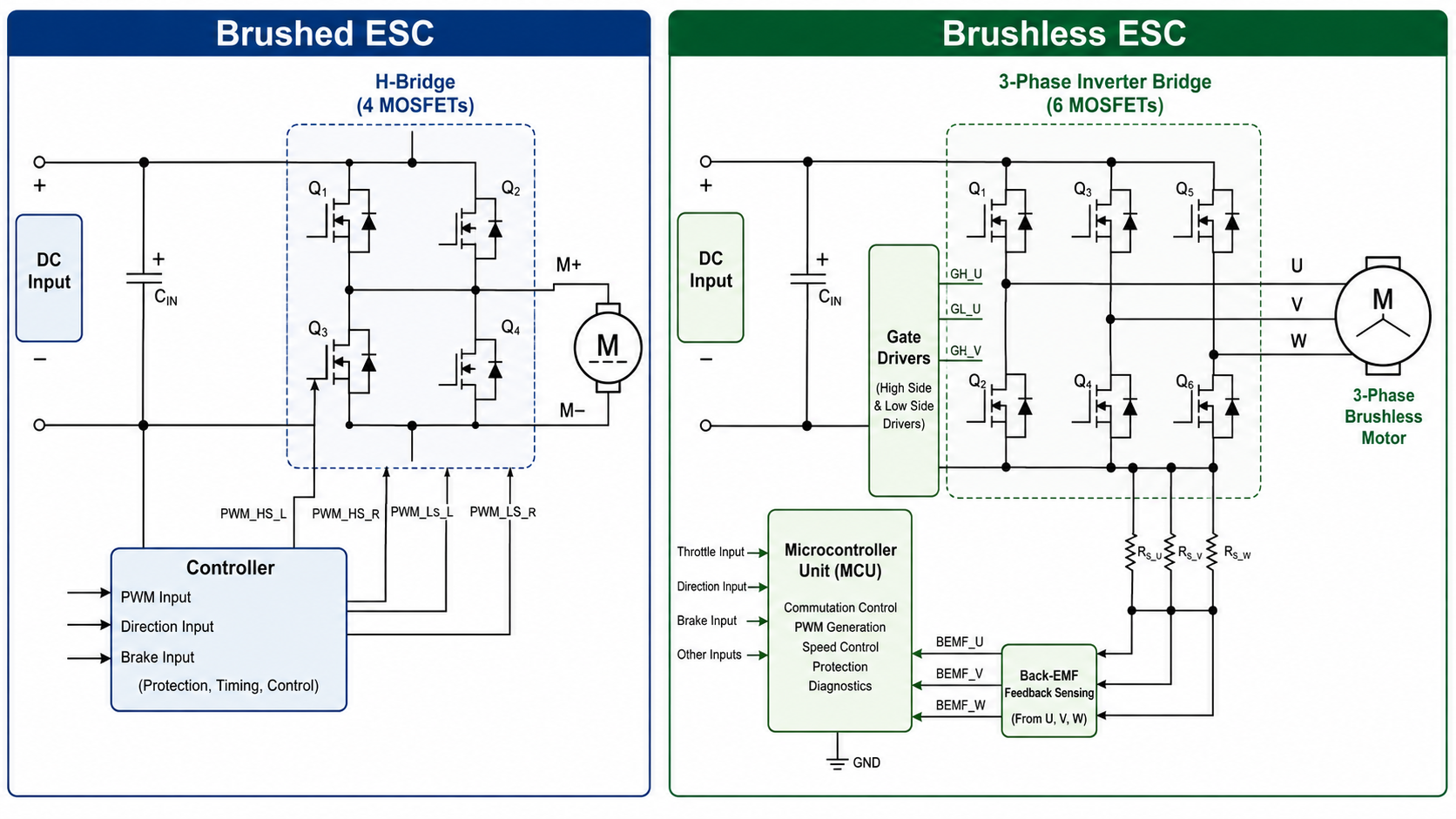
Schematic comparison showing the simple H-bridge architecture of a brushed DC ESC alongside the 3-phase bridge and feedback routing of a sensorless brushless ESC.
2. Key Specifications & Sizing Parameters
Selecting an ESC purely by its price or size often leads to catastrophic failure (burning out MOSFETs or triggering thermal shutdowns) [1, 7]. You must size your system based on these four foundational specifications:
Current Rating (Amperage)
This is the most critical specification [7]. It is divided into two distinct limits:
Continuous Current: The maximum amount of current (in Amperes) the ESC can continuously handle under sustained full-throttle operation, assuming adequate airflow [7].
Burst Current: The absolute maximum current the ESC can survive for brief intervals (usually 10 seconds or less) during rapid acceleration or high aerodynamic loading.
The 20% Safety Margin: When matching an ESC, calculate the maximum possible current draw of your motor (often found in the motor's thrust or test charts at 100% throttle). Select an ESC with a continuous rating at least 20% higher than the motor’s maximum draw [1, 6]. For example, if your motor draws 40A at peak throttle, specify an ESC rated for at least 48A to prevent thermal runaway and premature component aging.
Voltage Rating (LiPo Cell Count)
ESCs are designed to operate within strict voltage windows [7]. Exceeding this limit will immediately compromise the internal capacitors and bridge transistors [7]. In the hobby and small UAV industries, voltage is typically represented by the supported Lithium Polymer (LiPo) cell count (e.g., 2S–6S or 6S–12S), where each nominal cell represents 3.7V (4.2V fully charged) [7].
Always match the voltage rating of the ESC to both your battery supply and your motor’s operational parameters.
Battery Eliminator Circuit (BEC)
Many ESCs contain an integrated voltage regulator known as a Battery Eliminator Circuit (BEC) [7].
The Purpose: The BEC steps down the main battery voltage (e.g., 14.8V from a 4S LiPo) to a regulated 5.0V, 6.0V, or 7.4V. This output powers auxiliary electronics such as receivers, flight controllers, and steering servos, eliminating the need for a secondary, dedicated battery pack [7].
Opto ESCs: ESCs without a built-in BEC are historically termed "Opto-isolated" (or simply "Opto"). When utilizing an Opto ESC, you must provide an external voltage regulator (often called a UBEC or SBEC) to power your control electronics.
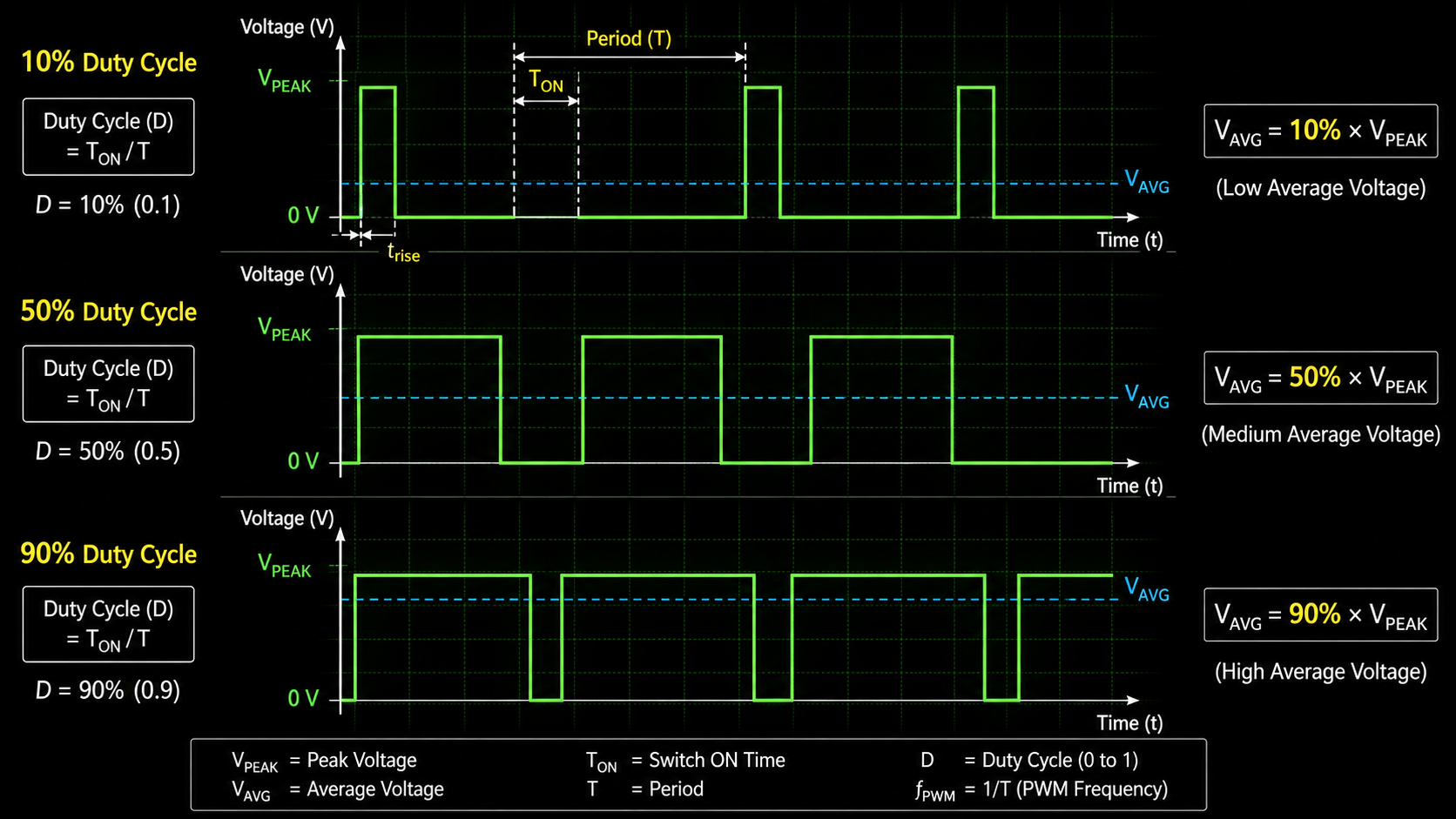
Pulse Width Modulation (PWM) duty cycle transitions and their direct relationship to the average voltage delivered to a DC system.
3. Control Protocols and Firmware
The responsiveness, smoothness, and telemetry capabilities of your motor drive depend heavily on the control protocol and firmware running on the MCU [1, 7].
Analog vs. Digital Communication Protocols
The communication standard dictates how fast and how accurately the master controller (e.g., a flight controller) can command the ESC [7].
Analog PWM (Pulse Width Modulation): The legacy standard [7]. Command values are determined by the physical width of a pulse (typically ranging from 1000 microseconds for zero throttle to 2000 microseconds for full throttle), repeating at a sluggish 50 Hz to 400 Hz frame rate. Analog PWM is highly susceptible to electrical noise and ground-loop voltage drift, requiring manual calibration.
Oneshot (Oneshot125): An accelerated analog protocol that shortens the pulse width to 125–250 microseconds, allowing the ESC to update in sync with faster flight controller loop times.
DShot (Digital Shot): The modern digital standard. Instead of measuring pulse widths, DShot sends throttle commands as packetized digital data frames (usually 16-bit packets consisting of 11 throttle bits, 1 telemetry bit, and 4 Cyclic Redundancy Check bits).
Benefits: Highly resistant to electrical noise, requires absolutely zero throttle calibration, and supports robust error-checking to prevent erratic motor behavior [1]. DShot variations (DShot300, DShot600, DShot2400) dictate the digital transmission speed.
Primary Firmware Ecosystems
The software flashed to the ESC's MCU controls the underlying commutation logic, timing advance algorithms, and protection features:
BLHeli_S / BLHeli_32: The dominant standards for multirotors and racing drones. BLHeli_32 runs on high-speed 32-bit ARM processors, supporting bidirectional DShot, real-time telemetry (temp, RPM, voltage, current), and advanced motor timing filtering [1].
AM32: A rapidly growing, open-source 32-bit firmware designed as an alternative to proprietary firmware, optimized for both drones and low-speed RC crawlers requiring exceptional startup torque.
VESC (Vedder ESC): An advanced, open-source firmware designed primarily for high-power applications (electric skateboards, e-bikes, and industrial robotics). It supports advanced Field Oriented Control (FOC), regenerative braking, and complex CAN-bus communication.
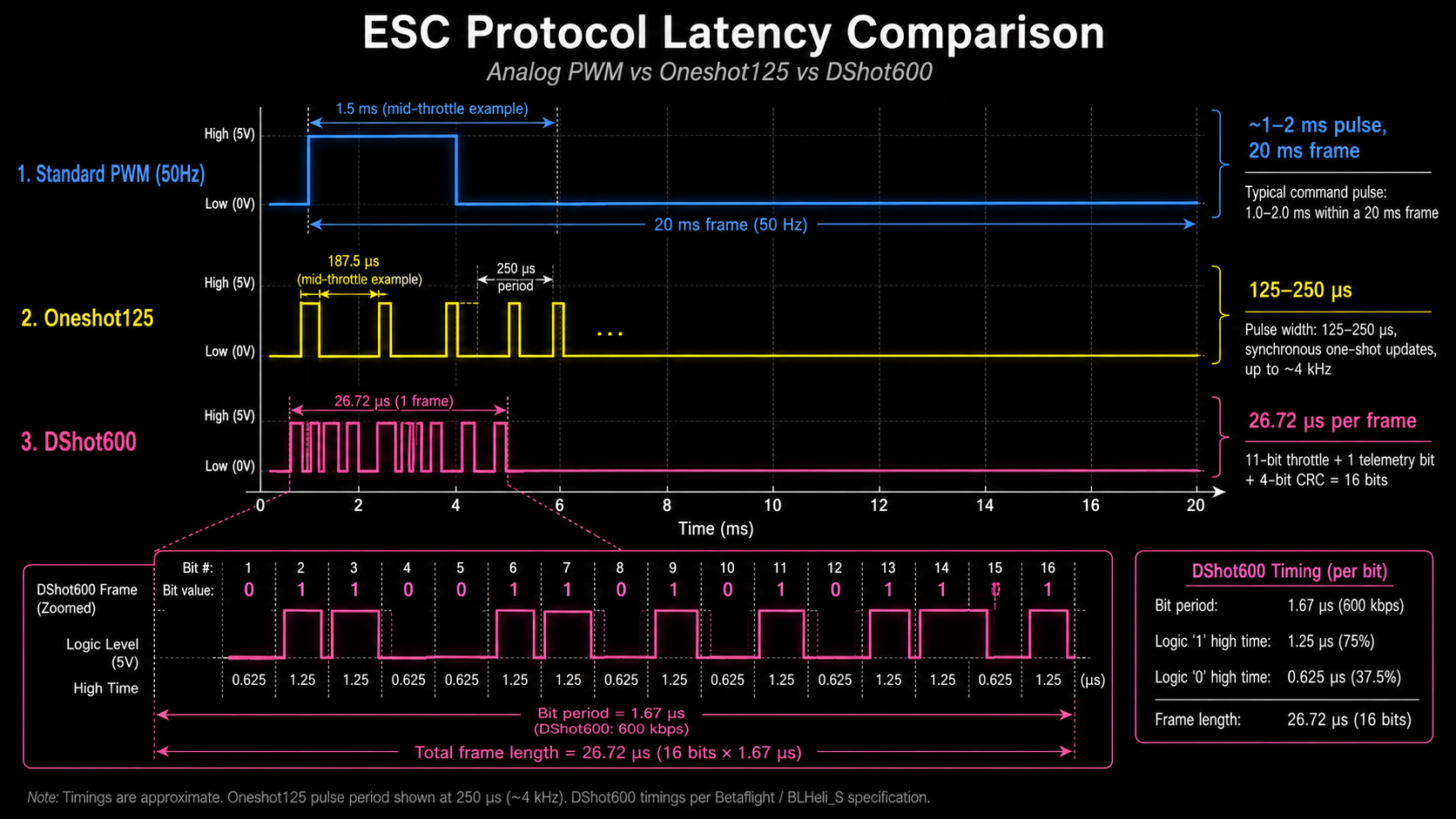
Visualizing signal latency: Traditional analog PWM pulses contrast with the ultra-fast digital packets of the DShot protocol.
4. Real-World Applications
While all ESCs serve the same basic function, their designs are tailored specifically to their intended operating environments:
+--------------------------------------------+
               |         ESC Industry Specialization         |
               +--------------------------------------------+
                                     |
      +------------------+-----------+-----------+------------------+
      |                  |                       |                  |
      v                  v                       v                  v
+-----------+      +-----------+           +-----------+      +-----------+
|  Drones   |      |  RC Cars  |           |E-Mobility |      | Robotics/ |
|  & UAVs   |      |  & Boats  |           | (VESC/EV) |      |Industrial |
+-----------+      +-----------+           +-----------+      +-----------+
  - Ultra-Light      - Heavy Heat-           - High Amp-        - CAN-bus/CAN
  - Fast Update        sinks/Fans              erages             open link
  - DShot            - Waterproofed          - Regen-           - Absolute
    Protocols          Enclosures              erative            Position
  - 4-in-1 PCBs      - Reverse/              Braking            Feedback
                       Braking               - Thermal          - Precision
                                               Protection         Torque/FOC
1. Drones & Multi-rotors
Drones rely on rapid, minute variations in individual motor speeds to hover, pitch, roll, and yaw [1]. Consequently, drone ESCs prioritize extremely low latency, minimal weight, and fast heat dissipation. They are frequently manufactured as "4-in-1" boards, where four individual ESCs share a single compact PCB that mounts directly beneath the flight controller.
2. RC Vehicles (Cars, Trucks, and Boats)
Unlike drones, RC surface vehicles encounter extreme physical abuse, dust, mud, and water. These ESCs feature rugged, waterproofed enclosures, substantial passive aluminum heatsinks, and active cooling fans. Crucially, they must support bidirectional rotation (reverse gear) and sophisticated braking profiles to manage heavy vehicle inertia [2, 3].
3. Electric Rideables (E-Skate, E-Scooters, and E-Bikes)
Often running on scaled-up variations of the open-source VESC architecture, these controllers must manage immense electrical current demands (often 50A to 200A sustained) at high nominal voltages (36V to 72V+). Safety features like regenerative braking (returning energy to the battery during deceleration) and reliable thermal fallback routines are critical to protect human riders.
4. Robotics & Industrial Automation
In industrial motion control, "raw speed" is less important than predictability, precision, and diagnostic feedback [1]. Industrial speed controllers frequently communicate over industrial protocols like CANopen or Modbus. They are designed to operate under Field Oriented Control (FOC) algorithms to provide quiet, highly efficient rotation and precise torque holding even at near-zero RPM.
5. Sourcing, Compatibility, and Common Pitfalls
Sourcing electronic components requires strict attention to part lifecycles and manufacturer specifications. Avoid these common engineering mistakes:
The Danger of Counterfeit Power Components
High-current devices like ESCs rely heavily on authentic, low-resistance MOSFETs from reputable manufacturers (e.g., Infineon, STMicroelectronics, or ON Semiconductor). Lower-tier or counterfeit ESCs often utilize remarked, factory-reject, or counterfeit transistors that feature higher internal resistance (). Under heavy loads, these counterfeit components generate immense heat, leading to rapid thermal runaway, short circuits, and localized fire hazards.
Lifecycle Management (Obsolete & NRND Components)
When specifying ESCs or their internal components for long-term production runs (such as in commercial industrial robots or military-grade UAVs), always check the lifecycle status:
NRND (Not Recommended for New Designs): The component is still in production, but the manufacturer plans to phase it out.
EOL (End of Life) / Obsolete: The component is no longer manufactured. Specifying an EOL component will lead to costly design revisions when existing stock is depleted.
Ensure you verify that the primary MCU (typically an STM32, GD32, or similar ARM controller) and gate drivers are marked as "Active" with a guaranteed manufacturing lifetime of at least 5 to 10 years.
Phase Matching and Reverse Rotation Mistakes
Brushless motors do not have dedicated "positive" and "negative" terminals. To reverse the physical rotation of a brushless motor, do not alter the input battery power lines; doing so will immediately destroy the ESC. Instead, simply swap any two of the three output phase wires connecting the ESC to the motor, or change the rotation direction parameter directly in the ESC configuration software (such as BLHeliSuite).
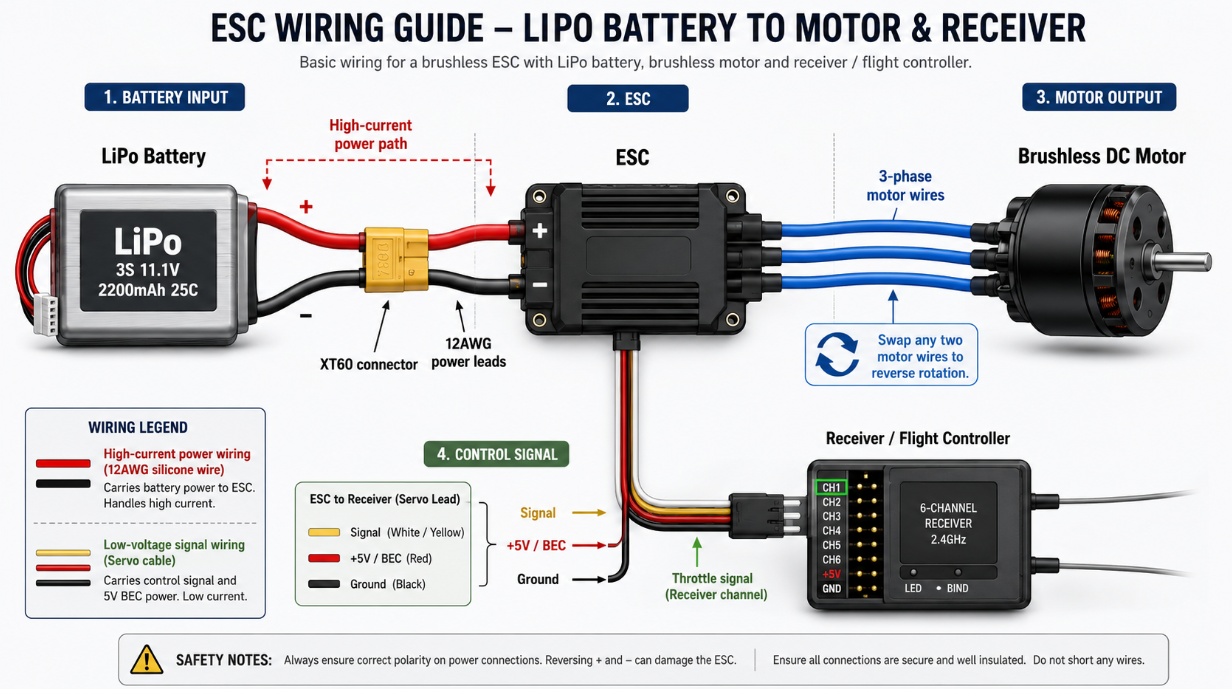
Standard wiring configuration for a brushless ESC, highlighting high-current power input, signal input, and 3-phase motor output lines.
6. Sourcing & Sizing Verification Checklist
Before finalizing your purchase order or integrating an ESC into your prototype, walk through this checklist to ensure system compatibility and electrical safety:
Continuous Current Margin: Is the ESC's continuous current rating at least 20% higher than your motor's maximum measured current draw at 100% throttle?
Voltage Compatibility: Does your battery's maximum fully charged voltage fall safely within the ESC's supported voltage range? (e.g., a fully charged 6S LiPo sits at 25.2V; ensure your ESC is rated for at least 6S/26V).
BEC Sizing (If Applicable): Does your system require a built-in BEC? If so, does the BEC's continuous current rating (e.g., 3A) exceed the total peak current drawn by all connected servos, receivers, and sensors combined?
Motor Type Compatibility: Have you matched a brushed motor only to a brushed ESC, and a brushless motor only to a brushless ESC?
Control Signal & Protocol: Does your flight controller, receiver, or PLC support the specific communication protocol (PWM, Oneshot, or DShot) required by the ESC?
Enclosure and Environmental Rating: Will the ESC be exposed to moisture, dust, or high vibration? If so, is it rated for IP67 waterproofing, or does it feature conformal coating?
Sourcing & Lifecycle Check: Is the ESC or its primary internal silicon (MCU, MOSFETs) in an "Active" lifecycle stage? Avoid spec'ing NRND or obsolete components for commercial designs.
Cooling Requirements: Does your application provide sufficient passive airflow over the ESC heatsink? If mounting the ESC in an enclosed, unventilated space, have you factored in a 50% derating of its maximum continuous current limit?
Frequently Asked Questions (FAQ)
Q1: Why does my ESC get hot even when the motor is running at a low speed?
This is a common issue known as switching loss. At low speeds, the MOSFETs must rapidly turn on and off thousands of times per second to drop the average voltage. Each transition generates thermal energy. In many scenarios, an ESC running at 10% to 50% partial throttle actually runs hotter than it does at 100% full throttle, where the MOSFETs remain continuously open. Ensure you have active airflow or select an ESC with "Active Freewheeling" (or damped light mode) to improve partial-throttle efficiency.
Q2: What happens if I connect the battery polarities backward to the ESC?
Connecting the positive and negative terminals backward (reverse polarity) will result in immediate, catastrophic failure. The internal bypass and filtering capacitors will fail, and the MOSFET bridge will typically short out instantly, often producing smoke or fire. Always double-check your power lead connectors before plugging in a battery.
Q3: Can I run a brushless motor using a brushed ESC, or vice versa?
No. A brushed motor requires a steady variable DC voltage across two leads, whereas a brushless motor requires a highly complex, sequenced 3-phase AC wave across three leads. Connecting a brushed ESC to a brushless motor will result in no rotation, and attempting to connect a brushless ESC to a brushed motor will likely damage the controller's internal commutation circuitry.
Q4: What is the difference between an Opto ESC and a standard ESC?
A standard ESC includes an integrated Battery Eliminator Circuit (BEC) that steps down battery voltage to power your receiver and servos. An Opto ESC lacks this internal regulator. This layout physically isolates the high-power motor circuit from the sensitive control circuit, preventing electrical noise and ground loops from feeding back into your receiver. If using an Opto ESC, you must provide a separate power supply (such as an external UBEC or a dedicated receiver battery) to power your flight controller and servos.
Sources and references used for this guide
Source type: Vendor blog / technical overview
Used for: Explaining the basic components of speed controllers and outlining their general application domains.
Caution: Authored by an electric motor vendor; information is accurate but naturally highlights general electric motor use cases rather than specialized digital protocols.
Source type: Independent electronic components distributor blog
Used for: Distinguishing brushed versus brushless operating concepts and identifying consumer applications.
Caution: High-level distributor guide. Excellent for product sourcing context, but lacks detailed mathematical derivations for motor timing.
Source type: Hobbyist specialist portal
Used for: Detailing the practical differences in surface-vehicle ESCs, active braking profiles, and physical cooling configurations.
Caution: Geared heavily toward hobbyists and recreational RC drivers, rather than high-voltage industrial applications.
Source type: Engineering and motor test equipment manufacturer publication
Used for: Describing Back-EMF sensing loops, physical commutation cycles, and sensorless rotor feedback loops.
Caution: Written by a testing hardware manufacturer; focuses on high-precision measurements and specifications.
Source type: Industrial automation equipment manufacturer blog
Used for: Definitions of industrial speed control, basic power modulation, and industrial safety concepts.
Caution: Primarily addresses mains-powered, industrial motor controllers rather than low-voltage micro-ESC components.
Source type: Professional defense and unmanned aerospace journal
Used for: Outlining fast drone communication protocols (such as DShot), lightweight constraints, and digital telemetry updates.
Caution: Tailored specifically toward commercial drone integration, defense UAV specs, and professional aerospace platforms.
Source type: Open encyclopedia
Used for: Historic context on mechanical speed controls and general operating definitions.
Caution: Curated by the community; useful as a background starting point, but exact wiring and safety precautions must be cross-referenced with manufacturer datasheets.
 UTMEL
UTMEL
We are the professional distributor of electronic components, providing a large variety of products to save you a lot of time, effort, and cost with our efficient self-customized service. careful order preparation fast delivery service
 Modeling Wide Band-Gap Semiconductors for Enhanced PerformanceRakesh Kumar, Ph.D.31 January 20243751
The article delves into the challenges faced by silicon-based power electronic devices and highlights the potential of wide band-gap semiconductors. It also emphasizes the importance of modeling power semiconductor devices and provides insights into various models. For electrical energy conversion to be dependable and effective, power electronics and semiconductor device technologies are essential.
Read More Optimizing Energy Management with Non-Isolated DC-DC ConvertersRakesh Kumar, Ph.D.04 February 20243399
The article classifies DC-DC converters and discusses the benefits and limitations of them. It proposes a modified DC-DC converter topology that combines the Cuk and Positive Output Super Lift Luo topologies to achieve a higher voltage gain with fewer components.
Read More ‘6G Networks’ - Pioneering the Next Era of Connectivity And InnovationRakesh Kumar, Ph.D.18 March 20243708
The article provides a comprehensive overview of the evolving landscape of mobile networks, the requirements that will shape the future of mobile communication, and the innovative technologies driving the transition to 6G.
Read More Review of IoT-Based Smart Home Security Systems- Part 1Rakesh Kumar, Ph.D.28 March 20244173
The article discusses the evolution of IoT-based smart home security systems, integrating advanced technologies like Raspberry Pi, PIR sensors, and voice recognition for enhanced user experience and efficiency.
Read More Understanding Photodiodes: Working Principles and Applications - Part 2Rakesh Kumar, Ph.D.24 May 20245376
The article provides a comprehensive overview of photodiodes, focusing on their operational principles, key factors affecting their efficiency, advantages, and disadvantages, and highlights their diverse applications.
Read More
Subscribe to Utmel !
![WCACCK2]() WCACCK2
WCACCK2Apex Tool Group
![WLTC04LBA12]() WLTC04LBA12
WLTC04LBA12Apex Tool Group
![REM4.5]() REM4.5
REM4.5Chip Quik
![SMD2SWLT.047 2OZ]() SMD2SWLT.047 2OZ
SMD2SWLT.047 2OZChip Quik
![REMKIT4.5]() REMKIT4.5
REMKIT4.5Chip Quik
![REM16-NL]() REM16-NL
REM16-NLChip Quik
![MAX6504UKP005]() MAX6504UKP005
MAX6504UKP005Analog Devices
![917172007]() 917172007
917172007Molex
![24-7068-1407]() 24-7068-1407
24-7068-1407Amphenol
![S-5843A44AA-M5T1U]() S-5843A44AA-M5T1U
S-5843A44AA-M5T1USII Semiconductor