

 Product
 Brand
Brand Articles
 Tools
Tools
ACS711 Current Sensor: Datasheet, Pinout and Applications

Hall Effect, Open Loop Sensor 1-Channel Bidirectional -40°C~85°C 3V~5.5V DC~100kHz Accuracy-±5% Linearity-±1%


Hall Effect, Open Loop Sensor 1-Channel Bidirectional -40°C~85°C 3V~5.5V DC~100kHz Accuracy-±5% Linearity-±1%
ACS711 is a hall-effect linear current sensor with overcurrent fault output for <100 v isolation applications. This article enforces datasheet, pinout, applications, and other details about ACS711.
ACS711 Pinout

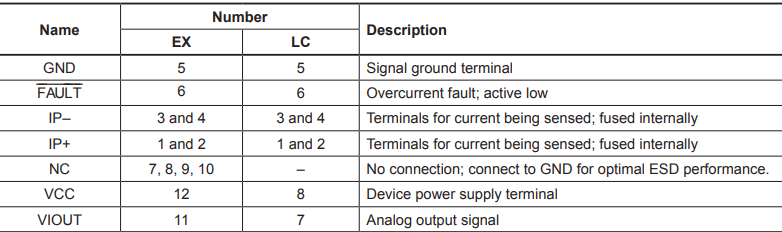
ACS711 CAD Model
Symbol

Footprint

ACS711 Description
The ACS711 provides economical and precise solutions for AC or DC current sensing in <100 V audio, communications systems, and white goods. The device package allows for easy implementation by the customer. Typical applications include circuit protection, current monitoring, and motor and inverter control.
Specifications
- TypeParameter
- Factory Lead Time16 Weeks
- Surface Mount
having leads that are designed to be soldered on the side of a circuit board that the body of the component is mounted on.
YES - Mounting Type
The "Mounting Type" in electronic components refers to the method used to attach or connect a component to a circuit board or other substrate, such as through-hole, surface-mount, or panel mount.
Surface Mount - Package / Case
refers to the protective housing that encases an electronic component, providing mechanical support, electrical connections, and thermal management.
8-SOIC (0.154, 3.90mm Width) - Number of Pins8
- Current Sensing
Current sensing refers to the generation of the voltage signal which is related to the current passing in the circuit.
12.5A - Published2007
- Operating Temperature
The operating temperature is the range of ambient temperature within which a power supply, or any other electrical equipment, operate in. This ranges from a minimum operating temperature, to a peak or maximum operating temperature, outside which, the power supply may fail.
-40°C~85°C - Packaging
Semiconductor package is a carrier / shell used to contain and cover one or more semiconductor components or integrated circuits. The material of the shell can be metal, plastic, glass or ceramic.
Tape & Reel (TR) - JESD-609 Code
The "JESD-609 Code" in electronic components refers to a standardized marking code that indicates the lead-free solder composition and finish of electronic components for compliance with environmental regulations.
e3 - Pbfree Code
The "Pbfree Code" parameter in electronic components refers to the code or marking used to indicate that the component is lead-free. Lead (Pb) is a toxic substance that has been widely used in electronic components for many years, but due to environmental concerns, there has been a shift towards lead-free alternatives. The Pbfree Code helps manufacturers and users easily identify components that do not contain lead, ensuring compliance with regulations and promoting environmentally friendly practices. It is important to pay attention to the Pbfree Code when selecting electronic components to ensure they meet the necessary requirements for lead-free applications.
yes - Part Status
Parts can have many statuses as they progress through the configuration, analysis, review, and approval stages.
Active - Moisture Sensitivity Level (MSL)
Moisture Sensitivity Level (MSL) is a standardized rating that indicates the susceptibility of electronic components, particularly semiconductors, to moisture-induced damage during storage and the soldering process, defining the allowable exposure time to ambient conditions before they require special handling or baking to prevent failures
2 (1 Year) - Number of Terminations8
- Terminal Finish
Terminal Finish refers to the surface treatment applied to the terminals or leads of electronic components to enhance their performance and longevity. It can improve solderability, corrosion resistance, and overall reliability of the connection in electronic assemblies. Common finishes include nickel, gold, and tin, each possessing distinct properties suitable for various applications. The choice of terminal finish can significantly impact the durability and effectiveness of electronic devices.
Matte Tin (Sn) - Voltage - Supply
Voltage - Supply refers to the range of voltage levels that an electronic component or circuit is designed to operate with. It indicates the minimum and maximum supply voltage that can be applied for the device to function properly. Providing supply voltages outside this range can lead to malfunction, damage, or reduced performance. This parameter is critical for ensuring compatibility between different components in a circuit.
3V~5.5V - Frequency
In electronic components, the parameter "Frequency" refers to the rate at which a signal oscillates or cycles within a given period of time. It is typically measured in Hertz (Hz) and represents how many times a signal completes a full cycle in one second. Frequency is a crucial aspect in electronic components as it determines the behavior and performance of various devices such as oscillators, filters, and communication systems. Understanding the frequency characteristics of components is essential for designing and analyzing electronic circuits to ensure proper functionality and compatibility with other components in a system.
DC~100kHz - Output
In electronic components, the parameter "Output" typically refers to the signal or data that is produced by the component and sent to another part of the circuit or system. The output can be in the form of voltage, current, frequency, or any other measurable quantity depending on the specific component. The output of a component is often crucial in determining its functionality and how it interacts with other components in the circuit. Understanding the output characteristics of electronic components is essential for designing and troubleshooting electronic circuits effectively.
Ratiometric, Voltage - Current - Supply (Max)
The parameter "Current - Supply (Max)" in electronic components refers to the maximum amount of current that a component can draw from a power supply for its operation. This parameter is critical for ensuring that the power supply can adequately meet the demands of the component without causing damage or malfunction. Exceeding this specified maximum current can lead to overheating, reduced performance, or failure of the component. It is essential to consider this value when designing or integrating components into electronic circuits to maintain reliability and functionality.
5.5mA - Body Length or Diameter
Body length or diameter in electronic components refers to the physical dimensions of a component's housing, typically measured in millimeters or inches. It indicates the size of the component that affects its fit within a circuit board or system. This parameter is crucial for ensuring compatibility with the design and mounting of electronic devices. It can impact heat dissipation, electrical performance, and overall assembly efficiency. Accurate measurement of body length or diameter is essential for proper component selection and placement in electronic applications.
4.9mm - Body Breadth
Body breadth in electronic components refers to the width of the physical body of a component, such as a resistor, capacitor, or integrated circuit. This measurement is crucial for ensuring proper fit within a circuit board or enclosure. It can affect the component's thermal performance, mechanical stability, and overall compatibility with other components in a design. Body breadth is typically specified in millimeters or inches and is an important factor in the selection and design of electronic assemblies.
3.9 mm - Operating Supply Voltage
The voltage level by which an electrical system is designated and to which certain operating characteristics of the system are related.
3.3V - Number of Channels1
- Termination Type
Termination Type in electronic components refers to the method used to connect the component to a circuit board or other electronic devices. It specifies how the component's leads or terminals are designed for soldering or mounting onto a PCB. Common termination types include through-hole, surface mount, and wire lead terminations. The termination type is an important consideration when selecting components for a circuit design, as it determines how the component will be physically connected within the circuit. Different termination types offer varying levels of durability, ease of assembly, and suitability for specific applications.
SOLDER - Polarization
In electronic components, polarization refers to the orientation or alignment of certain properties within the component. This property can affect the behavior and performance of the component in a circuit. For example, in capacitors, polarization refers to the alignment of the electric field within the dielectric material. Polarized capacitors, such as electrolytic capacitors, have a specific orientation for proper functioning. In other components like diodes, polarization refers to the direction of current flow, which is important for their correct operation. Understanding polarization is crucial for proper usage and integration of electronic components in circuits.
Bidirectional - Accuracy
Accuracy in electronic components refers to the degree to which a measured value agrees with the true or accepted value. It evaluates the precision of a component in providing correct output or measurement under specified conditions. High accuracy indicates minimal deviation from the actual value, while low accuracy shows significant error in measurement. This parameter is crucial in applications where precise data is essential for reliable performance and decision-making.
±5% - Response Time
the time taken for a circuit or measuring device, when subjected to a change in input signal, to change its state by a specified fraction of its total response to that change.
4.6μs - Sensor Type
In electronic components, the parameter "Sensor Type" refers to the specific type of sensor technology used in a particular component to detect and measure physical phenomena such as light, temperature, pressure, motion, or proximity. Different sensor types utilize various principles and mechanisms to convert the detected input into an electrical signal that can be processed by the electronic component. Common sensor types include photodiodes, thermistors, accelerometers, and proximity sensors, each designed for specific applications and environments. Understanding the sensor type is crucial for selecting the right component for a given task and ensuring accurate and reliable sensing capabilities in electronic systems.
Hall Effect, Open Loop - -3db Bandwidth
The "-3dB bandwidth" of an electronic component refers to the frequency range over which the component's output signal power is reduced by 3 decibels (dB) compared to its maximum output power. This parameter is commonly used to describe the frequency response of components such as amplifiers, filters, and other signal processing devices. The -3dB point is significant because it represents the half-power point, where the output signal power is reduced to half of its maximum value. Understanding the -3dB bandwidth is important for designing and analyzing electronic circuits to ensure that signals are accurately processed within the desired frequency range.
100 kHz - Linearity
In electronic components, linearity refers to the relationship between the input and output signals of the component. A component is said to be linear if its output is directly proportional to its input over a specified range. In other words, when the input signal changes, the output signal changes in a consistent and predictable manner without introducing distortion or non-linear effects.Linearity is an important parameter in electronic components such as amplifiers, filters, and sensors, as it determines the accuracy and fidelity of signal processing. Non-linearities in components can lead to signal distortion, harmonic generation, and other undesirable effects that can degrade the performance of electronic systems.Engineers often characterize the linearity of components by measuring parameters such as gain error, harmonic distortion, and intermodulation distortion. By ensuring that components exhibit good linearity characteristics, designers can create electronic systems that accurately process signals and faithfully reproduce the desired output.
±1% - Sensors/Transducers Type
In electronic components, the parameter "Sensors/Transducers Type" refers to the specific type of sensor or transducer that is integrated into the component. Sensors are devices that detect changes in physical properties and convert them into electrical signals, while transducers are devices that convert one form of energy into another. The type of sensor or transducer used in an electronic component can vary widely depending on the intended application, such as temperature sensors, pressure sensors, proximity sensors, accelerometers, and more. Understanding the Sensors/Transducers Type parameter is crucial for selecting the right component for a particular electronic system or device, as different types of sensors/transducers have different functionalities and performance characteristics.
PROXIMITY SENSOR,HALL EFFECT - For Measuring
The parameter "For Measuring" in electronic components refers to the specific characteristics or properties of the component that can be measured to determine its performance, functionality, or quality. These parameters are essential for evaluating the behavior of the component in a circuit and ensuring that it meets the required specifications.Common parameters for measuring electronic components include resistance, capacitance, inductance, voltage, current, frequency, temperature coefficient, and power rating. These measurements help engineers and technicians understand how the component will interact with other elements in a circuit and whether it will perform as expected.Accurate measurement of these parameters is crucial for designing and troubleshooting electronic circuits, as deviations from the specified values can lead to malfunctions or failures. Various testing equipment such as multimeters, oscilloscopes, and signal generators are used to measure these parameters accurately.
AC/DC - Sensitivity (mV/A)
The parameter "Sensitivity (mV/A)" in electronic components refers to the ratio of the output voltage to the input current of a sensor or transducer. It indicates how much the output voltage of the component changes in response to a change in the input current. A higher sensitivity value means that a small change in input current will result in a larger change in output voltage, making the component more responsive to variations in the input signal. Sensitivity is an important characteristic in sensors and transducers as it determines the accuracy and precision of the measurements they provide.
110 mV/A - RoHS Status
RoHS means “Restriction of Certain Hazardous Substances” in the “Hazardous Substances Directive” in electrical and electronic equipment.
ROHS3 Compliant
ACS711 Block Diagram
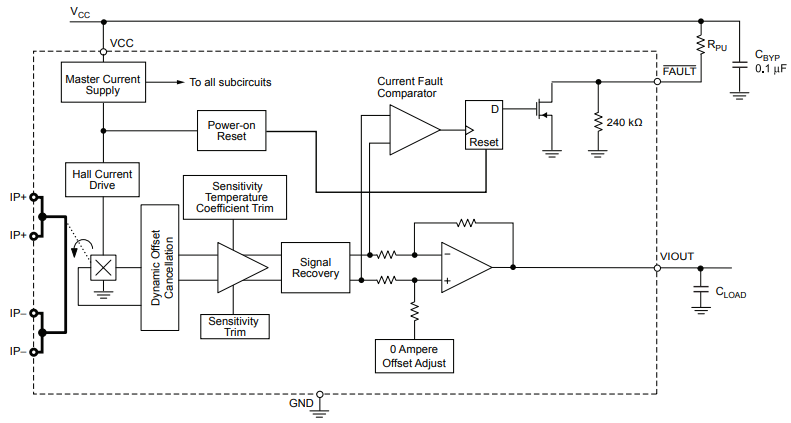
ACS711 Features
• No external sense resistor required; single package solution
• Reduced power loss:
□ 0.6 mΩ internal conductor resistance on EX package
□ 1.2 mΩ internal conductor resistance on LC package
• Economical low- and high-side current sensing
• Output voltage proportional to AC or DC currents
• ±12.5 A and ±25 A full-scale sensing ranges on LC package
• ±15.5 A and ±31 A full-scale sensing ranges on EX package
• Overcurrent Fault trips and latches at 100% of full-scale current
• Low-noise analog signal path
• 100 kHz bandwidth
• Small footprint, low-profile SOIC8, and QFN packages
• 3 to 5.5 V single-supply operation
• Integrated electrostatic shield for output stability
• Factory-trimmed for accuracy
• Extremely stable output offset voltage
• Zero magnetic hysteresis
• Ratiometric output from the supply voltage
ACS711 Applications
Typical applications include circuit protection, current monitoring, and motor and inverter control.
ACS711 Typical Application Diagram

ACS711 Pakcage

ACS711 Manufacturer
As a leading company in the development, manufacture, and market of high-performance semiconductors, Allegro MicroSystems, LLC provides high-growth applications for the automotive market and also stays focus on consumer/communications, automation, and industrial solutions. Headquartered in Worcester, Massachusetts (USA) Allegro locates its design, applications, and sales support centers worldwide.
Parts with Similar Specs
- ImagePart NumberManufacturerNumber of ChannelsCurrent - SensingFrequencyAccuracyLinearityResponse TimeMax Supply CurrentRoHS StatusView Compare
![ACS711ELCTR-12AB-T]()
ACS711ELCTR-12AB-T
1
12.5A
DC ~ 100kHz
±5%
±1%
4.6μs
5.5 mA
ROHS3 Compliant
![ACS711KEXLT-15AB-T]()
1
15.5A
DC ~ 100kHz
±5%
±1%
4.6μs
5.5 mA
ROHS3 Compliant
![ACS711EEXLT-15AB-T]()
1
12.5A
DC ~ 100kHz
±5%
±1%
4.6μs
5.5 mA
ROHS3 Compliant
![ACS711KLCTR-12AB-T]()
1
15.5A
DC ~ 100kHz
±5%
±1%
4.6μs
5.5 mA
ROHS3 Compliant


Datasheet PDF
- Datasheets :
Trend Analysis
What is acs711 used for?
The Allegro™ ACS711 provides economical and precise solutions for AC or DC current sensing in <100 V audio, communications systems, and white goods. The device package allows for easy implementation by the customer. Typical applications include circuit protection, current monitoring, and motor and inverter control.
How does acs711 work?
The device consists of a linear Hall sensor circuit with a copper conduction path located near the surface of the die. Applied current flowing through this copper conduction path generates a magnetic field which is sensed by the integrated Hall IC and converted into a proportional voltage.
Where to use acs711?
Typical applications include circuit protection, current monitoring, and motor and inverter control. The device consists of a linear Hall sensor circuit with a copper conduction path located near the surface of the die.
 STM32H747XIH6 Microcontroller: Features, Applications and Datasheet
26 December 20237632
 AVR® ATtiny 4KB 8-bit MCU: Datasheet, Pinout, and Performance Deep Dive
12 February 2026554
 SS14 Diode: Package, Pinout and Datasheet
24 August 20219592
 TPS2051CDBVR Power-Distribution Switches: Layout, Pinout, and Datasheet
09 April 20222199
 VB300 3-Axis G-Force Datalogger:Battery Replacement, Features and Application
08 January 20221412
 IRLML2502 Rectifier: Package, Pinout, and Datasheet
12 October 20215389
![RN42-I/RM Bluetooth Bluetooth v2.1 +EDR Transceiver Module[Video]: Datasheet, Features, and Pinout](https://res.utmel.com/Images/Article/819bff82-5d76-4c74-8bb5-c189bedb82fa.jpg) RN42-I/RM Bluetooth Bluetooth v2.1 +EDR Transceiver Module[Video]: Datasheet, Features, and Pinout
RN42-I/RM Bluetooth Bluetooth v2.1 +EDR Transceiver Module[Video]: Datasheet, Features, and Pinout16 March 20222381
 A Comprehensive Guide to LTC6420CUDC-20#TRPBF ADC Driver
06 March 2024174
 Classification and Application of UV Sensor
20 October 20215739
 What Size Wire for a 60 Amp Breaker? The Complete NEC Guide
22 May 20268356
 Semiconductor Materials:Types, Properties and Production Process
21 October 202527701
 What Makes Time Delay Relays Essential in Automation
10 July 20252146
 What is Mouse in Computer?
14 February 20226752
 Best 1N4007 diode alternatives to use in 2025
25 August 20259918
 How Fast is Wi-Fi 6?
07 June 20217769
 Introduction to TTL and CMOS Logic Gate Circuits
24 November 202524335
Allegro MicroSystems
In Stock
United States
China
Canada
Japan
Russia
Germany
United Kingdom
Singapore
Italy
Hong Kong(China)
Taiwan(China)
France
Korea
Mexico
Netherlands
Malaysia
Austria
Spain
Switzerland
Poland
Thailand
Vietnam
India
United Arab Emirates
Afghanistan
Åland Islands
Albania
Algeria
American Samoa
Andorra
Angola
Anguilla
Antigua & Barbuda
Argentina
Armenia
Aruba
Australia
Azerbaijan
Bahamas
Bahrain
Bangladesh
Barbados
Belarus
Belgium
Belize
Benin
Bermuda
Bhutan
Bolivia
Bonaire, Sint Eustatius and Saba
Bosnia & Herzegovina
Botswana
Brazil
British Indian Ocean Territory
British Virgin Islands
Brunei
Bulgaria
Burkina Faso
Burundi
Cabo Verde
Cambodia
Cameroon
Cayman Islands
Central African Republic
Chad
Chile
Christmas Island
Cocos (Keeling) Islands
Colombia
Comoros
Congo
Congo (DRC)
Cook Islands
Costa Rica
Côte d’Ivoire
Croatia
Cuba
Curaçao
Cyprus
Czechia
Denmark
Djibouti
Dominica
Dominican Republic
Ecuador
Egypt
El Salvador
Equatorial Guinea
Eritrea
Estonia
Eswatini
Ethiopia
Falkland Islands
Faroe Islands
Fiji
Finland
French Guiana
French Polynesia
Gabon
Gambia
Georgia
Ghana
Gibraltar
Greece
Greenland
Grenada
Guadeloupe
Guam
Guatemala
Guernsey
Guinea
Guinea-Bissau
Guyana
Haiti
Honduras
Hungary
Iceland
Indonesia
Iran
Iraq
Ireland
Isle of Man
Israel
Jamaica
Jersey
Jordan
Kazakhstan
Kenya
Kiribati
Kosovo
Kuwait
Kyrgyzstan
Laos
Latvia
Lebanon
Lesotho
Liberia
Libya
Liechtenstein
Lithuania
Luxembourg
Macao(China)
Madagascar
Malawi
Maldives
Mali
Malta
Marshall Islands
Martinique
Mauritania
Mauritius
Mayotte
Micronesia
Moldova
Monaco
Mongolia
Montenegro
Montserrat
Morocco
Mozambique
Myanmar
Namibia
Nauru
Nepal
New Caledonia
New Zealand
Nicaragua
Niger
Nigeria
Niue
Norfolk Island
North Korea
North Macedonia
Northern Mariana Islands
Norway
Oman
Pakistan
Palau
Palestinian Authority
Panama
Papua New Guinea
Paraguay
Peru
Philippines
Pitcairn Islands
Portugal
Puerto Rico
Qatar
Réunion
Romania
Rwanda
Samoa
San Marino
São Tomé & Príncipe
Saudi Arabia
Senegal
Serbia
Seychelles
Sierra Leone
Sint Maarten
Slovakia
Slovenia
Solomon Islands
Somalia
South Africa
South Sudan
Sri Lanka
St Helena, Ascension, Tristan da Cunha
St. Barthélemy
St. Kitts & Nevis
St. Lucia
St. Martin
St. Pierre & Miquelon
St. Vincent & Grenadines
Sudan
Suriname
Svalbard & Jan Mayen
Sweden
Syria
Tajikistan
Tanzania
Timor-Leste
Togo
Tokelau
Tonga
Trinidad & Tobago
Tunisia
Turkey
Turkmenistan
Turks & Caicos Islands
Tuvalu
U.S. Outlying Islands
U.S. Virgin Islands
Uganda
Ukraine
Uruguay
Uzbekistan
Vanuatu
Vatican City
Venezuela
Wallis & Futuna
Yemen
Zambia
Zimbabwe
![ACS754SCB-050-PFF]() ACS754SCB-050-PFF
ACS754SCB-050-PFFAllegro MicroSystems
![ACS773ECB-200B-PFF-T]() ACS773ECB-200B-PFF-T
ACS773ECB-200B-PFF-TAllegro MicroSystems
![ACS712ELCTR-05B-T]() ACS712ELCTR-05B-T
ACS712ELCTR-05B-TAllegro MicroSystems
![ACS710KLATR-25CB-T]() ACS710KLATR-25CB-T
ACS710KLATR-25CB-TAllegro MicroSystems
![ACS758LCB-100B-PFF-T]() ACS758LCB-100B-PFF-T
ACS758LCB-100B-PFF-TAllegro MicroSystems
![ACS711KEXLT-15AB-T]() ACS711KEXLT-15AB-T
ACS711KEXLT-15AB-TAllegro MicroSystems
![ACS713ELCTR-20A-T]() ACS713ELCTR-20A-T
ACS713ELCTR-20A-TAllegro MicroSystems
![ACS770LCB-050B-PFF-T]() ACS770LCB-050B-PFF-T
ACS770LCB-050B-PFF-TAllegro MicroSystems
![ACS758ECB-200B-PFF-T]() ACS758ECB-200B-PFF-T
ACS758ECB-200B-PFF-TAllegro MicroSystems
![ACS710KLATR-12CB-T]() ACS710KLATR-12CB-T
ACS710KLATR-12CB-TAllegro MicroSystems

