Product
 Brand
Brand Articles
 Tools
Tools
AON7403 P-Channel MOSFET: 30V 11A 8DFN, AON7403 Datasheet and Equivalents

Alpha & Omega Semiconductor Inc.
P-Channel Tape & Reel (TR) 18m Ω @ 8A, 10V ±25V 1400pF @ 15V 24nC @ 15V 30V 8-PowerVDFN


P-Channel Tape & Reel (TR) 18m Ω @ 8A, 10V ±25V 1400pF @ 15V 24nC @ 15V 30V 8-PowerVDFN
AON7403 is a 30V P-Channel MOSFET. This article is going to explain guidance details about AON7403 MOSFET and explain the types and usage of p-channel MOSFET.

MOSFET - Enhancement Type MOSFET Explained
What is AON7403?
AON7403 Pinout
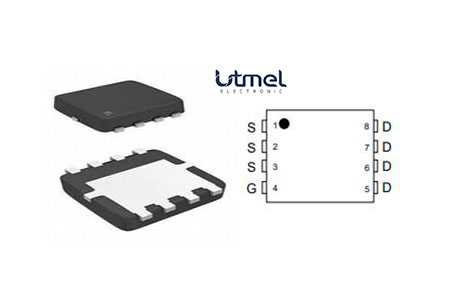
AON7403 Pinout
AON7403 CAD Model
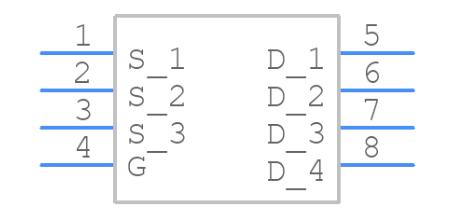
AON7403 Symbol
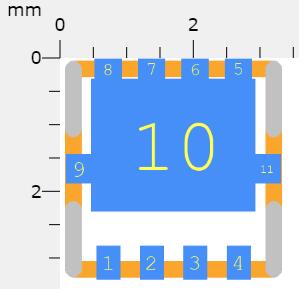
AON7403 Footprint
Specifications
- TypeParameter
- Factory Lead Time16 Weeks
- Mount
In electronic components, the term "Mount" typically refers to the method or process of physically attaching or fixing a component onto a circuit board or other electronic device. This can involve soldering, adhesive bonding, or other techniques to secure the component in place. The mounting process is crucial for ensuring proper electrical connections and mechanical stability within the electronic system. Different components may have specific mounting requirements based on their size, shape, and function, and manufacturers provide guidelines for proper mounting procedures to ensure optimal performance and reliability of the electronic device.
Surface Mount - Mounting Type
The "Mounting Type" in electronic components refers to the method used to attach or connect a component to a circuit board or other substrate, such as through-hole, surface-mount, or panel mount.
Surface Mount - Package / Case
refers to the protective housing that encases an electronic component, providing mechanical support, electrical connections, and thermal management.
8-PowerVDFN - Number of Pins8
- Transistor Element Material
The "Transistor Element Material" parameter in electronic components refers to the material used to construct the transistor within the component. Transistors are semiconductor devices that amplify or switch electronic signals and are a fundamental building block in electronic circuits. The material used for the transistor element can significantly impact the performance and characteristics of the component. Common materials used for transistor elements include silicon, germanium, and gallium arsenide, each with its own unique properties and suitability for different applications. The choice of transistor element material is crucial in designing electronic components to meet specific performance requirements such as speed, power efficiency, and temperature tolerance.
SILICON - Current - Continuous Drain (Id) @ 25℃11A Ta 29A Tc
- Drive Voltage (Max Rds On, Min Rds On)5V 10V
- Number of Elements1
- Power Dissipation (Max)3.1W Ta 25W Tc
- Voltage - Gate Threshold (Vgs(th)) (Max) @ Id3V @ 250μA
- Operating Temperature
The operating temperature is the range of ambient temperature within which a power supply, or any other electrical equipment, operate in. This ranges from a minimum operating temperature, to a peak or maximum operating temperature, outside which, the power supply may fail.
-55°C~150°C TJ - Packaging
Semiconductor package is a carrier / shell used to contain and cover one or more semiconductor components or integrated circuits. The material of the shell can be metal, plastic, glass or ceramic.
Tape & Reel (TR) - Published2011
- Part Status
Parts can have many statuses as they progress through the configuration, analysis, review, and approval stages.
Obsolete - Moisture Sensitivity Level (MSL)
Moisture Sensitivity Level (MSL) is a standardized rating that indicates the susceptibility of electronic components, particularly semiconductors, to moisture-induced damage during storage and the soldering process, defining the allowable exposure time to ambient conditions before they require special handling or baking to prevent failures
1 (Unlimited) - Number of Terminations5
- ECCN Code
An ECCN (Export Control Classification Number) is an alphanumeric code used by the U.S. Bureau of Industry and Security to identify and categorize electronic components and other dual-use items that may require an export license based on their technical characteristics and potential for military use.
EAR99 - Terminal Position
In electronic components, the term "Terminal Position" refers to the physical location of the connection points on the component where external electrical connections can be made. These connection points, known as terminals, are typically used to attach wires, leads, or other components to the main body of the electronic component. The terminal position is important for ensuring proper connectivity and functionality of the component within a circuit. It is often specified in technical datasheets or component specifications to help designers and engineers understand how to properly integrate the component into their circuit designs.
DUAL - Terminal Form
Occurring at or forming the end of a series, succession, or the like; closing; concluding.
FLAT - JESD-30 Code
JESD-30 Code refers to a standardized descriptive designation system established by JEDEC for semiconductor-device packages. This system provides a systematic method for generating designators that convey essential information about the package's physical characteristics, such as size and shape, which aids in component identification and selection. By using JESD-30 codes, manufacturers and engineers can ensure consistency and clarity in the specification of semiconductor packages across various applications and industries.
S-PDSO-F5 - Qualification Status
An indicator of formal certification of qualifications.
Not Qualified - Configuration
The parameter "Configuration" in electronic components refers to the specific arrangement or setup of the components within a circuit or system. It encompasses how individual elements are interconnected and their physical layout. Configuration can affect the functionality, performance, and efficiency of the electronic system, and may influence factors such as signal flow, impedance, and power distribution. Understanding the configuration is essential for design, troubleshooting, and optimizing electronic devices.
SINGLE WITH BUILT-IN DIODE - Operating Mode
A phase of operation during the operation and maintenance stages of the life cycle of a facility.
ENHANCEMENT MODE - Power Dissipation
the process by which an electronic or electrical device produces heat (energy loss or waste) as an undesirable derivative of its primary action.
25W - Case Connection
Case Connection refers to the method by which an electronic component's case or housing is connected to the electrical circuit. This connection is important for grounding purposes, mechanical stability, and heat dissipation. The case connection can vary depending on the type of component and its intended application. It is crucial to ensure a secure and reliable case connection to maintain the overall performance and safety of the electronic device.
DRAIN - FET Type
"FET Type" refers to the type of Field-Effect Transistor (FET) being used in an electronic component. FETs are three-terminal semiconductor devices that can be classified into different types based on their construction and operation. The main types of FETs include Metal-Oxide-Semiconductor FETs (MOSFETs), Junction FETs (JFETs), and Insulated-Gate Bipolar Transistors (IGBTs).Each type of FET has its own unique characteristics and applications. MOSFETs are commonly used in digital circuits due to their high input impedance and low power consumption. JFETs are often used in low-noise amplifiers and switching circuits. IGBTs combine the high input impedance of MOSFETs with the high current-carrying capability of bipolar transistors, making them suitable for high-power applications like motor control and power inverters.When selecting an electronic component, understanding the FET type is crucial as it determines the device's performance and suitability for a specific application. It is important to consider factors such as voltage ratings, current handling capabilities, switching speeds, and power dissipation when choosing the right FET type for a particular circuit design.
P-Channel - Transistor Application
In the context of electronic components, the parameter "Transistor Application" refers to the specific purpose or function for which a transistor is designed and used. Transistors are semiconductor devices that can amplify or switch electronic signals and are commonly used in various electronic circuits. The application of a transistor can vary widely depending on its design and characteristics, such as whether it is intended for audio amplification, digital logic, power control, or radio frequency applications. Understanding the transistor application is important for selecting the right type of transistor for a particular circuit or system to ensure optimal performance and functionality.
SWITCHING - Rds On (Max) @ Id, Vgs
Rds On (Max) @ Id, Vgs refers to the maximum on-resistance of a MOSFET or similar transistor when it is fully turned on or in the saturation region. It is specified at a given drain current (Id) and gate-source voltage (Vgs). This parameter indicates how much resistance the component will offer when conducting, impacting power loss and efficiency in a circuit. Lower Rds On values are preferred for better performance in switching applications.
18m Ω @ 8A, 10V - Input Capacitance (Ciss) (Max) @ Vds
The parameter "Input Capacitance (Ciss) (Max) @ Vds" in electronic components refers to the maximum input capacitance measured at a specific drain-source voltage (Vds). Input capacitance is a crucial parameter in field-effect transistors (FETs) and power MOSFETs, as it represents the total capacitance at the input terminal of the device. This capacitance affects the device's switching speed and overall performance, as it influences the time required for charging and discharging during operation. Manufacturers provide this parameter to help designers understand the device's input characteristics and make informed decisions when integrating it into a circuit.
1400pF @ 15V - Gate Charge (Qg) (Max) @ Vgs
Gate Charge (Qg) (Max) @ Vgs refers to the maximum amount of charge that must be supplied to the gate of a MOSFET or similar device to fully turn it on, measured at a specific gate-source voltage (Vgs). This parameter is crucial for understanding the switching characteristics of the device, as it influences the speed at which the gate can charge and discharge. A higher gate charge value often implies slower switching speeds, which can impact the efficiency of high-frequency applications. This parameter is typically specified in nanocoulombs (nC) in the component's datasheet.
24nC @ 15V - Drain to Source Voltage (Vdss)
The Drain to Source Voltage (Vdss) is a key parameter in electronic components, particularly in field-effect transistors (FETs) such as MOSFETs. It refers to the maximum voltage that can be applied between the drain and source terminals of the FET without causing damage to the component. Exceeding this voltage limit can lead to breakdown and potentially permanent damage to the device.Vdss is an important specification to consider when designing or selecting components for a circuit, as it determines the operating range and reliability of the FET. It is crucial to ensure that the Vdss rating of the component is higher than the maximum voltage expected in the circuit to prevent failures and ensure proper functionality.In summary, the Drain to Source Voltage (Vdss) is a critical parameter that defines the maximum voltage tolerance of a FET component and plays a significant role in determining the overall performance and reliability of electronic circuits.
30V - Vgs (Max)
Vgs (Max) refers to the maximum gate-source voltage that can be applied to a field-effect transistor (FET) without causing damage to the component. This parameter is crucial in determining the safe operating limits of the FET and helps prevent overvoltage conditions that could lead to device failure. Exceeding the specified Vgs (Max) rating can result in breakdown of the gate oxide layer, leading to permanent damage to the FET. Designers must ensure that the applied gate-source voltage does not exceed the maximum rating to ensure reliable and long-term operation of the electronic component.
±25V - Continuous Drain Current (ID)
Continuous Drain Current (ID) is a key parameter in electronic components, particularly in field-effect transistors (FETs) such as MOSFETs. It refers to the maximum current that can flow continuously through the drain terminal of the FET without causing damage to the component. This parameter is crucial for determining the power handling capability of the FET and is specified by the manufacturer in the component's datasheet. Designers must ensure that the actual operating current does not exceed the specified Continuous Drain Current to prevent overheating and potential failure of the component.
29A - Gate to Source Voltage (Vgs)
The Gate to Source Voltage (Vgs) is a crucial parameter in electronic components, particularly in field-effect transistors (FETs) such as MOSFETs. It refers to the voltage difference between the gate and source terminals of the FET. This voltage determines the conductivity of the FET and controls the flow of current through the device. By varying the Vgs, the FET can be switched on or off, allowing for precise control of electronic circuits. Understanding and properly managing the Vgs is essential for ensuring the reliable and efficient operation of FET-based circuits.
25V - DS Breakdown Voltage-Min
The parameter "DS Breakdown Voltage-Min" in electronic components refers to the minimum voltage at which the device will experience a breakdown in its Drain-Source (DS) junction. This voltage represents the point at which the component can no longer effectively regulate or control the flow of current, leading to potential damage or failure. It is an important specification to consider when designing or selecting components for a circuit, as exceeding this breakdown voltage can result in permanent damage to the device. Manufacturers provide this specification to ensure proper usage and to help engineers determine the appropriate operating conditions for the component.
30V - RoHS Status
RoHS means “Restriction of Certain Hazardous Substances” in the “Hazardous Substances Directive” in electrical and electronic equipment.
ROHS3 Compliant
AON7403 Features
Type of Transistor: MOSFET
Type of Control Channel: P -Channel
Maximum Power Dissipation (Pd): 25 W
Maximum Drain-Source Voltage |Vds|: 30 V
Maximum Gate-Source Voltage |Vgs|: 25 V
Maximum Gate-Threshold Voltage |Vgs(th)|: 3 V
Maximum Drain Current |Id|: 29 A
Maximum Junction Temperature (Tj): 150 °C
Rise Time (tr): 8.5 nS
Drain-Source Capacitance (Cd): 240 pF
Maximum Drain-Source On-State Resistance (Rds): 0.018 Ohm
AON7403 Equivalents
AON7280 , AON7290 , AON7292 , AON7296 , AON7400 , AON7400A , AON7401 , AON7402 , 2N5484 , AON7404 , AON7405 , AON7406 , AON7407 , AON7408 , AON7409 , AON7410 , AON7412
The Introduction to P-Channel MOSFET
A P-Channel MOSFET is a type of MOSFET with a predominance of holes as current carriers in the channel. The majority of the current goes through the channels while the MOSFET is enabled and on holes traveling through the channels. This is in contrast to the other type of MOSFET. N-Channel MOSFETs, which have electrons as the bulk of current carriers.
There are 2 types of P-Channel MOSFETs, enhancement-type MOSFETs, and depletion-type MOSFETs.
How a P-Channel MOSFET Works
How a P-Channel Enhancement -type MOSFET Works
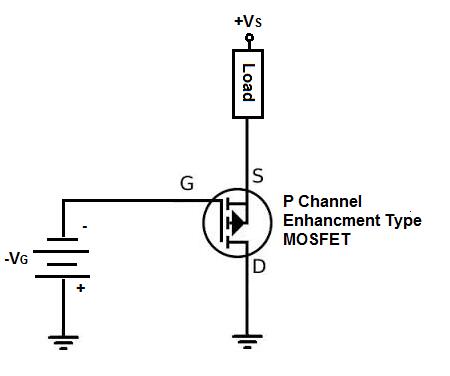
Apply a positive voltage VS to the source of a P-Channel Enhancement -type MOSFET and a negative voltage to the gate terminal of the MOSFET to turn it on (the gate must be sufficiently more negative than the threshold voltage across the drain-source region) (VGDS). A current will be able to pass across the source-drain channel as a result of this.
The P-Channel Enhancement -type MOSFET is completely functional and in the active 'ON' mode of operation when a sufficiently positive voltage, VS, is applied to the source and load, and a sufficient negative voltage is applied to the gate.
To turn off a P-channel enhancement type MOSFET. there are 2 steps you can take. You can either cut off the bias positive voltage, VS, that powers the source. Or you can turn off the negative voltage going to the gate of the transistor.
How a P-Channel Depletion Type MOSFET Works
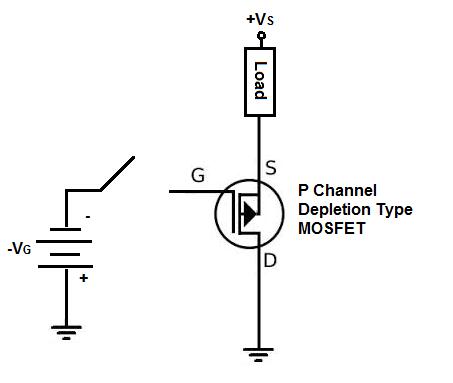
The gate voltage feeding the gate terminal should be 0V to turn on a P-Channel Depletion-Type MOSFET for maximum operation. The drain current is at its maximum magnitude when the gate voltage is 0V, and the transistor is in the active 'ON' zone of conduction.
There are two methods for turning off a P-channel MOSFET, You can either turn off the bias positive voltage, VDD, which drives the drain, or you can leave it on. Alternatively, a negative voltage can be applied to the gate. The current is lowered when a negative voltage is applied to the gate. The current decreases as the gate voltage, VG, grows more negative until cutoff, at which point the MOSFET is in the 'OFF' state. A huge source-drain current is halted.
AON7403 Dimensions
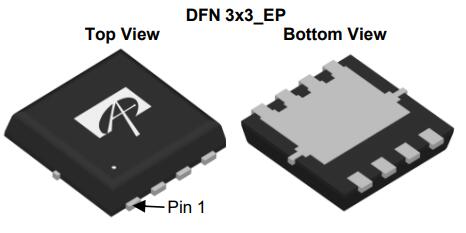
AON7403 Dimensions
AON7403 Manufacturer
Alpha and Omega Semiconductor, Inc., or AOS, is a designer, developer, and global supplier of a broad range of power semiconductors, including a wide portfolio of Power MOSFET and Power IC products. AOS seeks to differentiate itself by integrating its expertise in device physics, process technology, design, and advanced packaging to optimize product performance and cost, and its product portfolio is designed to meet the ever-increasing power efficiency requirements in high volume applications, including portable computers, flat-panel TVs, battery packs, portable media players and power supplies.
Similar Parts from AOS:
Parts with Similar Specs
- ImagePart NumberManufacturerMountPackage / CaseDrain to Source Voltage (Vdss)Continuous Drain Current (ID)Current - Continuous Drain (Id) @ 25°CRoHS StatusMoisture Sensitivity Level (MSL)Mounting TypeView Compare
![AON7403]()
AON7403
Surface Mount
8-PowerVDFN
30V
29 A
11A (Ta), 29A (Tc)
ROHS3 Compliant
1 (Unlimited)
Surface Mount
![DMG4800LFG-7]()
Surface Mount
8-PowerUDFN
30V
7.44 A
7.44A (Ta)
ROHS3 Compliant
1 (Unlimited)
Surface Mount
![DMG4468LFG-7]()
Surface Mount
8-PowerUDFN
30V
7.62 A
7.62A (Ta)
ROHS3 Compliant
1 (Unlimited)
Surface Mount
![DMP32D4SFB-7B]()
Surface Mount
3-UFDFN
30V
500 mA
400mA (Ta)
ROHS3 Compliant
1 (Unlimited)
Surface Mount


Trend Analysis
Datasheet PDF
- PCN Assembly/Origin :
- Datasheets :
- PCN Obsolescence/ EOL :
What is the voltage of a P-Channel MOSFET?
30V
What is a type of MOSFET with a predominance of holes as current carriers in the channel?
P-Channel MOSFET
What is the AON7403 suitable for?
Load switch or in PWM applications
What technology does the AON7403 use to provide excellent RDS?
Advanced trench technology
What is the package type of AON7403?
8DFN
How does the operating temperature of AON7403 range?
The temperature of AON7403 ranges from -55°C to 150°C TJ.
 ATtiny202 tinyAVR 0-series 20MHz Microcontroller: Datasheet, Pinout, and UPDI Programming Analysis
10 March 20261611
 ATMEGA32U4 Microcontroller: Pinout, Datasheet and Equivalents
09 July 202114765
 Comparing STM32G474RET6 and STM32G474RCT6
24 July 20252829
 AD8479 Precision Difference Amplifier: Pinout and Basic Connections
12 November 20212049
 TOP245YN:TOP Switch-GX Family, Pin Diagram, Circuit Diagram
15 May 20237093
 XC6206 Low ESR Voltage Regulator: Datasheet pdf, Pinout and Equivalents
26 November 20215679
 LM301A Operational Amplifier: Pinout, Features and Datasheet
08 November 20212177
 MUR460 Diode: Features, Pinout, and Datasheet
26 October 202110809
 What is Comparator?
11 April 20227773
 Using SiC-GaN to Create Two-Phase Interleaved DC-DC Converters for Plug-in Electric Vehicles
03 February 20233071
 Microwave Diode: Introduction and Types
07 January 202126602
 Function and Application of Laser Sensors
28 October 20258739
 IoT Chips Lead Time 2026: Navigating MCU, PMIC, and Sensor Shortages
15 July 20261042
 Switching Regulator Noise: Comprehensive Understanding and Analysis
26 February 20223876
 Ultimate Guide to KVM Switches: Definition, Usage, and 2025 Trends
18 December 202514539
 What are Quantum Sensors?
27 October 20212697
Alpha & Omega Semiconductor Inc.
In Stock: 50000
United States
China
Canada
Japan
Russia
Germany
United Kingdom
Singapore
Italy
Hong Kong(China)
Taiwan(China)
France
Korea
Mexico
Netherlands
Malaysia
Austria
Spain
Switzerland
Poland
Thailand
Vietnam
India
United Arab Emirates
Afghanistan
Åland Islands
Albania
Algeria
American Samoa
Andorra
Angola
Anguilla
Antigua & Barbuda
Argentina
Armenia
Aruba
Australia
Azerbaijan
Bahamas
Bahrain
Bangladesh
Barbados
Belarus
Belgium
Belize
Benin
Bermuda
Bhutan
Bolivia
Bonaire, Sint Eustatius and Saba
Bosnia & Herzegovina
Botswana
Brazil
British Indian Ocean Territory
British Virgin Islands
Brunei
Bulgaria
Burkina Faso
Burundi
Cabo Verde
Cambodia
Cameroon
Cayman Islands
Central African Republic
Chad
Chile
Christmas Island
Cocos (Keeling) Islands
Colombia
Comoros
Congo
Congo (DRC)
Cook Islands
Costa Rica
Côte d’Ivoire
Croatia
Cuba
Curaçao
Cyprus
Czechia
Denmark
Djibouti
Dominica
Dominican Republic
Ecuador
Egypt
El Salvador
Equatorial Guinea
Eritrea
Estonia
Eswatini
Ethiopia
Falkland Islands
Faroe Islands
Fiji
Finland
French Guiana
French Polynesia
Gabon
Gambia
Georgia
Ghana
Gibraltar
Greece
Greenland
Grenada
Guadeloupe
Guam
Guatemala
Guernsey
Guinea
Guinea-Bissau
Guyana
Haiti
Honduras
Hungary
Iceland
Indonesia
Iran
Iraq
Ireland
Isle of Man
Israel
Jamaica
Jersey
Jordan
Kazakhstan
Kenya
Kiribati
Kosovo
Kuwait
Kyrgyzstan
Laos
Latvia
Lebanon
Lesotho
Liberia
Libya
Liechtenstein
Lithuania
Luxembourg
Macao(China)
Madagascar
Malawi
Maldives
Mali
Malta
Marshall Islands
Martinique
Mauritania
Mauritius
Mayotte
Micronesia
Moldova
Monaco
Mongolia
Montenegro
Montserrat
Morocco
Mozambique
Myanmar
Namibia
Nauru
Nepal
New Caledonia
New Zealand
Nicaragua
Niger
Nigeria
Niue
Norfolk Island
North Korea
North Macedonia
Northern Mariana Islands
Norway
Oman
Pakistan
Palau
Palestinian Authority
Panama
Papua New Guinea
Paraguay
Peru
Philippines
Pitcairn Islands
Portugal
Puerto Rico
Qatar
Réunion
Romania
Rwanda
Samoa
San Marino
São Tomé & Príncipe
Saudi Arabia
Senegal
Serbia
Seychelles
Sierra Leone
Sint Maarten
Slovakia
Slovenia
Solomon Islands
Somalia
South Africa
South Sudan
Sri Lanka
St Helena, Ascension, Tristan da Cunha
St. Barthélemy
St. Kitts & Nevis
St. Lucia
St. Martin
St. Pierre & Miquelon
St. Vincent & Grenadines
Sudan
Suriname
Svalbard & Jan Mayen
Sweden
Syria
Tajikistan
Tanzania
Timor-Leste
Togo
Tokelau
Tonga
Trinidad & Tobago
Tunisia
Turkey
Turkmenistan
Turks & Caicos Islands
Tuvalu
U.S. Outlying Islands
U.S. Virgin Islands
Uganda
Ukraine
Uruguay
Uzbekistan
Vanuatu
Vatican City
Venezuela
Wallis & Futuna
Yemen
Zambia
Zimbabwe
![AON6562]() AON6562
AON6562Alpha & Omega Semiconductor Inc.
![AOL1428]() AOL1428
AOL1428Alpha & Omega Semiconductor Inc.
![AON6912ALS]() AON6912ALS
AON6912ALSAlpha & Omega Semiconductor Inc.
![AO4722]() AO4722
AO4722Alpha & Omega Semiconductor Inc.
![AO3422]() AO3422
AO3422Alpha & Omega Semiconductor Inc.
![AO3419]() AO3419
AO3419Alpha & Omega Semiconductor Inc.
![AOD458]() AOD458
AOD458Alpha & Omega Semiconductor Inc.
![AO4459]() AO4459
AO4459Alpha & Omega Semiconductor Inc.
![AO3401A]() AO3401A
AO3401AAlpha & Omega Semiconductor Inc.
![AO3400A]() AO3400A
AO3400AAlpha & Omega Semiconductor Inc.