Product
 Brand
Brand Articles
 Tools
Tools
RX5500 433.92 MHz Hybrid Receiver:Pinout, Datasheet, and Applications

20 Pin RF Receiver 2.2V~3.7V -40°C~85°C PCB, Surface Mount PCB, Surface Mount 433.92MHz 3.1mA 19.2kbps -110.5dBm 20-SMD Module, No Lead


20 Pin RF Receiver 2.2V~3.7V -40°C~85°C PCB, Surface Mount PCB, Surface Mount 433.92MHz 3.1mA 19.2kbps -110.5dBm 20-SMD Module, No Lead
Hey dude,this time i wanna introduce you all a very special component call RX5500.The RX5500 hybrid receiver is ideal for short-range wireless control applications where robust operation,small size, low power consumption and low cost are required.

Is the RADEON 5500XT worth the price?
RX5500 Descriptions
The RX5500 hybrid receiver is ideal for short-range wireless control applications where robust operation, small size, low power consumption and low cost are required. The RX5500 employs Murata’s amplifiersequenced hybrid (ASH) architecture to achieve this unique blend of characteristics. All critical RF functions are contained in the hybrid, simplifying and speeding design-in. The RX5500 is sensitive and stable. A wide dynamic range log detector provides robust performance in the presence of on-channel interference or noise. Two stages of SAW filtering provide excellent receiver out-of-band rejection. The RX5500 generates virtually no RF emissions, facilitating compliance with ETSI I-ETS 300 220 and similar regulations.
RX5500 Pinout

RX5500 Pinout
RX5500 Features
• Designed for Short-Range Wireless Control Applications
• 3 V, Low Current Operation plus Sleep Mode
• Characterized for Automotive Applications
• High EMI Rejection Capability
• Complies with Directive 2002/95/EC (RoHS)
RX5500 Electrical Characteristics

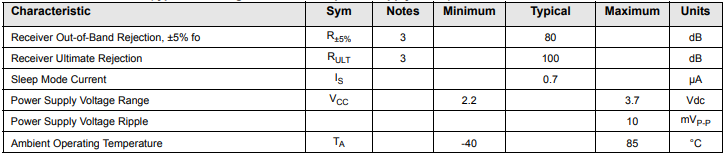
RX5500 Electrical Characteristics
RX5500 PCB Pad Layout

RX5500 PCB Pad Layout
Specifications
- TypeParameter
- Package / Case
refers to the protective housing that encases an electronic component, providing mechanical support, electrical connections, and thermal management.
20-SMD Module, No Lead - Number of Pins20
- Supplier Device Package
The parameter "Supplier Device Package" in electronic components refers to the physical packaging or housing of the component as provided by the supplier. It specifies the form factor, dimensions, and layout of the component, which are crucial for compatibility and integration into electronic circuits and systems. The supplier device package information typically includes details such as the package type (e.g., DIP, SOP, QFN), number of pins, pitch, and overall size, allowing engineers and designers to select the appropriate component for their specific application requirements. Understanding the supplier device package is essential for proper component selection, placement, and soldering during the manufacturing process to ensure optimal performance and reliability of the electronic system.
SM-20L - Operating Temperature
The operating temperature is the range of ambient temperature within which a power supply, or any other electrical equipment, operate in. This ranges from a minimum operating temperature, to a peak or maximum operating temperature, outside which, the power supply may fail.
-40°C~85°C - Packaging
Semiconductor package is a carrier / shell used to contain and cover one or more semiconductor components or integrated circuits. The material of the shell can be metal, plastic, glass or ceramic.
Tape & Reel (TR) - Part Status
Parts can have many statuses as they progress through the configuration, analysis, review, and approval stages.
Obsolete - Moisture Sensitivity Level (MSL)
Moisture Sensitivity Level (MSL) is a standardized rating that indicates the susceptibility of electronic components, particularly semiconductors, to moisture-induced damage during storage and the soldering process, defining the allowable exposure time to ambient conditions before they require special handling or baking to prevent failures
1 (Unlimited) - Max Operating Temperature
The Maximum Operating Temperature is the maximum body temperature at which the thermistor is designed to operate for extended periods of time with acceptable stability of its electrical characteristics.
85°C - Min Operating Temperature
The "Min Operating Temperature" parameter in electronic components refers to the lowest temperature at which the component is designed to operate effectively and reliably. This parameter is crucial for ensuring the proper functioning and longevity of the component, as operating below this temperature may lead to performance issues or even damage. Manufacturers specify the minimum operating temperature to provide guidance to users on the environmental conditions in which the component can safely operate. It is important to adhere to this parameter to prevent malfunctions and ensure the overall reliability of the electronic system.
-40°C - Applications
The parameter "Applications" in electronic components refers to the specific uses or functions for which a component is designed. It encompasses various fields such as consumer electronics, industrial automation, telecommunications, automotive, and medical devices. Understanding the applications helps in selecting the right components for a particular design based on performance, reliability, and compatibility requirements. This parameter also guides manufacturers in targeting their products to relevant markets and customer needs.
General Purpose - Voltage - Supply
Voltage - Supply refers to the range of voltage levels that an electronic component or circuit is designed to operate with. It indicates the minimum and maximum supply voltage that can be applied for the device to function properly. Providing supply voltages outside this range can lead to malfunction, damage, or reduced performance. This parameter is critical for ensuring compatibility between different components in a circuit.
2.2V~3.7V - Frequency
In electronic components, the parameter "Frequency" refers to the rate at which a signal oscillates or cycles within a given period of time. It is typically measured in Hertz (Hz) and represents how many times a signal completes a full cycle in one second. Frequency is a crucial aspect in electronic components as it determines the behavior and performance of various devices such as oscillators, filters, and communication systems. Understanding the frequency characteristics of components is essential for designing and analyzing electronic circuits to ensure proper functionality and compatibility with other components in a system.
433.92MHz - Operating Supply Voltage
The voltage level by which an electrical system is designated and to which certain operating characteristics of the system are related.
3.3V - Operating Supply Current
Operating Supply Current, also known as supply current or quiescent current, is a crucial parameter in electronic components that indicates the amount of current required for the device to operate under normal conditions. It represents the current drawn by the component from the power supply while it is functioning. This parameter is important for determining the power consumption of the component and is typically specified in datasheets to help designers calculate the overall power requirements of their circuits. Understanding the operating supply current is essential for ensuring proper functionality and efficiency of electronic systems.
2.9mA - Nominal Supply Current
Nominal current is the same as the rated current. It is the current drawn by the motor while delivering rated mechanical output at its shaft.
3.1A - Data Interface
A Data Interface in EDQ is a template of a set of attributes representing a given entity, used to create processes that read from, or write to, interfaces rather than directly from or to sources or targets of data.
PCB, Surface Mount - Sensitivity
Sensitivity in electronic components refers to the degree to which the output of a device responds to changes in input. It indicates how effectively a component translates a specific input signal into an observable output. High sensitivity means that even small variations in input can produce significant changes in output, making the device more responsive to signals. Sensitivity is crucial in applications where precise measurements or signal detection are required.
-110.5dBm - Data Rate (Max)
Data Rate (Max) refers to the maximum rate at which data can be transferred or processed within an electronic component or device. It is typically measured in bits per second (bps) or megabits per second (Mbps). This parameter is important for determining the speed and efficiency of data transmission or processing in various electronic applications such as computer systems, networking devices, and memory modules. A higher data rate indicates that the component is capable of handling larger volumes of data at a faster pace, leading to improved performance and responsiveness in electronic systems. It is crucial to consider the Data Rate (Max) specification when selecting electronic components to ensure compatibility and optimal functionality for specific applications.
19.2kbps - Current - Receiving
Current - Receiving refers to the amount of electrical current that an electronic component or device is capable of accepting from a power source or another component in a circuit. It indicates the maximum current that can be safely received without causing damage or malfunction. This parameter is crucial for ensuring compatibility and reliability in electronic designs, as exceeding the rated receiving current can lead to overheating or failure of the component.
3.1mA - Modulation or Protocol
Modulation is the process of converting data into radio waves by adding information to an electronic or optical carrier signal. A carrier signal is one with a steady waveform -- constant height, or amplitude, and frequency.
ASK, OOK - Sensitivity (dBm)
Sensitivity (dBm) is a parameter used to measure the minimum input power level required for an electronic component or device to operate effectively. It is typically expressed in decibels relative to one milliwatt (dBm), which is a common unit of power measurement in the field of electronics. A higher sensitivity value indicates that the component can detect weaker input signals, making it more responsive and capable of functioning in low-power conditions. Sensitivity is an important specification for devices like receivers, sensors, and transducers, as it directly impacts their ability to detect and process signals accurately. Manufacturers often provide sensitivity ratings to help users understand the performance capabilities of the component in different operating conditions.
-110.5 dBm - Antenna Connector
An antenna connector is a radio frequency connector that is located at the termination of an antenna. Its attachment to the antenna provides a conduit for the transmission of radio frequency signals with signal loss, discontinuity, and impedance mismatches kept to a strict minimum.
PCB, Surface Mount - RoHS Status
RoHS means “Restriction of Certain Hazardous Substances” in the “Hazardous Substances Directive” in electrical and electronic equipment.
RoHS Compliant - Lead Free
Lead Free is a term used to describe electronic components that do not contain lead as part of their composition. Lead is a toxic material that can have harmful effects on human health and the environment, so the electronics industry has been moving towards lead-free components to reduce these risks. Lead-free components are typically made using alternative materials such as silver, copper, and tin. Manufacturers must comply with regulations such as the Restriction of Hazardous Substances (RoHS) directive to ensure that their products are lead-free and environmentally friendly.
Lead Free
RX5500 Functional Block Diagram

RX5500 Functional Block Diagram
RX5500 Equivalent
| Part Number | Describtions | Manufaturer |
| RX5500TELECOMMUNICATION CIRCUITS | Telecom Circuit, 1-Func, SM-20 | Murata Connectivity |
Parts with Similar Specs
RX5500 Package/Dimension

RX5500 Package

RX5500 Dimension
RX5500 Manufacturer
Honorary Chairman Akira Murata started Murata Manufacturing as a personal venture in October, 1944. In December 1950 reorganized the company into Murata Manufacturing Co., Ltd. with paid-in Capital ¥1 million.
Murata Manufacturing is primarily involved in the manufacturing of ceramic passive electronic components, primarily capacitors, and has an overwhelming marketshare worldwide in ceramic filters, high-frequency parts, and sensors.
Trend Analysis
Datasheet PDF
- Datasheets :
- ReachStatement :
- PCN Obsolescence/ EOL :
Is the RX 5500 XT good for gaming?
If you're building a new budget gaming system from scratch, the RX 5500 XT is a good shout for 1080p gaming at medium settings with reasonable frame rates. If you know the games you want to play are heavy on VRAM, though, spend a little more and get the 8GB version
Does RX 5500 XT?
The Radeon RX 5500 XT is a mid-range graphics card by AMD, launched on December 12th, 2019. Built on the 7 nm process, and based on the Navi 14 graphics processor, in its Navi 14 XTX variant, the card supports DirectX 12. This ensures that all modern games will run on Radeon RX 5500 XT
How much FPS can the RX 5500 XT run?
Get the ultimate gaming experience with the AMD Radeon™ RX 5500 XT graphics card. The AMD Radeon™ RX 5500 XT graphics card takes 1080p gaming to the next level, delivering ultra-responsive, high-fidelity AAA gaming with up to 60 FPS and esports gaming with up to 90 FPS.
Can Rx 5500 XT run 1440p?
The 5500 XT does match the 580 at 1440p, making it 5-6 fps slower than the 590 and 11% slower than the GTX 1660 Super. Last up we have Gears 5 and here the 5500 XT is able to match the RX 590 with 75 fps on average at 1080p using the high quality preset
 LM5145RGYR DC/DC Controller: 75-V, Datasheet, Application Circuit
08 April 20222691
 TMC5160 vs. TMC2209: How to Differentiate?
18 April 202221001
 LD1117V33 Regulator: Pinout, Applications and Datasheet
18 October 20233233
 TMP36 Temperature Sensors: Pinout, Datasheet and Circuit
14 July 202113953
 BLM21PG221SN1D 220 Ohms @ 100 MHz Tape & Reel: Datasheet, Application, and Equivalents
12 February 20221150
![BTA41600B Triacs: Circuits, Pinout, and Datasheet [Video&FAQ]](https://res.utmel.com/Images/Article/5169be14-70e1-4baf-b0ca-11d2e3847bd3.png) BTA41600B Triacs: Circuits, Pinout, and Datasheet [Video&FAQ]
BTA41600B Triacs: Circuits, Pinout, and Datasheet [Video&FAQ]16 December 202127276
 XC7A200T-2FBG484I Xilinx FPGA Features and Applications Explained
26 March 20253231
 74HC86 Exculsive or Gates : Pinout, Application and Datasheet
13 July 20216725
 Designing Application-Specific Integrated Circuits
07 March 20252394
 Antenna: Principles, Performance Parameters and Classification
15 November 20218752
 The Era of UFS 4.0, Announced?
06 May 20227545
 Google Co-releases SayCan Model for Bots to Give Sensible Answers
30 August 20223880
 Cryogenic Cooling Technology using SiC and GaN Devices
07 July 20232771
 What Sensors does a Car Engine Have?
28 March 202526681
 Basic Introduction to RF Connector
30 October 20258672
 Characteristics and Working Principle of IGBT
31 October 202523339
Murata Electronics
In Stock: 11
United States
China
Canada
Japan
Russia
Germany
United Kingdom
Singapore
Italy
Hong Kong(China)
Taiwan(China)
France
Korea
Mexico
Netherlands
Malaysia
Austria
Spain
Switzerland
Poland
Thailand
Vietnam
India
United Arab Emirates
Afghanistan
Åland Islands
Albania
Algeria
American Samoa
Andorra
Angola
Anguilla
Antigua & Barbuda
Argentina
Armenia
Aruba
Australia
Azerbaijan
Bahamas
Bahrain
Bangladesh
Barbados
Belarus
Belgium
Belize
Benin
Bermuda
Bhutan
Bolivia
Bonaire, Sint Eustatius and Saba
Bosnia & Herzegovina
Botswana
Brazil
British Indian Ocean Territory
British Virgin Islands
Brunei
Bulgaria
Burkina Faso
Burundi
Cabo Verde
Cambodia
Cameroon
Cayman Islands
Central African Republic
Chad
Chile
Christmas Island
Cocos (Keeling) Islands
Colombia
Comoros
Congo
Congo (DRC)
Cook Islands
Costa Rica
Côte d’Ivoire
Croatia
Cuba
Curaçao
Cyprus
Czechia
Denmark
Djibouti
Dominica
Dominican Republic
Ecuador
Egypt
El Salvador
Equatorial Guinea
Eritrea
Estonia
Eswatini
Ethiopia
Falkland Islands
Faroe Islands
Fiji
Finland
French Guiana
French Polynesia
Gabon
Gambia
Georgia
Ghana
Gibraltar
Greece
Greenland
Grenada
Guadeloupe
Guam
Guatemala
Guernsey
Guinea
Guinea-Bissau
Guyana
Haiti
Honduras
Hungary
Iceland
Indonesia
Iran
Iraq
Ireland
Isle of Man
Israel
Jamaica
Jersey
Jordan
Kazakhstan
Kenya
Kiribati
Kosovo
Kuwait
Kyrgyzstan
Laos
Latvia
Lebanon
Lesotho
Liberia
Libya
Liechtenstein
Lithuania
Luxembourg
Macao(China)
Madagascar
Malawi
Maldives
Mali
Malta
Marshall Islands
Martinique
Mauritania
Mauritius
Mayotte
Micronesia
Moldova
Monaco
Mongolia
Montenegro
Montserrat
Morocco
Mozambique
Myanmar
Namibia
Nauru
Nepal
New Caledonia
New Zealand
Nicaragua
Niger
Nigeria
Niue
Norfolk Island
North Korea
North Macedonia
Northern Mariana Islands
Norway
Oman
Pakistan
Palau
Palestinian Authority
Panama
Papua New Guinea
Paraguay
Peru
Philippines
Pitcairn Islands
Portugal
Puerto Rico
Qatar
Réunion
Romania
Rwanda
Samoa
San Marino
São Tomé & Príncipe
Saudi Arabia
Senegal
Serbia
Seychelles
Sierra Leone
Sint Maarten
Slovakia
Slovenia
Solomon Islands
Somalia
South Africa
South Sudan
Sri Lanka
St Helena, Ascension, Tristan da Cunha
St. Barthélemy
St. Kitts & Nevis
St. Lucia
St. Martin
St. Pierre & Miquelon
St. Vincent & Grenadines
Sudan
Suriname
Svalbard & Jan Mayen
Sweden
Syria
Tajikistan
Tanzania
Timor-Leste
Togo
Tokelau
Tonga
Trinidad & Tobago
Tunisia
Turkey
Turkmenistan
Turks & Caicos Islands
Tuvalu
U.S. Outlying Islands
U.S. Virgin Islands
Uganda
Ukraine
Uruguay
Uzbekistan
Vanuatu
Vatican City
Venezuela
Wallis & Futuna
Yemen
Zambia
Zimbabwe