

 Product
 Brand
Brand Articles
 Tools
Tools
LM555 vs. NE555: What Difference is between LM555 and NE555?

5V 555 Type, Timer/Oscillator (Single) Programmable Timers LM555 2MHz 5V 8-DIP (0.300, 7.62mm)


5V 555 Type, Timer/Oscillator (Single) Programmable Timers LM555 2MHz 5V 8-DIP (0.300, 7.62mm)
In this post, we will first compare NE555 vs. LM55 IC and see how improvements were made to the LM555 from the early NE555. Furthermore, there is a huge range of Semiconductors, Capacitors, Resistors and ICs in stock. Welcome RFQ!
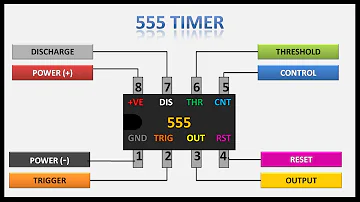
What is 555 timer?
LM555 vs. NE555: Overview
The letter prefixes in front of IC component numbers are frequently assumed to signify the IC's manufacturer (though this is not always the case) – although this is not always the case. While certain chips have a large number of second sources with the same part numbers and/or prefixes, there are typically minor variances between each of these components due to manufacturer optimizations and revisions. The NE555 timer IC, originally from Signetics, and the LM555, which was originally second sourced from National Semiconductor, are two examples of this.
LM555 vs. NE555: Pinout
The following figures show the pinouts of LM555 and NE555:

LM555 Pinout
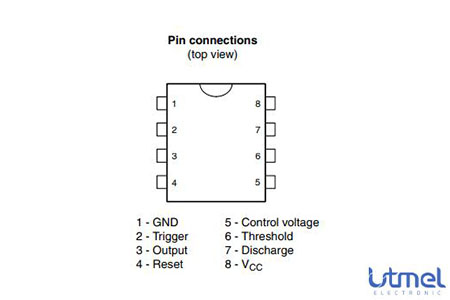
NE555 Pinout
LM555 vs. NE555: Internal Circuit
The following circuits show the internal circuits of LM555 and NE555:
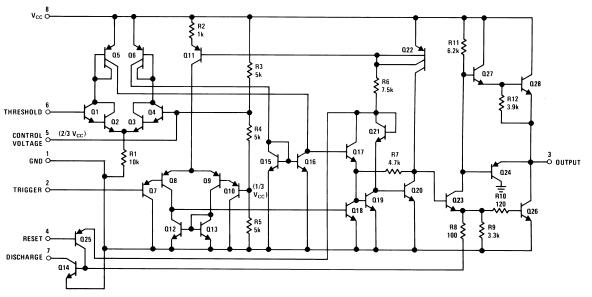
LM555 Internal Circuit
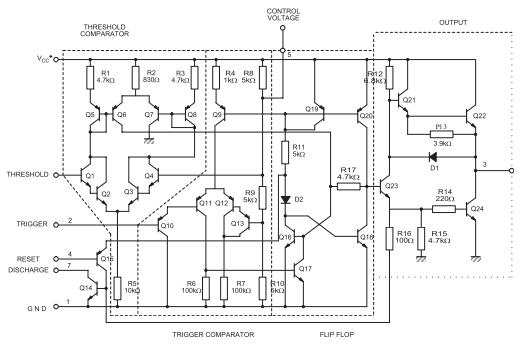
NE555 Internal Circuit
Because most second-source ICs are promoted as 'plug-in' replacements for the original, little is done to call attention to the fact that the IC's internals may have been altered slightly. Fortunately, manufacturers include a (simplified) schematic diagram with the datasheets, which we shall examine.
One of the most notable differences between the two ICs is the use of current mirror active loads in the LM555.
Despite being 'pin-compatible, the LM555's modifications cause the circuit to act very differently than the NE555.
We can see from the internal design that the LM55 uses active loads instead of fixed resistors. One of the most significant advantages of switching from resistors to active loads is that output timing is less dependent on temperature and supply voltage.
Another difference is that the trigger signal is prioritized in the original NE555, whereas the threshold signal is prioritized in the LM555. When pin 2 (trigger) is less than 1/3VCC, the output of a 555 timer is high, and when pin 6 (threshold) is greater than 2/3VCC, the output is low. The output of the NE555 is low if the trigger pin is low while the threshold pin is high. The output of the LM555, on the other hand, remains low even when the trigger pin is low, and only becomes high when the threshold pin is low.
Additional undesired pulses have been reported on the LM555's output, which could be related to the various priorities assigned to the threshold and trigger pins.
LM555 vs. NE555: Major Differences
Conclusion
Because there may be slight differences and improvements between components from different manufacturers, believing that the identical part from a different manufacturer is totally 'pin-compatible' is sometimes incorrect. It is always a good idea to test chips before using them in a specific application.
What is NE555 used for?
The 555 IC has the following operating modes: Astable (free-running) mode – the 555 can operate as an electronic oscillator. Uses include LED and lamp flashers, pulse generation, logic clocks, tone generation, security alarms, pulse position modulation and so on.
What is the difference between NE555 and lm555?
They're both the same thing. Signetics originally allocated the NE555 component number to the commercial temperature range variation (SE555 was the military temperature range type).
Is NE555 a CMOS?
The NE555 is bipolar, not CMOS
What is the maximum supply voltage for a lm555?
4.5V to 15V
The 555 timers can be used with a supply voltage (Vs) in the range of 4.5V to 15V (18V is the absolute maximum).
Is 555 timer CMOS or TTL?
The CMOS 555 is a monolithic timing circuit that is fully compatible with CMOS, TTL, and MOS logic and operates at frequencies up to 2MHz. Because of its high input impedance, this device uses smaller timing capacitors than those used by the standard 555 timers.
 MPF102 N-Channel JFET: Datasheet, Pinout, and Equivalents
26 August 20217113
 DS26LV32ATM:CMOS Receiver, Pinout, Datasheet
24 March 20221329
 Microchip PIC18LF67K40IMR Technical Overview
29 February 2024163
 TIP32C Power Transistor: Pinout, Datasheet, and Circuit
08 July 202110508
![Is LM317 better than LM7805?[video+FAQ]](https://res.utmel.com/Images/Article/5cafb24b-3f28-4935-b123-c59a0f9c15eb.jpg) Is LM317 better than LM7805?[video+FAQ]
Is LM317 better than LM7805?[video+FAQ]27 April 20229589
 Microchip PIC16LF18856TIMV Microcontroller: In-depth Technical Analysis
29 February 2024157
![C106D Thyristor: Circuits, Pinout, and Datasheet [Video]](https://res.utmel.com/Images/Article/d67d29cd-e061-4abc-832a-4d1631d57c61.png) C106D Thyristor: Circuits, Pinout, and Datasheet [Video]
C106D Thyristor: Circuits, Pinout, and Datasheet [Video]11 January 202222422
 MCP3424 A/D Converter: Datasheet, Pinout and Schematic
13 August 20214690
 Comparison of Advantages and Disadvantages of Common Switch Mode Power Supply(SMPS)
21 January 20228381
 What is OLED?
16 March 20217766
 The Rise of Co-Packaged Optics (CPO) and Silicon Photonics in AI Superclusters
24 June 20262668
 EMC can also observe the waveform with an oscilloscope?
04 March 20226104
 4680 Battery - Upgrade of Battery Technology
17 December 20216956
 Selection Criteria for Power Management ICs (PMICs)
06 April 20223932
 Various Reasons for the Failure, Explosion and Burning of Tantalum Capacitors
02 June 202211528
 An Overview of LPDDR
25 August 202638660
ON Semiconductor
In Stock: 4770
United States
China
Canada
Japan
Russia
Germany
United Kingdom
Singapore
Italy
Hong Kong(China)
Taiwan(China)
France
Korea
Mexico
Netherlands
Malaysia
Austria
Spain
Switzerland
Poland
Thailand
Vietnam
India
United Arab Emirates
Afghanistan
Åland Islands
Albania
Algeria
American Samoa
Andorra
Angola
Anguilla
Antigua & Barbuda
Argentina
Armenia
Aruba
Australia
Azerbaijan
Bahamas
Bahrain
Bangladesh
Barbados
Belarus
Belgium
Belize
Benin
Bermuda
Bhutan
Bolivia
Bonaire, Sint Eustatius and Saba
Bosnia & Herzegovina
Botswana
Brazil
British Indian Ocean Territory
British Virgin Islands
Brunei
Bulgaria
Burkina Faso
Burundi
Cabo Verde
Cambodia
Cameroon
Cayman Islands
Central African Republic
Chad
Chile
Christmas Island
Cocos (Keeling) Islands
Colombia
Comoros
Congo
Congo (DRC)
Cook Islands
Costa Rica
Côte d’Ivoire
Croatia
Cuba
Curaçao
Cyprus
Czechia
Denmark
Djibouti
Dominica
Dominican Republic
Ecuador
Egypt
El Salvador
Equatorial Guinea
Eritrea
Estonia
Eswatini
Ethiopia
Falkland Islands
Faroe Islands
Fiji
Finland
French Guiana
French Polynesia
Gabon
Gambia
Georgia
Ghana
Gibraltar
Greece
Greenland
Grenada
Guadeloupe
Guam
Guatemala
Guernsey
Guinea
Guinea-Bissau
Guyana
Haiti
Honduras
Hungary
Iceland
Indonesia
Iran
Iraq
Ireland
Isle of Man
Israel
Jamaica
Jersey
Jordan
Kazakhstan
Kenya
Kiribati
Kosovo
Kuwait
Kyrgyzstan
Laos
Latvia
Lebanon
Lesotho
Liberia
Libya
Liechtenstein
Lithuania
Luxembourg
Macao(China)
Madagascar
Malawi
Maldives
Mali
Malta
Marshall Islands
Martinique
Mauritania
Mauritius
Mayotte
Micronesia
Moldova
Monaco
Mongolia
Montenegro
Montserrat
Morocco
Mozambique
Myanmar
Namibia
Nauru
Nepal
New Caledonia
New Zealand
Nicaragua
Niger
Nigeria
Niue
Norfolk Island
North Korea
North Macedonia
Northern Mariana Islands
Norway
Oman
Pakistan
Palau
Palestinian Authority
Panama
Papua New Guinea
Paraguay
Peru
Philippines
Pitcairn Islands
Portugal
Puerto Rico
Qatar
Réunion
Romania
Rwanda
Samoa
San Marino
São Tomé & Príncipe
Saudi Arabia
Senegal
Serbia
Seychelles
Sierra Leone
Sint Maarten
Slovakia
Slovenia
Solomon Islands
Somalia
South Africa
South Sudan
Sri Lanka
St Helena, Ascension, Tristan da Cunha
St. Barthélemy
St. Kitts & Nevis
St. Lucia
St. Martin
St. Pierre & Miquelon
St. Vincent & Grenadines
Sudan
Suriname
Svalbard & Jan Mayen
Sweden
Syria
Tajikistan
Tanzania
Timor-Leste
Togo
Tokelau
Tonga
Trinidad & Tobago
Tunisia
Turkey
Turkmenistan
Turks & Caicos Islands
Tuvalu
U.S. Outlying Islands
U.S. Virgin Islands
Uganda
Ukraine
Uruguay
Uzbekistan
Vanuatu
Vatican City
Venezuela
Wallis & Futuna
Yemen
Zambia
Zimbabwe
![MC1455DR2G]() MC1455DR2G
MC1455DR2GON Semiconductor
![LM555CMX]() LM555CMX
LM555CMXON Semiconductor
![NCV1455BDR2G]() NCV1455BDR2G
NCV1455BDR2GON Semiconductor
![MC14536BDWR2G]() MC14536BDWR2G
MC14536BDWR2GON Semiconductor
![MC1455BDR2G]() MC1455BDR2G
MC1455BDR2GON Semiconductor
![MC14541BDR2G]() MC14541BDR2G
MC14541BDR2GON Semiconductor
![LM555CM]() LM555CM
LM555CMON Semiconductor
![MC14541BDG]() MC14541BDG
MC14541BDGON Semiconductor
![MC1455P1G]() MC1455P1G
MC1455P1GON Semiconductor


