

STM32H7 Series 480 MHz MCU: Performance Analysis, Pinout, and Design Handbook


STM32H753XIH6 EVAL BRD
Explore the STM32H7 Series, a high-performance 480 MHz Cortex-M7 MCU with 2MB Flash. Perfect for industrial HMI and AI. Review specs and pinouts for your BOM.
- Executive Summary: What is the STM32H7 Series?
- 1. Technical Specifications & Performance Analysis
- 2. Pinout, Package, and Configuration
- 3. Design & Integration Guide (For Engineers & Makers)
- 4. Typical Applications & Use Cases
- 5. Alternatives and Cross-Reference Guide
- 6. Frequently Asked Questions (FAQ)
- 7. Resources
- Specifications
- Datasheet PDF
Executive Summary: What is the STM32H7 Series?
The STM32H7 Series is a family of high-performance 32-bit microcontrollers based on the Arm Cortex-M7 core, designed for demanding industrial, consumer, and medical applications that require real-time processing and advanced graphics capabilities. It represents the pinnacle of the STM32 portfolio, bridging the gap between traditional microcontrollers and application processors.
Market Position: High-performance "Crossover" MCU.
Top Features: 480 MHz clock speed, 2 MB Flash memory, and the Chrom-ART Accelerator for advanced UI/UX.
Primary Audience: Ideal for industrial automation designers, HMI developers, and engineers implementing AI/ML at the edge.
Supply Status: Active; widely available through major distributors.
1. Technical Specifications & Performance Analysis
The STM32H7 series datasheet highlights a significant leap in embedded processing power, offering nearly double the performance of the previous STM32F7 generation.
1.1 Core Architecture (CPU/Logic/Power)
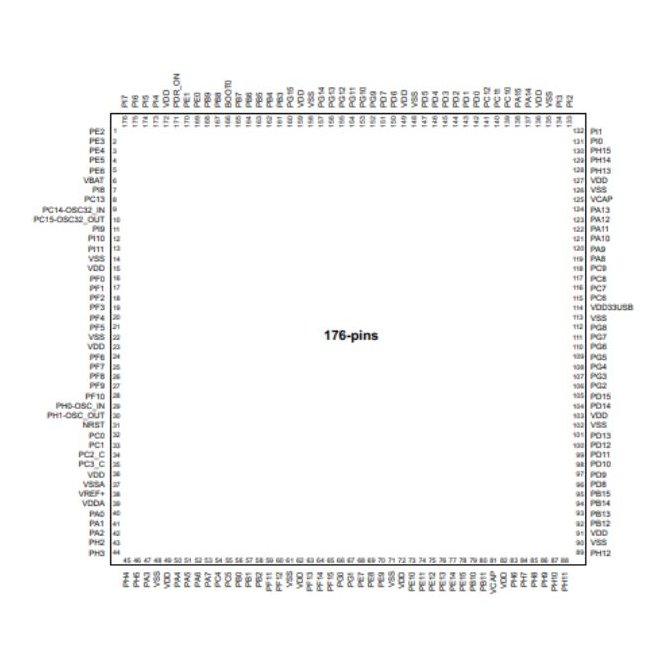
At the heart of the STM32H7 is the Arm Cortex-M7 core, operating at frequencies up to 480 MHz. This architecture includes a Double-Precision Floating Point Unit (FPU) and L1 cache (Instruction/Data), which minimizes latency when executing complex algorithms. The integration of an AXI bus matrix ensures that the CPU, memory, and peripherals can communicate simultaneously without bottlenecks.
1.2 Key Electrical Characteristics
Engineers must account for the following power specifications during the design phase: - Supply Voltage: Flexible range from 1.62V to 3.6V, supporting various battery and industrial power rails. - Operating Temperature: Rated for industrial environments from -40°C to +85°C. - Power Efficiency: While high-performance, the series utilizes a 40nm process and multiple power domains to optimize consumption during idle states.
1.3 Interfaces and Connectivity
The STM32H7 is a connectivity powerhouse, featuring:
- Networking: Ethernet MAC with IEEE 1588v2 support.
- USB: Dual USB OTG (High-Speed and Full-Speed).
- Industrial Bus: CAN FD for high-speed automotive and industrial networking.
- Memory Expansion: Dual-mode Quad-SPI and a Flexible Memory Controller (FMC) for external SDRAM or Flash.
2. Pinout, Package, and Configuration
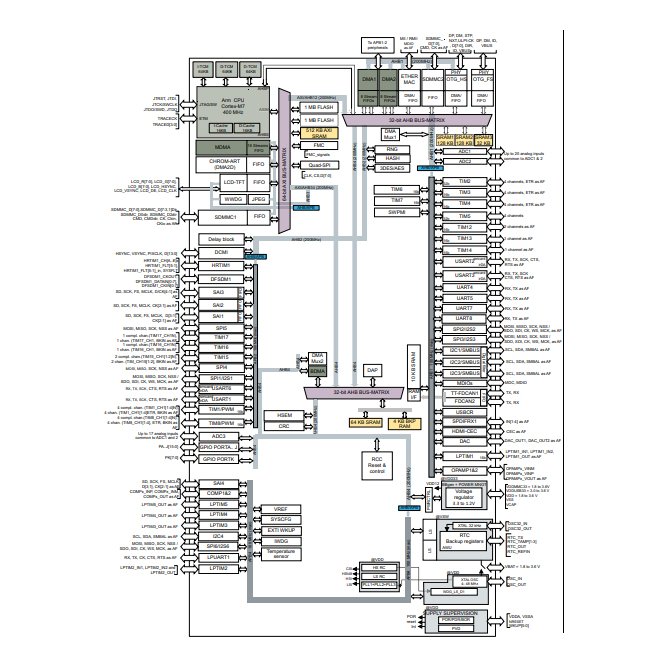
The STM32H7 series is available in a variety of high-pin-count packages to accommodate its massive I/O capabilities.
2.1 Pin Configuration Guide
The pinout is generally grouped into functional blocks:
- Power Supply: VDD, VSS, and VCAP pins for internal regulator decoupling.
- System Control: NRST (Reset), BOOT0, and Oscillator pins (HSE/LSE).
- Analog: High-speed 16-bit ADCs and 12-bit DACs.
- Dedicated I/O: High-speed communication pins for Ethernet and USB.
2.2 Naming Convention & Ordering Codes
Understanding the STM32H7 part numbering is vital for procurement:
- STM32H7xx: The base series.
- Flash Size: e.g., "I" for 2MB.
- Package: e.g., "T" for LQFP, "I" for UFBGA.
- Temperature: e.g., "6" for -40 to +85°C.
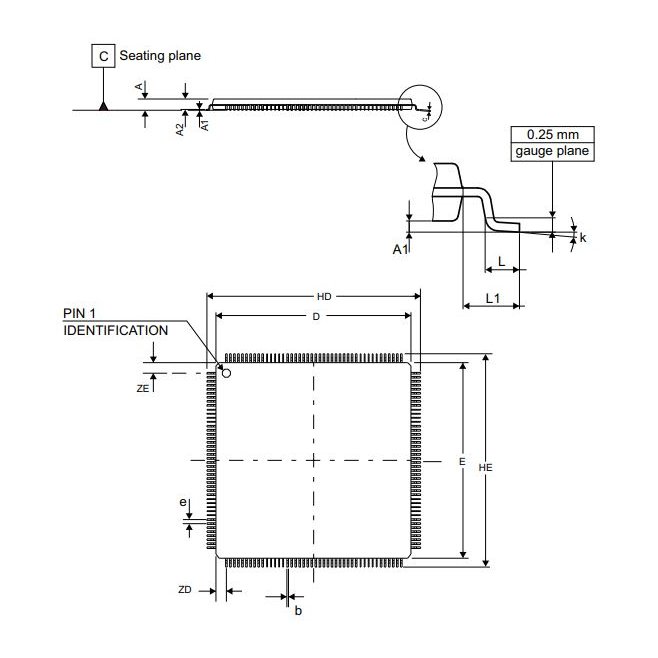
2.3 Available Packages
| Package Type | Dimensions | Common Use Case |
|---|---|---|
| LQFP100/144/176 | 14x14mm to 24x24mm | General industrial boards; hand-soldering friendly for prototyping. |
| TFBGA240 | 14x14mm | High-density HMI and complex industrial controllers. |
| UFBGA169/176 | 7x7mm to 10x10mm | Space-constrained IoT gateways and wearables. |
3. Design & Integration Guide (For Engineers & Makers)
Pro Tip: Always utilize STM32CubeMX for initial pin assignment to avoid multiplexing conflicts between the Ethernet and QSPI interfaces.
3.1 Hardware Implementation
Bypass Capacitors: Place 100nF ceramic capacitors as close as possible to every VDD pin, with larger 4.7µF or 10µF tantalum caps at the main entry point.
PCB Layout: Use a minimum of 4 layers to provide dedicated ground and power planes, reducing EMI for the 480 MHz clock.
Thermal Management: At peak performance, the STM32H7 can generate significant heat. Ensure the thermal pad (on applicable packages) is soldered to a large ground plane.
3.2 Common Design Challenges
Power Domain Complexity: The H7 uses three domains (D1, D2, D3). Fix: Use the STM32Cube HAL to manage power sequencing automatically.
SPI EOT Signal Truncation: SPI signals may cut off if the peripheral is disabled too fast. Fix: Implement a short software delay or monitor the TXC (Transfer Complete) flag before disabling the SPI clock.
Rev V Bootloader: Some Revision V chips have UART bootloader issues. Fix: Use an ST-Link V3 for programming or implement an in-application-programming (IAP) solution.
4. Typical Applications & Use Cases
4.1 Real-World Example: Industrial HMI
In a Smart Factory PLC, the STM32H7 manages the graphical user interface via the Chrom-ART Accelerator, reducing CPU load by 90% during image rendering. Simultaneously, it handles real-time motor control via the 2.1 ns high-resolution timer and communicates with the factory floor via Ethernet.
5. Alternatives and Cross-Reference Guide
When selecting a component for your BOM, consider these alternatives:
Direct Replacements: The NXP i.MX RT1060 is a primary competitor, offering similar clock speeds as a crossover MCU.
Better Performance: For even higher integration, consider the Renesas RA8 Series (Cortex-M85).
Cost-Effective Options: If 480 MHz is overkill, the STM32F7 Series offers a pin-compatible migration path with lower power consumption and cost.
6. Frequently Asked Questions (FAQ)
Q: What is the difference between STM32H7 and STM32F7?
A: The H7 is built on a 40nm process (vs 90nm), runs at 480 MHz (vs 216 MHz), and includes advanced features like CAN FD and higher-resolution ADCs.
Q: Can STM32H7 be programmed with the Arduino IDE?
A: Yes, via the STM32duino core, though professional tools like STM32CubeIDE are recommended to utilize the dual-core and advanced DMA features.
Q: Is the STM32H7 suitable for battery-operated devices?
A: While it is a high-performance chip, it features a "Standby" mode with very low current consumption, making it viable for devices that wake up periodically to perform heavy computation.
Q: How do I handle the high clock speed on a PCB?
A: Use controlled impedance traces for external memory interfaces (SDRAM/QSPI) and keep high-speed signals away from sensitive analog inputs.
7. Resources
Development Tools: STM32H743I-EVAL or NUCLEO-H743ZI2.
Software Framework: STM32CubeH7 Firmware Package.
Specifications
Datasheet PDF
- Datasheets :
- Design Resources :
 RS-1205S Regulated Converter: Pinout, Features, Circuit
26 July 20211503
 XC7A200T-2FBG484I Xilinx FPGA Features and Applications Explained
26 March 20252020
 LM334D Adjustable Current Source: Feature, Specification, and Datasheet
03 July 2021768
 ADC120 Converter:Datasheet, Application, Pinout
07 September 2021561
 Unraveling the Silicon Labs C8051F000/1/2/5/6/7 and C8051F010/1/2/5/6/7 Series Mixed-Signal 32KB ISP FLASH MCUs
29 February 2024137
 LTC3780 Buck-Boost Controller: Alternative, Price and Datasheet
21 July 20214047
 AO6800:30V Dual N-Channel MOSFET
08 March 2022517
![What is a NC7SZ08P5X?[Datasheet&Pinout]](https://res.utmel.com/Images/Article/43edaebb-f0ef-4046-81c6-5038d607926a.png) What is a NC7SZ08P5X?[Datasheet&Pinout]
What is a NC7SZ08P5X?[Datasheet&Pinout]03 February 2023614
 Several Steps to Choose a Microcontroller MCU
17 June 20224172
 What is an Electrical Connector?
19 November 20256674
 Tough Times for Japanese Component Manufacturers
10 August 20221520
 Methodologies for Increasing Efficiency of Fuel Stack Technology for Energy Generation
19 November 20242551
 Organic Semiconductor Market Set to Reach USD 843.62 Billion by 2032, Driven by Rising Demand for Flexible Electronics
05 October 2023642
 Modeling Wide Band-Gap Semiconductors for Enhanced Performance
31 January 20243302
 A Decade-Long Investment in ON Semiconductor Corp. Yields Over 1200% Returns
18 September 20232672
 RVDT(Rotary Variable Differential Transformer) Basics
02 February 202117622
STMicroelectronics
In Stock: 2294
United States
China
Canada
Japan
Russia
Germany
United Kingdom
Singapore
Italy
Hong Kong(China)
Taiwan(China)
France
Korea
Mexico
Netherlands
Malaysia
Austria
Spain
Switzerland
Poland
Thailand
Vietnam
India
United Arab Emirates
Afghanistan
Åland Islands
Albania
Algeria
American Samoa
Andorra
Angola
Anguilla
Antigua & Barbuda
Argentina
Armenia
Aruba
Australia
Azerbaijan
Bahamas
Bahrain
Bangladesh
Barbados
Belarus
Belgium
Belize
Benin
Bermuda
Bhutan
Bolivia
Bonaire, Sint Eustatius and Saba
Bosnia & Herzegovina
Botswana
Brazil
British Indian Ocean Territory
British Virgin Islands
Brunei
Bulgaria
Burkina Faso
Burundi
Cabo Verde
Cambodia
Cameroon
Cayman Islands
Central African Republic
Chad
Chile
Christmas Island
Cocos (Keeling) Islands
Colombia
Comoros
Congo
Congo (DRC)
Cook Islands
Costa Rica
Côte d’Ivoire
Croatia
Cuba
Curaçao
Cyprus
Czechia
Denmark
Djibouti
Dominica
Dominican Republic
Ecuador
Egypt
El Salvador
Equatorial Guinea
Eritrea
Estonia
Eswatini
Ethiopia
Falkland Islands
Faroe Islands
Fiji
Finland
French Guiana
French Polynesia
Gabon
Gambia
Georgia
Ghana
Gibraltar
Greece
Greenland
Grenada
Guadeloupe
Guam
Guatemala
Guernsey
Guinea
Guinea-Bissau
Guyana
Haiti
Honduras
Hungary
Iceland
Indonesia
Iran
Iraq
Ireland
Isle of Man
Israel
Jamaica
Jersey
Jordan
Kazakhstan
Kenya
Kiribati
Kosovo
Kuwait
Kyrgyzstan
Laos
Latvia
Lebanon
Lesotho
Liberia
Libya
Liechtenstein
Lithuania
Luxembourg
Macao(China)
Madagascar
Malawi
Maldives
Mali
Malta
Marshall Islands
Martinique
Mauritania
Mauritius
Mayotte
Micronesia
Moldova
Monaco
Mongolia
Montenegro
Montserrat
Morocco
Mozambique
Myanmar
Namibia
Nauru
Nepal
New Caledonia
New Zealand
Nicaragua
Niger
Nigeria
Niue
Norfolk Island
North Korea
North Macedonia
Northern Mariana Islands
Norway
Oman
Pakistan
Palau
Palestinian Authority
Panama
Papua New Guinea
Paraguay
Peru
Philippines
Pitcairn Islands
Portugal
Puerto Rico
Qatar
Réunion
Romania
Rwanda
Samoa
San Marino
São Tomé & Príncipe
Saudi Arabia
Senegal
Serbia
Seychelles
Sierra Leone
Sint Maarten
Slovakia
Slovenia
Solomon Islands
Somalia
South Africa
South Sudan
Sri Lanka
St Helena, Ascension, Tristan da Cunha
St. Barthélemy
St. Kitts & Nevis
St. Lucia
St. Martin
St. Pierre & Miquelon
St. Vincent & Grenadines
Sudan
Suriname
Svalbard & Jan Mayen
Sweden
Syria
Tajikistan
Tanzania
Timor-Leste
Togo
Tokelau
Tonga
Trinidad & Tobago
Tunisia
Turkey
Turkmenistan
Turks & Caicos Islands
Tuvalu
U.S. Outlying Islands
U.S. Virgin Islands
Uganda
Ukraine
Uruguay
Uzbekistan
Vanuatu
Vatican City
Venezuela
Wallis & Futuna
Yemen
Zambia
Zimbabwe
![NUCLEO-F030R8]() NUCLEO-F030R8
NUCLEO-F030R8STMicroelectronics
![SPC560B-DIS]() SPC560B-DIS
SPC560B-DISSTMicroelectronics
![NUCLEO-L152RE]() NUCLEO-L152RE
NUCLEO-L152RESTMicroelectronics
![NUCLEO-F411RE]() NUCLEO-F411RE
NUCLEO-F411RESTMicroelectronics
![NUCLEO-F767ZI]() NUCLEO-F767ZI
NUCLEO-F767ZISTMicroelectronics
![NUCLEO-F401RE]() NUCLEO-F401RE
NUCLEO-F401RESTMicroelectronics
![NUCLEO-F412ZG]() NUCLEO-F412ZG
NUCLEO-F412ZGSTMicroelectronics
![STM32F769I-DISCO]() STM32F769I-DISCO
STM32F769I-DISCOSTMicroelectronics
![NUCLEO-F429ZI]() NUCLEO-F429ZI
NUCLEO-F429ZISTMicroelectronics
![STM32F746G-DISCO]() STM32F746G-DISCO
STM32F746G-DISCOSTMicroelectronics


