

 Product
 Brand
Brand Articles
 Tools
Tools
AT28C256 150ns Parallel EEPROM: Detailed Pinout, SDP Unlocking, and Retrocomputing Design Guide


Memory IC 37.215mm mm
Explore the AT28C256 256-Kbit Parallel EEPROM. Learn about its 150ns access time, pinout differences, and how to solve SDP lock issues for your next design or BOM.
- Executive Summary: What is the AT28C256?
- 1. Technical Specifications & Performance Analysis
- 2. Pinout, Package, and Configuration
- 3. Design & Integration Guide (For Engineers & Makers)
- 4. Typical Applications & Use Cases
- 5. Alternatives and Cross-Reference Guide
- 6. Frequently Asked Questions (FAQ)
- 7. Resources
- Specifications
- Datasheet PDF
Executive Summary: What is the AT28C256?
The AT28C256 is a 256-Kbit (32K x 8) paged parallel EEPROM designed for high-reliability nonvolatile storage in industrial, military, and legacy computing systems. It offers a robust alternative to older EPROM technology by allowing in-system electrical reprogramming without the need for UV erasure.
Market Position: High-reliability legacy standard; the go-to choice for 8-bit bus architectures.
Top Features: 150 ns fast access time, 5V single power supply, and internal Software Data Protection (SDP).
Primary Audience: Ideal for retrocomputing enthusiasts (Z80/6502), industrial maintenance engineers, and aerospace hardware designers.
Supply Status: Active (Manufactured by Microchip Technology).
1. Technical Specifications & Performance Analysis
1.1 Core Architecture (Parallel EEPROM)
The AT28C256 utilizes a paged architecture, specifically organized as 32,768 words by 8 bits. Unlike serial EEPROMs that use I2C or SPI, this parallel interface allows the CPU to access memory addresses directly on the data bus, making it significantly faster for executing code directly from the chip (Execute-In-Place).
1.2 Key Electrical Characteristics
Supply Voltage: Operates at a standard 5V ±10%, making it natively compatible with TTL logic levels.
Access Speed: Features a 150 ns read access time, which is sufficient for most vintage CPUs running up to 6-8 MHz without wait states.
Power Consumption: Active current is typically around 30 mA to 45 mA, with a CMOS standby mode that drops significantly to reduce BOM power budgets.
Endurance: Rated for 100,000 write cycles with a 10-year data retention span, exceeding the requirements for firmware storage.
1.3 Interfaces and Connectivity
The device features a standard parallel interface consisting of 15 address lines (A0-A14) and 8 bi-directional data lines (I/O0-I/O7). Control is managed via three active-low pins: Chip Enable (CE#), Output Enable (OE#), and Write Enable (WE#).
2. Pinout, Package, and Configuration
2.1 Pin Configuration Guide
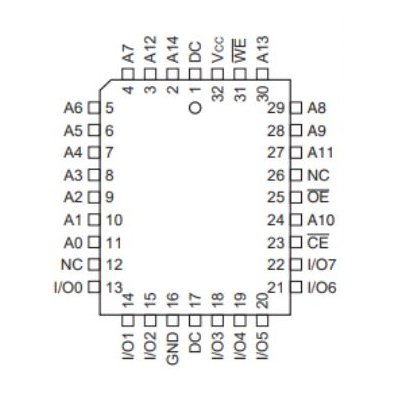
A0 – A14 (Address Inputs): Selects the specific 8-bit byte within the 32K memory space.
I/O0 – I/O7 (Data Inputs/Outputs): The 8-bit bi-directional data bus.
WE# (Write Enable): Must be pulsed low to initiate a write cycle.
CE# (Chip Enable): Must be low for the device to be active.
OE# (Output Enable): Gates the data onto the bus during a read cycle.
2.2 Naming Convention & Ordering Codes
Microchip uses suffixes to denote speed and package. For example, AT28C256-15PU indicates:
- 15: 150 ns access time.
- P: PDIP (Plastic Dual In-line Package).
- U: Lead-free/RoHS compliant.
2.3 Available Packages
| Package Type | Dimensions | Common Use Case |
|---|---|---|
| PDIP-28 | 0.600" Wide | Breadboarding, Retro-PC builds, Hobbyist projects. |
| SOIC-28 | Surface Mount | Industrial PCBs with limited vertical clearance. |
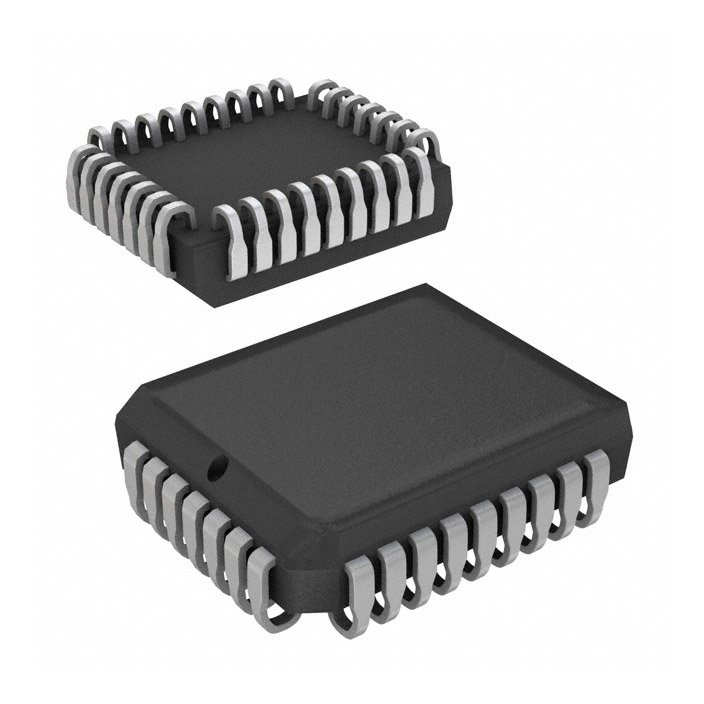
| PLCC-32 | Square SMT | Common in legacy BIOS sockets and avionics. |
| TSOP-28 | Thin SMT | Space-constrained embedded systems. |
3. Design & Integration Guide (For Engineers & Makers)
Pro Tip: Always verify pin compatibility before migrating from older series. The AT28C256 is often mistaken for a 27C256 EPROM, but their pinouts differ significantly at pins 1 and 27.
3.1 Hardware Implementation
Bypass Capacitors: Place a 0.1µF ceramic capacitor as close to the VCC pin as possible to suppress high-frequency noise during switching.
PCB Layout: Keep address and data bus traces relatively equal in length to prevent timing skew, though at 150ns, this is less critical than in modern DDR memory.
Pull-up Resistors: It is good practice to place a 10kΩ pull-up resistor on the WE# line to prevent accidental writes during microcontroller power-up sequences.
3.2 Common Design Challenges
The SDP Lock Issue: Many AT28C256 chips arrive with Software Data Protection enabled.
Issue: Standard "bit-banging" code on an Arduino is often too slow to perform the 3-byte unlock sequence (requires timing < 150µs).
Fix: Use direct port manipulation (e.g.,
PORTDon AVR) or a dedicated programmer like the TL866II Plus to disable SDP.27C256 Incompatibility:
Issue: Pin 1 is A14 on the AT28C256, but VPP on the 27C256. Pin 27 is WE# on the AT28C256, but A14 on the 27C256.
Fix: If replacing a 27C256, you must use an adapter or modify PCB traces to avoid grounding your highest address bit.
4. Typical Applications & Use Cases
📺 Recommended Video Tutorial:
4.1 Real-World Example: 8-Bit "Homebrew" Computer
In a Z80 or 6502 computer build, the AT28C256 acts as the "ROM." It stores the OS monitor or BASIC interpreter. Because it is an EEPROM, the designer can update the BIOS code directly from the computer itself using a small assembly routine, rather than pulling the chip and using a UV eraser.
5. Alternatives and Cross-Reference Guide
Direct Replacements: ON Semiconductor CAT28C256 is a near-identical functional equivalent.
Legacy Equivalents: Xicor X28C256 was the original standard but is now largely obsolete/surplus only.
Flash Alternative: The SST39SF010A is a faster NOR Flash alternative, though it requires a different write algorithm and has a different pinout (32-pin).
EPROM Replacement: If you need a pin-compatible replacement for a 27C256 EPROM, consider the Winbond W27C257, which is electrically erasable but maintains the 27-series pinout.
6. Frequently Asked Questions (FAQ)
Q: What is the difference between AT28C256 and 27C256?
A: The AT28C256 is an EEPROM (Electrically Erasable), while the 27C256 is an EPROM (usually UV Erasable). They have different pinouts for pins 1 and 27.
Q: Can AT28C256 be used in Automotive environments?
A: Yes, provided you select the "Industrial" or "Automotive" grade versions (suffix 'I' or 'E') which support wider temperature ranges (-40°C to +125°C).
Q: How do I program the AT28C256 with an Arduino?
A: You can use an Arduino Mega (due to the high number of I/O pins needed), but you must use direct port writing to meet the timing requirements if SDP is enabled.
Q: Is the AT28C256 suitable for battery-operated devices?
A: It is excellent for data retention without power, but during active read/write, it consumes significant current compared to modern low-power Serial Flash.
7. Resources
Datasheet: Refer to the Microchip website for the latest AT28C256 PDF.
Development Tools: TL866II Plus Programmer, Ben Eater's EEPROM Programmer project.
Libraries: Arduino "EEPROM" libraries specifically modified for Parallel interfaces.
Specifications
Datasheet PDF
- ConflictMineralStatement :
- Datasheets :
 CR2025 vs. CR2032: How to differentiate?
03 November 202139247
 LMV321 Rail-to-Rail Op Amp: Datasheet, Pinout and Applications
14 October 20212909
 EP2C35F672I8N FPGA: Features, Specifications and Pins
17 April 20251034
 Microchip PIC32MX Series: Technical Overview
29 February 2024367
 2N3439 Transistor: Datasheet, Equivalent, Pinout
09 December 20212539
 ITR2010:Through Hole Photointerrupters - Slot Type - Transistor Output ROHS
08 January 20222062
 Comprehensive Guide to XC7Z010-1CLG400C Specifications and Features
21 February 20251607
 Unveiling the Freescale MC9S08JM16 Microcontroller: Features, Configuration, and Package Migration
29 February 2024411
 Will This Be the World's Lowest-Power MCU?
21 April 20221512
 An Artificial Brain Chip With 86 Billion Physical Neurons
31 March 20225510
 Vision Capabilities Are at the Heart of AI's Evolutionary Possession of Intelligence
06 July 20222332
 How Can Memory Adapt and Influence the Smart Age of the Future?
11 October 20222478
 Low Temperature Drift Resistors Increase the Accuracy of Analog Circuits
11 February 20251685
 10 Details to Improve the Anti-Interference Ability of MCU
29 December 20215568
 What is a Digital-to-analog Converter?
04 June 20244041
 How to Design Reliable High-Side Switching Circuits with P-Channel MOSFETs?
22 July 202513442
Microchip Technology
In Stock
United States
China
Canada
Japan
Russia
Germany
United Kingdom
Singapore
Italy
Hong Kong(China)
Taiwan(China)
France
Korea
Mexico
Netherlands
Malaysia
Austria
Spain
Switzerland
Poland
Thailand
Vietnam
India
United Arab Emirates
Afghanistan
Åland Islands
Albania
Algeria
American Samoa
Andorra
Angola
Anguilla
Antigua & Barbuda
Argentina
Armenia
Aruba
Australia
Azerbaijan
Bahamas
Bahrain
Bangladesh
Barbados
Belarus
Belgium
Belize
Benin
Bermuda
Bhutan
Bolivia
Bonaire, Sint Eustatius and Saba
Bosnia & Herzegovina
Botswana
Brazil
British Indian Ocean Territory
British Virgin Islands
Brunei
Bulgaria
Burkina Faso
Burundi
Cabo Verde
Cambodia
Cameroon
Cayman Islands
Central African Republic
Chad
Chile
Christmas Island
Cocos (Keeling) Islands
Colombia
Comoros
Congo
Congo (DRC)
Cook Islands
Costa Rica
Côte d’Ivoire
Croatia
Cuba
Curaçao
Cyprus
Czechia
Denmark
Djibouti
Dominica
Dominican Republic
Ecuador
Egypt
El Salvador
Equatorial Guinea
Eritrea
Estonia
Eswatini
Ethiopia
Falkland Islands
Faroe Islands
Fiji
Finland
French Guiana
French Polynesia
Gabon
Gambia
Georgia
Ghana
Gibraltar
Greece
Greenland
Grenada
Guadeloupe
Guam
Guatemala
Guernsey
Guinea
Guinea-Bissau
Guyana
Haiti
Honduras
Hungary
Iceland
Indonesia
Iran
Iraq
Ireland
Isle of Man
Israel
Jamaica
Jersey
Jordan
Kazakhstan
Kenya
Kiribati
Kosovo
Kuwait
Kyrgyzstan
Laos
Latvia
Lebanon
Lesotho
Liberia
Libya
Liechtenstein
Lithuania
Luxembourg
Macao(China)
Madagascar
Malawi
Maldives
Mali
Malta
Marshall Islands
Martinique
Mauritania
Mauritius
Mayotte
Micronesia
Moldova
Monaco
Mongolia
Montenegro
Montserrat
Morocco
Mozambique
Myanmar
Namibia
Nauru
Nepal
New Caledonia
New Zealand
Nicaragua
Niger
Nigeria
Niue
Norfolk Island
North Korea
North Macedonia
Northern Mariana Islands
Norway
Oman
Pakistan
Palau
Palestinian Authority
Panama
Papua New Guinea
Paraguay
Peru
Philippines
Pitcairn Islands
Portugal
Puerto Rico
Qatar
Réunion
Romania
Rwanda
Samoa
San Marino
São Tomé & Príncipe
Saudi Arabia
Senegal
Serbia
Seychelles
Sierra Leone
Sint Maarten
Slovakia
Slovenia
Solomon Islands
Somalia
South Africa
South Sudan
Sri Lanka
St Helena, Ascension, Tristan da Cunha
St. Barthélemy
St. Kitts & Nevis
St. Lucia
St. Martin
St. Pierre & Miquelon
St. Vincent & Grenadines
Sudan
Suriname
Svalbard & Jan Mayen
Sweden
Syria
Tajikistan
Tanzania
Timor-Leste
Togo
Tokelau
Tonga
Trinidad & Tobago
Tunisia
Turkey
Turkmenistan
Turks & Caicos Islands
Tuvalu
U.S. Outlying Islands
U.S. Virgin Islands
Uganda
Ukraine
Uruguay
Uzbekistan
Vanuatu
Vatican City
Venezuela
Wallis & Futuna
Yemen
Zambia
Zimbabwe
![24LC16BT-I/OT]() 24LC16BT-I/OT
24LC16BT-I/OTMicrochip Technology
![AT93C46DN-SH-T]() AT93C46DN-SH-T
AT93C46DN-SH-TMicrochip Technology
![24LC32AT-I/SN]() 24LC32AT-I/SN
24LC32AT-I/SNMicrochip Technology
![AT24C01C-SSHM-T]() AT24C01C-SSHM-T
AT24C01C-SSHM-TMicrochip Technology
![AT24C04D-SSHM-T]() AT24C04D-SSHM-T
AT24C04D-SSHM-TMicrochip Technology
![AT93C66B-SSHM-T]() AT93C66B-SSHM-T
AT93C66B-SSHM-TMicrochip Technology
![AT25020B-SSHL-T]() AT25020B-SSHL-T
AT25020B-SSHL-TMicrochip Technology
![23K256T-I/SN]() 23K256T-I/SN
23K256T-I/SNMicrochip Technology
![AT93C46D-PU]() AT93C46D-PU
AT93C46D-PUMicrochip Technology
![24LC16BT-I/SN]() 24LC16BT-I/SN
24LC16BT-I/SNMicrochip Technology


