

 Product
 Brand
Brand Articles
 Tools
Tools
AD936x Series RF Agile Transceiver: Wideband Performance Review and SDR Design Guide


TxRx Only 325MHz~3.8GHz 1.3V SPI 660mA - Receiving 144-LFBGA, CSPBGA
Master SDR design with the AD936x Series RF Transceiver. 2x2 MIMO, 325MHz to 3.8GHz range for 4G/LTE apps. View specs, pinouts, and equivalents for your BOM.
- Executive Summary: What is the AD936x Series?
- 1. Technical Specifications & Performance Analysis
- 2. Pinout, Package, and Configuration
- 3. Design & Integration Guide (For Engineers & Makers)
- 4. Typical Applications & Use Cases
- 5. Alternatives and Cross-Reference Guide
- 6. Frequently Asked Questions (FAQ)
- 7. Resources
- Specifications
- Datasheet PDF
Executive Summary: What is the AD936x Series?
The AD936x Series is a high-performance, highly integrated Radio Frequency (RF) agile transceiver designed for 3G and 4G femtocell applications and Software Defined Radio (SDR) systems. It combines an RF front end, a mixed-signal baseband section, and integrated frequency synthesizers to simplify wireless protocol development.
Market Position: High-performance integrated solution; the industry standard for mid-range SDR platforms.
Top Features: 2 × 2 MIMO architecture, tunable channel bandwidth (<200 kHz to 20 MHz), and integrated 12-bit data converters.
Primary Audience: RF Design Engineers, Wireless Infrastructure Architects, and Advanced SDR Hobbyists.
Supply Status: Active (Widely available through major electronics distributors).
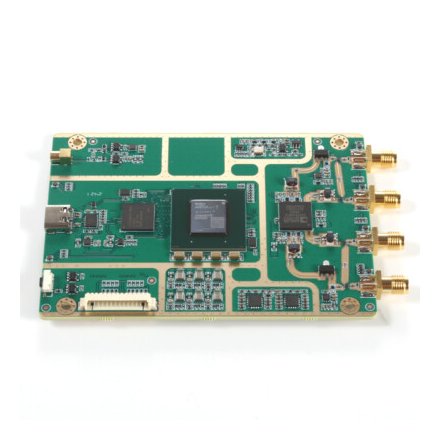
1. Technical Specifications & Performance Analysis
The AD936x Series represents a "Radio-on-a-Chip" philosophy, significantly reducing the Bill of Materials (BOM) for complex wireless systems by replacing dozens of discrete components.
1.1 Core Architecture (RF-to-Bits)
The series utilizes a direct-conversion architecture to achieve high integration and low power consumption. By integrating the local oscillators (LO) and fractional-N synthesizers with a 2.4 Hz step size, the device allows for incredibly precise frequency tuning. The digital interface supports both LVDS and CMOS modes, making it compatible with a wide range of FPGAs and SoCs like the Xilinx Zynq series.
1.2 Key Electrical Characteristics
Engineers must account for the following power and thermal parameters during the design phase:
Frequency Range: 325 MHz to 3.8 GHz (Note: Specific models like the AD9361 extend this range).
Supply Voltage: Operates on a core voltage of 1.3 V.
Noise Figure: Highly sensitive reception with a noise figure of 2.5 dB to 3.3 dB.
Transmit Power: Maximum output power is approximately +7.5 dBm, suitable for short-range links or as a driver for external power amplifiers.
1.3 Interfaces and Connectivity
The AD936x Series communicates with a host processor via a standard SPI port for configuration. Data transfer occurs over a high-speed digital interface (parallel data bus), supporting both Frequency Division Duplex (FDD) and Time Division Duplex (TDD) operations.
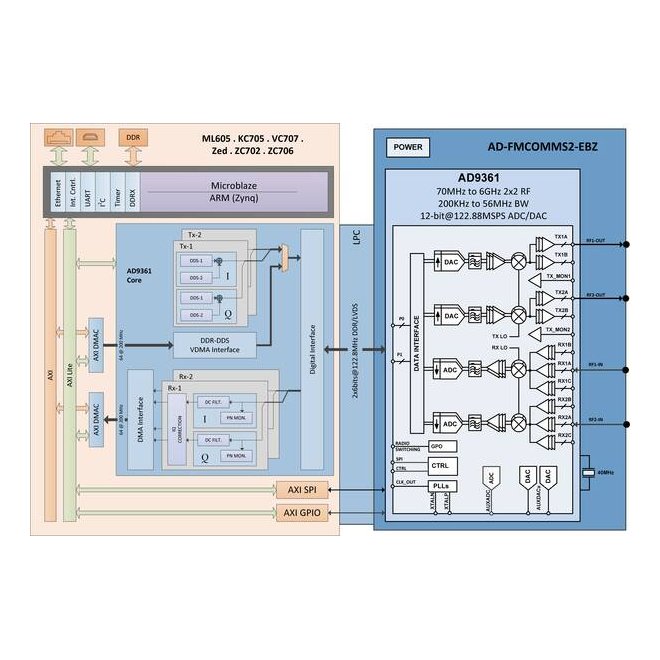
2. Pinout, Package, and Configuration
Due to the high pin count and RF sensitivity, the physical layout of the AD936x is critical for performance.
2.1 Pin Configuration Guide
The device features a complex array of pins dedicated to differential RF signals and high-speed digital data.
RF Ports (RX1A/B, RX2A/B, TX1A/B, TX2A/B): Differential inputs and outputs for the 2x2 MIMO streams.
Digital Supply (VDD_DIG): 1.3V supply for the internal logic.
Control Pins (ENABLE, TXNRX): Real-time hardware control for switching between transmit and receive states.
Clock Input (XTAL_N/P): Connection for the external reference clock or crystal oscillator.
2.2 Naming Convention & Ordering Codes
While the series is often referred to collectively, specific part numbers denote different capabilities: - AD9361: The flagship model (70 MHz to 6 GHz). - AD9363: Optimized for femtocells (325 MHz to 3.8 GHz). - AD9364: A 1x1 SISO (Single-Input, Single-Output) alternative for lower-cost designs.
2.3 Available Packages
| Package Type | Dimensions | Common Use Case |
|---|---|---|
| 144-Ball CSPBGA | 10mm x 10mm | High-density PCB designs; requires machine SMT assembly. |
3. Design & Integration Guide (For Engineers & Makers)
Pro Tip: Always utilize a 4-layer or higher PCB stackup with a dedicated ground plane directly beneath the AD936x to minimize RF interference.
3.1 Hardware Implementation
Bypass Capacitors: Use low-ESR ceramic capacitors (0.1µF and 10pF) as close to the power pins as possible to prevent logic noise from entering the RF chain.
PCB Layout: Maintain 50-ohm controlled impedance for all RF traces. Avoid 90-degree bends; use mitered or curved traces instead.
Thermal Management: The CSPBGA package requires an array of thermal vias to the ground plane to dissipate heat during high-duty-cycle TX operations.
3.2 Common Design Challenges
Issue: Restricted Frequency Range -> Fix: The AD9363 is limited to 3.8 GHz. If your application requires 5.8 GHz Wi-Fi or C-band, upgrade to the pin-compatible AD9361.
Issue: Low Transmit Power -> Fix: Integrate an external Power Amplifier (PA) and a Low Noise Amplifier (LNA) to achieve long-range communication.
Issue: Configuration Complexity -> Fix: Do not attempt to write the register map from scratch. Use Analog Devices' libiio library and the AD-FMCOMMS reference designs.
4. Typical Applications & Use Cases
4.1 Real-World Example: UAV Data Link
In modern drone applications, the AD936x Series acts as the heart of the digital video transmission system. By using the 2x2 MIMO capability, the system can maintain a robust link even in high-interference environments. The tunable bandwidth allows the drone to switch from a high-resolution 20 MHz video stream to a narrow, long-range 200 kHz telemetry link on the fly.
5. Alternatives and Cross-Reference Guide
If the AD936x Series does not meet your specific BOM requirements, consider these alternatives:
Direct Upgrades: AD9361 (provides wider frequency coverage from 70 MHz to 6 GHz).
Cost-Effective Options: AD9364 (if 2x2 MIMO is not required, this 1x1 version reduces cost and power).
Competitor Cross-Reference:
Lime Microsystems LMS7002M: Offers wider frequency range but often requires more complex external matching.
Texas Instruments AFE7070: A viable alternative for specific transmit-heavy applications.
6. Frequently Asked Questions (FAQ)
Q: What is the difference between the AD9363 and the AD9361?A: The AD9361 supports a wider frequency range (70 MHz to 6 GHz) and higher performance specs, whereas the AD9363 is a cost-optimized version limited to 325 MHz to 3.8 GHz.
Q: Can the AD936x Series be used for 5G applications?A: It is suitable for Sub-6 GHz 5G prototyping and small cells (specifically 4G/5G shared bands), but not for mmWave 5G.
Q: Where can I find the AD936x Series datasheet and library files?A: Official documentation is available on the Analog Devices website. For software, search for the "IIO Oscilloscope" and "libiio" on GitHub.
Q: Is the AD936x Series suitable for battery-operated devices?A: Yes, with a 1.3V core and integrated power-saving modes, it is highly efficient, though the accompanying FPGA will typically be the primary power draw.
7. Resources
Development Tools: ADALM-PLUTO (PlutoSDR) is the most popular entry-level tool using this series.
Software: MATLAB and Simulink support packages for AD936x.
Documentation: ADI Wiki (EngineerZone) for real-time technical support.
Specifications
Datasheet PDF
- Datasheets :
- Other Related Documents :
- ConflictMineralStatement :
 A Comprehensive Guide to LTC6945IUFD#TRPBF PLL Frequency Synthesizer
06 March 2024401
 TL431 Shunt Regulator: How to Test and Replace?
26 April 202222011
 STM32G030C8T6 MCU: Pinout, Applications and Datasheet
26 October 20236097
 MPL3115A2 Pressure Sensor: Datasheet, Pinout and Schematic
25 August 20213350
 Unraveling the Texas Instruments PIC32MX330F064L Microcontroller: A Technical Exploration
29 February 2024181
 GRM21BR71C475KA73L Ceramic Capacitor: Datasheet, Price, GRM Series
15 March 2022391
 NC7SB3157P6X: Overview, Features, and Applications
14 December 2023926
 What Is The Difference Between SOT23 And SOT323?
21 February 202240504
 What is a Power Capacitor?
20 November 20216708
 Semiconductor Sales Expected to Rebound in 2024, Driven by Innovation
18 December 20235014
 A/D Converter: Basic Principle and Types
06 November 202021229
 What is DDR5 SDRAM? The Ultimate Guide to Specs, Architecture, and Market Trends
05 January 202612257
 In-depth Analysis of the Global Semiconductor Supply Chain
20 January 202213787
 What is Inertial Measurement Unit (IMU)?
15 October 202511030
 LDR/Light Dependent Resistor: Working Principle, Types and Applications
19 January 202634559
 What is AMOLED?
25 April 202111337
Analog Devices Inc.
In Stock: 2108
United States
China
Canada
Japan
Russia
Germany
United Kingdom
Singapore
Italy
Hong Kong(China)
Taiwan(China)
France
Korea
Mexico
Netherlands
Malaysia
Austria
Spain
Switzerland
Poland
Thailand
Vietnam
India
United Arab Emirates
Afghanistan
Åland Islands
Albania
Algeria
American Samoa
Andorra
Angola
Anguilla
Antigua & Barbuda
Argentina
Armenia
Aruba
Australia
Azerbaijan
Bahamas
Bahrain
Bangladesh
Barbados
Belarus
Belgium
Belize
Benin
Bermuda
Bhutan
Bolivia
Bonaire, Sint Eustatius and Saba
Bosnia & Herzegovina
Botswana
Brazil
British Indian Ocean Territory
British Virgin Islands
Brunei
Bulgaria
Burkina Faso
Burundi
Cabo Verde
Cambodia
Cameroon
Cayman Islands
Central African Republic
Chad
Chile
Christmas Island
Cocos (Keeling) Islands
Colombia
Comoros
Congo
Congo (DRC)
Cook Islands
Costa Rica
Côte d’Ivoire
Croatia
Cuba
Curaçao
Cyprus
Czechia
Denmark
Djibouti
Dominica
Dominican Republic
Ecuador
Egypt
El Salvador
Equatorial Guinea
Eritrea
Estonia
Eswatini
Ethiopia
Falkland Islands
Faroe Islands
Fiji
Finland
French Guiana
French Polynesia
Gabon
Gambia
Georgia
Ghana
Gibraltar
Greece
Greenland
Grenada
Guadeloupe
Guam
Guatemala
Guernsey
Guinea
Guinea-Bissau
Guyana
Haiti
Honduras
Hungary
Iceland
Indonesia
Iran
Iraq
Ireland
Isle of Man
Israel
Jamaica
Jersey
Jordan
Kazakhstan
Kenya
Kiribati
Kosovo
Kuwait
Kyrgyzstan
Laos
Latvia
Lebanon
Lesotho
Liberia
Libya
Liechtenstein
Lithuania
Luxembourg
Macao(China)
Madagascar
Malawi
Maldives
Mali
Malta
Marshall Islands
Martinique
Mauritania
Mauritius
Mayotte
Micronesia
Moldova
Monaco
Mongolia
Montenegro
Montserrat
Morocco
Mozambique
Myanmar
Namibia
Nauru
Nepal
New Caledonia
New Zealand
Nicaragua
Niger
Nigeria
Niue
Norfolk Island
North Korea
North Macedonia
Northern Mariana Islands
Norway
Oman
Pakistan
Palau
Palestinian Authority
Panama
Papua New Guinea
Paraguay
Peru
Philippines
Pitcairn Islands
Portugal
Puerto Rico
Qatar
Réunion
Romania
Rwanda
Samoa
San Marino
São Tomé & Príncipe
Saudi Arabia
Senegal
Serbia
Seychelles
Sierra Leone
Sint Maarten
Slovakia
Slovenia
Solomon Islands
Somalia
South Africa
South Sudan
Sri Lanka
St Helena, Ascension, Tristan da Cunha
St. Barthélemy
St. Kitts & Nevis
St. Lucia
St. Martin
St. Pierre & Miquelon
St. Vincent & Grenadines
Sudan
Suriname
Svalbard & Jan Mayen
Sweden
Syria
Tajikistan
Tanzania
Timor-Leste
Togo
Tokelau
Tonga
Trinidad & Tobago
Tunisia
Turkey
Turkmenistan
Turks & Caicos Islands
Tuvalu
U.S. Outlying Islands
U.S. Virgin Islands
Uganda
Ukraine
Uruguay
Uzbekistan
Vanuatu
Vatican City
Venezuela
Wallis & Futuna
Yemen
Zambia
Zimbabwe
![AD9364BBCZ]() AD9364BBCZ
AD9364BBCZAnalog Devices Inc.
![ADF7025BCPZ]() ADF7025BCPZ
ADF7025BCPZAnalog Devices Inc.
![AD9361BBCZ]() AD9361BBCZ
AD9361BBCZAnalog Devices Inc.
![ADUCRF101BCPZ128]() ADUCRF101BCPZ128
ADUCRF101BCPZ128Analog Devices Inc.
![ADF7021BCPZ-RL7]() ADF7021BCPZ-RL7
ADF7021BCPZ-RL7Analog Devices Inc.
![AD9371BBCZ]() AD9371BBCZ
AD9371BBCZAnalog Devices Inc.
![ADF7023BCPZ]() ADF7023BCPZ
ADF7023BCPZAnalog Devices Inc.
![ADF7020-1BCPZ]() ADF7020-1BCPZ
ADF7020-1BCPZAnalog Devices Inc.
![ADF7021BCPZ-RL]() ADF7021BCPZ-RL
ADF7021BCPZ-RLAnalog Devices Inc.
![ADF7020BCPZ-RL]() ADF7020BCPZ-RL
ADF7020BCPZ-RLAnalog Devices Inc.


