

 Product
 Brand
Brand Articles
 Tools
Tools
78L05 Voltage Regulator: Circuit, Equivalent, and 78L05 vs 7805

78L05 datasheet pdf and Unclassified product details from Shikues stock available at Utmel
Unit Price: $0.026853
Ext Price: $0.03


The LM78L05 is a 5 V-fixed three-terminal positive voltage regulator that employs internal current limiting and thermal shutdown, making it essentially indestructible.

voltage regulator 5v power supply
- 78L05 Description
- 78L05 Pinout
- 78L05 CAD Model
- 78L05 Features
- 78L05 Advantages
- Specifications
- 78L05 Schematic Diagram
- 78L05 Test Circuit
- 78L05 Layout
- 78L05 Equivalents
- 78L05 Negative Voltage Complement
- Where to use 78L05
- How to use 78L05
- 78L05 vs 7805
- 78L05 Applications
- 78L05 Application Circuits
- 78L05 Package
- 78L05 Manufacturer
78L05 Description
The LM78L05 is a 5 V-fixed three-terminal positive voltage regulator that employs internal current limiting and thermal shutdown, making it essentially indestructible. The 78L05 can provide local, on-card regulation, eliminating distribution problems associated with single-point regulation. With adequate heat sinking, the regulator can deliver 100 mA output current. Current limiting is included to limit the peak output current to a safe value. Safe area protection for the output transistors is provided to limit internal power dissipation. If internal power dissipation is too high for the heat sinking provided, the thermal shutdown circuit prevents the IC from overheating.
When used as a Zener diode/resistor combination replacement, the 78L05 offers effective output impedance improvement of two orders of magnitude along with lower quiescent current and lower noise. The 78L05 can also be used with power-pass elements to make high-current voltage regulators. The LM78L05 is also a low-current substitute (max 0.1 A) for LM7805.
78L05 Pinout

78L05 CAD Model
Symbol

Footprint

3D Model

78L05 Features
Type of IC: 5 V-Fixed 3-Terminal Positive Voltage Regulator
Package: SOT-89 (also available in TO-92 and SO-8 package)
Output Configuration: Positive
Fixed Output Voltage: 5 V
Max Output Current: 150 mA
Max Input Voltage: 35 V
Power Dissipation: 0.5 W
Operating Temperature: -40 to +85 °C
Note: Different manufacturers may have different ratings
78L05 Advantages
Output voltage tolerances of ±5% over the temperature range
Thermal overload protection
Short-circuit protection
Output transistor safe area protection
Full military temperature range
No external components are required
Available in either ±4% (A) or ±8% (C) selection
Specifications
- TypeParameter
- Package / Case
refers to the protective housing that encases an electronic component, providing mechanical support, electrical connections, and thermal management.
SOT-89(SOT-89-3) - Operating Temperature
The operating temperature is the range of ambient temperature within which a power supply, or any other electrical equipment, operate in. This ranges from a minimum operating temperature, to a peak or maximum operating temperature, outside which, the power supply may fail.
-40°C~85°C - Packaging
Semiconductor package is a carrier / shell used to contain and cover one or more semiconductor components or integrated circuits. The material of the shell can be metal, plastic, glass or ceramic.
Tape & Reel (TR) - Voltage - Input (Max)
Voltage - Input (Max) is a parameter in electronic components that specifies the maximum voltage that can be safely applied to the input of the component without causing damage. This parameter is crucial for ensuring the proper functioning and longevity of the component. Exceeding the maximum input voltage can lead to electrical overstress, which may result in permanent damage or failure of the component. It is important to carefully adhere to the specified maximum input voltage to prevent any potential issues and maintain the reliability of the electronic system.
35V - Output Type
The "Output Type" parameter in electronic components refers to the type of signal or data that is produced by the component as an output. This parameter specifies the nature of the output signal, such as analog or digital, and can also include details about the voltage levels, current levels, frequency, and other characteristics of the output signal. Understanding the output type of a component is crucial for ensuring compatibility with other components in a circuit or system, as well as for determining how the output signal can be utilized or processed further. In summary, the output type parameter provides essential information about the nature of the signal that is generated by the electronic component as its output.
Fixed - Output Configuration
Output Configuration in electronic components refers to the arrangement or setup of the output pins or terminals of a device. It defines how the output signals are structured and how they interact with external circuits or devices. The output configuration can determine the functionality and compatibility of the component in a circuit design. Common types of output configurations include single-ended, differential, open-drain, and push-pull configurations, each serving different purposes and applications in electronic systems. Understanding the output configuration of a component is crucial for proper integration and operation within a circuit.
positive - Voltage Dropout (Max)
Voltage Dropout (Max) refers to the minimum voltage difference between the input and output of a voltage regulator or linear power supply needed to maintain proper regulation. It indicates the maximum allowable voltage drop across the device for it to function effectively without dropout. If the input voltage falls below this threshold, the output voltage may drop below the specified level, leading to potential operational issues for connected components. This parameter is critical for ensuring stable and reliable power delivery in electronic circuits.
1.7V @ 40mA typ - Output Current-Max
Output Current-Max is a parameter in electronic components that specifies the maximum amount of current that can be safely drawn from the output of the component without causing damage. It is an important specification to consider when designing circuits to ensure that the component can handle the required current without overheating or failing. Exceeding the maximum output current can lead to performance issues, component damage, or even complete failure of the circuit. It is crucial to adhere to the specified maximum output current to ensure the reliable operation of the electronic component and the overall circuit.
150mA - Number of Output Channels1
- Voltage - Output (Fixed)
Voltage - Output (Fixed) is a parameter in electronic components that refers to the specific output voltage level that the component is designed to provide. This parameter indicates that the output voltage of the component is fixed and cannot be adjusted or varied. It is an important specification to consider when designing circuits or systems that require a consistent and stable output voltage. Knowing the fixed output voltage of a component helps ensure compatibility and proper functioning within the overall system.
5V - Ripple Rejection (PSRR)
Ripple Rejection (PSRR), also known as Power Supply Rejection Ratio, is a measure of how well a device can reject variations in the power supply voltage. It indicates the ability of a component to maintain a stable output voltage despite fluctuations in the input power source. A high PSRR value means that the component is effective at filtering out unwanted noise and ripple from the power supply, resulting in a cleaner and more stable output signal. PSRR is an important specification for components like voltage regulators and amplifiers, where maintaining a consistent output voltage is critical for proper operation.
49dB(120Hz) - RoHS Status
RoHS means “Restriction of Certain Hazardous Substances” in the “Hazardous Substances Directive” in electrical and electronic equipment.
RoHS Compliant
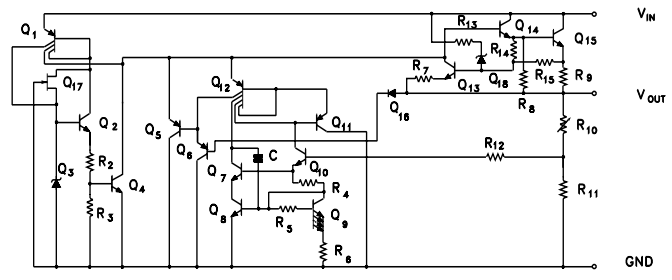
78L05 Schematic Diagram
78L05 Test Circuit

78L05 Layout

78L05 Equivalents
L4931-5.0, LM2931-5.0, NTE977, LP2950 5.0, LM7805, AMS7111, LM7806, LM7809, LM7812, LM317, LM7905, LM7912, LM117V33, XC6206P332MR
Please check the pin configuration and parameters before replacing them in your circuit.
78L05 Negative Voltage Complement
79L05
Where to use 78L05
The 78L05 is a three-terminal integrated voltage regulator with excellent internal current limit and thermal shutdown characteristics. The 78L05 is suitable for many commercial and educational applications. It can be combined with other power transfer devices to form a high-current regulated power supply, such as a voltage regulator that can drive an output current of up to 100 mA. But, the 78L05 suffers from heavy heat loss hence a heat sink is recommended for projects that consume more current. For example, if the input voltage is 12V and you are consuming 50mA, then (12-5) * (50*10^-3) = 0.35 W. This 0.35 Watts will be dissipated as heat.
The 78L05 also has a wide input supply range that is from 7V to 35V DC. The input voltage should not be less than 7V because the 78L05 requires a minimum of two volts above its output voltage to provide stable 5V output.
How to use 78L05
The 78L05 is a three-terminal voltage regulator. The three terminals are input, output, and ground. The 78L05 is fairly easy to use, you only have to connect the input pin to the input voltage that has to be regulated and the ground pin to the system ground. The regulated 5V can be obtained from the output pin.
In the circuit below an input voltage of 12V is regulated to 5V using the 78L05.

Also, note the capacitors C1 and C2 are used at both the input and output ends. These capacitors are used to filter any noise that's coupled with the input voltage. It's not mandatory to use the exact value of capacitor but a value of 10uF for C1 and 1uF for C2 would be an ideal choice.
These regulators also have the ability to limit current and protect the circuit when the temperature exceeds junction temperature. The 78L05 can be used to power small loads like LED which is rated for less than 100mA. But if you connect high current loads, the 78L05 will get very hot and will shut down eventually. In that case, a high current regulator like 7805 would be an ideal replacement.
Apart from using it as a voltage regulator, it can also be used as a current regulator, short-circuit protector, booster circuit, and even a variable voltage regulator.
78L05 vs 7805
Introduction
The LM7805 is a voltage regulator that outputs +5 volts and 1 A. Like most other regulators in the market, it is a three-pin IC: input pin for accepting incoming DC voltage, ground pin for establishing the ground for the regulator, and output pin that supplies the positive 5 volts.
The LM78L05 is an IC of the LM78Lxx series of positive voltage regulators that provides a fixed output of 5 V and 100 mA DC.
Part Numbers
The 7805 is the original manufacturer part number, 78 means positive voltage, whereas 79 means negative voltage, and 05 means positive 5 V output.
The letter between “78” and “05” stands for its current. “78L05” means low current which is 0.1 A, “78M05” means medium current which is 0.5 A, “78S05” means high current which is 2 A, and “78T05” with a higher current which can be as high as 3 A, while the “7805” has a typical current of 1A.
The last two digits stand for different output voltages. For example, 7805 means 5 V output, 7806 means 6 V output, 7808 means 8 V output, etc.
Substitution
In most cases, the 78L05 can be replaced by 7805, but they also have their differences. Their functions are the same, but their pins are reversed, for 7805 its pin 1, 2, 3 stand for input, ground, and output; while for 78L05 its pin 1, 2, 3 stands for output, ground, and input. And they often come in different packages. The 7805 often comes in the TO-220 package and the 78L05 often comes in a TO-92 package. Their output voltage is the same, but their output current is different where the 78L05 is 0.1 A and the 7805 is 1 A. The 78L05 is physically smaller than 7805 and can dissipate less power, and may be rated for less current.
78L05 Applications
Adjustable output regulator
Power small loads under 100 mA
LED lighting
Output polarity-reversal-protection circuit
Output booster circuit
Current limiter
Voltage step down circuits
Power supply circuits
Battery charger circuits
Microcontroller related applications
Portable instrumentation
78L05 Application Circuits

78L05 High Output Current Short-Circuit Protected

78L05 Output Boost Circuit

78L05 Current Regulator
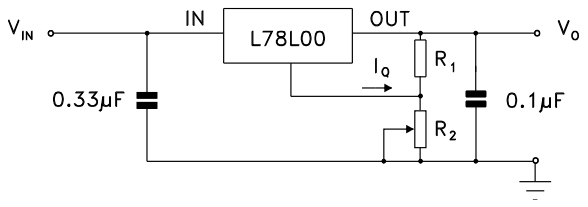
78L05 Adjustable Output Regulator

78L05 ±15-V, 100-mA Dual Power Supply Circuit
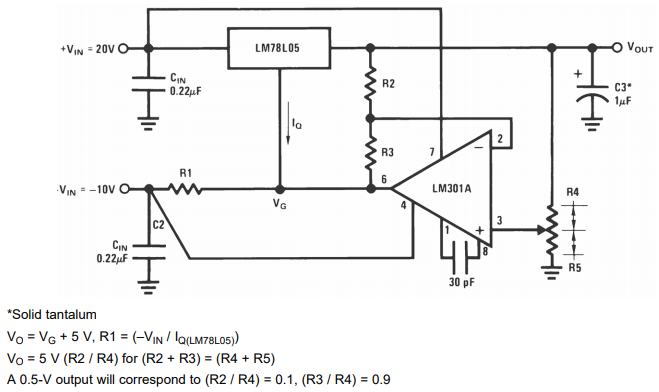
78L05 Variable Output Regulator Circuit (0.5 V to 18 V)
78L05 Package

78L05 Package Outline

78L05 Mechanical Data
78L05 Manufacturer
Shikues, from Taiwan, is one of the world's leading manufacturers of semiconductor discrete components and mainly provides engineers and designers with a variety of semiconductor products and software for a better experience in automotive, communications, computer, consumer electronics, industries, LED lighting, health care, aviation, and power applications.
1.What is a 78L05?
The 78L05 is a 5V fixed 3-terminal voltage regulator delivering up to 100mA of output current and equipped with internal limiting + thermal shutdown features for overload immunity. The 78L05 can also be used with power-pass elements to make high-current voltage regulators.
2.How to use 78L05?
The 78L05 is a three-terminal voltage regulator. The three terminals are Input, Output, and ground as shown in the 78L05 pinout diagram. It is very easy and straightforward to use this IC, just connect the input into the input voltage which has to be regulated, and the ground pin to the system ground.
3.How to safely long run 78L05 in a circuit?
For getting long-term performance from the LM78L05 voltage regulator it is suggested to always use it 20% below its maximum ratings. The maximum load the IC can handle is 100mA DC for the long term and safety does not operate a load of more than 80mA DC. The maximum input voltage is 35V DC for safety does not provide input voltage of more than 28 to 30V DC. Always operate the IC in temperature between 0 degrees centigrade to 85 degrees centigrade. The storage temperature range is from -65 centigrade to +150 centigrade.
4.How do you test 78L05?
You need to take the positive probe off the input pin and place it on the output pin. You can leave the negative probe on the ground pin. The amount of output voltage indicated should be 5 volts because of the “05” associated with 78L05.
5.Where are voltage regulators used?
Such a device is widely used in motor vehicles of all types to match the generator's output voltage to the electrical load and the battery's charging requirements. Voltage regulators also are used in electronic equipment in which excessive variations in voltage would be detrimental.
6.What are the symptoms of a bad voltage regulator?
Probably, the most common symptom associated with a bad regulator is flickering, dimming, or pulsing lights. To be more specific, you may notice that the vehicle's: Headlights fluctuate between bright and dim, without you doing anything. The high beam isn't working as expected.
7.When should you use a voltage regulator?
Voltage regulators are designed to maintain and stabilize voltage levels. Regulators are found in most electronic devices and can be used to step down and control voltage outputs from a high voltage source, dissipating excess energy as heat.
 FDS6910 MOSFET: Features, Pinout, and Datasheet
27 April 20222190
 LM1458 Dual Op-Amp : Pinout, Applications and Datasheet
10 August 20213929
 Introduction to MSP430G2x11 and MSP430G2x01 Mixed-Signal Microcontrollers
29 February 2024150
 AD7171BCPZ-500RL7 A/D Converter: Pinout, Datasheet and Applications
14 September 2021637
 Guide to the STMicroelectronics STM32F100VCT6B Microcontroller
07 June 2025367
 CA3130 Operational Amplifier IC: Pinout, Equivalent and Datasheet
15 September 20219840
 EPM240T100C5 Altera: Specifications, Features and Applications
10 April 2025734
 NE555N Timer: Pinout, Datasheet, and Schematic Diagram
13 July 202110076
 An Overview of Photoelectric Sensors
27 October 20259458
![Basic Introduction to Digital Filter [Video]](https://res.utmel.com/Images/Article/b0245181-c936-414a-8241-51bf13e7c6b3.jpg) Basic Introduction to Digital Filter [Video]
Basic Introduction to Digital Filter [Video]23 October 20204918
 What is Gallium Nitride(GaN)?
19 January 20218418
 Intel Launches First-of-its-Kind Semiconductor Technician Certificate Program to Address Workforce Shortage
28 September 20233601
 What is a Servo Motor?
09 March 20216528
 Memory Chip: The Key to Smart Connectivity
03 November 20212873
 Optimizing Energy Exchange with Vehicle-to-Grid Technology
25 April 20233239
 What to Know Before Buying CR1225 Battery Equivalent
05 September 20252066
Shikues
In Stock: 27478
Minimum: 1 Multiples: 1
Qty
Unit Price
Ext Price
1
$0.026853
$0.03
10
$0.025333
$0.25
100
$0.023899
$2.39
500
$0.022546
$11.27
1000
$0.021270
$21.27
Not the price you want? Send RFQ Now and we'll contact you ASAP.
Inquire for More Quantity