

MOC3021 Optoisolators: Pinout, Circuit and Equivalent


TRIAC OUTPUT OPTOCOUPLER
MOC3021 is a non-zero crossing-based optoisolator consists of gallium arsenide infrared emitting diodes, optically coupled to a silicon-based triac. This article enforces pinout, datasheet, circuit, and other details about MOC3021.

Optocoupler/Optoisolator Tutorial | PC817 MOC3021 | How to use? | Pinout
- MOC3021 Pinout
- MOC3021 Description
- MOC3021 Features
- Specifications
- MOC3021 Logic Diagram
- MOC3021 CAD Model
- MOC3021 Applications
- MOC3021 Application Circuit
- MOC3021 Alternatives
- MOC3021 Equivalent
- MOC3021 vs. MOC3041
- Where to use MOC3021
- How to use MOC3021
- MOC3021 Dimension
- MOC3021 Manufaturer
- Trend Analysis
- Datasheet PDF
MOC3021 Pinout

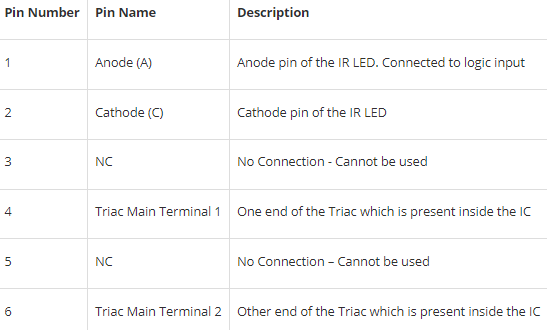
MOC3021 Description
The MOC3021 is a Zero-Crossing TRIAC driven Optocoupler or Optoisolator. As we know the term Optocoupler/optoisolator means the same that is we use light to indirectly coupled to sets of circuits. The specialty of MOC3021 is that it has Zero-Crossing ability and is driven by a Triac.
MOC3021 Features
400 V Phototriac Driver Output
Gallium-Arsenide-Diode Infrared Source and Optically-Coupled Silicon Traic Driver (Bilateral Switch)
UL Recognized . . . File Number E65085
High Isolation . . . 7500 V Peak
Output Driver Designed for 220 Vac
Standard 6-Terminal Plastic DIP
Directly Interchangeable with Motorola MOC3020, MOC3021, MOC3022, and MOC3023
Specifications
- TypeParameter
- Mounting Type
The "Mounting Type" in electronic components refers to the method used to attach or connect a component to a circuit board or other substrate, such as through-hole, surface-mount, or panel mount.
Through Hole - Package / Case
refers to the protective housing that encases an electronic component, providing mechanical support, electrical connections, and thermal management.
6-DIP (0.300, 7.62mm) - Current-Hold(Ih)100μA
- Current-LED Trigger(Ift)(Max)15mA
- Number of Elements1
- Operating Temperature (Min.)-40°C
- Voltage-Off State400V
- Zero-Crossing CircuitNo
- Packaging
Semiconductor package is a carrier / shell used to contain and cover one or more semiconductor components or integrated circuits. The material of the shell can be metal, plastic, glass or ceramic.
Tube - JESD-609 Code
The "JESD-609 Code" in electronic components refers to a standardized marking code that indicates the lead-free solder composition and finish of electronic components for compliance with environmental regulations.
e0 - Pbfree Code
The "Pbfree Code" parameter in electronic components refers to the code or marking used to indicate that the component is lead-free. Lead (Pb) is a toxic substance that has been widely used in electronic components for many years, but due to environmental concerns, there has been a shift towards lead-free alternatives. The Pbfree Code helps manufacturers and users easily identify components that do not contain lead, ensuring compliance with regulations and promoting environmentally friendly practices. It is important to pay attention to the Pbfree Code when selecting electronic components to ensure they meet the necessary requirements for lead-free applications.
no - Part Status
Parts can have many statuses as they progress through the configuration, analysis, review, and approval stages.
Obsolete - Moisture Sensitivity Level (MSL)
Moisture Sensitivity Level (MSL) is a standardized rating that indicates the susceptibility of electronic components, particularly semiconductors, to moisture-induced damage during storage and the soldering process, defining the allowable exposure time to ambient conditions before they require special handling or baking to prevent failures
1 (Unlimited) - Terminal Finish
Terminal Finish refers to the surface treatment applied to the terminals or leads of electronic components to enhance their performance and longevity. It can improve solderability, corrosion resistance, and overall reliability of the connection in electronic assemblies. Common finishes include nickel, gold, and tin, each possessing distinct properties suitable for various applications. The choice of terminal finish can significantly impact the durability and effectiveness of electronic devices.
TIN LEAD - Additional Feature
Any Feature, including a modified Existing Feature, that is not an Existing Feature.
UL RECOGNIZED - Voltage - Isolation
Voltage - Isolation is a parameter in electronic components that refers to the maximum voltage that can be safely applied between two isolated points without causing electrical breakdown or leakage. It is a crucial specification for components such as transformers, optocouplers, and capacitors that require isolation to prevent electrical interference or safety hazards. The voltage isolation rating ensures that the component can withstand the specified voltage without compromising its performance or safety. It is typically measured in volts and is an important consideration when designing circuits that require isolation between different parts of the system.
5300Vrms - Output Type
The "Output Type" parameter in electronic components refers to the type of signal or data that is produced by the component as an output. This parameter specifies the nature of the output signal, such as analog or digital, and can also include details about the voltage levels, current levels, frequency, and other characteristics of the output signal. Understanding the output type of a component is crucial for ensuring compatibility with other components in a circuit or system, as well as for determining how the output signal can be utilized or processed further. In summary, the output type parameter provides essential information about the nature of the signal that is generated by the electronic component as its output.
Triac - Configuration
The parameter "Configuration" in electronic components refers to the specific arrangement or setup of the components within a circuit or system. It encompasses how individual elements are interconnected and their physical layout. Configuration can affect the functionality, performance, and efficiency of the electronic system, and may influence factors such as signal flow, impedance, and power distribution. Understanding the configuration is essential for design, troubleshooting, and optimizing electronic devices.
SINGLE - Number of Channels1
- Forward Current-Max
Forward Current-Max is a parameter used to specify the maximum amount of current that an electronic component, such as a diode or LED, can safely handle when it is forward-biased. This parameter is crucial for determining the operating limits of the component to prevent damage or failure due to excessive current flow. Exceeding the specified Forward Current-Max can lead to overheating, degradation of the component, or even permanent damage. It is important to carefully consider this parameter when designing circuits to ensure the component operates within its safe limits.
0.05A - Current - DC Forward (If) (Max)
The parameter "Current - DC Forward (If) (Max)" in electronic components refers to the maximum forward current that can safely pass through the component without causing damage. This parameter is typically specified in datasheets for diodes and LEDs, indicating the maximum current that can flow through the component in the forward direction. Exceeding this maximum current rating can lead to overheating and potentially permanent damage to the component. It is important to ensure that the current flowing through the component does not exceed this specified maximum to maintain proper functionality and reliability.
50mA - Input Trigger Current-Nom
The parameter "Input Trigger Current-Nom" in electronic components refers to the nominal current level required to trigger a specific function or operation within the component. This parameter is crucial for determining the threshold at which the component will respond to an input signal or command. It helps in ensuring that the component functions reliably and consistently within its specified operating conditions. Understanding the Input Trigger Current-Nom is essential for designing circuits and systems that rely on precise triggering mechanisms for proper operation.
8mA - RoHS Status
RoHS means “Restriction of Certain Hazardous Substances” in the “Hazardous Substances Directive” in electrical and electronic equipment.
Non-RoHS Compliant
MOC3021 Logic Diagram

MOC3021 CAD Model
Symbol

Footprint

MOC3021 Applications
Solenoid/Valve Controls
Lamp Ballasts
Interfacing Microprocessors to 115/240 Vac Peripherals
Motor Controls
Incandescent Lamp Dimmers
MOC3021 Application Circuit

MOC3021 Alternatives
MCT2E (non-Zero transistor), MOC3041 (Non-Zero Cross TRIAC), FOD3180 (High-Speed MOSFET)
MOC3021 Equivalent
The MOC3043 devices consist of gallium arsenide infrared emitting diodes optically coupled to a monolithic silicon detector performing the function of a Zero Voltage Crossing bilateral triac dr.
MOC3021 vs. MOC3041
Where to use MOC3021
The MOC3021 is normally used to control the AC appliance, such as the brightness of the bulb, the speed of the motor, etc. Either way, due to its limited current rating, an optocoupler will not be allowed to drive loads directly.
How to use MOC3021
The MOC3021 can be used to switch loads by just turning the LED on or off, or we can also use PWM signals to switch the LED and thus the TRIAC. When we switch the TRIAC using PWM signals then the output voltage across the load can be controlled thus controlling the speed/brightness of the load.
MOC3021 Dimension

MOC3021 Manufaturer
Rochester Electronics is the largest continuing source manufacturer of semiconductors in the world. With product licensing from leading manufacturers such as Analog Devices, Altera, Cypress, Fairchild, Freescale, Infineon, Intel, NXP, Renesas, and Texas Instruments, Rochester continues to manufacture and distribute mature products. For industrial, transportation, and hi-reliability markets, this extension of the product life is critical for long-term production and maintenance. With over 100,000 products and 15 billion units in stock, no other company compares to our selection, capabilities, or solutions.
Trend Analysis
Datasheet PDF
- Datasheets :
What is MOC3021?
The MOC3021 is a Zero-Crossing TRIAC driven Optocoupler or Optoisolator. As we know the term Optocoupler/optoisolator means the same that is we use light to indirectly coupled to sets of circuits. The specialty of MOC3021 is that it has Zero-Crossing ability and is driven by a Triac.
What is the use of MOC3021?
MOC3021 is used to operate high load TRIAC. In industrial applications, the IC has vast usage. IC is also used as switching in Traffic Lights. Motor control and Fan speed control also use MOC3021 with the microcontroller.
 STM32F723E-DISCO Communities and Development Resources Guide
07 June 2025122
 STM32H747XIH6 Microcontroller: Features, Applications and Datasheet
26 December 20232532
 BA159 Fast Diode: Datasheet, Equivalent and Pinout
13 October 202113309
 ATMEGA128-16AU 8-bit Microcontrollers - MCU 128kB Flash: Pinout, Datasheet, and Applications
04 March 20225045
 A Comprehensive Overview of the Analog Devices Inc. 5962-8777101MCA Linear Amplifier
06 March 202481
 IR2113 High And Low Side Driver: 1.2V, 500V IGBT Driver IC, 14 PDIP and Schematic
05 January 20227071
 MP1584EN Step-Down Converter: Datasheet, Pinout and Circuit
16 April 202518275
 IRF740 Power MOSFET: Replacement, Price and Circuit
27 August 20215560
 What is an Electromagnetic Relay?
13 October 20209530
 15 Key Elements of Diode Selection
26 November 202116146
 Logic - Translators, Level Shifters: A Semiconductor Device on A Circuit
22 February 20231523
 Four Proximity Sensors PK, Who can Win?
08 April 20222045
 What is Optical Module?
08 December 20215893
 All You Need to Know About Rectifier Circuit
24 April 202514036
 How do Solar Cells Work?
20 November 20202798
 How Does the A4988 Stepper Motor Driver Work
27 February 20233685
Rochester Electronics, LLC
In Stock
United States
China
Canada
Japan
Russia
Germany
United Kingdom
Singapore
Italy
Hong Kong(China)
Taiwan(China)
France
Korea
Mexico
Netherlands
Malaysia
Austria
Spain
Switzerland
Poland
Thailand
Vietnam
India
United Arab Emirates
Afghanistan
Åland Islands
Albania
Algeria
American Samoa
Andorra
Angola
Anguilla
Antigua & Barbuda
Argentina
Armenia
Aruba
Australia
Azerbaijan
Bahamas
Bahrain
Bangladesh
Barbados
Belarus
Belgium
Belize
Benin
Bermuda
Bhutan
Bolivia
Bonaire, Sint Eustatius and Saba
Bosnia & Herzegovina
Botswana
Brazil
British Indian Ocean Territory
British Virgin Islands
Brunei
Bulgaria
Burkina Faso
Burundi
Cabo Verde
Cambodia
Cameroon
Cayman Islands
Central African Republic
Chad
Chile
Christmas Island
Cocos (Keeling) Islands
Colombia
Comoros
Congo
Congo (DRC)
Cook Islands
Costa Rica
Côte d’Ivoire
Croatia
Cuba
Curaçao
Cyprus
Czechia
Denmark
Djibouti
Dominica
Dominican Republic
Ecuador
Egypt
El Salvador
Equatorial Guinea
Eritrea
Estonia
Eswatini
Ethiopia
Falkland Islands
Faroe Islands
Fiji
Finland
French Guiana
French Polynesia
Gabon
Gambia
Georgia
Ghana
Gibraltar
Greece
Greenland
Grenada
Guadeloupe
Guam
Guatemala
Guernsey
Guinea
Guinea-Bissau
Guyana
Haiti
Honduras
Hungary
Iceland
Indonesia
Iran
Iraq
Ireland
Isle of Man
Israel
Jamaica
Jersey
Jordan
Kazakhstan
Kenya
Kiribati
Kosovo
Kuwait
Kyrgyzstan
Laos
Latvia
Lebanon
Lesotho
Liberia
Libya
Liechtenstein
Lithuania
Luxembourg
Macao(China)
Madagascar
Malawi
Maldives
Mali
Malta
Marshall Islands
Martinique
Mauritania
Mauritius
Mayotte
Micronesia
Moldova
Monaco
Mongolia
Montenegro
Montserrat
Morocco
Mozambique
Myanmar
Namibia
Nauru
Nepal
New Caledonia
New Zealand
Nicaragua
Niger
Nigeria
Niue
Norfolk Island
North Korea
North Macedonia
Northern Mariana Islands
Norway
Oman
Pakistan
Palau
Palestinian Authority
Panama
Papua New Guinea
Paraguay
Peru
Philippines
Pitcairn Islands
Portugal
Puerto Rico
Qatar
Réunion
Romania
Rwanda
Samoa
San Marino
São Tomé & Príncipe
Saudi Arabia
Senegal
Serbia
Seychelles
Sierra Leone
Sint Maarten
Slovakia
Slovenia
Solomon Islands
Somalia
South Africa
South Sudan
Sri Lanka
St Helena, Ascension, Tristan da Cunha
St. Barthélemy
St. Kitts & Nevis
St. Lucia
St. Martin
St. Pierre & Miquelon
St. Vincent & Grenadines
Sudan
Suriname
Svalbard & Jan Mayen
Sweden
Syria
Tajikistan
Tanzania
Timor-Leste
Togo
Tokelau
Tonga
Trinidad & Tobago
Tunisia
Turkey
Turkmenistan
Turks & Caicos Islands
Tuvalu
U.S. Outlying Islands
U.S. Virgin Islands
Uganda
Ukraine
Uruguay
Uzbekistan
Vanuatu
Vatican City
Venezuela
Wallis & Futuna
Yemen
Zambia
Zimbabwe
![MOC3012SVM]() MOC3012SVM
MOC3012SVMRochester Electronics, LLC
![FODM3021R2V]() FODM3021R2V
FODM3021R2VRochester Electronics, LLC
![FODM3010R4V]() FODM3010R4V
FODM3010R4VRochester Electronics, LLC
![FODM3021R3V]() FODM3021R3V
FODM3021R3VRochester Electronics, LLC
![FODM3051V]() FODM3051V
FODM3051VRochester Electronics, LLC
![FODM3051R3V]() FODM3051R3V
FODM3051R3VRochester Electronics, LLC
![FODM3011R1]() FODM3011R1
FODM3011R1Rochester Electronics, LLC
![FODM3022]() FODM3022
FODM3022Rochester Electronics, LLC
![FODM3053R2V]() FODM3053R2V
FODM3053R2VRochester Electronics, LLC

