Product
 Brand
Brand Articles
 Tools
Tools
Buffer Amplifier Guide: How It Works, Key Specifications, Applications and Selection
Quick answer: A buffer amplifier transfers a signal from one circuit stage to another while minimizing interaction between them. A typical voltage buffer has a voltage gain close to one, high input impedance and low output impedance. It does not primarily increase signal voltage; it isolates the source and gives the signal enough drive capability for the next stage.
A circuit with a voltage gain of one may appear unnecessary. If the output voltage is almost identical to the input voltage, why add another component?
The answer is impedance.
A signal source may produce the correct open-circuit voltage but fail to maintain that voltage after a load is connected. A buffer amplifier separates the source from the load, allowing a weak or high-impedance source to control a lower-impedance circuit without excessive voltage loss, distortion or settling error.
That makes buffers useful in sensor interfaces, data-acquisition systems, active filters, audio equipment, reference circuits, cable drivers and many other analog designs.
This guide explains what a buffer amplifier does, how a voltage-follower circuit works, which datasheet specifications matter and where a buffer may create more problems than it solves.
What Is a Buffer Amplifier?
A buffer amplifier is an active circuit placed between a signal source and a load. Its main purpose is to reduce the electrical interaction between those two stages.
The most familiar implementation is an operational amplifier configured as a voltage follower:
The signal is connected to the non-inverting input.
The output is connected directly to the inverting input.
Negative feedback makes the output follow the input.
The resulting closed-loop voltage gain is approximately one.
For an ideal voltage buffer:
(V_{OUT}=V_{IN})
Input impedance is infinite.
Output impedance is zero.
The buffer draws no current from the source.
The buffer can deliver any current required by the load.
A real device cannot achieve those ideal values. Its input draws some bias current, its output has finite impedance, and its voltage and current are limited by the power supply, output stage, temperature and load. The ideal model is nevertheless useful because it explains the function of the circuit.
Why impedance matters
Without a buffer, a source with output impedance (Z_S) and a load with impedance (Z_L) form a voltage divider:
[V_L=V_S\frac{Z_L}{Z_S+Z_L}]
When (Z_L) is not much larger than (Z_S), the voltage reaching the load can be substantially lower than the source voltage.
A buffer changes what each side sees:
The source sees the buffer’s high input impedance.
The load sees the buffer’s low output impedance.
The buffer obtains the required load current from its power supply rather than from the original signal source.
This is why a buffer can preserve voltage while increasing current and power-drive capability.
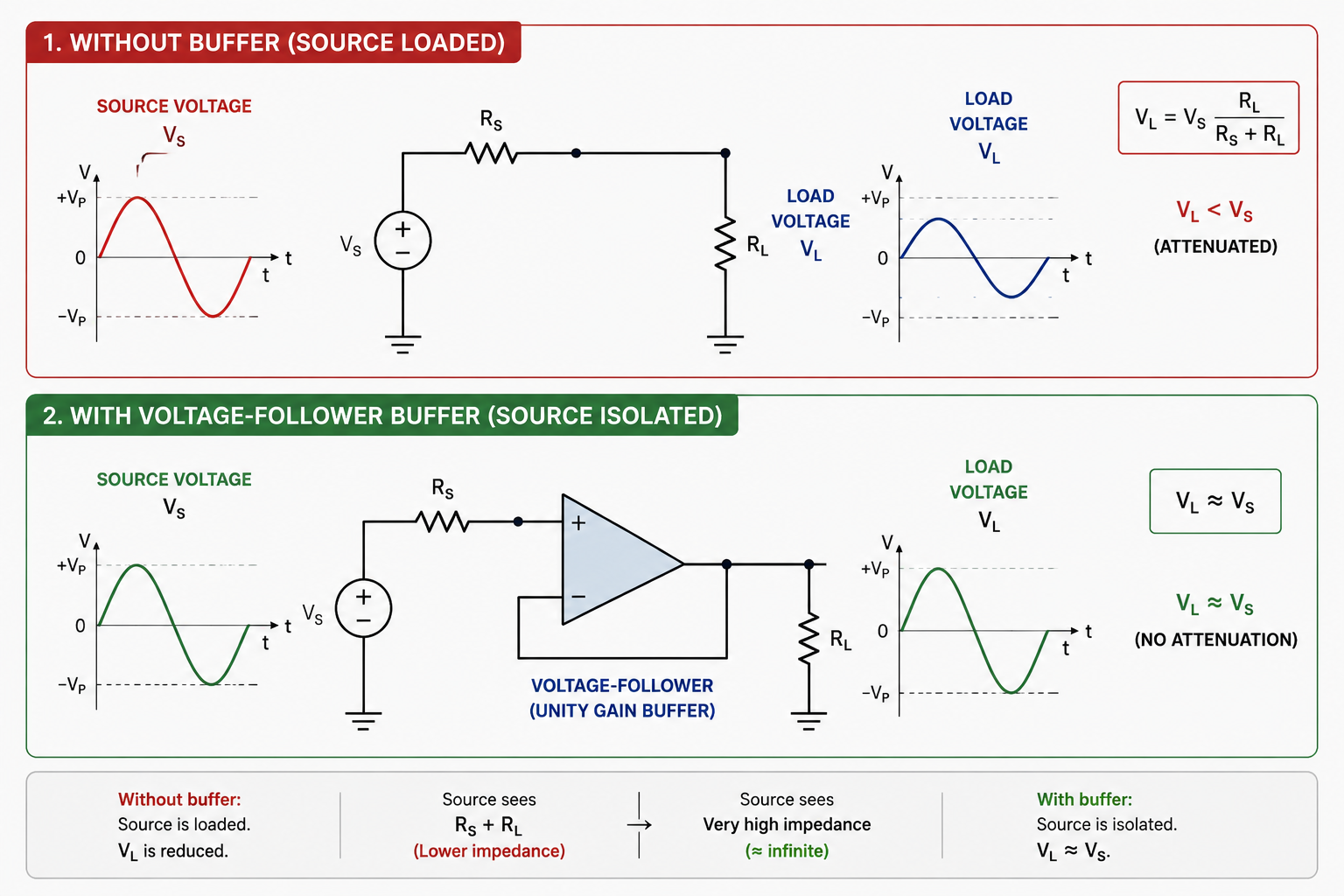
The voltage follower allows a high-impedance source to control a heavier load without forming a harmful voltage divider.
How Does a Buffer Amplifier Work?
An op amp has very high open-loop voltage gain. In a voltage follower, negative feedback continuously adjusts the output in the direction that reduces the voltage difference between the two inputs.
When the circuit is operating linearly:
[V_+\approx V_-]
Because the inverting input is connected to the output:
[V_{OUT}\approx V_{IN}]
This relationship is often explained using two ideal op-amp rules:
The inputs draw approximately zero current.
Negative feedback drives the input voltages toward the same value.
These rules are approximations, not unconditional laws. They are useful only while the amplifier is operating inside its valid input range, output range, current limit, frequency range and stability conditions.
If the output saturates, the input common-mode range is violated or the feedback loop becomes unstable, the output may no longer follow the input.
Unity gain does not mean zero amplification
“Unity gain” refers to voltage gain. A buffer may still provide significant current gain and power gain.
For example, a high-impedance sensor may be able to establish a voltage but supply almost no current. The buffer senses that voltage while drawing very little source current, then uses energy from its power supply to drive the downstream load.
Main Buffer Amplifier Implementations
The term “buffer amplifier” can describe several related circuit types. They share the goal of isolation or increased drive capability, but they are not interchangeable.
| Implementation | Main advantage | Main limitation | Typical use |
|---|---|---|---|
| Op-amp voltage follower | Simple, accurate unity-gain voltage transfer | Must be unity-gain stable and remain within input/output limits | Sensors, references, low-frequency signal conditioning |
| Dedicated unity-gain buffer IC | Higher output current or speed than many general-purpose op amps | May offer little or no adjustable voltage gain | Cable driving, capacitive loads, power buffering |
| BJT emitter follower | Simple current gain and relatively low output impedance | Base-emitter voltage drop and biasing must be considered | Discrete output stages and level shifting |
| MOSFET source follower | High input impedance and useful current drive | Gate threshold and bias conditions affect output level | High-impedance and discrete power stages |
| ADC driver or fully differential amplifier | Designed for converter settling, dynamic loads and differential signals | More complex than a basic follower | High-resolution or high-speed data acquisition |
A general-purpose voltage follower is appropriate only when its performance matches the source, load and signal. A high-speed ADC, long transmission line or demanding capacitive load may require a specialized driver rather than an ordinary op amp.
The Buffer Amplifier Specifications That Matter Most
Selecting a buffer by voltage gain alone is a common mistake. Most candidates can produce a nominal gain of one under light laboratory conditions. The real question is whether the device can preserve the signal under the actual supply, load, frequency and accuracy requirements.
Buffer amplifier selection table
| Specification | Why it matters | What to verify |
| Unity-gain stability | Some op amps are stable only above a specified minimum closed-loop gain | The datasheet explicitly states unity-gain stable or provides a valid gain-of-one circuit |
| Supply-voltage range | Determines whether the device can operate from the available rails | Recommended operating range, not only absolute maximum ratings |
| Input common-mode range | The input stage may stop operating correctly near one or both rails | Entire expected input range across temperature |
| Output-voltage swing | The output usually cannot reach the supply rails under every load | Swing limits at the intended load current and supply voltage |
| Input impedance | Higher impedance reduces loading of the source | Differential and common-mode input impedance where specified |
| Input bias current | Bias current flowing through source resistance creates voltage error | Maximum bias current across temperature, especially for high-impedance sensors |
| Output impedance | Lower impedance helps maintain voltage under load | Closed-loop output impedance versus frequency when available |
| Output current | Determines the resistive load and transient current the buffer can drive | Source and sink current, current limit and short-circuit behavior |
| Bandwidth or GBW | Limits small-signal frequency response | Closed-loop bandwidth at gain one and under the intended load |
| Slew rate | Limits large-signal rate of change | Required slew rate for the highest amplitude and frequency |
| Settling time | Critical when the signal must reach a precise value within a limited acquisition period | Settling tolerance, step size and test conditions |
| Capacitive-load stability | Cables, ADC inputs and large MOSFET gates can reduce phase margin | Maximum recommended load capacitance and compensation circuit |
| Input offset voltage | Appears as DC error in precision applications | Maximum offset and offset drift, not only typical room-temperature values |
| Noise | Adds uncertainty to low-level or high-resolution signals | Voltage noise, current noise and integrated bandwidth |
| Distortion | Important for audio and precision AC systems | THD or THD+N at the required amplitude, frequency and load |
| Quiescent current | Affects battery life and self-heating | Per-channel current over supply and temperature |
| Temperature range | Electrical performance can change significantly with temperature | Guaranteed operating range and maximum specifications |
1. Unity-gain stability
Do not assume every op amp can be connected as a voltage follower.
Some amplifiers are decompensated for higher speed and require a minimum closed-loop gain greater than one. Using one at unity gain can produce ringing or sustained oscillation even when the DC output appears correct.
Look for an explicit statement such as “unity-gain stable” and review the recommended circuit, phase-margin plots and capacitive-load guidance.
2. Input common-mode range
The buffer input must remain inside the amplifier’s valid common-mode range.
A single-supply op amp powered from 0 V and 5 V does not necessarily accept every input between 0 V and 5 V. Even a device described as rail-to-rail input may show changing offset, distortion or reduced performance near a rail.
Check the guaranteed input range at the intended supply voltage and temperature.
3. Output swing and load current
A rail-to-rail output is not an ideal voltage source that reaches both rails under every condition.
Output headroom usually depends on:
Load resistance
Source or sink direction
Supply voltage
Temperature
Output current
Required distortion or accuracy
Estimate the load current before choosing a device. For a resistive load:
[I_{LOAD}\approx\frac{V_{OUT}}{R_{LOAD}}]
Also account for transient current into capacitive loads:
[I=C\frac{dV}{dt}]
A buffer that can drive a 10 kΩ measurement input may be unsuitable for a 50 Ω cable, a large capacitor or a power transistor gate.
4. Bandwidth and slew rate
Bandwidth describes small-signal behavior. Slew rate limits large-signal behavior. Both must be considered.
For a sine wave, a useful minimum slew-rate estimate is:
[SR_{MIN}\ge 2\pi fV_{PK}]
where:
(f) is the highest signal frequency.
(V_{PK}) is the peak output voltage.
A device may have sufficient gain bandwidth for a signal but still distort it because the required output slope exceeds its slew rate.
Use additional margin rather than selecting a device whose published limit only equals the calculated requirement.
5. Settling time
Settling time is the time required for the output to enter and remain within a specified error band after an input step.
This matters in multiplexed data-acquisition systems. When a multiplexer switches channels, the buffer may need to move from one voltage to another and settle before the ADC begins sampling.
A settling-time figure is meaningful only when its conditions are known:
Step amplitude
Load
Closed-loop gain
Final tolerance, such as 0.1%, 0.01% or a fraction of one LSB
Supply voltage
A device that settles to 0.1% quickly may need substantially more time to settle to the accuracy required by a high-resolution converter.
6. Capacitive-load stability
Capacitive loads are among the most common causes of buffer instability.
Examples include:
Long cables
ADC sample-and-hold inputs
Large MOSFET gates
Shielded wiring
Test probes and connectors
Intentional output capacitors
Load capacitance interacts with the amplifier’s output impedance and feedback loop. The result can be overshoot, ringing or oscillation.
Possible remedies include an output isolation resistor, an RC network, modified feedback or a device specifically rated for capacitive loads. The correct solution depends on the amplifier and load, so it should be based on the manufacturer’s guidance and validated in simulation and hardware.
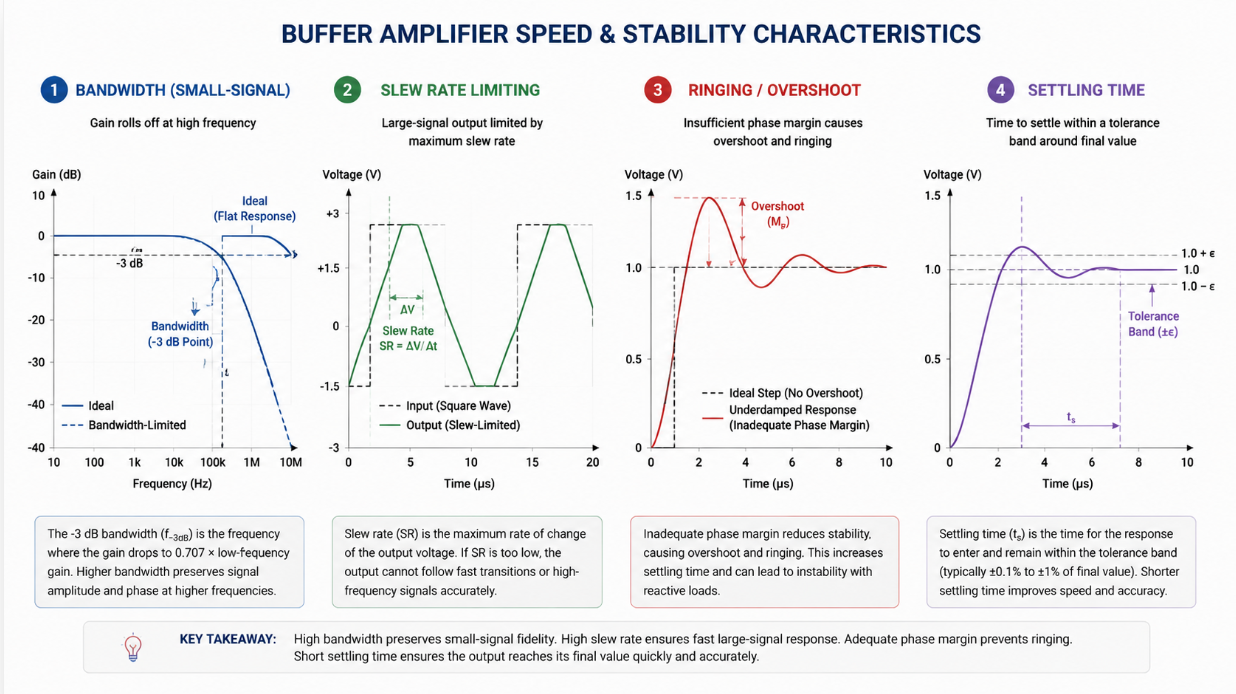
Bandwidth, slew rate, phase margin and settling time describe different parts of a buffer’s dynamic performance.
Common Buffer Amplifier Applications
1. High-impedance sensor interfaces
Some sensors generate a useful voltage but cannot supply meaningful load current. Connecting them directly to an ADC, cable or filter may change the measured voltage.
A low-input-bias-current buffer can isolate sources such as:
Electrochemical probes
Resistive divider networks
Piezoelectric sensors
Photodetector-related front ends
Bridge and precision sensor circuits
The appropriate input technology depends on the source resistance, signal bandwidth, leakage environment and required accuracy. In very high-impedance circuits, PCB contamination and leakage can become as important as the amplifier’s nominal input impedance.
2. ADC input driving
An ADC input is not always a simple, constant resistance.
Successive-approximation converters commonly contain switched-capacitor input networks that draw transient charge from the source. A buffer can provide a low-impedance path that allows the ADC input to acquire and settle accurately.
However, adding an op amp does not automatically improve performance. The buffer adds its own offset, noise and distortion, and it must remain stable while driving the ADC input network.
For demanding converters, select the amplifier and any RC network together with the ADC rather than treating the buffer as an independent block.
3. DAC output buffering
A DAC may produce the required voltage but have limited output-current capability or load restrictions. A buffer can isolate the DAC and drive the following circuit.
Check:
Output range
Required source and sink current
Settling time
Capacitive load
Glitch response
Stability of the combined DAC, buffer and load
4. Active-filter stage isolation
Filter sections can interact when the output impedance of one stage is not sufficiently low relative to the input impedance of the next.
A buffer between stages can reduce loading and help preserve the intended cutoff frequency, damping and gain. The buffer must still have enough bandwidth and sufficiently low noise for the filter.
5. Audio and instrument signals
Audio buffers are used to prevent tone loss, isolate volume-control networks and drive cables or subsequent stages.
Important specifications may include:
Input impedance
Voltage and current noise
Input bias current
Output current
THD+N
Output swing
Behavior with cable capacitance
Turn-on and turn-off transients
A buffer for a high-impedance guitar pickup has different priorities from a line driver or headphone output. A basic op-amp follower should not be assumed to drive a speaker or headphones unless the device is rated for that load.
6. Voltage references and virtual grounds
A voltage divider or reference IC may establish a stable voltage but fail when several circuits draw changing current from it.
A buffer can distribute that voltage with lower output impedance. This is common in single-supply systems that need a midpoint reference or virtual ground.
The designer must still consider:
Source and sink current
Stability with bypass capacitance
Noise
Offset
Power-up behavior
Whether loads can inject current back into the buffer
7. Thermal and power-stage isolation
A precision front-end may perform well until it is also required to drive a heavy load. Increased output current can heat the amplifier and shift its offset.
Separating precision amplification from load driving allows the front-end to remain lightly loaded while a second buffer handles the output current.
8. Wideband and cable-driving systems
High-frequency systems may use dedicated buffers to isolate stages, drive controlled-impedance cables or increase output current.
At higher frequencies, layout becomes part of the circuit. Trace impedance, connector transitions, termination, parasitic capacitance and power-supply decoupling can dominate performance. A slow general-purpose voltage follower is not an RF buffer simply because its gain is one.
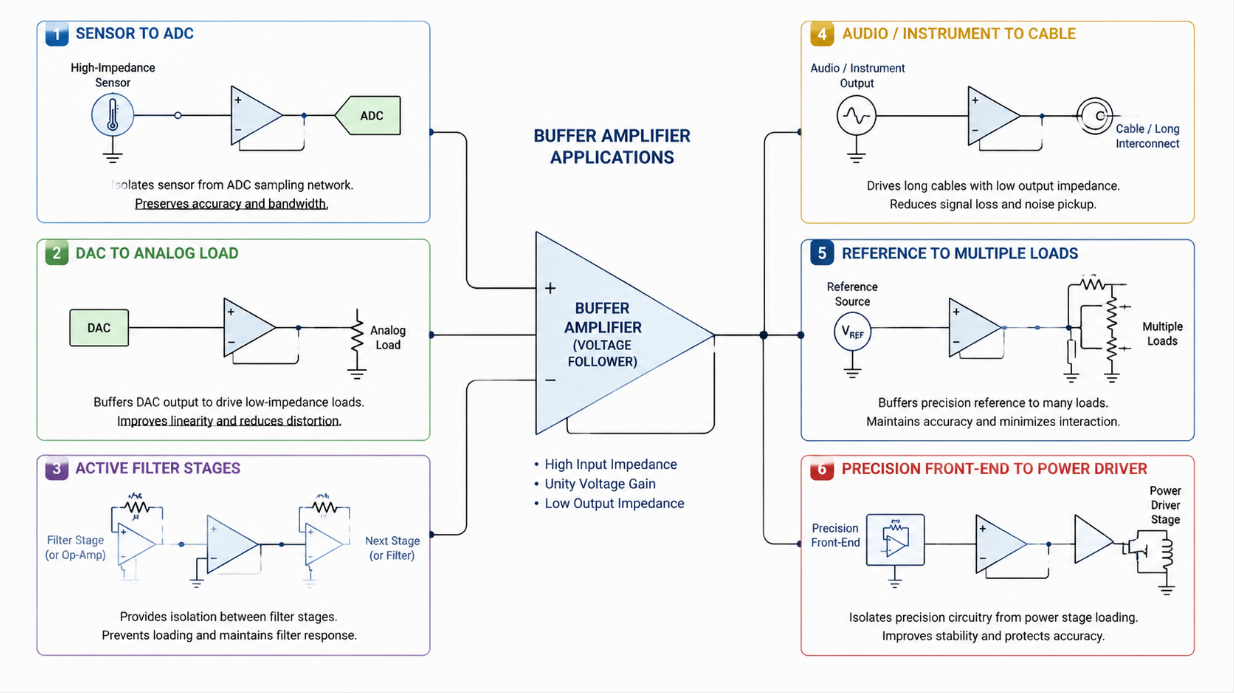
The correct buffer architecture depends on both the source and the load.
When a Buffer Amplifier May Not Be Necessary
A buffer is not automatically beneficial.
You may not need one when:
The source impedance is already low.
The load impedance is sufficiently high.
The source can provide the required current.
The signal settles within the required acquisition time.
The added amplifier noise and offset would exceed the benefit.
The power budget cannot support another active stage.
The signal requires functions better handled by another circuit, such as differential conversion, gain, isolation or level translation.
Microchip’s ADC guidance makes an important practical point: when the original signal is already low impedance, buffering may offer little advantage while still adding noise and offset.
Treat the buffer as a solution to a defined source-to-load problem, not as a default schematic decoration.
A Practical Buffer Amplifier Selection Process
Step 1: Characterize the signal source
Record:
Minimum and maximum voltage
DC and AC content
Source impedance
Maximum available source current
Frequency range
Expected transient behavior
Required measurement accuracy
A high source resistance makes input bias current and PCB leakage more important.
Step 2: Characterize the load
Determine whether the load is:
Resistive
Capacitive
Dynamic or switched
Single-ended or differential
Connected through a cable
Shared among several circuits
Calculate steady-state current and estimate transient current.
Step 3: Establish the accuracy budget
Allocate allowable error among:
Offset voltage
Input bias current
Noise
Gain error
Drift
Settling error
Distortion
Source and load tolerance
A buffer whose “typical” performance looks excellent may still fail the system if its maximum error exceeds the budget.
Step 4: Establish the speed requirement
Check both:
Small-signal bandwidth
Large-signal slew rate
For sampled systems, also define the required settling tolerance and available acquisition time.
Step 5: Check voltage headroom
Compare the intended input and output ranges with:
Input common-mode limits
Output-swing limits at the actual load
Supply-voltage range
Startup and fault conditions
Do not assume “rail-to-rail” removes the need for this check.
Step 6: Confirm unity-gain and load stability
Verify that the selected amplifier is stable:
At a closed-loop gain of one
With the expected output capacitance
With the chosen feedback and isolation components
Across process, supply and temperature conditions
Step 7: Review power and thermal limits
Calculate or estimate:
Quiescent power
Load power
Short-circuit exposure
Package temperature rise
Self-heating-related offset drift
Step 8: Simulate and prototype
Simulation is useful for evaluating bandwidth, phase margin, overshoot and settling, but the model must include the relevant load and parasitic elements.
Hardware verification should include:
Maximum signal amplitude
Maximum frequency
Worst-case load
Supply extremes
Temperature extremes where relevant
Startup and shutdown
Long cables or actual ADC inputs
Oscilloscope probing effects
Common Buffer Amplifier Design Mistakes
Assuming every op amp is unity-gain stable
A device optimized for higher closed-loop gain may oscillate as a follower. Confirm the minimum stable gain in the datasheet.
Using positive feedback by mistake
A voltage follower has a positive output response, but its feedback is negative. The output connects to the inverting input. Reversing the inputs generally drives the circuit toward a rail rather than producing a linear buffer.
Ignoring input common-mode limits
An output stuck near a rail may be caused by an invalid input voltage, not a damaged amplifier.
Ignoring output swing under load
Output-swing specifications measured with a light load may not apply when the buffer must deliver substantial current.
Treating GBW as the only speed specification
A circuit can meet a small-signal bandwidth requirement and still fail large-signal tests because of slew rate, settling time or output-current limits.
Driving an unknown capacitive load directly
A cable or converter input can destabilize an otherwise suitable amplifier. Review capacitive-load plots and compensation recommendations.
Forgetting supply decoupling
The buffer draws transient current from its supply pins. Place suitable bypass capacitors close to the device and follow the manufacturer’s layout guidance.
Choosing by familiar part number alone
A widely used general-purpose op amp is not automatically suitable for every buffer application. The correct choice depends on supply voltage, common-mode range, output swing, current, speed, noise and load stability.
Relying only on typical values
Use guaranteed maximum and minimum specifications for production designs. Typical values describe representative behavior, not the worst case.
Buffer Amplifier Troubleshooting Table
| Symptom | Likely causes | What to check |
| Output stuck near a supply rail | Feedback wired incorrectly, invalid input range, output saturation | Pin connections, common-mode range, supply voltage and load |
| High-frequency oscillation | Device not unity-gain stable, capacitive load, poor decoupling or layout | Minimum stable gain, phase margin, output capacitance and bypass placement |
| Ringing after an input step | Low phase margin or unsuitable load network | Overshoot, isolation resistance and capacitive-load recommendations |
| Output amplitude lower than expected | Current limit, insufficient output swing or excessive load | Load current and output-swing curves |
| Slow response | Insufficient bandwidth, slew rate or settling performance | Signal amplitude, frequency and acquisition time |
| Unexpected DC error | Offset voltage, input bias current or leakage | Source resistance, temperature and PCB cleanliness |
| ADC readings fail to settle | Dynamic ADC load, inadequate driver bandwidth or RC network | ADC driver recommendations and acquisition timing |
| Excess noise | Wide noise bandwidth, unsuitable amplifier or poor grounding | Input noise, resistor noise, filtering and PCB layout |
| Device becomes hot | Excessive load current, oscillation or inadequate package dissipation | Supply current, output current, waveform and thermal limits |
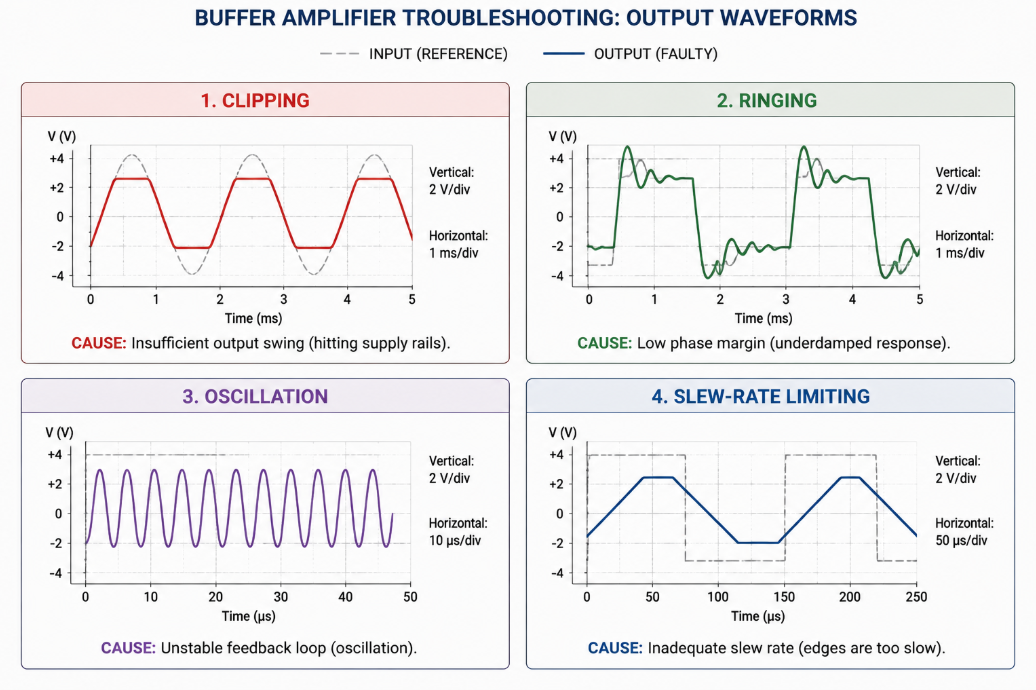
Common buffer failures often produce recognizable waveform patterns.
Buffer Amplifier vs. Other Amplifier Types
| Circuit type | Primary purpose | Typical voltage gain | Key distinction |
| Voltage buffer | Isolate source and load | Approximately 1 | High input impedance and low output impedance |
| Non-inverting amplifier | Increase voltage without phase inversion | Greater than or equal to 1 | Uses a resistor network to set gain |
| Inverting amplifier | Scale and invert a voltage | Set by resistor ratio | Input impedance is influenced by the input resistor |
| Instrumentation amplifier | Amplify small differential signals | Usually greater than 1 | High common-mode rejection and precision gain |
| Transimpedance amplifier | Convert input current to output voltage | V/A transfer function | Used with current-output sensors such as photodiodes |
| ADC driver | Drive a converter input accurately | May be 1 or another value | Designed for settling, dynamic load and often differential output |
| Power amplifier | Deliver substantial power | Application-dependent | Optimized for high voltage, current or load power |
A buffer is therefore not a universal substitute for an instrumentation amplifier, line driver, ADC driver or power amplifier. The topology should match the actual function required.
Frequently Asked Questions
What is the main point of a buffer amplifier?
The main point is electrical isolation between circuit stages. A voltage buffer presents a light load to the source and a lower source impedance to the load, helping preserve the intended signal voltage.
What are the most common buffer amplifier applications?
Common applications include sensor isolation, ADC and DAC interfaces, active-filter stages, audio signal paths, voltage-reference distribution, virtual grounds, cable driving and separation of precision circuitry from high-current loads.
What is the “golden rule” of op amps?
For an ideal op amp operating with negative feedback, the input currents are approximately zero and the two input voltages are approximately equal. These assumptions stop being reliable when the device is saturated, unstable or operating outside its specified input, output or frequency limits.
Is a voltage follower the same as a buffer amplifier?
A voltage follower is the most common form of voltage buffer. “Buffer amplifier” is a broader term that may also refer to dedicated high-current, high-speed or application-specific buffer devices.
Can an LM358 be used as a buffer amplifier?
An LM358-family device can be configured as a voltage follower when the specific version is unity-gain stable. Suitability still depends on supply voltage, input common-mode range, output swing, bandwidth, slew rate, load current, capacitive load and accuracy. Check the exact manufacturer datasheet rather than assuming all LM358-compatible parts behave identically.
Does a buffer amplifier increase power?
It can. Although a voltage follower has a voltage gain close to one, it can provide current gain and power gain by drawing energy from its power supply.
Can any op amp drive a capacitive load?
No. Capacitive loading can reduce phase margin and cause ringing or oscillation. Use a device rated for the expected capacitance or follow the manufacturer’s recommended compensation method.
How much bandwidth should a buffer have?
There is no universal multiplier. The required bandwidth depends on acceptable amplitude error, phase error, settling time, load and signal waveform. Select bandwidth together with slew rate and settling requirements rather than using GBW alone.
Is lower output impedance always better?
A lower output impedance generally improves load regulation and isolation, but it is not the only requirement. Noise, stability, current capability, distortion, power and accuracy may be more important in a particular design.
Should a buffer be placed before or after an active filter?
It depends on which stages need isolation. A buffer may be placed before a filter to prevent the source from affecting it, between filter sections to reduce stage interaction, or after the filter to drive a load. Its bandwidth and noise must be appropriate for the filter.
Final Buffer Amplifier Selection Checklist
Before approving a buffer circuit, confirm the following:
The source voltage and source impedance are defined.
The load resistance, capacitance and transient behavior are known.
The amplifier is explicitly stable at unity gain.
The full input range is inside the guaranteed common-mode range.
The required output range is achievable at the actual load.
Source and sink current are sufficient.
Bandwidth is sufficient for small-signal operation.
Slew rate is sufficient for the largest and fastest waveform.
Settling time meets the system’s accuracy and timing requirements.
Capacitive-load stability has been checked.
Offset, drift, bias current and noise fit the error budget.
Supply current and thermal performance are acceptable.
Bypass capacitors and PCB layout follow manufacturer guidance.
Maximum and minimum datasheet values—not only typical values—have been reviewed.
The complete circuit has been simulated and tested with the real load.
Conclusion
A buffer amplifier is valuable not because it creates a larger voltage, but because it changes the relationship between a source and a load.
The best buffer is not necessarily the device with the highest bandwidth or lowest advertised offset. It is the device that remains stable, accurate and within its operating limits for the specific source, load, supply and signal.
Start by defining the impedance problem. Then verify unity-gain stability, voltage headroom, output current, dynamic performance, capacitive-load behavior and error contribution. This approach turns a seemingly simple voltage follower into a predictable, production-ready circuit.
Sources and References Used for This Guide
Analog Devices — Activity: Simple Op Amps, Unity-Gain Amplifier
Source type: Manufacturer educational laboratory material
Used for: Voltage-follower definition, unity-gain behavior, source loading and slew-rate concepts
Caution: The laboratory examples illustrate principles; component-specific limits must come from the selected device’s datasheet.Microchip — AN682: Using Single-Supply Operational Amplifiers in Embedded Systems
Source type: Manufacturer application note
Used for: Buffer applications, impedance matching, load isolation, output-current considerations, decoupling and common design mistakes
Caution: Component examples in the note are illustrative and should not be treated as current universal recommendations.Texas Instruments — Understanding Operational Amplifier Specifications
Source type: Manufacturer technical application report
Used for: Offset voltage, bias current, common-mode range, slew rate, noise, bandwidth, phase margin and settling-time definitions
Caution: Always use the definitions together with the conditions in the actual device datasheet.Texas Instruments Precision Labs — Capacitive Loads
Source type: Manufacturer engineering training
Used for: Capacitive-load instability and isolation-resistor compensation
Caution: Compensation must be designed for the selected amplifier and load rather than copied without analysis.Analog Devices — High-Speed Op Amp Drives a 16-Bit Differential-Input ADC
Source type: Manufacturer engineering article
Used for: ADC-driver settling, dynamic load, noise, distortion and low-output-impedance requirements
Caution: The featured components and numerical examples are application-specific.Analog Devices — Amplifier Applications Guide, Section VII: Driving ADCs
Source type: Manufacturer engineering handbook
Used for: System-level ADC driver trade-offs, anti-alias filtering and real-time signal-chain design
Caution: Validate current component availability and specifications using current product documentation.Analog Devices — LT1010 Fast Unity-Gain Power Buffer
Source type: Official product and datasheet page
Used for: Demonstrating how a dedicated unity-gain buffer can provide higher current and capacitive-load drive than a general-purpose op amp
Caution: Product specifications apply only to that device and must not be generalized to all buffer amplifiers.
 UTMEL
UTMEL
We are the professional distributor of electronic components, providing a large variety of products to save you a lot of time, effort, and cost with our efficient self-customized service. careful order preparation fast delivery service
 Introduction to MD8002A Audio AmplifierUTMEL27 March 20259630
The MD8002A is an audio power amplifier that uses a 5V DC power supply to provide 2.0 watts of continuous power to a BTL load with less than 10% distortion. It was created with the aim of providing high-quality o/p control with fewer components. It doesn't use any output coupling capacitors or bootstrap capacitors.
Read More Understanding the Low Noise Amplifier (LNA)UTMEL20 March 202526273
A low noise amplifier is an amplifier with a very low noise figure. It is generally used as a high-frequency or intermediate-frequency preamplifier for various types of radio receivers, as well as amplifying circuits for high-sensitivity electronic detection equipment.
Read More Introduction to Optical AmplifierUTMEL27 March 202510308
An optical amplifier is a subsystem product that can amplify optical signals in optical fiber communication systems. The principle of the optical amplifier is basically based on the stimulated radiation of the laser, which realizes the amplification effect by converting the energy of the pump light into the energy of the signal light.
Read More What is an Inverting Amplifier?UTMEL25 April 202512182
An inverting amplifier is a fundamental configuration of operational amplifiers where the output signal has opposite polarity to the input signal. This configuration uses an operational amplifier with its inverting input terminal receiving the input signal, while the non-inverting terminal is typically connected to ground. The primary function of this circuit is to amplify the input signal while inverting its phase by 180 degrees.
Read More Low-Power Design of Operational AmplifiersUTMEL27 March 20257570
Hello, this is Candy. With the rise in popularity of battery-powered electronics in recent years, analog circuit designers have been increasingly concerned about power usage. This article will cover how to use low-power op amps in system design, as well as low-power op amps with low supply voltage capabilities and their applications, as well as how to read and understand op amp data sheets appropriately. Circuit design with energy-saving technologies for more efficient device choices.
Read More
Subscribe to Utmel !
![JANTX1N6053A/TR]() JANTX1N6053A/TR
JANTX1N6053A/TRMicrochip Technology
![MSMCJLCE6.5A/TR]() MSMCJLCE6.5A/TR
MSMCJLCE6.5A/TRMicrochip Technology
![SP723ABG]() SP723ABG
SP723ABGLittelfuse Inc.
![M5KP5.0A/TR]() M5KP5.0A/TR
M5KP5.0A/TRMicrochip Technology
![1N6474USE3]() 1N6474USE3
1N6474USE3Microchip Technology
![LT4363CDE-1#PBF]() LT4363CDE-1#PBF
LT4363CDE-1#PBFLinear Technology/Analog Devices
![MRT100KP45AE3/TR]() MRT100KP45AE3/TR
MRT100KP45AE3/TRMicrochip Technology
![JANTX1N6056A/TR]() JANTX1N6056A/TR
JANTX1N6056A/TRMicrochip Technology
![EPS5SM/TR]() EPS5SM/TR
EPS5SM/TRMicrochip Technology
![JANS1N6166AUS/TR]() JANS1N6166AUS/TR
JANS1N6166AUS/TRMicrochip Technology