

 Product
 Brand
Brand Articles
 Tools
Tools
74LS107 Dual JK Flip-Flops: Flip-Flops Datasheet pdf, Pinout and Diagram

74LS107A datasheet pdf and Unclassified product details from SIGNETICS CORP stock available at Utmel


The 74LS107 is a JK Flip-Flop with individual J, K, Direct Clear, and Clock Pulse inputs. This article is going to explain datasheet, pinout, equivalent, applications, and other details about 74LS107 flip-flops.
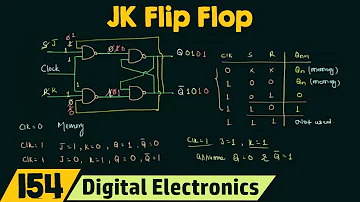
Introduction to JK flip flop
What is 74LS107?
The 74LS107 is a JK Flip-Flop with individual J, K, Direct Clear, and Clock Pulse inputs. The clock's HIGH-to-LOW transition is what triggers output adjustments. For predictable functioning, the J and K inputs must be steady one setup time before the high-to-low clock change. The 74LS107 IC offers a large operating voltage range, a wide operating temperature range, and directly interfaces with CMOS, NMOS, and TTL.

Logic Diagram
74LS107 Pinout
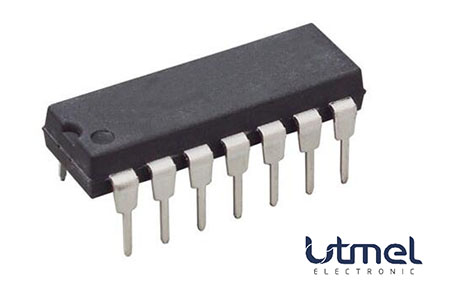
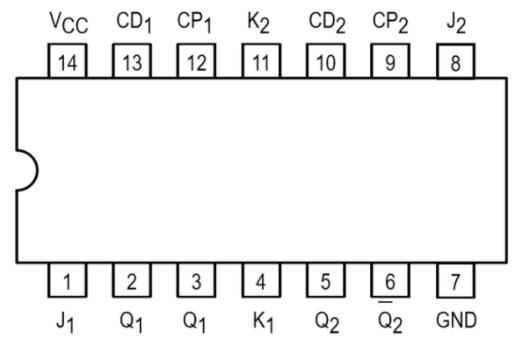
74LS107 Pinout
| Pin No | Pin Name | Description |
| 1 | J1 | Input Pin J1 |
| 2 | Q1 | Active high Output pin 1 |
| 3 | Q1′ | Active low output pin 1 |
| 4 | K1 | Input Pin K1 |
| 5 | Q2 | Active high Output pin 2 |
| 6 | Q2′ | Active low output pin 2 |
| 7 | GND | Ground Pin |
| 8 | J2 | Input Pin J2 |
| 9 | CP2 | Clock Pulse Input Pin 2 |
| 10 | CD2 | Reset Pin 2 |
| 11 | K2 | Input Pin K2 |
| 12 | CP1 | Clock Pulse Input Pin 1 |
| 13 | CD1 | Reset Pin 1 |
| 14 | VCC | Supply Voltage |
Product details of 74LS107
Technology Family: LS
Dual JK Flip Flop Package IC
-ve edge-triggered
VCC (Min): 4.75V
VCC (Max): 5.25
Bits (#): 2
Operating Voltage (Nom): 5V
Frequency at normal voltage (Max): 35MHz
Propagation delay (Max): 20ns
IOL (Max): 8mA
IOH (Max):-0.4mA
Rating: Catalog
Available in 14-pin PDIP, GDIP, PDSO packages
Specifications
- TypeParameter
- Surface Mount
having leads that are designed to be soldered on the side of a circuit board that the body of the component is mounted on.
NO - Number of Terminals14
- Operating Temperature (Max.)70°C
- HTS Code
HTS (Harmonized Tariff Schedule) codes are product classification codes between 8-1 digits. The first six digits are an HS code, and the countries of import assign the subsequent digits to provide additional classification. U.S. HTS codes are 1 digits and are administered by the U.S. International Trade Commission.
8542.39.00.01 - Terminal Position
In electronic components, the term "Terminal Position" refers to the physical location of the connection points on the component where external electrical connections can be made. These connection points, known as terminals, are typically used to attach wires, leads, or other components to the main body of the electronic component. The terminal position is important for ensuring proper connectivity and functionality of the component within a circuit. It is often specified in technical datasheets or component specifications to help designers and engineers understand how to properly integrate the component into their circuit designs.
DUAL - Terminal Form
Occurring at or forming the end of a series, succession, or the like; closing; concluding.
THROUGH-HOLE - Number of Functions2
- Supply Voltage
Supply voltage refers to the electrical potential difference provided to an electronic component or circuit. It is crucial for the proper operation of devices, as it powers their functions and determines performance characteristics. The supply voltage must be within specified limits to ensure reliability and prevent damage to components. Different electronic devices have specific supply voltage requirements, which can vary widely depending on their design and intended application.
5V - JESD-30 Code
JESD-30 Code refers to a standardized descriptive designation system established by JEDEC for semiconductor-device packages. This system provides a systematic method for generating designators that convey essential information about the package's physical characteristics, such as size and shape, which aids in component identification and selection. By using JESD-30 codes, manufacturers and engineers can ensure consistency and clarity in the specification of semiconductor packages across various applications and industries.
R-PDIP-T14 - Qualification Status
An indicator of formal certification of qualifications.
Not Qualified - Temperature Grade
Temperature grades represent a tire's resistance to heat and its ability to dissipate heat when tested under controlled laboratory test conditions.
COMMERCIAL - Load Capacitance
the amount of capacitance measured or computed across the crystal terminals on the PCB. Frequency Tolerance. Frequency tolerance refers to the allowable deviation from nominal, in parts per million (PPM), at a specific temperature, usually +25°C.
15pF - Number of Bits2
- Family
In electronic components, the parameter "Family" typically refers to a categorization or classification system used to group similar components together based on their characteristics, functions, or applications. This classification helps users easily identify and select components that meet their specific requirements. The "Family" parameter can include various subcategories such as resistors, capacitors, diodes, transistors, integrated circuits, and more. Understanding the "Family" of an electronic component can provide valuable information about its compatibility, performance specifications, and potential uses within a circuit or system. It is important to consider the "Family" parameter when designing or troubleshooting electronic circuits to ensure proper functionality and compatibility with other components.
LS - Output Polarity
Output polarity in electronic components refers to the orientation of the output signal in relation to the ground or reference voltage. It indicates whether the output voltage is positive or negative with respect to the ground. Positive output polarity means the signal is higher than the ground potential, while negative output polarity signifies that the signal is lower than the ground. This characteristic is crucial for determining compatibility with other components in a circuit and ensuring proper signal processing.
COMPLEMENTARY - Logic IC Type
Logic IC Type refers to the type of integrated circuit (IC) that is specifically designed to perform logical operations. These ICs are commonly used in digital electronic devices to process and manipulate binary data according to predefined logic functions. The Logic IC Type parameter typically specifies the specific logic family or technology used in the IC, such as TTL (Transistor-Transistor Logic), CMOS (Complementary Metal-Oxide-Semiconductor), or ECL (Emitter-Coupled Logic). Understanding the Logic IC Type is important for selecting the appropriate IC for a given application, as different logic families have varying characteristics in terms of speed, power consumption, and noise immunity.
J-K FLIP-FLOP - Trigger Type
Trigger Type in electronic components refers to the mechanism or method by which a device, such as a flip-flop or timer, responds to an input signal. It defines how the device transitions between states based on specific conditions, such as rising or falling edges of a signal, levels, or pulses. Different trigger types such as edge-triggered, level-triggered, or pulse-triggered influence the timing and behavior of the circuit, thereby determining how input signals affect the output in various applications.
NEGATIVE EDGE - Propagation Delay (tpd)
Propagation delay (tpd) is a crucial parameter in electronic components, especially in digital circuits. It refers to the time taken for a signal to travel from the input of a component to its output. This delay is caused by various factors such as the internal circuitry, interconnections, and the physical properties of the component. Propagation delay is essential to consider in designing circuits to ensure proper timing and functionality. It is typically measured in nanoseconds or picoseconds and plays a significant role in determining the overall performance and speed of electronic systems.
30 ns - Power Supply Current-Max (ICC)
The parameter "Power Supply Current-Max (ICC)" in electronic components refers to the maximum amount of current that the component will draw from the power supply under specified operating conditions. It is an important specification as it helps determine the power consumption of the component and ensures that the power supply can provide enough current to meet the component's requirements without being overloaded. Exceeding the maximum power supply current can lead to overheating, component damage, or system failure. Designers use this parameter to select an appropriate power supply and ensure the reliable operation of the electronic system.
8mA - fmax-Min
fmax-Min refers to the frequency range that an electronic component or system can operate within. It represents the difference between the maximum frequency (fmax) and the minimum frequency (Min) limits of operation. This parameter is crucial in defining the bandwidth of the component, indicating how effectively it can transmit or receive signals over that range. A wider fmax-Min value typically signifies better performance for applications that require broad frequency response.
30 MHz
74LS107 Features
Two Independent JK Flip-Flops with Clock and Clear Inputs
Standard Pin Arrangement
Fast Switching Times
Operating Temperature up to 70°C
Standard TTL Switching Voltages
Where to use 74LS107?
They are used in digital clocks, electronic meters, and other electronic devices that display numerical information.
74LS107 Equivalent
SN7476, 74HC76, 74HC73a, 4027B
Advantage and Disadvantages of Flip-Flops
Advantages
The timing difficulty known as "RACE" is a downside of the JK flip-flop. RACE occurs when the output Q changes state before the clock input's timing pulse has a chance to move into the OFF state. To avoid timing issues, the timing pulse time (T) should be kept as short as possible.
Disadvantage
When both the inputs and clock pulse signal are at level 1 after the output is complemented once, output transmission will start getting repeated and continuous.
74LS107 Package Dimensions
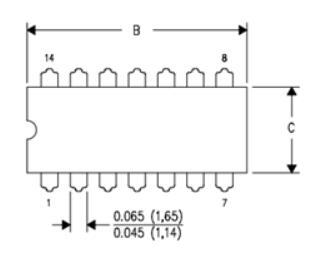
74LS107 Package Dimensions
74LS107 Manufacturer
Signetics was an American electronics manufacturer specifically established to make integrated circuits. Founded in 1961, they went on to develop several early microprocessors and support chips, as well as the widely used 555 timer chip. They were bought by Philips in 1975 and incorporated in Philips Semiconductors (now NXP).
What is the use of 74LS107?
The 74LS107 is used in digital clocks, electronic meters, and other electronic devices that display numerical information.
How does Flip-flop work?
The JK flip flop work in the same way as the SR flip flop work. The JK Flip Flop is a gated SR flip-flop having the addition of a clock input circuitry.
What is disadvantage of JK flip flop?
JK flip-flop has a drawback of timing problem known as “RACE”. The condition of RACE arises if the output Q changes its state before the timing pulse of the clock input has time to go in the OFF state. The timing pulse period (T) should be kept as short as possible to avoid the problem of timing.
 TPS2051CDBVR Power-Distribution Switches: Layout, Pinout, and Datasheet
09 April 20222151
 74HC08 Quadruple 2-Input AND Gates: Pinout, Equivalent and Datasheet
05 November 202111987
![PIC18F4520 Microcontroller: Features, Pinout, and Datasheet [Video&FAQ]](https://res.utmel.com/Images/Article/1b537121-21db-4977-8bec-b3192c2ba52b.png) PIC18F4520 Microcontroller: Features, Pinout, and Datasheet [Video&FAQ]
PIC18F4520 Microcontroller: Features, Pinout, and Datasheet [Video&FAQ]29 November 202110863
 RP2040 VS ESP8266 VS ESP32 VS STM32
20 April 202210309
 PIC18F66K80 Family of Microcontrollers: Technical Overview
29 February 2024442
 2SC3281 NPN Power Transistor: 200V Power Transistor, Datasheet pdf and Equivalent
22 December 20217895
![BH1750 Ambient Light Sensor IC Series[Video]:Datasheet, Features, and Applications](https://res.utmel.com/Images/Article/2b8d00ac-cb29-4754-b187-66647f67ef8f.png) BH1750 Ambient Light Sensor IC Series[Video]:Datasheet, Features, and Applications
BH1750 Ambient Light Sensor IC Series[Video]:Datasheet, Features, and Applications13 April 20227964
 A Comprehensive Guide to LTC6560HUD#TRPBF Transimpedance Amplifier
06 March 2024221
 Introduction to Top Sensor Manufacturers in the World
15 February 202210055
 Unveiling the Potential of GaN Semiconductor-Enabled Three-Phase Propulsion Inverters for Enhanced EV Performance
09 August 20231732
 2026 Advanced Packaging Components Trends: Navigating Shortages and Ecosystem Impacts
20 July 20262385
 Basic Introduction to the Types of Capacitors
16 October 202511347
 Understanding Machine Vision and Visual Sensor
27 September 20212327
 What is 232\485\422 Communication? Common problems of Serial Communication
29 April 20222664
 Structure and Imaging Principle of Smartphone Camera
26 November 202124062
 What is a Monostable Multivibrator?
16 January 20217149
SIGNETICS CORP
In Stock
United States
China
Canada
Japan
Russia
Germany
United Kingdom
Singapore
Italy
Hong Kong(China)
Taiwan(China)
France
Korea
Mexico
Netherlands
Malaysia
Austria
Spain
Switzerland
Poland
Thailand
Vietnam
India
United Arab Emirates
Afghanistan
Åland Islands
Albania
Algeria
American Samoa
Andorra
Angola
Anguilla
Antigua & Barbuda
Argentina
Armenia
Aruba
Australia
Azerbaijan
Bahamas
Bahrain
Bangladesh
Barbados
Belarus
Belgium
Belize
Benin
Bermuda
Bhutan
Bolivia
Bonaire, Sint Eustatius and Saba
Bosnia & Herzegovina
Botswana
Brazil
British Indian Ocean Territory
British Virgin Islands
Brunei
Bulgaria
Burkina Faso
Burundi
Cabo Verde
Cambodia
Cameroon
Cayman Islands
Central African Republic
Chad
Chile
Christmas Island
Cocos (Keeling) Islands
Colombia
Comoros
Congo
Congo (DRC)
Cook Islands
Costa Rica
Côte d’Ivoire
Croatia
Cuba
Curaçao
Cyprus
Czechia
Denmark
Djibouti
Dominica
Dominican Republic
Ecuador
Egypt
El Salvador
Equatorial Guinea
Eritrea
Estonia
Eswatini
Ethiopia
Falkland Islands
Faroe Islands
Fiji
Finland
French Guiana
French Polynesia
Gabon
Gambia
Georgia
Ghana
Gibraltar
Greece
Greenland
Grenada
Guadeloupe
Guam
Guatemala
Guernsey
Guinea
Guinea-Bissau
Guyana
Haiti
Honduras
Hungary
Iceland
Indonesia
Iran
Iraq
Ireland
Isle of Man
Israel
Jamaica
Jersey
Jordan
Kazakhstan
Kenya
Kiribati
Kosovo
Kuwait
Kyrgyzstan
Laos
Latvia
Lebanon
Lesotho
Liberia
Libya
Liechtenstein
Lithuania
Luxembourg
Macao(China)
Madagascar
Malawi
Maldives
Mali
Malta
Marshall Islands
Martinique
Mauritania
Mauritius
Mayotte
Micronesia
Moldova
Monaco
Mongolia
Montenegro
Montserrat
Morocco
Mozambique
Myanmar
Namibia
Nauru
Nepal
New Caledonia
New Zealand
Nicaragua
Niger
Nigeria
Niue
Norfolk Island
North Korea
North Macedonia
Northern Mariana Islands
Norway
Oman
Pakistan
Palau
Palestinian Authority
Panama
Papua New Guinea
Paraguay
Peru
Philippines
Pitcairn Islands
Portugal
Puerto Rico
Qatar
Réunion
Romania
Rwanda
Samoa
San Marino
São Tomé & Príncipe
Saudi Arabia
Senegal
Serbia
Seychelles
Sierra Leone
Sint Maarten
Slovakia
Slovenia
Solomon Islands
Somalia
South Africa
South Sudan
Sri Lanka
St Helena, Ascension, Tristan da Cunha
St. Barthélemy
St. Kitts & Nevis
St. Lucia
St. Martin
St. Pierre & Miquelon
St. Vincent & Grenadines
Sudan
Suriname
Svalbard & Jan Mayen
Sweden
Syria
Tajikistan
Tanzania
Timor-Leste
Togo
Tokelau
Tonga
Trinidad & Tobago
Tunisia
Turkey
Turkmenistan
Turks & Caicos Islands
Tuvalu
U.S. Outlying Islands
U.S. Virgin Islands
Uganda
Ukraine
Uruguay
Uzbekistan
Vanuatu
Vatican City
Venezuela
Wallis & Futuna
Yemen
Zambia
Zimbabwe