

 Product
 Brand
Brand Articles
 Tools
Tools
BT136 Triac: Datasheet, Pinout, Equivalent [FAQ+Video]

Changjiang Electronics Tech (CJ)
BT136 datasheet pdf and Unclassified product details from Changjiang Electronics Tech (CJ) stock available at Utmel


The BT136 is TRIAC with a 4A maximum terminal current. This passage is going to tell you everything about BT136.
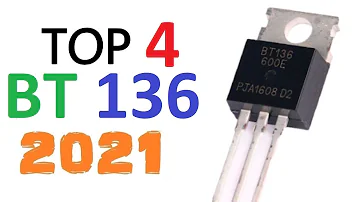
TOP 4 ELECTRONICS PROJECTS USING BT136 TRIAC
BT136 Introduction
BT136 is a type of electronic component, which is a triac.
The thyristor is also the abbreviation of the thyristor rectifier element. It is a high-power semiconductor device with a four-layer structure with three PN junctions, which is generally formed by reversely connecting two thyristors. Its function is not only to rectify, but also to be used as a non-contact switch to quickly turn on or off the circuit, realize the inversion of the direct current into the alternating current, the alternating current of one frequency into the alternating current of another frequency, and so on.
The thyristor, like other semiconductor devices, has the advantages of small size, high efficiency, good stability, and reliable operation. With its emergence, semiconductor technology has moved from the weak current field to the strong current field and has become a component used in industries, agriculture, transportation, military scientific research, as well as commercial and civilian electrical appliances.
BT136 CAD Models
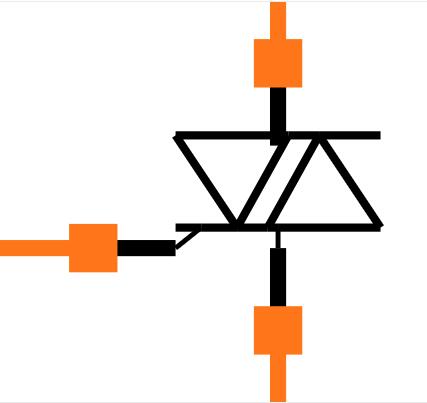
Symbol
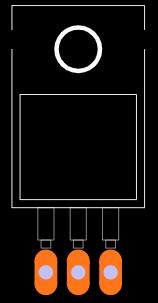
Footprint
Specifications
- TypeParameter
- Package / Case
refers to the protective housing that encases an electronic component, providing mechanical support, electrical connections, and thermal management.
TO-220(TO-220-3) - Packaging
Semiconductor package is a carrier / shell used to contain and cover one or more semiconductor components or integrated circuits. The material of the shell can be metal, plastic, glass or ceramic.
Tube-packed - TypeTwo-way thyristor
- Voltage - Gate Trigger (Vgt) (Max)
Voltage - Gate Trigger (Vgt) (Max) refers to the maximum voltage level required to trigger the gate of a semiconductor device, such as a thyristor or triac, into the conductive state. When the gate receives this voltage, it initiates the device's conduction, allowing current to flow between its anode and cathode. Exceeding this voltage can lead to unwanted behavior or damage to the component, making it a critical parameter in designing circuits that utilize these devices. Understanding Vgt is essential for ensuring proper operation and reliability in electronic applications.
1.45V - Current - Gate Trigger (Igt) (Max)
Current - Gate Trigger (Igt) (Max) refers to the maximum gate trigger current required to activate a semiconductor device, such as a thyristor or triac. It is the minimum current that must flow into the gate terminal to ensure that the device turns on and conducts current between its anode and cathode. Exceeding this value can lead to unnecessary power consumption, while insufficient current may prevent the device from turning on effectively. This parameter is crucial for circuit design, as it influences the selection of gate driving circuits.
10mA - Current - On State (It (RMS)) (Max)
The parameter "Current - On State (It (RMS)) (Max)" refers to the maximum root mean square (RMS) current that an electronic component, typically a semiconductor device like a thyristor or a transistor, can handle while in the on state without sustaining damage. This value is crucial for ensuring that the component operates safely under load conditions. Exceeding this maximum rating can result in overheating, degradation, or failure of the component over time. It is an important specification for designers to consider when selecting components for a circuit to ensure reliable performance.
6A - Voltage - Off State (Max)
Voltage - Off State (Max) refers to the maximum voltage that an electronic component can withstand when it is in the off state, meaning it is not conducting electrical current. This parameter is critical for ensuring that the component does not break down or become damaged under high voltage conditions when it is not active. It is commonly specified for components such as transistors, diodes, and switches, indicating their reliability and suitability for specific applications in electronic circuits.
600V - RoHS Status
RoHS means “Restriction of Certain Hazardous Substances” in the “Hazardous Substances Directive” in electrical and electronic equipment.
RoHS Compliant
BT136 TRIAC Features
1. Direct triggering from low power drivers and logic ICS
2. High blocking voltage capability
3. Low holding current for low current loads and lowest EMI at commutation
4. Planar passivated for voltage ruggedness and reliability
5. Triggering in all four quadrants
6. Very sensitive gate
7. 2A Peak gate current
8. 0.5W Average gate power
BT136 Applications/Where to use
The applications of TRIAC include the following.
1. Because of the bidirectional control of alternating current, these components are used as different controllers for AC, fan, heater, static switch with three positions, triggering devices for silicon controlled rectifiers, light dimmers, etc.
2. Triac is used as a switch
3. It is used as a High power switch
4. Used to control phase
5. Strode lights
6. Speed control of AC motor
7. Used in circuits of noise coupling
8. AC loads controlling with MPU or MCU
9. Power control of AC or DC
TRIAC Application Tips
Since TRIACS deal with AC voltages, the circuit involving them has to be designed properly to avoid problem some tips are shared below
1. All TRIAC circuits suffer from an effect called Rate Effect. This occurs when the TRIAC is switching frequently and a sudden high voltage occurs at either main terminal of the TRIAC and damages the TRIAC itself. It can be avoided by using a snubber circuit.
2. Similarly there is another effect called the backlash effect. This occurs due to the capacitance that gets accumulated between the two terminals of the MT1 and MT2 of the TRIAC. Due to this, the TRIAC will not turn on even if the gate voltage is applied. This problem can be solved by providing resistance in series for the capacitance to discharge.
3. When controlling the output AC voltage for dimmer or speed control applications a Zero crossing method is always recommended to be used.
4. In switching circuits the TRIAC is easily subjected to harmonics and EMI interference hence should be isolated from other digital electronics.
5. There is a chance of backward current when the TRIAC is switching inductive loads, so an alternate discharge path has to be provided for the load to drain the inrush current.
BT136 Pinout and Configurations
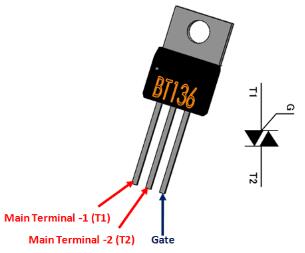
| Pin Number | Pin Name | Description |
| 1 | Main Terminal 1 | Connected to Phase or neutral of AC mains |
| 2 | Main Terminal 2 | Connected to Phase or neutral of AC mains |
| 3 | Gate | Used to trigger the SCR. |
BT136 Advantages
With a maximum terminal current of 4A, the BT136 is a TRIAC. The BT136's gate threshold voltage is likewise very low, allowing it to be driven by digital circuits.
TRIACs are often utilized for switching AC applications since they are bi-directional switching devices. So, if you want to use a digital device like a microcontroller or a microprocessor to manage (dim, speed control) an AC load that consumes less than 6A, the BT136 can be a perfect choice.
Four quadrants sensitive gate triac with planar passivation in a SOT78 plastic package for general purpose bidirectional switching and phase control applications. This "series E" sensitive gate triac is designed to connect directly to microcontrollers, logic integrated circuits, and other low-power gate trigger circuits.
BT136 Disadvantages
The disadvantages of TRIAC include the following.
1. More care needs to be taken while choosing a gate triggers circuit because a TRIAC device activates in both the biased conditions.
2. These are less reliable as compared to thyristors.
3. As compared to thyristors, these have less dv/dt rating
4. The switching frequencies of TRIACs are extremely small.
How to use BT136?
A TRIAC can be used in a variety of ways, and because the device is bi-directional, the TRIAC gate can be triggered by either positive or negative voltage. As a result, the TIRAC can be used in four different modes. If you want to learn more about switching modes, check this article. Below is a simple TRIAC switching circuit.

The TRIAC in this circuit is controlled by the switch; when the switch is pressed, the TRIAC closes the connection between the ACbulb and the AC mains. For this to happen, the TRIAC's gate pin must be exposed to a voltage larger than the threshold gate voltage, as well as a current greater than the gate trigger current. This will activate the TRIAC.
Because the TRIAC and SCR have many of the same features, the TRIAC will not turn off when the gate voltage is removed, just like the SCR. To switch off the SCR again, we need a particular form of circuit called a commutation circuit.
BT136 Equivalent TRIAC
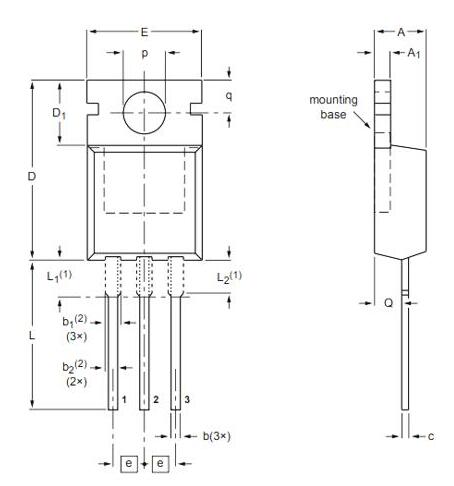
BT136 Package
Package Name: TO-220AB
Package Description: plastic single-ended package; heatsink mounted; 1 mounting hole; 3-lead TO-220AB
Package Version: SOT78
Package Outline:
Trend Analysis
Parts with Similar Specs
What is BT136?
The BT136 is TRIAC with a 4A maximum terminal current. The gate threshold voltage of the BT136 is also very less so can be driven by digital circuits. Since TRIACs are bi-directional switching devices they are commonly used for switching AC applications.
What does a triac do?
Triacs are electronic components that are widely used in AC power control applications. They are able to switch high voltages and high levels of current, and over both parts of an AC waveform. This makes triac circuits ideal for use in a variety of applications where power switching is needed.
How do I turn on TRIAC?
To turn on a TRIAC a positive or negative gate voltage/pulse has to be supplied to the gate pin of the TRIAC. When triggered one of the two SCR is inside, the TRIAC begins to conduct based on the polarity of the MT1 and MT2 terminals.
What is the difference between SCR and TRIAC?
The main difference between SCR and TRIAC is that SCR is a unidirectional device, and TRIAC is a bidirectional device. A thyristor is more reliable while TRIAC has less reliability. Thyristor needs two heat sinks whereas TRIAC needs only one heat sink.
Why is TRIAC not popular as SCR?
TRIAC has (dv/dt) rating lower than SCR. Lower ratings are available compared to SCR. We need to be careful about the triggering circuit as it can be triggered in either direction.
 Si3865BDV Load Switch with Level-Shift: Datasheet, Pinout, Application
21 January 2022939
![A6K SWITCH ROTARY DIP HEX 25MA 24V[Video]: Datasheet, Features, and Output Codes](https://res.utmel.com/Images/Article/d6e80446-68b3-42fa-b1d8-10bbce9388eb.png) A6K SWITCH ROTARY DIP HEX 25MA 24V[Video]: Datasheet, Features, and Output Codes
A6K SWITCH ROTARY DIP HEX 25MA 24V[Video]: Datasheet, Features, and Output Codes31 March 20221157
 PMEG3050EP Schottky Barrier Rectifier: 30V, 5A, Datasheet PDF
22 February 20221423
 CD4071 Dual Input OR Gate IC: Datasheet, Pinout and Equivalents
23 October 20216875
 Unveiling the Texas Instruments MSP430F20x Microcontroller Series: A Comprehensive Analysis
29 February 2024255
 ADS1015 A/D Converter: Datasheet, Pinout and Applications
17 August 20215322
 M24128-BR 128-Kbit serial I²C bus EEPROM: Pinout, Equivalent and Datasheet
11 April 20222179
 TE Connectivity 1-968855-1 Terminal: Complete Automotive Wiring Guide
28 August 2025270
 A76 Battery Equivalent Pros and Cons Explained
29 August 20253467
 What is OLED?
16 March 20217884
 How to read Resistors Color Code?
16 October 202525154
 Vibration Isolator: Types and Applications
13 January 202113006
 Use the Renesas AE-CLOUD2 to Send GPS Data to the Google Cloud IoT
15 November 20191423
 What is a Vibration Sensor?
24 October 20253483
 Optical Transceiver Guide: How It Works, Types, Form Factors, and Selection
24 June 2026638
 What is a USB Type-C Connector?
28 October 20256848
Changjiang Electronics Tech (CJ)
In Stock
United States
China
Canada
Japan
Russia
Germany
United Kingdom
Singapore
Italy
Hong Kong(China)
Taiwan(China)
France
Korea
Mexico
Netherlands
Malaysia
Austria
Spain
Switzerland
Poland
Thailand
Vietnam
India
United Arab Emirates
Afghanistan
Åland Islands
Albania
Algeria
American Samoa
Andorra
Angola
Anguilla
Antigua & Barbuda
Argentina
Armenia
Aruba
Australia
Azerbaijan
Bahamas
Bahrain
Bangladesh
Barbados
Belarus
Belgium
Belize
Benin
Bermuda
Bhutan
Bolivia
Bonaire, Sint Eustatius and Saba
Bosnia & Herzegovina
Botswana
Brazil
British Indian Ocean Territory
British Virgin Islands
Brunei
Bulgaria
Burkina Faso
Burundi
Cabo Verde
Cambodia
Cameroon
Cayman Islands
Central African Republic
Chad
Chile
Christmas Island
Cocos (Keeling) Islands
Colombia
Comoros
Congo
Congo (DRC)
Cook Islands
Costa Rica
Côte d’Ivoire
Croatia
Cuba
Curaçao
Cyprus
Czechia
Denmark
Djibouti
Dominica
Dominican Republic
Ecuador
Egypt
El Salvador
Equatorial Guinea
Eritrea
Estonia
Eswatini
Ethiopia
Falkland Islands
Faroe Islands
Fiji
Finland
French Guiana
French Polynesia
Gabon
Gambia
Georgia
Ghana
Gibraltar
Greece
Greenland
Grenada
Guadeloupe
Guam
Guatemala
Guernsey
Guinea
Guinea-Bissau
Guyana
Haiti
Honduras
Hungary
Iceland
Indonesia
Iran
Iraq
Ireland
Isle of Man
Israel
Jamaica
Jersey
Jordan
Kazakhstan
Kenya
Kiribati
Kosovo
Kuwait
Kyrgyzstan
Laos
Latvia
Lebanon
Lesotho
Liberia
Libya
Liechtenstein
Lithuania
Luxembourg
Macao(China)
Madagascar
Malawi
Maldives
Mali
Malta
Marshall Islands
Martinique
Mauritania
Mauritius
Mayotte
Micronesia
Moldova
Monaco
Mongolia
Montenegro
Montserrat
Morocco
Mozambique
Myanmar
Namibia
Nauru
Nepal
New Caledonia
New Zealand
Nicaragua
Niger
Nigeria
Niue
Norfolk Island
North Korea
North Macedonia
Northern Mariana Islands
Norway
Oman
Pakistan
Palau
Palestinian Authority
Panama
Papua New Guinea
Paraguay
Peru
Philippines
Pitcairn Islands
Portugal
Puerto Rico
Qatar
Réunion
Romania
Rwanda
Samoa
San Marino
São Tomé & Príncipe
Saudi Arabia
Senegal
Serbia
Seychelles
Sierra Leone
Sint Maarten
Slovakia
Slovenia
Solomon Islands
Somalia
South Africa
South Sudan
Sri Lanka
St Helena, Ascension, Tristan da Cunha
St. Barthélemy
St. Kitts & Nevis
St. Lucia
St. Martin
St. Pierre & Miquelon
St. Vincent & Grenadines
Sudan
Suriname
Svalbard & Jan Mayen
Sweden
Syria
Tajikistan
Tanzania
Timor-Leste
Togo
Tokelau
Tonga
Trinidad & Tobago
Tunisia
Turkey
Turkmenistan
Turks & Caicos Islands
Tuvalu
U.S. Outlying Islands
U.S. Virgin Islands
Uganda
Ukraine
Uruguay
Uzbekistan
Vanuatu
Vatican City
Venezuela
Wallis & Futuna
Yemen
Zambia
Zimbabwe