

 Product
 Brand
Brand Articles
 Tools
Tools
AMD Xilinx Kintex-7 FPGA Series: Architecture Analysis and Design Guide


3.35mm mm FPGAs Kintex®-7 Series 900-BBGA, FCBGA 1mm mm 901
The AMD Kintex-7 FPGA delivers 356k+ logic cells and 1,440 DSP slices on 28nm architecture. Optimize designs for broadcast video, 5G, and high-speed DAQ.
Product Introduction
Engineer’s Takeaway
Positioning: The Kintex-7 family is the "mid-range" anchor of Xilinx's 7-series, specifically engineered to bridge the gap between the budget-friendly Artix-7 and the ultra-high-end Virtex-7. It offers the best price-performance per watt for DSP-heavy applications.
Key Spec Highlight: The XC7K355T variant boasts 1,440 DSP48E1 slices and 356,160 Logic Cells, making it exceptionally potent for signal processing tasks like 8K video transcoding without the cost premium of the Virtex line.
Supply Chain Status: While 7-series is a mature product line (28nm), stock availability is marked as "Limited Availability". Designs should verify channel inventory or consider migration paths for new long-lifecycle projects.
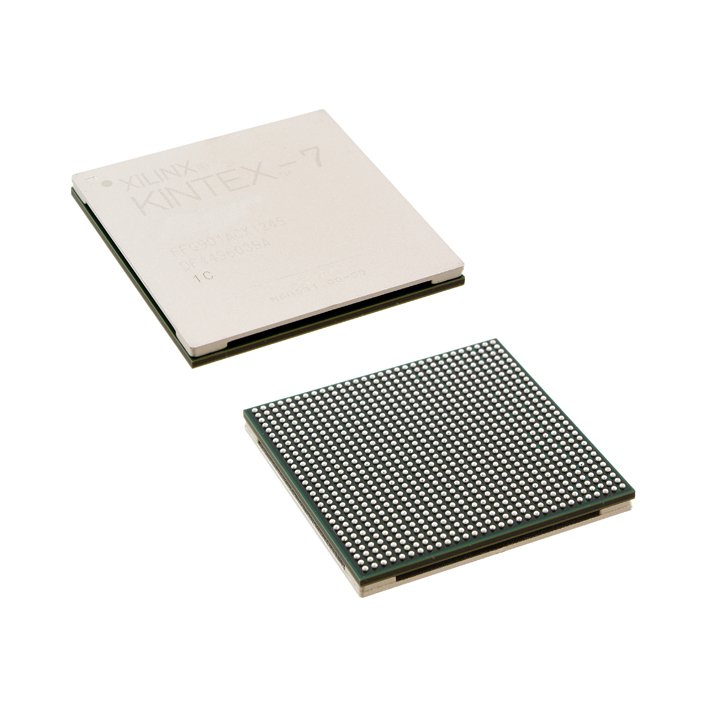
Figure 1: Kintex-7 overview
1. Technical Architecture and Core Advantages
The Kintex-7 architecture is built on Taiwan Semiconductor Manufacturing Company’s (TSMC) 28nm High-Performance, Low-Power (HPL) process. This process technology allows the fabric to balance static power leakage with high switching speeds required for direct RF sampling and 10Gbps+ serial connectivity.
1.1 Processing & Control (The "Brain")
The core logic fabric utilizes Configurable Logic Blocks (CLBs) composed of 6-input Look-Up Tables (LUTs).
- Logic Density: With up to 356,160 Logic Cells (in the XC7K355T), the device can accommodate complex soft-core processors (like MicroBlaze) alongside heavy hardware acceleration blocks.
- DSP Potency: The 1,440 DSP48E1 slices are the architecture's defining feature. Each slice contains a 25x18 multiplier and a 48-bit accumulator/adder, enabling highly parallelized filtering and FFT operations essential for radar and wireless infrastructure.
- Memory: The fabric integrates 25,740 Kb (approx. 25 Mb) of Block RAM, reducing the need for external caching in high-throughput pipelines.
1.2 Peripherals & Interfaces (The "Limbs")
Kintex-7 is defined by its transceiver technology and hard IP blocks meant to handle high-bandwidth data ingress/egress.
- GTX Transceivers: Supports high-speed serial I/O (up to 12.5 Gb/s). These are critical for implementing protocols like 10 Gigabit Ethernet, CPRI, and JESD204B.
- PCI Express: Integrated capabilities for PCIe Gen2 x8 hard blocks save FPGA logic resources and power compared to soft-core implementations.
- Memory Interface: Hard physical interfaces support DDR3 SDRAM at speeds exceeding 1866 Mbps, crucial for buffering in video applications (such as the RED 8K cameras mentioned in industry teardowns).
2. Naming / Variant Map and Selection Guide
2.1 Part Number Decoding
The Xilinx part number structure provides immediate insight into the device capabilities. For part XC7K355T-2FFG901I:
XC: Xilinx Commercial (Automotive is XA, Defense is XQ).
7: 7 Series.
K: Kintex Family.
355: Approximate Logic Cell count (355k).
T: Includes high-speed serial transceivers (GTX).
-2: Speed Grade (Higher number = Faster; -1 is slowest, -3 is fastest).
FFG901: Package Type (Flip-Chip Fine-Pitch BGA, 901 pins, Pb-free).
I: Industrial Temperature Range (-40°C to +100°C).
2.2 Core Variant Comparison
| Variant | Key Differences | Flash/RAM | Package | Target Use |
|---|---|---|---|---|
| XC7K355T-1FFG901C | Standard Speed (-1), Commercial Temp (0°C to 85°C) | 25.7Mb BRAM | 901-pin FBGA | Cost-sensitive Data Centers |
| XC7K355T-2FFG901I | Mid-Speed (-2), Industrial Temp (-40°C to 100°C) | 25.7Mb BRAM | 901-pin FBGA | Wireless Radio Heads / Edge Comp. |
| XC7K355T-L2FFG901I | Low Power (-L2), Industrial Temp | 25.7Mb BRAM | 901-pin FBGA | Sealed/Fanless Enclosures |
3. Key Specifications Explained
Engineer's Note: Values below are typical. Always consult the specific datasheet (DS180 / DC182) for absolute maximum ratings to prevent device latch-up or damage.
3.1 Power & Operating Conditions
Core Voltage (Vccint): 0.97V to 1.03V for standard speed grades.
Low Power Option: The "-L" series allows operation at 0.9V, yielding roughly a 20-30% reduction in static power, which is vital for thermal management in dense blade servers.
Thermal Design Power (TDP): Highly dependent on toggle rate and resource utilization. Designers must use the Xilinx Power Estimator (XPE) as 7-series static power can be significant even when idle.
3.2 Performance & Efficiency
Logic Cells: 356,160. High availability supports complex state machines without routing congestion.
DSP Slices: 1,440. This high ratio of DSP-to-Logic is why Kintex-7 is preferred over Artix-7 for signal processing work.
I/O Count: 500 user I/Os in the 901-pin package, enabling wide parallel buses to ADCs/DACs.
4. Design Notes and Common Integration Issues
4.1 PCB Layout Guidelines
Power Rails: Place 0.1µF and 4.7µF ceramic decoupling capacitors as close as possible to the Vccint and Vccaux pins. The low core voltage (1.0V) has tight tolerance (±30mV typically); excessive ripple will cause timing violations.
Grounding: Use a solid ground plane. Avoid splitting analog and digital grounds unless specifically required by mixed-signal I/O macros. Impedance control on GTX pairs (100Ω differential) is mandatory.
Breakout: The FFG901 package is a fine-pitch BGA. Use via-in-pad or dog-bone fanout strategies, ensuring sufficient layers (typically 10-14+) to escape all 500 I/Os.
4.2 Debugging Common Faults (Pain Points)
The following issues are frequently reported by engineers integrating the XC7K355T:
Problem: Thermal Runaway in Compact Chassis
Symptom: Unpredictable shutdowns or timing errors during heavy video processing loads.
Fix: The XC7K355T has high power density. Per Reddit teardowns of RED 8K cameras, these chips often require aggressive active cooling or liquid cooling loops in small form factors. Validate thermals early using XPE.
Problem: Boot Failure / Reliability Issues
Symptom: FPGA fails to configure or exhibits latch-up behavior.
Fix: Complex Power Sequencing. Xilinx 7-series FPGAs define strict power-on sequences (typically Vccint -> Vccaux -> Vcco). Use dedicated Power Management ICs (PMICs) or sequencers verified for Xilinx to adhere to the datasheet slopes.
5. Typical Applications
5.1 System Integration Analysis
High-End Broadcast Video (e.g., RED 8K Cameras):The Kintex-7 is a standard-bearer in professional cinema equipment. The 1,440 DSP slices are leveraged to run proprietary debayering algorithms and compression codecs (like ProRes or REDCODE RAW) in real-time. The integrated PCIe Gen2 blocks allow the camera to offload high-bandwidth footage to NVMe storage layers efficiently, while the GTX transceivers handle the SDI video outputs.
6. Competitors and Alternatives
The Kintex-7 competes in the mid-to-high range FPGA market.
Vs. Intel (Altera) Arria 10: The Arria 10 generally offers higher raw floating-point performance (native hard floating-point DSPs) but often at a higher power/cost price point. Kintex-7 is often chosen for fixed-point efficiency.
Vs. Microchip PolarFire: PolarFire competes on power efficiency (non-volatile, instant-on, lower static power). However, Kintex-7 ecosystem support (Vivado) and IP availability for high-end video/Comms is often considered more mature.
Migration Path: If the XC7K355T is overkill, the Artix-7 is the footprint-compatible(ish) step down (requires pinout verification). For higher performance, migration to Kintex UltraScale is the natural progression.
7. FAQ
Q: What is the primary operating voltage for the Kintex-7 core? The standard core voltage (Vccint) operates between 0.97V and 1.03V, typically centered at 1.0V.
Q: Can the XC7K355T support DDR4 memory? Native support is primarily for DDR3/DDR3L (up to 1866 Mbps). DDR4 support usually requires UltraScale architecture, though soft-controller implementations at lower speeds may be theoretically possible (but not recommended).
Q: What is the difference between Commercial and Industrial temperature grades? Commercial parts are rated for 0°C to 85°C junction temperature, while Industrial parts (suffix "I") are rated for -40°C to 100°C, making them essential for outdoor wireless infrastructure.
Q: Does Kintex-7 include a hardened Processor System (PS)? No, Kintex-7 is a pure FPGA fabric options. It does not contain hard ARM cores like the Zynq-7000 SoC series. Processors must be implemented as soft cores (MicroBlaze).
8. Resources and Downloads
Dev Tools: Xilinx Vivado Design Suite
Evaluation Kits: KC705, Genesys 2
Specifications
- TypeParameter
- Factory Lead Time10 Weeks
- Package / Case
refers to the protective housing that encases an electronic component, providing mechanical support, electrical connections, and thermal management.
900-BBGA, FCBGA - Mounting Type
The "Mounting Type" in electronic components refers to the method used to attach or connect a component to a circuit board or other substrate, such as through-hole, surface-mount, or panel mount.
Surface Mount - Mount
In electronic components, the term "Mount" typically refers to the method or process of physically attaching or fixing a component onto a circuit board or other electronic device. This can involve soldering, adhesive bonding, or other techniques to secure the component in place. The mounting process is crucial for ensuring proper electrical connections and mechanical stability within the electronic system. Different components may have specific mounting requirements based on their size, shape, and function, and manufacturers provide guidelines for proper mounting procedures to ensure optimal performance and reliability of the electronic device.
Surface Mount - Number of Pins901
- Number of I/Os300
- Operating Temperature
The operating temperature is the range of ambient temperature within which a power supply, or any other electrical equipment, operate in. This ranges from a minimum operating temperature, to a peak or maximum operating temperature, outside which, the power supply may fail.
0°C~100°C TJ - Packaging
Semiconductor package is a carrier / shell used to contain and cover one or more semiconductor components or integrated circuits. The material of the shell can be metal, plastic, glass or ceramic.
Tray - Series
In electronic components, the "Series" refers to a group of products that share similar characteristics, designs, or functionalities, often produced by the same manufacturer. These components within a series typically have common specifications but may vary in terms of voltage, power, or packaging to meet different application needs. The series name helps identify and differentiate between various product lines within a manufacturer's catalog.
Kintex®-7 - Published2010
- JESD-609 Code
The "JESD-609 Code" in electronic components refers to a standardized marking code that indicates the lead-free solder composition and finish of electronic components for compliance with environmental regulations.
e1 - Pbfree Code
The "Pbfree Code" parameter in electronic components refers to the code or marking used to indicate that the component is lead-free. Lead (Pb) is a toxic substance that has been widely used in electronic components for many years, but due to environmental concerns, there has been a shift towards lead-free alternatives. The Pbfree Code helps manufacturers and users easily identify components that do not contain lead, ensuring compliance with regulations and promoting environmentally friendly practices. It is important to pay attention to the Pbfree Code when selecting electronic components to ensure they meet the necessary requirements for lead-free applications.
yes - Part Status
Parts can have many statuses as they progress through the configuration, analysis, review, and approval stages.
Active - Moisture Sensitivity Level (MSL)
Moisture Sensitivity Level (MSL) is a standardized rating that indicates the susceptibility of electronic components, particularly semiconductors, to moisture-induced damage during storage and the soldering process, defining the allowable exposure time to ambient conditions before they require special handling or baking to prevent failures
4 (72 Hours) - Number of Terminations901
- ECCN Code
An ECCN (Export Control Classification Number) is an alphanumeric code used by the U.S. Bureau of Industry and Security to identify and categorize electronic components and other dual-use items that may require an export license based on their technical characteristics and potential for military use.
3A991.D - Terminal Finish
Terminal Finish refers to the surface treatment applied to the terminals or leads of electronic components to enhance their performance and longevity. It can improve solderability, corrosion resistance, and overall reliability of the connection in electronic assemblies. Common finishes include nickel, gold, and tin, each possessing distinct properties suitable for various applications. The choice of terminal finish can significantly impact the durability and effectiveness of electronic devices.
Tin/Silver/Copper (Sn/Ag/Cu) - HTS Code
HTS (Harmonized Tariff Schedule) codes are product classification codes between 8-1 digits. The first six digits are an HS code, and the countries of import assign the subsequent digits to provide additional classification. U.S. HTS codes are 1 digits and are administered by the U.S. International Trade Commission.
8542.39.00.01 - Voltage - Supply
Voltage - Supply refers to the range of voltage levels that an electronic component or circuit is designed to operate with. It indicates the minimum and maximum supply voltage that can be applied for the device to function properly. Providing supply voltages outside this range can lead to malfunction, damage, or reduced performance. This parameter is critical for ensuring compatibility between different components in a circuit.
1V - Terminal Position
In electronic components, the term "Terminal Position" refers to the physical location of the connection points on the component where external electrical connections can be made. These connection points, known as terminals, are typically used to attach wires, leads, or other components to the main body of the electronic component. The terminal position is important for ensuring proper connectivity and functionality of the component within a circuit. It is often specified in technical datasheets or component specifications to help designers and engineers understand how to properly integrate the component into their circuit designs.
BOTTOM - Terminal Form
Occurring at or forming the end of a series, succession, or the like; closing; concluding.
BALL - Peak Reflow Temperature (Cel)
Peak Reflow Temperature (Cel) is a parameter that specifies the maximum temperature at which an electronic component can be exposed during the reflow soldering process. Reflow soldering is a common method used to attach electronic components to a circuit board. The Peak Reflow Temperature is crucial because it ensures that the component is not damaged or degraded during the soldering process. Exceeding the specified Peak Reflow Temperature can lead to issues such as component failure, reduced performance, or even permanent damage to the component. It is important for manufacturers and assemblers to adhere to the recommended Peak Reflow Temperature to ensure the reliability and functionality of the electronic components.
NOT SPECIFIED - Terminal Pitch
The center distance from one pole to the next.
1mm - Reach Compliance Code
Reach Compliance Code refers to a designation indicating that electronic components meet the requirements set by the Registration, Evaluation, Authorization, and Restriction of Chemicals (REACH) regulation in the European Union. It signifies that the manufacturer has assessed and managed the chemical substances within the components to ensure safety and environmental protection. This code is vital for compliance with regulations aimed at minimizing risks associated with hazardous substances in electronic products.
not_compliant - Time@Peak Reflow Temperature-Max (s)
Time@Peak Reflow Temperature-Max (s) refers to the maximum duration that an electronic component can be exposed to the peak reflow temperature during the soldering process, which is crucial for ensuring reliable solder joint formation without damaging the component.
NOT SPECIFIED - Base Part Number
The "Base Part Number" (BPN) in electronic components serves a similar purpose to the "Base Product Number." It refers to the primary identifier for a component that captures the essential characteristics shared by a group of similar components. The BPN provides a fundamental way to reference a family or series of components without specifying all the variations and specific details.
XC7K355T - JESD-30 Code
JESD-30 Code refers to a standardized descriptive designation system established by JEDEC for semiconductor-device packages. This system provides a systematic method for generating designators that convey essential information about the package's physical characteristics, such as size and shape, which aids in component identification and selection. By using JESD-30 codes, manufacturers and engineers can ensure consistency and clarity in the specification of semiconductor packages across various applications and industries.
S-PBGA-B901 - Number of Outputs300
- Qualification Status
An indicator of formal certification of qualifications.
Not Qualified - Power Supplies
an electronic circuit that converts the voltage of an alternating current (AC) into a direct current (DC) voltage.?
0.91.83.3V - RAM Size
RAM size refers to the amount of random access memory (RAM) available in an electronic component, such as a computer or smartphone. RAM is a type of volatile memory that stores data and instructions that are actively being used by the device's processor. The RAM size is typically measured in gigabytes (GB) and determines how much data the device can store and access quickly for processing. A larger RAM size allows for smoother multitasking, faster loading times, and better overall performance of the electronic component. It is an important factor to consider when choosing a device, especially for tasks that require a lot of memory, such as gaming, video editing, or running multiple applications simultaneously.
3.1MB - Number of Inputs300
- Programmable Logic Type
Generally, programmable logic devices can be described as being one of three different types: Simple programmable logic devices (SPLD) Complex programmable logic devices (CPLD) Field programmable logic devices (FPGA).
FIELD PROGRAMMABLE GATE ARRAY - Number of Logic Elements/Cells356160
- Total RAM Bits
Total RAM Bits refers to the total number of memory bits that can be stored in a Random Access Memory (RAM) component. RAM is a type of computer memory that allows data to be accessed in any random order, making it faster than other types of memory like hard drives. The total RAM bits indicate the capacity of the RAM chip to store data temporarily for quick access by the computer's processor. The more total RAM bits a component has, the more data it can store and process at any given time, leading to improved performance and multitasking capabilities.
26357760 - Number of LABs/CLBs27825
- Number of Registers445200
- Combinatorial Delay of a CLB-Max
The Combinatorial Delay of a CLB-Max in electronic components refers to the time it takes for a signal to propagate through a combinational logic block (CLB) within a Field-Programmable Gate Array (FPGA) to reach its output. This delay is influenced by factors such as the complexity of the logic function being implemented, the routing resources available, and the physical distance the signal needs to travel within the CLB. Understanding and optimizing the Combinatorial Delay of a CLB-Max is crucial in designing efficient and high-performance digital circuits, as it directly impacts the overall speed and functionality of the FPGA design. By minimizing this delay, designers can achieve faster operation and improved performance in their electronic systems.
0.91 ns - Height Seated (Max)
Height Seated (Max) is a parameter in electronic components that refers to the maximum allowable height of the component when it is properly seated or installed on a circuit board or within an enclosure. This specification is crucial for ensuring proper fit and alignment within the overall system design. Exceeding the maximum seated height can lead to mechanical interference, electrical shorts, or other issues that may impact the performance and reliability of the electronic device. Manufacturers provide this information to help designers and engineers select components that will fit within the designated space and function correctly in the intended application.
3.35mm - Width31mm
- Length31mm
- RoHS Status
RoHS means “Restriction of Certain Hazardous Substances” in the “Hazardous Substances Directive” in electrical and electronic equipment.
ROHS3 Compliant
Parts with Similar Specs
- ImagePart NumberManufacturerPackage / CaseNumber of InputsNumber of Logic Elements/CellsNumber of I/ORAM SizeSupply VoltagePart StatusTechnologyView Compare
![XC7K355T-L2FFG901E]()
XC7K355T-L2FFG901E
900-BBGA, FCBGA
300
356160
300
3.1 MB
0.9 V
Active
CMOS
![XC7K420T-1FFG901C]()
900-BBGA, FCBGA
350
416960
380
3.7 MB
1 V
Active
CMOS
![XC7K420T-2FFG901C]()
900-BBGA, FCBGA
-
416960
380
3.7 MB
-
Active
-
![XC6VHX250T-1FFG1154I]()
FCBGA
-
251904
320
2.2 MB
1 V
Active
CMOS


Datasheet PDF
- Datasheets :
- PCN Design/Specification :
- PCN Assembly/Origin :
- Environmental Information :
 TDA7265 Audio Amplifier: Pinout, Datasheet, and Application Circuits
21 July 202123806
 How To Make Simple Mini Stereo Audio Amplifier Circuit- TDA2822
21 April 20252100
 Silicon Labs EFM32LG Microcontroller: Technical Overview
29 February 2024188
 Designing with INA128: Datasheet, Pinout, and Precision Sensor Amplification Guide
05 February 2026574
 A Comprehensive Guide to LTC7813EUH#TRPBF DC DC Switching Controller
06 March 2024230
 LP2951 Voltage Regulator: Pinout, Equivalent and Datasheet
23 October 20213772
 LF351 Op-Amp: Pinout, Circuit and Replacement
29 July 20215761
 TPS5430 Step-Down Converter: Pinout, Equivalent and Datasheet
26 October 202113616
 Introduction to Boost Converter Circuit
26 January 20213029
 2 Semiconductor Stocks to Buy Hand Over Fist in 2024 and 1 to Avoid Like the Plague
18 December 20234473
 Nearly 60% of the Industry Believes That the Chip Shortage Will Be Solved in 2023 at the Earliest
21 April 20221097
 UTMEL 2024 Annual gala: Igniting Passion, Renewing Brilliance
18 January 20245067
 Comprehensive Introduction to Snapdragon 888
28 June 202116655
 The Introduction to QFN Package
15 October 20259436
 A Comprehensive Guide to FPGA Development Boards
07 September 202622979
 What are the Types of Camera Lenses?
18 June 20212836
Xilinx Inc.
In Stock: 5
United States
China
Canada
Japan
Russia
Germany
United Kingdom
Singapore
Italy
Hong Kong(China)
Taiwan(China)
France
Korea
Mexico
Netherlands
Malaysia
Austria
Spain
Switzerland
Poland
Thailand
Vietnam
India
United Arab Emirates
Afghanistan
Åland Islands
Albania
Algeria
American Samoa
Andorra
Angola
Anguilla
Antigua & Barbuda
Argentina
Armenia
Aruba
Australia
Azerbaijan
Bahamas
Bahrain
Bangladesh
Barbados
Belarus
Belgium
Belize
Benin
Bermuda
Bhutan
Bolivia
Bonaire, Sint Eustatius and Saba
Bosnia & Herzegovina
Botswana
Brazil
British Indian Ocean Territory
British Virgin Islands
Brunei
Bulgaria
Burkina Faso
Burundi
Cabo Verde
Cambodia
Cameroon
Cayman Islands
Central African Republic
Chad
Chile
Christmas Island
Cocos (Keeling) Islands
Colombia
Comoros
Congo
Congo (DRC)
Cook Islands
Costa Rica
Côte d’Ivoire
Croatia
Cuba
Curaçao
Cyprus
Czechia
Denmark
Djibouti
Dominica
Dominican Republic
Ecuador
Egypt
El Salvador
Equatorial Guinea
Eritrea
Estonia
Eswatini
Ethiopia
Falkland Islands
Faroe Islands
Fiji
Finland
French Guiana
French Polynesia
Gabon
Gambia
Georgia
Ghana
Gibraltar
Greece
Greenland
Grenada
Guadeloupe
Guam
Guatemala
Guernsey
Guinea
Guinea-Bissau
Guyana
Haiti
Honduras
Hungary
Iceland
Indonesia
Iran
Iraq
Ireland
Isle of Man
Israel
Jamaica
Jersey
Jordan
Kazakhstan
Kenya
Kiribati
Kosovo
Kuwait
Kyrgyzstan
Laos
Latvia
Lebanon
Lesotho
Liberia
Libya
Liechtenstein
Lithuania
Luxembourg
Macao(China)
Madagascar
Malawi
Maldives
Mali
Malta
Marshall Islands
Martinique
Mauritania
Mauritius
Mayotte
Micronesia
Moldova
Monaco
Mongolia
Montenegro
Montserrat
Morocco
Mozambique
Myanmar
Namibia
Nauru
Nepal
New Caledonia
New Zealand
Nicaragua
Niger
Nigeria
Niue
Norfolk Island
North Korea
North Macedonia
Northern Mariana Islands
Norway
Oman
Pakistan
Palau
Palestinian Authority
Panama
Papua New Guinea
Paraguay
Peru
Philippines
Pitcairn Islands
Portugal
Puerto Rico
Qatar
Réunion
Romania
Rwanda
Samoa
San Marino
São Tomé & Príncipe
Saudi Arabia
Senegal
Serbia
Seychelles
Sierra Leone
Sint Maarten
Slovakia
Slovenia
Solomon Islands
Somalia
South Africa
South Sudan
Sri Lanka
St Helena, Ascension, Tristan da Cunha
St. Barthélemy
St. Kitts & Nevis
St. Lucia
St. Martin
St. Pierre & Miquelon
St. Vincent & Grenadines
Sudan
Suriname
Svalbard & Jan Mayen
Sweden
Syria
Tajikistan
Tanzania
Timor-Leste
Togo
Tokelau
Tonga
Trinidad & Tobago
Tunisia
Turkey
Turkmenistan
Turks & Caicos Islands
Tuvalu
U.S. Outlying Islands
U.S. Virgin Islands
Uganda
Ukraine
Uruguay
Uzbekistan
Vanuatu
Vatican City
Venezuela
Wallis & Futuna
Yemen
Zambia
Zimbabwe
![XC6SLX45-2FGG484C]() XC6SLX45-2FGG484C
XC6SLX45-2FGG484CXilinx Inc.
![XC3S400-4PQG208I]() XC3S400-4PQG208I
XC3S400-4PQG208IXilinx Inc.
![XC6SLX9-2CSG225I]() XC6SLX9-2CSG225I
XC6SLX9-2CSG225IXilinx Inc.
![XCV1000-4BG560C]() XCV1000-4BG560C
XCV1000-4BG560CXilinx Inc.
![XC5VFX130T-2FFG1738I]() XC5VFX130T-2FFG1738I
XC5VFX130T-2FFG1738IXilinx Inc.
![XCV50E-7FG256I]() XCV50E-7FG256I
XCV50E-7FG256IXilinx Inc.
![XC2S400E-6FGG456C]() XC2S400E-6FGG456C
XC2S400E-6FGG456CXilinx Inc.
![XC2S100E-6FT256C]() XC2S100E-6FT256C
XC2S100E-6FT256CXilinx Inc.
![XC2S15-5CS144C]() XC2S15-5CS144C
XC2S15-5CS144CXilinx Inc.
![XCS10-3VQG100C]() XCS10-3VQG100C
XCS10-3VQG100CXilinx Inc.


