

 Product
 Brand
Brand Articles
 Tools
Tools
AVX TAJA106K016RNJ Datasheet Guide: Complete Tantalum Capacitor Specs

10μF ±10% 3Ohm 2-Termination Polar Tantalum 1.6μA Tape & Reel (TR) 1206 (3216 Metric)


10μF ±10% 3Ohm 2-Termination Polar Tantalum 1.6μA Tape & Reel (TR) 1206 (3216 Metric)
AVX TAJA106K016RNJ datasheet explained simply—find specs, usage tips, and avoid common mistakes for confident capacitor selection in your projects.
Product Introduction
Have you ever opened a technical datasheet and felt lost right away? You are not alone. Many people see the AVX TAJA106K016RNJ datasheet and think it is only for engineers. You can understand it, too. This guide will show you simple steps. You will soon feel ready to use datasheets for your own projects.
AVX TAJA106K016RNJ Overview
Component Basics
You might wonder what makes the AVX TAJA106K016RNJ special. This part is a solid molded tantalum capacitor. You use it to store and release small amounts of electrical energy in a circuit. The AVX TAJA106K016RNJ stands out because it offers stable performance and fits into small spaces on a circuit board.
Here is a table that shows the main features and specifications:
| Feature | Specification |
|---|---|
| Capacitance | 10 µF |
| Voltage Rating (DC) | 16 V |
| Tolerance | ±10% |
| Equivalent Series Resistance (ESR) | 3 Ohms |
| Type | Molded Solid Tantalum |
| Case Size | 1206 (3216 Metric) |
| Operating Temperature | -55°C to +125°C |
| Packaging | Tape & Reel, Cut Tape, Digi-Reel® |
| Mounting Type | Surface Mount (SMD/SMT) |
| Manufacturer | KYOCERA AVX |
| Part Status | Active |
You can see that this capacitor has a 10 microfarad (µF) capacitance and can handle up to 16 volts. The ±10% tolerance means the actual value can be a little higher or lower than 10 µF. The 1206 size makes it easy to use in surface-mount designs.
Main Uses
You will find the AVX TAJA106K016RNJ in many electronic devices. Designers choose it for circuits that need steady and reliable capacitance. Common uses include:
Power supply filtering
Decoupling noise in digital circuits
Timing circuits
Audio equipment
This capacitor works well in places where space is tight and reliability matters. Its solid molded design helps it last longer, even in tough conditions.
Did you know? AVX holds a strong position in the global market for tantalum capacitors. The chart below shows how AVX compares to other top manufacturers.
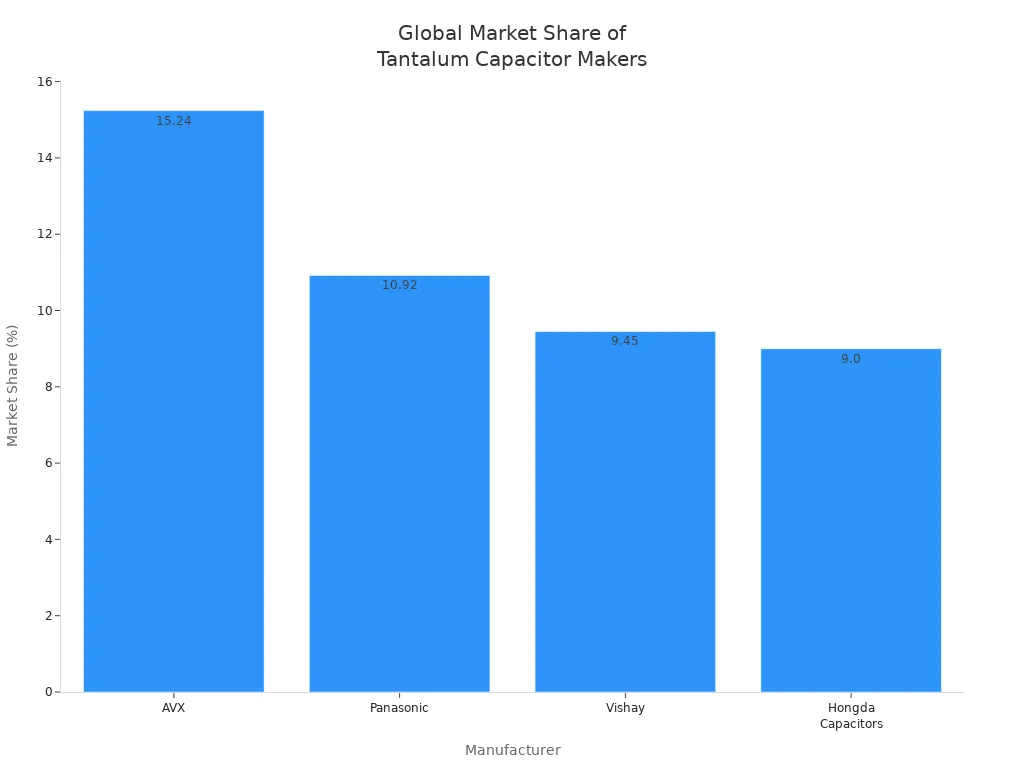
You can trust the AVX TAJA106K016RNJ for your projects because it comes from a leading manufacturer with a large share of the market.
Key Information
Part Number
When you look at the part number TAJA106K016RNJ, you can learn a lot about the capacitor. Each section of the code tells you something important:
TAJ: This shows the series of the capacitor. The TAJ series is known for reliability and solid molded construction.
A: This letter tells you the case size. "A" means the 1206 (3216 metric) package.
106: These three numbers show the capacitance. "106" means 10 followed by six zeros in picofarads (pF), which equals 10 microfarads (μF).
K: This letter shows the tolerance. "K" means ±10%.
016: These numbers show the voltage rating. "016" means 16 volts.
R: This letter stands for packaging type, such as tape and reel.
N: This letter can show special features or lead style.
J: This letter often shows the termination or finish.
Tip: You can always check the manufacturer’s datasheet for a full breakdown of each part number section.
Specs
You need to know the main electrical specifications to choose the right capacitor for your project. The table below shows the key specs for the AVX TAJA106K016RNJ:
| Parameter | Specification |
|---|---|
| Capacitance | 10 μF |
| Voltage Rating (DC) | 16 V |
| Tolerance | ±10% |
| Equivalent Series Resistance (ESR) | 3 Ohm |
| Dissipation Factor | 8 % |
| Leakage Current | 1.6 μA |
| Tan Delta | 0.08 |
| Operating Temperature Range | -55°C to 125°C |
| Package / Case | 1206 (3216 Metric) |
| Mounting Type | Surface Mount |
| Polarity | Polarized |
| Dimensions (L x W x H) | 3.2 mm x 1.6 mm x 1.6 mm |
| Packaging | Tape & Reel (TR) |
You can see that the AVX TAJA106K016RNJ has a capacitance of 10 μF and can handle up to 16 volts. The tolerance of ±10% means the actual value can be a bit higher or lower than 10 μF. The ESR, or Equivalent Series Resistance, is 3 Ohms. This value is important because a lower ESR means better performance in high-frequency circuits.
Let’s compare the ESR of this capacitor with others in the same series:
| Capacitor Model | ESR (Ohms) | Capacitance | Voltage Rating | Series |
|---|---|---|---|---|
| TAJA106K016RNJ | 3 | 10 uF | 16 VDC | TAJ |
| TAJA476K006RNJ | 1.6 | N/A | N/A | TAJ |
| TAJA476M006RNJ | 1.6 | N/A | N/A | TAJ |
| TAJA475M016RNJ | 4 | N/A | N/A | TAJ |
| TAJB105M035RNJ | 6.5 | N/A | N/A | TAJ |
| TAJA105M020RNJ | 9 | N/A | N/A | TAJ |
| TAJR685K002RNJ | 20 | N/A | N/A | TAJ |
You can see that the AVX TAJA106K016RNJ has a lower ESR than many other models, which means it can handle higher frequencies better and produce less heat.
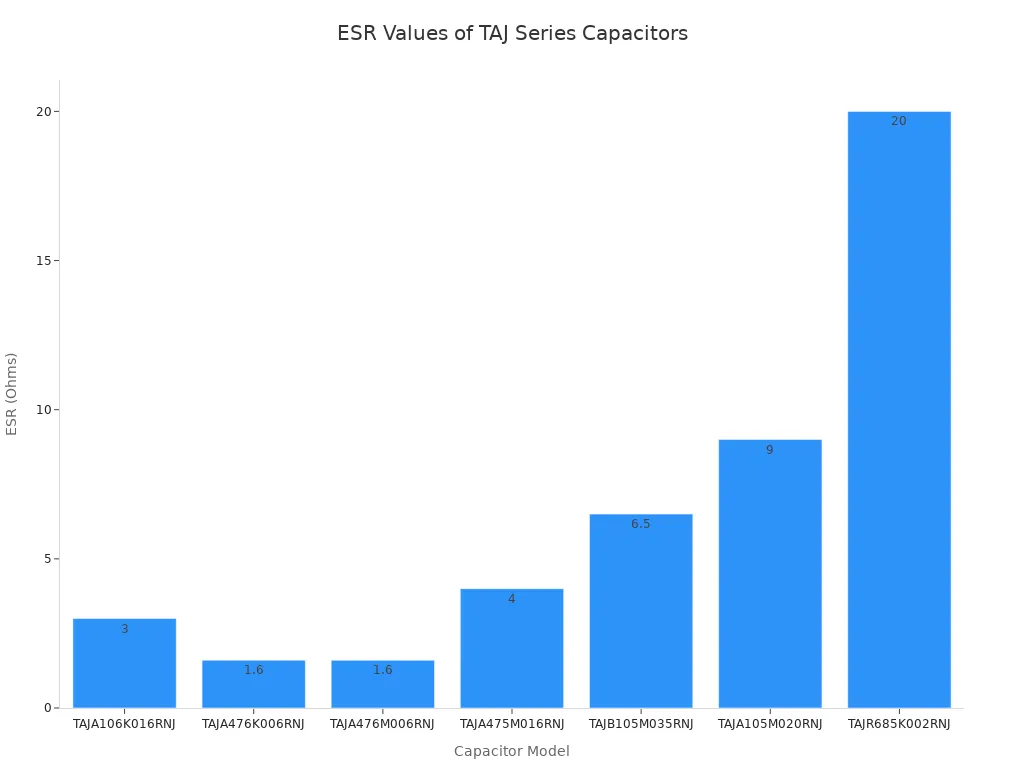
Note: The lower the ESR, the better the capacitor performs in filtering and decoupling tasks.
Dimensions
You need to know the size of your capacitor to make sure it fits on your circuit board. The AVX TAJA106K016RNJ uses the 1206 package, which matches the 3216 metric standard. Here are the details:
| Attribute | Value (Imperial) | Value (Metric) |
|---|---|---|
| Package / Case | 1206 | 3216 |
| Length | 0.126 inches | 3.20 mm |
| Width | 0.063 inches | 1.60 mm |
| Maximum Seated Height | 0.071 inches | 1.80 mm |
| Manufacturer Size Code | A | N/A |
The 1206 package means the capacitor is 3.2 mm long and 1.6 mm wide. The maximum height is 1.8 mm. This small size helps you save space on your board. The typical size tolerance for this capacitor is ±10%. This means the actual size can be a little bigger or smaller than the listed value.
Remember: Always check the size and tolerance before placing the capacitor on your board. This helps you avoid fitting problems during assembly.
Tables and Graphs
Ratings
When you look at a datasheet, you often see a table with maximum ratings. This table tells you how much stress the capacitor can handle before it fails. You should always check these numbers before using the part in your project. If you go over these limits, the capacitor might get damaged or stop working.
Here is a comparison of the AVX TAJA106K016RNJ with other similar capacitors:
| Parameter | AVX TAJA106K016RNJ Specification | Industry Standard / Similar Capacitors |
|---|---|---|
| Capacitance | 10 µF | Microfarad range |
| Voltage Rating | 16 V | Up to 16 V |
| Tolerance | 10% | Typically 10% |
| Equivalent Series Resistance (ESR) | ~3 Ohms | Low single-digit Ohms |
| Maximum Operating Temperature | 125°C | Up to 125°C |
| Case Size | 3.2 x 1.6 x 1.6 mm | Similar SMD sizes |
You can see that the AVX TAJA106K016RNJ matches the industry standard for solid tantalum capacitors. The voltage rating, tolerance, and temperature range all fit what you expect for this type of part. This means you can use it in most projects that need a reliable, small capacitor.
Always stay within the maximum ratings. If you use a higher voltage or temperature than listed, you risk damaging your circuit.
Performance
Performance graphs help you understand how the capacitor behaves in real-world conditions. One important graph shows ESR (Equivalent Series Resistance) versus frequency. ESR tells you how much resistance the capacitor adds to your circuit. Lower ESR means better performance, especially in high-frequency circuits.
When you look at the ESR vs. frequency curve, you will notice that ESR usually drops as frequency increases. This means the capacitor works better at filtering out high-frequency noise. If your project has fast digital signals or switching power supplies, you want a capacitor with low ESR at those frequencies.
Temperature also affects performance. As temperature rises, the ESR can change. The AVX TAJA106K016RNJ keeps a stable ESR up to 125°C, which matches what you see in other top-quality capacitors. This stability helps your circuit stay reliable, even if it gets warm during use.
Tip: Use the performance graphs to pick the right capacitor for your needs. Check both ESR and temperature curves to make sure the part will work well in your project.
Using the Datasheet
Compatibility
You want to make sure the AVX TAJA106K016RNJ fits your project before you order or use it. Start by checking the most important parameters. The table below shows what you should look for and why each one matters:
| Parameter | Description & Importance |
|---|---|
| Capacitance | 10μF - Stores electrical energy, affects circuit function. |
| Voltage Rating (DC/AC) | 16V - Maximum safe voltage, prevents damage. |
| Tolerance | ±10% - Acceptable range for capacitance, keeps performance within limits. |
| Size / Package | 1206 (3.20mm x 1.60mm x 1.3mm) - Must fit your PCB layout. |
| Mounting Type | Surface Mount (SMD/SMT) - Matches your assembly process. |
| Operating Temperature Range | -55°C to 125°C - Handles your project's environment. |
| ESR | 3 Ohm - Lower ESR means better high-frequency performance. |
| Polarity | Polar - Needs correct orientation to work. |
| Moisture Sensitivity Level | 1 (Unlimited) - Easy to handle and store. |
| Environmental Compliance | RoHS3, Lead Free, No SVHC - Meets safety standards. |
To check compatibility, follow these steps:
Review the electrical specs: capacitance, voltage, and tolerance.
Check the size and package to ensure a good fit on your board.
Confirm the mounting style matches your assembly process.
Make sure the temperature range covers your operating conditions.
Look at ESR, dissipation factor, and leakage current for your application.
Ensure you understand the polarity and install it correctly.
Check moisture sensitivity for storage needs.
Verify environmental compliance for your region.
Compare reference standards if your project requires them.
Review packaging and lead pitch for manufacturing.
Tip: Always double-check these points before finalizing your design. This helps you avoid costly mistakes.
Ordering
When you are ready to order, you want to find the right part quickly. Start by searching for the full part number. Many suppliers carry the AVX TAJA106K016RNJ, but sometimes it may be out of stock. If that happens, you can look for alternatives with similar specs.
Here is a table comparing some common alternatives:
| Capacitor Part Number | Capacitance | Voltage Rating | Tolerance | ESR (Ohms) | Package Size | Dissipation Factor | Leakage Current | Operating Temp Range |
|---|---|---|---|---|---|---|---|---|
| AVX TAJA106K016RNJ | 10 µF | 16 V | ±10% | 3 Ω | 1206 | 8% | 1.6 µA | -55°C to 125°C |
| AVX TAJA106M016RNJ | 10 µF | 16 V | ±20% | 7 Ω | 1206 | 8% | 1.6 µA | -55°C to 125°C |
| KEMET T491A106M016AT | 10 µF | 16 V | ±10% | 3 Ω | 1206 | 6% | 1.6 µA | -55°C to 125°C |
| Vishay Sprague 293D106X0016A2TE3 | 10 µF | 16 V | ±20% | 3 Ω | 1206 | 6% | 1.6 µA | -55°C to 125°C |
You can see that some alternatives have a higher ESR or a wider tolerance. Always pick a substitute that matches your most important requirements.
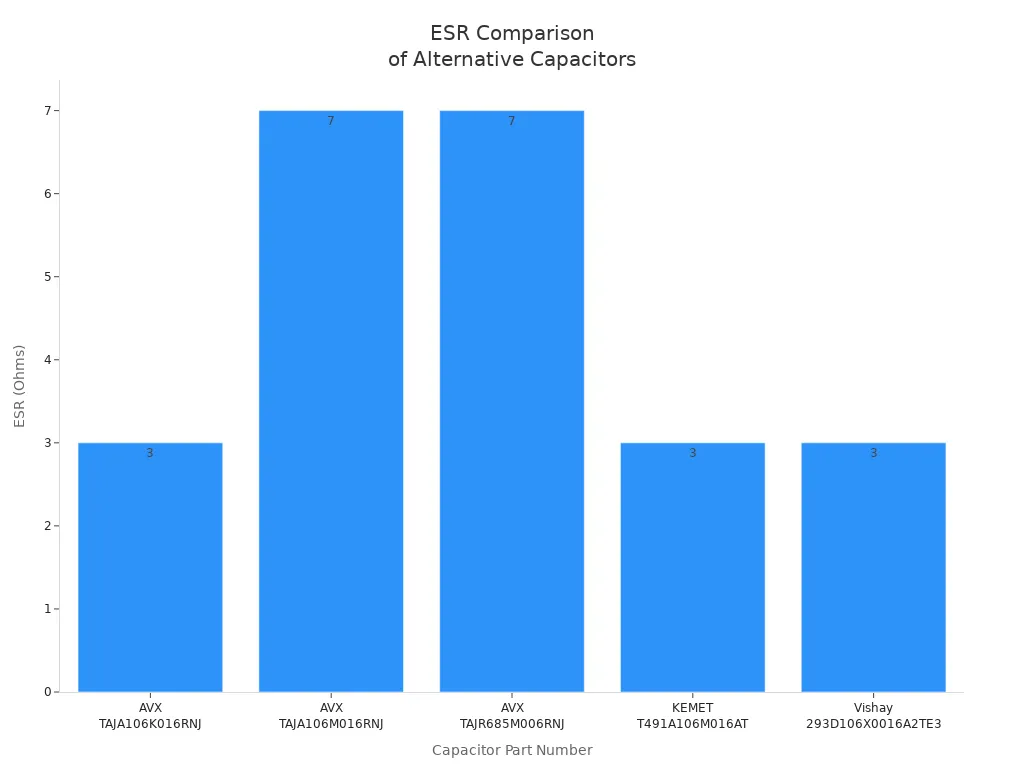
Note: If you need a higher voltage rating, you can sometimes connect capacitors in series. This increases the voltage limit but reduces total capacitance. Always check the datasheet for safe connection methods.
When you order, check the packaging type, such as tape and reel, to match your assembly process. Confirm the supplier’s stock and lead time. If you need help, contact the distributor or manufacturer for advice.
Common Mistakes
Misreading Specs
You might feel confident after reading a datasheet, but small mistakes can lead to big problems in your project. Many people misread specs or skip important details. Here are some common errors you should watch out for:
Ignoring ESR (Equivalent Series Resistance): If you do not check the ESR, your circuit may not filter noise well or could overheat.
Misinterpreting Tolerance: The ±10% tolerance means the actual capacitance can be higher or lower than 10 µF. If you need a precise value, always check this range.
Exceeding Voltage Rating: Using the capacitor above 16 V can cause it to fail or even burst.
Overlooking Temperature Range: The AVX TAJA106K016RNJ works from -55°C to +125°C. If your project gets hotter or colder, the capacitor may not work as expected.
Forgetting Polarity: This capacitor is polarized. If you install it backward, it can get damaged quickly.
Tip: Always double-check the specs before you buy or use a capacitor. A quick review can save you from costly mistakes.
Application Errors
Even if you pick the right part, you can still run into trouble during installation or use. Here are some mistakes you should avoid:
Install the capacitor with the correct polarity. The positive and negative sides matter.
Never exceed the rated voltage. Stay at or below 16 V for this part.
Avoid applying physical stress. Bending or pressing the capacitor can crack or break it.
Use proper soldering techniques. Too much heat can damage the part.
Ensure good insulation and spacing. This prevents shorts or accidental contact with other parts.
When replacing a capacitor, always check the capacitance, voltage rating, temperature stability, physical size, ESR, and environmental ratings. Make sure the new part matches your needs.
| Mistake | What Can Happen | How to Avoid |
|---|---|---|
| Wrong polarity | Capacitor damage | Check markings before install |
| Overvoltage | Failure or explosion | Stay within 16 V |
| Ignoring ESR | Poor performance, overheating | Compare ESR values |
| Bad soldering | Heat damage, poor connection | Use correct soldering tools |
Remember: Careful reading and handling help you get the best results from your AVX TAJA106K016RNJ capacitor. Small steps make a big difference!
You now know how to read the AVX TAJA106K016RNJ datasheet step by step. Start by checking the part number, then review the specs and dimensions. Use tables and graphs to understand ratings and performance. Practice these steps with other datasheets to build your confidence. If you have questions or want to share your experience, leave a comment below. Your feedback helps everyone learn!
FAQ
What does the “1206” package size mean?
The “1206” code tells you the capacitor’s size. It measures 3.2 mm long and 1.6 mm wide. This size fits most surface-mount circuit boards. Always check your board layout before choosing this part.
Can I use this capacitor in high-temperature environments?
Yes, you can use it in temperatures from -55°C to +125°C. This wide range makes it suitable for many electronics, including automotive and industrial devices.
How do I know which side is positive?
Look for a stripe or a “+” sign on the capacitor. This marks the positive side. You must match this side with the positive pad on your circuit board.
What happens if I exceed the voltage rating?
If you use more than 16 volts, the capacitor can fail or even burst. Always stay at or below the rated voltage to keep your circuit safe.
Where can I buy the AVX TAJA106K016RNJ?
You can find this capacitor at electronics suppliers like Digi-Key, Mouser, or Arrow. Search for the full part number to get the correct version and packaging.
Specifications
- TypeParameter
- Factory Lead Time21 Weeks
- Mounting Type
The "Mounting Type" in electronic components refers to the method used to attach or connect a component to a circuit board or other substrate, such as through-hole, surface-mount, or panel mount.
Surface Mount - Package / Case
refers to the protective housing that encases an electronic component, providing mechanical support, electrical connections, and thermal management.
1206 (3216 Metric) - Terminal Shape
Terminal Shape in electronic components refers to the physical design of the connection points on the component that allow for electrical connections to be made. These terminals can come in various shapes such as pins, leads, pads, or terminals with specific configurations like surface mount or through-hole. The terminal shape is important as it determines how the component can be mounted on a circuit board or connected to other components. Different terminal shapes are used based on the specific requirements of the electronic circuit design and manufacturing process.
J BEND - Number of Pins2
- Dielectric Material
a substance that is a poor conductor of electricity, but an efficient supporter of electrostatic field s.
Tantalum - Voltage - Rated
Voltage - Rated is a parameter in electronic components that specifies the maximum voltage that the component can safely handle without being damaged. It is an important specification to consider when designing or selecting components for a circuit, as exceeding the rated voltage can lead to component failure or even pose safety risks. The rated voltage is typically provided by the manufacturer and should be carefully matched to the voltage requirements of the circuit to ensure reliable operation. It is crucial to adhere to the rated voltage to prevent damage and ensure the longevity of the electronic component.
16V - Voltage - Rated (DC)16V
- Operating Temperature
The operating temperature is the range of ambient temperature within which a power supply, or any other electrical equipment, operate in. This ranges from a minimum operating temperature, to a peak or maximum operating temperature, outside which, the power supply may fail.
-55°C~125°C - Packaging
Semiconductor package is a carrier / shell used to contain and cover one or more semiconductor components or integrated circuits. The material of the shell can be metal, plastic, glass or ceramic.
Tape & Reel (TR) - Series
In electronic components, the "Series" refers to a group of products that share similar characteristics, designs, or functionalities, often produced by the same manufacturer. These components within a series typically have common specifications but may vary in terms of voltage, power, or packaging to meet different application needs. The series name helps identify and differentiate between various product lines within a manufacturer's catalog.
TAJ - Published2006
- Size / Dimension
In electronic components, the parameter "Size / Dimension" refers to the physical dimensions of the component, such as its length, width, and height. These dimensions are crucial for determining how the component will fit into a circuit or system, as well as for ensuring compatibility with other components and the overall design requirements. The size of a component can also impact its performance characteristics, thermal properties, and overall functionality within a given application. Engineers and designers must carefully consider the size and dimensions of electronic components to ensure proper integration and functionality within their designs.
0.126Lx0.063W 3.20mmx1.60mm - Tolerance
In electronic components, "tolerance" refers to the acceptable deviation or variation from the specified or ideal value of a particular parameter, such as resistance, capacitance, or voltage. It indicates the range within which the actual value of the component can fluctuate while still being considered acceptable for use in a circuit. Tolerance is typically expressed as a percentage or a specific value and is important for ensuring the accuracy and reliability of electronic devices. Components with tighter tolerances are more precise but may also be more expensive. It is crucial to consider tolerance when selecting components to ensure proper functionality and performance of the circuit.
±10% - JESD-609 Code
The "JESD-609 Code" in electronic components refers to a standardized marking code that indicates the lead-free solder composition and finish of electronic components for compliance with environmental regulations.
e3 - Pbfree Code
The "Pbfree Code" parameter in electronic components refers to the code or marking used to indicate that the component is lead-free. Lead (Pb) is a toxic substance that has been widely used in electronic components for many years, but due to environmental concerns, there has been a shift towards lead-free alternatives. The Pbfree Code helps manufacturers and users easily identify components that do not contain lead, ensuring compliance with regulations and promoting environmentally friendly practices. It is important to pay attention to the Pbfree Code when selecting electronic components to ensure they meet the necessary requirements for lead-free applications.
yes - Part Status
Parts can have many statuses as they progress through the configuration, analysis, review, and approval stages.
Active - Moisture Sensitivity Level (MSL)
Moisture Sensitivity Level (MSL) is a standardized rating that indicates the susceptibility of electronic components, particularly semiconductors, to moisture-induced damage during storage and the soldering process, defining the allowable exposure time to ambient conditions before they require special handling or baking to prevent failures
1 (Unlimited) - Number of Terminations2
- Termination
Termination in electronic components refers to the practice of matching the impedance of a circuit to prevent signal reflections and ensure maximum power transfer. It involves the use of resistors or other components at the end of transmission lines or connections. Proper termination is crucial in high-frequency applications to maintain signal integrity and reduce noise.
SMD/SMT - TypeMolded
- Capacitance
Capacitance is a fundamental electrical property of electronic components that describes their ability to store electrical energy in the form of an electric field. It is measured in farads (F) and represents the ratio of the amount of electric charge stored on a component to the voltage across it. Capacitors are passive components that exhibit capacitance and are commonly used in electronic circuits for various purposes such as filtering, energy storage, timing, and coupling. Capacitance plays a crucial role in determining the behavior and performance of electronic systems by influencing factors like signal propagation, frequency response, and power consumption.
10μF - Pitch
In electronic components, "Pitch" refers to the distance between the center of one pin or lead to the center of the adjacent pin or lead on a component, such as an integrated circuit (IC) or a connector. It is a crucial parameter as it determines the spacing and alignment of the pins or leads on a component, which in turn affects how the component can be mounted on a circuit board or connected to other components.The pitch measurement is typically expressed in millimeters (mm) or inches (in) and plays a significant role in determining the overall size and layout of a circuit board. Components with different pitches may require specific types of circuit boards or connectors to ensure proper alignment and connection. Designers must carefully consider the pitch of components when designing circuit layouts to ensure compatibility and proper functionality of the electronic system.
1.1mm - Depth
In electronic components, "Depth" typically refers to the measurement of the distance from the front to the back of the component. It is an important parameter to consider when designing or selecting components for a project, as it determines how much space the component will occupy within a circuit or device. The depth of a component can impact the overall size and layout of the circuit board or enclosure in which it will be installed. It is usually specified in millimeters or inches and is crucial for ensuring proper fit and functionality within the intended application.
1.6mm - Frequency
In electronic components, the parameter "Frequency" refers to the rate at which a signal oscillates or cycles within a given period of time. It is typically measured in Hertz (Hz) and represents how many times a signal completes a full cycle in one second. Frequency is a crucial aspect in electronic components as it determines the behavior and performance of various devices such as oscillators, filters, and communication systems. Understanding the frequency characteristics of components is essential for designing and analyzing electronic circuits to ensure proper functionality and compatibility with other components in a system.
300MHz - Reference Standard
In the context of electronic components, the term "Reference Standard" typically refers to a specific set of guidelines, specifications, or requirements that serve as a benchmark for evaluating the quality, performance, and characteristics of the component. These standards are established by organizations such as the International Electrotechnical Commission (IEC), the Institute of Electrical and Electronics Engineers (IEEE), or specific industry bodies.Reference standards help ensure consistency and interoperability among different components, as they provide a common framework for manufacturers, designers, and users to adhere to. They outline parameters such as electrical properties, mechanical dimensions, environmental conditions, and safety considerations that the component must meet to be considered compliant.By referencing these standards, manufacturers can design and produce components that meet industry-recognized criteria, which in turn helps users select the right components for their applications with confidence. Adhering to reference standards also facilitates regulatory compliance and promotes overall quality and reliability in electronic systems.
CECC30801-005 - Voltage - Rated AC
Voltage - Rated AC is a parameter that specifies the maximum alternating current (AC) voltage that an electronic component can safely handle without being damaged. This rating is crucial for ensuring the proper functioning and longevity of the component within an electrical circuit. It is typically expressed in volts (V) and helps users determine the compatibility of the component with the voltage levels present in the circuit. Exceeding the rated AC voltage can lead to overheating, malfunction, or permanent damage to the component, so it is important to adhere to this specification when designing or using electronic systems.
16V - Case Code (Metric)
Case Code (Metric) in electronic components refers to a standardized system that specifies the dimensions of surface-mount devices (SMD) in millimeters, consisting of a four-digit number where the first two digits represent the width and the last two digits represent the height of the component, measured in tenths of a millimeter. The metric case codes are standardized by organizations such as the EIA and IEC, and are often compared to the Imperial code which uses inches, allowing for easier identification and selection of components across different regions and industries. This coding system is widely used in the design and manufacturing of electronic devices, particularly in applications requiring compact and efficient component layouts, and is essential for engineers and designers to ensure proper component selection and facilitate the assembly process in electronic manufacturing.
3216 - Case Code (Imperial)
The term "Case Code (Imperial)" in electronic components refers to a standardized system used to specify the physical dimensions and package types of components, particularly capacitors and resistors. This code helps manufacturers and engineers identify the size and form factor of the component, ensuring compatibility with circuit designs and PCB layouts. In the context of electronic components, the Case Code (Imperial) typically follows a numerical format that indicates the length and width of the component in inches. For example, a Case Code of 1206 signifies a component that measures 0.12 inches by 0.06 inches. This coding system is essential for selecting the correct components for specific applications, as it provides a quick reference to the physical characteristics of the part, including its footprint and mounting style.
1206 - ESR (Equivalent Series Resistance)
Equivalent Series Resistance (ESR) is a parameter that describes the internal resistance of a capacitor or an inductor in an electronic circuit. It represents the total resistance that is present in series with the ideal capacitance or inductance of the component. ESR is typically caused by factors such as the resistance of the conductive materials used in the component, the connections within the component, and the dielectric material used. A lower ESR value is desirable in electronic components as it indicates better performance and efficiency, especially in applications where high-frequency signals or rapid changes in voltage are involved. ESR is an important parameter to consider when selecting components for applications such as power supplies, filtering circuits, and signal processing.
3Ohm - Polarity
In electronic components, polarity refers to the orientation or direction in which the component must be connected in a circuit to function properly. Components such as diodes, capacitors, and LEDs have polarity markings to indicate which terminal should be connected to the positive or negative side of the circuit. Connecting a component with incorrect polarity can lead to malfunction or damage. It is important to pay attention to polarity markings and follow the manufacturer's instructions to ensure proper operation of electronic components.
Polar - Leakage Current
Leakage current is a term used in electronics to describe the small amount of current that flows through a component when it is supposed to be in a non-conductive state. This current can occur due to imperfections in the materials used to manufacture the component, as well as other factors such as temperature and voltage. Leakage current can lead to power loss, reduced efficiency, and potential reliability issues in electronic devices. It is important to consider and minimize leakage current in electronic components to ensure proper functionality and performance.
1.6μA - Tan Delta
Tan Delta, also known as the dissipation factor, is a parameter used to measure the efficiency of an electronic component in converting electrical energy into heat. It is a dimensionless quantity that represents the ratio of the resistive component to the reactive component of the impedance in the component. A high tan delta value indicates that a significant amount of energy is being lost as heat, which can affect the performance and reliability of the component. Manufacturers often provide tan delta values in specifications to help engineers assess the quality and suitability of the component for their specific application.
0.08 - Dissipation Factor
Dissipation factor (DF) is a measure of loss-rate of energy of a mode of oscillation (mechanical, electrical, or electromechanical) in a dissipative system. It is the reciprocal of quality factor, which represents the "quality" or durability of oscillation.
8 % - Manufacturer Size Code
The Manufacturer Size Code is a designation used by electronic components manufacturers to specify the physical dimensions and package type of their products. It typically includes information about length, width, height, and other relevant size characteristics that help in the identification and compatibility of components within electronic designs. This code is essential for engineers and designers to ensure that they select components that fit correctly in their intended applications.
A - Features
In the context of electronic components, the term "Features" typically refers to the specific characteristics or functionalities that a particular component offers. These features can vary depending on the type of component and its intended use. For example, a microcontroller may have features such as built-in memory, analog-to-digital converters, and communication interfaces like UART or SPI.When evaluating electronic components, understanding their features is crucial in determining whether they meet the requirements of a particular project or application. Engineers and designers often look at features such as operating voltage, speed, power consumption, and communication protocols to ensure compatibility and optimal performance.In summary, the "Features" parameter in electronic components describes the unique attributes and capabilities that differentiate one component from another, helping users make informed decisions when selecting components for their electronic designs.
General Purpose - Height1.3mm
- Height Seated (Max)
Height Seated (Max) is a parameter in electronic components that refers to the maximum allowable height of the component when it is properly seated or installed on a circuit board or within an enclosure. This specification is crucial for ensuring proper fit and alignment within the overall system design. Exceeding the maximum seated height can lead to mechanical interference, electrical shorts, or other issues that may impact the performance and reliability of the electronic device. Manufacturers provide this information to help designers and engineers select components that will fit within the designated space and function correctly in the intended application.
0.071 1.80mm - REACH SVHC
The parameter "REACH SVHC" in electronic components refers to the compliance with the Registration, Evaluation, Authorization, and Restriction of Chemicals (REACH) regulation regarding Substances of Very High Concern (SVHC). SVHCs are substances that may have serious effects on human health or the environment, and their use is regulated under REACH to ensure their safe handling and minimize their impact.Manufacturers of electronic components need to declare if their products contain any SVHCs above a certain threshold concentration and provide information on the safe use of these substances. This information allows customers to make informed decisions about the potential risks associated with using the components and take appropriate measures to mitigate any hazards.Ensuring compliance with REACH SVHC requirements is essential for electronics manufacturers to meet regulatory standards, protect human health and the environment, and maintain transparency in their supply chain. It also demonstrates a commitment to sustainability and responsible manufacturing practices in the electronics industry.
No SVHC - Radiation Hardening
Radiation hardening is the process of making electronic components and circuits resistant to damage or malfunction caused by high levels of ionizing radiation, especially for environments in outer space (especially beyond the low Earth orbit), around nuclear reactors and particle accelerators, or during nuclear accidents or nuclear warfare.
No - RoHS Status
RoHS means “Restriction of Certain Hazardous Substances” in the “Hazardous Substances Directive” in electrical and electronic equipment.
ROHS3 Compliant - Lead Free
Lead Free is a term used to describe electronic components that do not contain lead as part of their composition. Lead is a toxic material that can have harmful effects on human health and the environment, so the electronics industry has been moving towards lead-free components to reduce these risks. Lead-free components are typically made using alternative materials such as silver, copper, and tin. Manufacturers must comply with regulations such as the Restriction of Hazardous Substances (RoHS) directive to ensure that their products are lead-free and environmentally friendly.
Lead Free
Parts with Similar Specs
- ImagePart NumberManufacturerCapacitanceMountPackage / CaseToleranceESR (Equivalent Series Resistance)Leakage CurrentDissipation FactorRadiation HardeningView Compare
![TAJA106K016RNJ]()
TAJA106K016RNJ
10μF
Surface Mount
1206 (3216 Metric)
±10%
3 Ω
1.6 μA
8 %
No
![TAJA106M016RNJ]()
10μF
PCB, Surface Mount
1206 (3216 Metric)
±20%
7 Ω
1.6 μA
8 %
No
![T491A106M016AT]()
10μF
PCB, Surface Mount
1206 (3216 Metric)
±10%
3 Ω
1.6 μA
6 %
No
![293D106X0016A2TE3]()
10μF
PCB, Surface Mount
1206 (3216 Metric)
±20%
3 Ω
1.6 μA
6 %
No
![293D106X9016A2TE3]()
10μF
PCB, Surface Mount
1206 (3216 Metric)
±20%
3 Ω
1.6 μA
8 %
No


Datasheet PDF
- RohsStatement :
- PCN Part Number :
 PIC16F726EML Microcontroller by Microchip: Technical Analysis
29 February 2024187
 LPC2148 Microcontroller: Datasheet, Price and Pinout
04 November 20217873
 STM32F207 Microcontroller: Features, Datasheet and Pinout
06 December 20216125
 onsemi MJE15032G Review for Advanced Frequency Applications
08 September 2025402
 SN74LVC2G17DCKR Dual Schmitt-Trigger Buffer: Circuit, Pinout, and Datasheet
29 March 20223912
 A Comprehensive Guide to LTC6406CMS8E#PBF - A High-Speed ADC Driver
06 March 2024212
 ISO1050DUBR Transceiver: Features, Applications and Datasheet
14 November 2023512
 PMEG10010ELRX Schottky Barrier Rectifier: 100V, 1A, Datasheet
08 March 20221431
 What is a USB Flash Drive?
25 May 20213653
 What is Inter-Integrated Circuit (I2C)?
23 February 20224046
 What Is an ASIC? Design Flow, Applications, and the 2026 AI Custom Silicon Boom
01 July 20261179
 What are the Differences Between Pull up and Pull down Resistors?
22 October 202539767
 This New Material Promises to Be the Best Semiconductor
25 July 20222509
 How to Address IoT Eco-security in the Era of Digital Transformation?
22 April 2022679
 Eight Internet of Things (IoT) Trends for 2022
08 April 20225483
 GenAI Boosts Semiconductor Market with First Revenue Increase in Five Quarters
25 March 20244243
AVX Corporation
In Stock: 89915
United States
China
Canada
Japan
Russia
Germany
United Kingdom
Singapore
Italy
Hong Kong(China)
Taiwan(China)
France
Korea
Mexico
Netherlands
Malaysia
Austria
Spain
Switzerland
Poland
Thailand
Vietnam
India
United Arab Emirates
Afghanistan
Åland Islands
Albania
Algeria
American Samoa
Andorra
Angola
Anguilla
Antigua & Barbuda
Argentina
Armenia
Aruba
Australia
Azerbaijan
Bahamas
Bahrain
Bangladesh
Barbados
Belarus
Belgium
Belize
Benin
Bermuda
Bhutan
Bolivia
Bonaire, Sint Eustatius and Saba
Bosnia & Herzegovina
Botswana
Brazil
British Indian Ocean Territory
British Virgin Islands
Brunei
Bulgaria
Burkina Faso
Burundi
Cabo Verde
Cambodia
Cameroon
Cayman Islands
Central African Republic
Chad
Chile
Christmas Island
Cocos (Keeling) Islands
Colombia
Comoros
Congo
Congo (DRC)
Cook Islands
Costa Rica
Côte d’Ivoire
Croatia
Cuba
Curaçao
Cyprus
Czechia
Denmark
Djibouti
Dominica
Dominican Republic
Ecuador
Egypt
El Salvador
Equatorial Guinea
Eritrea
Estonia
Eswatini
Ethiopia
Falkland Islands
Faroe Islands
Fiji
Finland
French Guiana
French Polynesia
Gabon
Gambia
Georgia
Ghana
Gibraltar
Greece
Greenland
Grenada
Guadeloupe
Guam
Guatemala
Guernsey
Guinea
Guinea-Bissau
Guyana
Haiti
Honduras
Hungary
Iceland
Indonesia
Iran
Iraq
Ireland
Isle of Man
Israel
Jamaica
Jersey
Jordan
Kazakhstan
Kenya
Kiribati
Kosovo
Kuwait
Kyrgyzstan
Laos
Latvia
Lebanon
Lesotho
Liberia
Libya
Liechtenstein
Lithuania
Luxembourg
Macao(China)
Madagascar
Malawi
Maldives
Mali
Malta
Marshall Islands
Martinique
Mauritania
Mauritius
Mayotte
Micronesia
Moldova
Monaco
Mongolia
Montenegro
Montserrat
Morocco
Mozambique
Myanmar
Namibia
Nauru
Nepal
New Caledonia
New Zealand
Nicaragua
Niger
Nigeria
Niue
Norfolk Island
North Korea
North Macedonia
Northern Mariana Islands
Norway
Oman
Pakistan
Palau
Palestinian Authority
Panama
Papua New Guinea
Paraguay
Peru
Philippines
Pitcairn Islands
Portugal
Puerto Rico
Qatar
Réunion
Romania
Rwanda
Samoa
San Marino
São Tomé & Príncipe
Saudi Arabia
Senegal
Serbia
Seychelles
Sierra Leone
Sint Maarten
Slovakia
Slovenia
Solomon Islands
Somalia
South Africa
South Sudan
Sri Lanka
St Helena, Ascension, Tristan da Cunha
St. Barthélemy
St. Kitts & Nevis
St. Lucia
St. Martin
St. Pierre & Miquelon
St. Vincent & Grenadines
Sudan
Suriname
Svalbard & Jan Mayen
Sweden
Syria
Tajikistan
Tanzania
Timor-Leste
Togo
Tokelau
Tonga
Trinidad & Tobago
Tunisia
Turkey
Turkmenistan
Turks & Caicos Islands
Tuvalu
U.S. Outlying Islands
U.S. Virgin Islands
Uganda
Ukraine
Uruguay
Uzbekistan
Vanuatu
Vatican City
Venezuela
Wallis & Futuna
Yemen
Zambia
Zimbabwe


