Product
 Brand
Brand Articles
 Tools
Tools
BMI160 Obsolete: Best Replacement Sensors BMI270, BMI323, LSM6DSOTR


IMU ACCEL/GYRO I2C/SPI 14LGA
Bosch BMI160 will be obsolete by April 2025. Compare top sensor replacements like BMI270, BMI323, and LSM6DSOTR to keep your projects on track.
Product Introduction
Bosch has officially marked the bosch bmi160 as obsolete, with support ending on April 14, 2025. Engineers now face a critical need to select new sensors for ongoing projects. Top recommended replacements include the bosch bmi270, BMI323, BHI360, and LSM6DSOTR. Many developers also consider sensors like MPU-6500, MPU-6050, MPU-9250, LSM6DSM, and LSM6DS3 for their low power use and high accuracy.
| Replacement Sensor | Key Features |
|---|---|
| MPU-6500 | 3-axis accelerometer and gyroscope, widely used, similar to bmi160 |
| MPU-6050 | Integrated 3-axis accelerometer and gyroscope, low power, wearable-ready |
| MPU-9250 | 3-axis accelerometer, gyroscope, magnetometer, compact, accurate |
| LSM6DSM | 3-axis accelerometer and gyroscope, low power, robotics-ready |
| LSM6DS3 | Integrated accelerometer and gyroscope, robust, smart power management |
Developers must act quickly, as bosch will discontinue support and supply for these sensors.
bosch bmi160 Obsolescence
End-of-Life Timeline
Bosch announced the official end-of-life for the bosch bmi160 sensor in early 2024. The company set April 14, 2025, as the final date for support and supply. After this date, engineers will not receive firmware updates, technical support, or new shipments. Many distributors have already started to reduce their inventory. Some have placed strict limits on order quantities.
⚠️ Note: Teams relying on the bmi160 should check their current stock and plan for last-time buys before the deadline.
A typical end-of-life process for sensors like the bosch bmi160 includes several stages:
Initial Notification: Bosch informs customers about the upcoming discontinuation.
Last-Time Buy Period: Customers can place final orders for the bmi160.
End of Support: Bosch stops providing technical help and software updates.
Obsolescence: The sensor becomes unavailable for new designs.
Impact on Projects
The obsolescence of the bosch bmi160 affects many industries. Wearable devices, robotics, and IoT products often use this sensor for motion tracking. When the bmi160 becomes unavailable, teams must redesign hardware and update firmware. Some projects may face delays or increased costs.
Project managers should review all designs that use the bmi160. They need to identify risks and create a migration plan. Early action helps avoid production stoppages and supply chain issues. Teams should also test new sensors to ensure performance matches the original bosch bmi160.
Comparison Table
bmi160 vs bmi270
Engineers often look to the bmi270 as a direct replacement for the bosch bmi160. Both sensors share similar pinouts and package sizes, making hardware swaps straightforward. However, software support and integration differ. The bmi270 requires a configuration file upload at every power-up, which increases firmware complexity and memory use. Devices with limited memory may need extra storage to handle this file. The bmi270 also offers advanced features, but these come with added setup steps.
| Feature | BMI160 | BMI270 |
|---|---|---|
| Manufacturer | Bosch | Bosch |
| Pin/Package | 14-pin LGA | 14-pin LGA |
| Power Consumption | ~950 μA | ~950 μA |
| Output Data Rate | Up to 1.6 kHz | Up to 1.6 kHz |
| Software Support | Dedicated API, active | Dedicated API, more recent updates |
| Firmware Requirement | None | 8KB config file upload at power-up |
| Drop-in Replacement | Yes (hardware) | Yes (hardware), but software changes needed |
Note: Users report that using bmi270 with bmi160 component software can cause communication failures. The bmi270 needs its own drivers and setup.
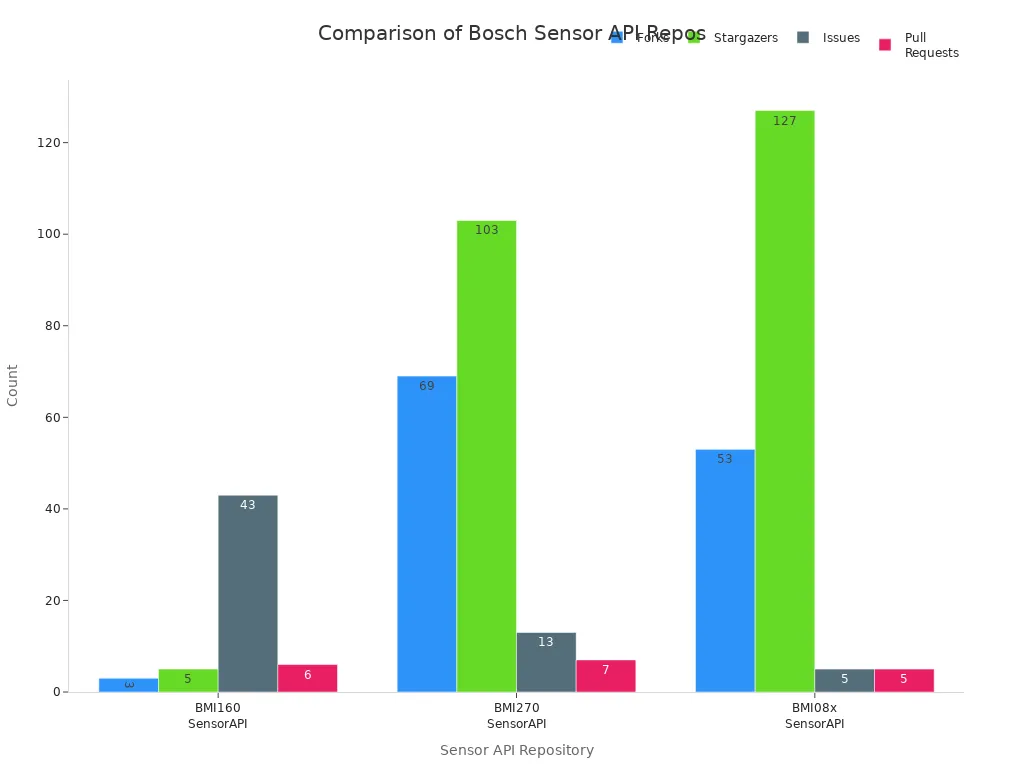
The chart above shows that the bmi270 SensorAPI has more community activity and recent updates than the bmi160 API. This means engineers can expect better ongoing support for the bmi270.
Other Alternatives
When the bmi270 does not fit project needs, teams can consider other sensors. The following part comparison table summarizes key specs, compatibility, and software support for leading options:
| Sensor | Pin/Package | Power Use | Output Data Rate | Software Support | Drop-in Replacement | Notes |
|---|---|---|---|---|---|---|
| BMI160 | 14-pin LGA | ~950 μA | Up to 1.6 kHz | Active, dedicated API | N/A | Obsolete after April 2025 |
| BMI270 | 14-pin LGA | ~950 μA | Up to 1.6 kHz | Active, more updates | Yes (hardware only) | Needs config file and new drivers |
| BMI323 | 14-pin LGA | ~700 μA | Up to 1.6 kHz | Bosch API | No | Lower power, check supply availability |
| BHI360 | 36-pin LGA | ~1.2 mA | Up to 800 Hz | Bosch API | No | Advanced features, new layout needed |
| LSM6DSOTR | 14-pin LGA | ~900 μA | Up to 6.6 kHz | STMicroelectronics API | No | High data rate, new drivers required |
Only the bmi270 matches the bmi160 component pinout, but software changes are always required.
BMI323, BHI360, and LSM6DSOTR need hardware redesigns and new drivers.
All sensors offer active software support, but each uses different APIs.
Tip: Always review memory and firmware needs before switching sensors. Some alternatives, like the bmi270, add extra steps for configuration and startup.
bmi270 and Other Replacements
BMI270 Overview
The bmi270 stands out as the most direct successor to the BMI160. Bosch designed this sensor to match the original’s pinout and package, which allows for easy hardware swaps. Many engineers choose the bmi270 because it offers improved motion detection and lower noise levels. This sensor supports advanced features like step counting and activity recognition, which benefit wearable and fitness devices.
Pros:
Hardware compatibility with BMI160 simplifies board redesign.
Active software support and frequent updates from Bosch.
Enhanced motion detection and lower noise improve accuracy.
Cons:
The bmi270 requires a configuration file upload at every power-up. This step increases firmware complexity and uses more memory.
Developers must update drivers and cannot reuse BMI160 software directly.
Tip: Teams should allocate extra memory for the configuration file and test the new driver integration early in the migration process.
BMI323 and BHI360
Bosch offers the BMI323 and BHI360 as strong alternative options for projects needing lower power or more advanced features. The BMI323 uses less power than the BMI160 and fits into the same 14-pin LGA package. The BHI360 provides a 36-pin LGA package and adds a programmable sensor hub for on-chip data processing.
BMI323 Pros:
Lower power consumption extends battery life in portable devices.
Maintains a compact package for space-limited designs.
BHI360 Pros:
Integrated sensor hub offloads processing from the main CPU.
Advanced features support gesture recognition and context awareness.
Cons:
Both sensors require hardware redesign due to different pinouts.
Developers must adapt software and drivers for new APIs.
Migration Tips for BMI323 and BHI360:
Write wrapper functions for low-level I2C or SPI communication using STM32 HAL libraries, instead of Bosch’s COINES protocol.
Modify interface files in the Bosch sensor API to replace COINES calls with STM32 HAL-based read/write functions.
Use examples from other Bosch sensor APIs, such as the BMP388, to guide the adaptation process.
Define device addresses, manage buffers, and handle register operations within the STM32 HAL framework.
Test communication thoroughly to ensure reliable sensor data transfer.
Note: This migration approach helps teams move from BMI160 to BMI323 or BHI360, even though Bosch does not provide explicit step-by-step instructions.
LSM6DSOTR
The LSM6DSOTR from STMicroelectronics serves as a popular alternative option to Bosch’s sensors. This device combines a 3-axis accelerometer and a 3-axis gyroscope in a single 14-lead LGA package. It delivers high accuracy and supports selectable full-scale ranges for precise motion tracking. The sensor’s low power consumption makes it ideal for battery-powered products.
Key Features:
High-resolution motion tracking with selectable ranges.
Embedded functions such as a programmable finite state machine, event detection, and a FIFO buffer.
Integrated temperature sensor for thermal drift compensation.
Flexible communication interfaces, supporting both I2C and SPI.
Compact package fits space-constrained designs.
Pros:
Advanced embedded features reduce CPU load and improve efficiency.
Low power operation extends device battery life.
Suitable for a wide range of applications, including wearables, industrial automation, and healthcare.
Cons:
Requires new drivers and software adaptation.
Hardware redesign needed due to differences in pinout and electrical characteristics.
Engineers should review the LSM6DSOTR’s documentation and reference designs before starting migration. Testing all embedded features ensures the sensor meets project requirements.
Migration Tips
Firmware Changes
Firmware migration requires careful planning. Developers often face new requirements when moving from the bmi160 to other sensors. For example, the BMI270 needs a configuration file upload at every power-up. This step increases memory use and makes firmware more complex. Many sensors, including the bmi160 and its alternatives, do not have enough internal processing power for all built-in features. Enabling too many features can cause the sensor to behave unpredictably or even lock up. Some built-in functions are buggy or poorly documented. Many teams choose to disable these features and process raw sensor data with their own code. When using the bosch sensor api, developers should update interface files and test all changes.
Common firmware migration pitfalls include:
Sensors like the BMI270 require firmware uploads at each startup, increasing resource use.
Limited internal processing power can cause lockups if too many features are enabled.
Built-in features may be buggy or hard to use, leading teams to rely on raw data.
Interfacing protocols (I2C or SPI) may have conflicting recommendations, making integration harder.
MEMS sensors often have short product lifecycles, forcing frequent firmware updates.
Tip: Start with basic sensor functions and add advanced features one at a time. This approach helps catch problems early.
Hardware Adjustments
Hardware changes depend on the chosen replacement. The bmi270 matches the bmi160 pinout, so hardware changes are minimal. Other sensors, like the BMI323, BHI360, or LSM6DSOTR, require new PCB layouts. Pin layouts and sensor packaging can complicate board design and soldering. Teams should review datasheets and reference designs before making changes. Careful planning reduces the risk of errors during assembly.
Testing Steps
Testing ensures the new sensor works as expected. Teams should validate communication using both I2C and SPI interfaces. They should check for reliable data transfer and correct sensor readings. Testing should include all power modes and feature settings. Teams must also verify that the sensor does not lock up when multiple features are enabled. Using automated tests helps catch issues early and speeds up development.
Note: Always test with real hardware and in the final product environment. This step ensures the sensor performs well in actual use.
Bosch BMI160 users face a strict deadline. Teams must replace this sensor before April 2025 to avoid supply chain risks. The BMI270, BMI323, BHI360, and LSM6DSOTR offer strong alternatives. These sensors deliver high accuracy, low power use, and flexible interfaces. Their compact size and robust design fit modern wearables and IoT devices.
| Key Benefit | Description |
|---|---|
| Precision Measurement | Accurate motion and position tracking |
| Low Power Consumption | Extends battery life in portable devices |
| Application Flexibility | Supports robotics, gaming, and health monitoring |
Early migration planning ensures smooth transitions and keeps projects on track.
FAQ
What happens if a team keeps using the Bosch BMI160 after April 2025?
Bosch will stop support and shipments. Teams may face supply shortages and no technical help. Projects could stall if the sensor fails or stock runs out.
Is the Bosch BMI270 a true drop-in replacement for the BMI160?
The BMI270 matches the BMI160’s pinout and size. However, it needs a configuration file upload at startup. Teams must update firmware and drivers for full compatibility.
Which sensor offers the lowest power consumption among the alternatives?
BMI323 uses the least power, around 700 μA.
LSM6DSOTR also provides low power operation.
Lower power helps extend battery life in portable devices.
Do teams need to redesign hardware for every replacement sensor?
Not every sensor needs a new board. The BMI270 fits the same footprint as the BMI160. BMI323, BHI360, and LSM6DSOTR require hardware changes due to different pinouts or package sizes.
Specifications
- TypeParameter
- Factory Lead Time14 Weeks
- Mounting Type
The "Mounting Type" in electronic components refers to the method used to attach or connect a component to a circuit board or other substrate, such as through-hole, surface-mount, or panel mount.
Surface Mount - Package / Case
refers to the protective housing that encases an electronic component, providing mechanical support, electrical connections, and thermal management.
14-VFLGA Module - Surface Mount
having leads that are designed to be soldered on the side of a circuit board that the body of the component is mounted on.
YES - Operating Temperature
The operating temperature is the range of ambient temperature within which a power supply, or any other electrical equipment, operate in. This ranges from a minimum operating temperature, to a peak or maximum operating temperature, outside which, the power supply may fail.
-40°C~85°C TA - Packaging
Semiconductor package is a carrier / shell used to contain and cover one or more semiconductor components or integrated circuits. The material of the shell can be metal, plastic, glass or ceramic.
Tape & Reel (TR) - Published2015
- Part Status
Parts can have many statuses as they progress through the configuration, analysis, review, and approval stages.
Active - Moisture Sensitivity Level (MSL)
Moisture Sensitivity Level (MSL) is a standardized rating that indicates the susceptibility of electronic components, particularly semiconductors, to moisture-induced damage during storage and the soldering process, defining the allowable exposure time to ambient conditions before they require special handling or baking to prevent failures
1 (Unlimited) - Number of Terminations14
- ECCN Code
An ECCN (Export Control Classification Number) is an alphanumeric code used by the U.S. Bureau of Industry and Security to identify and categorize electronic components and other dual-use items that may require an export license based on their technical characteristics and potential for military use.
EAR99 - HTS Code
HTS (Harmonized Tariff Schedule) codes are product classification codes between 8-1 digits. The first six digits are an HS code, and the countries of import assign the subsequent digits to provide additional classification. U.S. HTS codes are 1 digits and are administered by the U.S. International Trade Commission.
8542.39.00.01 - Terminal Position
In electronic components, the term "Terminal Position" refers to the physical location of the connection points on the component where external electrical connections can be made. These connection points, known as terminals, are typically used to attach wires, leads, or other components to the main body of the electronic component. The terminal position is important for ensuring proper connectivity and functionality of the component within a circuit. It is often specified in technical datasheets or component specifications to help designers and engineers understand how to properly integrate the component into their circuit designs.
BOTTOM - Terminal Form
Occurring at or forming the end of a series, succession, or the like; closing; concluding.
BUTT - Peak Reflow Temperature (Cel)
Peak Reflow Temperature (Cel) is a parameter that specifies the maximum temperature at which an electronic component can be exposed during the reflow soldering process. Reflow soldering is a common method used to attach electronic components to a circuit board. The Peak Reflow Temperature is crucial because it ensures that the component is not damaged or degraded during the soldering process. Exceeding the specified Peak Reflow Temperature can lead to issues such as component failure, reduced performance, or even permanent damage to the component. It is important for manufacturers and assemblers to adhere to the recommended Peak Reflow Temperature to ensure the reliability and functionality of the electronic components.
260 - Number of Functions1
- Supply Voltage
Supply voltage refers to the electrical potential difference provided to an electronic component or circuit. It is crucial for the proper operation of devices, as it powers their functions and determines performance characteristics. The supply voltage must be within specified limits to ensure reliability and prevent damage to components. Different electronic devices have specific supply voltage requirements, which can vary widely depending on their design and intended application.
3V - Terminal Pitch
The center distance from one pole to the next.
0.5mm - Time@Peak Reflow Temperature-Max (s)
Time@Peak Reflow Temperature-Max (s) refers to the maximum duration that an electronic component can be exposed to the peak reflow temperature during the soldering process, which is crucial for ensuring reliable solder joint formation without damaging the component.
40 - JESD-30 Code
JESD-30 Code refers to a standardized descriptive designation system established by JEDEC for semiconductor-device packages. This system provides a systematic method for generating designators that convey essential information about the package's physical characteristics, such as size and shape, which aids in component identification and selection. By using JESD-30 codes, manufacturers and engineers can ensure consistency and clarity in the specification of semiconductor packages across various applications and industries.
R-XBGA-B14 - Output Type
The "Output Type" parameter in electronic components refers to the type of signal or data that is produced by the component as an output. This parameter specifies the nature of the output signal, such as analog or digital, and can also include details about the voltage levels, current levels, frequency, and other characteristics of the output signal. Understanding the output type of a component is crucial for ensuring compatibility with other components in a circuit or system, as well as for determining how the output signal can be utilized or processed further. In summary, the output type parameter provides essential information about the nature of the signal that is generated by the electronic component as its output.
I2C, SPI - Supply Voltage-Max (Vsup)
The parameter "Supply Voltage-Max (Vsup)" in electronic components refers to the maximum voltage that can be safely applied to the component without causing damage. It is an important specification to consider when designing or using electronic circuits to ensure the component operates within its safe operating limits. Exceeding the maximum supply voltage can lead to overheating, component failure, or even permanent damage. It is crucial to adhere to the specified maximum supply voltage to ensure the reliable and safe operation of the electronic component.
3.6V - Supply Voltage-Min (Vsup)
The parameter "Supply Voltage-Min (Vsup)" in electronic components refers to the minimum voltage level required for the component to operate within its specified performance range. This parameter indicates the lowest voltage that can be safely applied to the component without risking damage or malfunction. It is crucial to ensure that the supply voltage provided to the component meets or exceeds this minimum value to ensure proper functionality and reliability. Failure to adhere to the specified minimum supply voltage may result in erratic behavior, reduced performance, or even permanent damage to the component.
1.71V - Analog IC - Other Type
Analog IC - Other Type is a parameter used to categorize electronic components that are integrated circuits (ICs) designed for analog signal processing but do not fall into more specific subcategories such as amplifiers, comparators, or voltage regulators. These ICs may include specialized analog functions such as analog-to-digital converters (ADCs), digital-to-analog converters (DACs), voltage references, or signal conditioning circuits. They are typically used in various applications where precise analog signal processing is required, such as in audio equipment, instrumentation, communication systems, and industrial control systems. Manufacturers provide detailed specifications for these components to help engineers select the most suitable IC for their specific design requirements.
ANALOG CIRCUIT - Sensor Type
In electronic components, the parameter "Sensor Type" refers to the specific type of sensor technology used in a particular component to detect and measure physical phenomena such as light, temperature, pressure, motion, or proximity. Different sensor types utilize various principles and mechanisms to convert the detected input into an electrical signal that can be processed by the electronic component. Common sensor types include photodiodes, thermistors, accelerometers, and proximity sensors, each designed for specific applications and environments. Understanding the sensor type is crucial for selecting the right component for a given task and ensuring accurate and reliable sensing capabilities in electronic systems.
Accelerometer, Gyroscope, 6 Axis - Length3mm
- Height Seated (Max)
Height Seated (Max) is a parameter in electronic components that refers to the maximum allowable height of the component when it is properly seated or installed on a circuit board or within an enclosure. This specification is crucial for ensuring proper fit and alignment within the overall system design. Exceeding the maximum seated height can lead to mechanical interference, electrical shorts, or other issues that may impact the performance and reliability of the electronic device. Manufacturers provide this information to help designers and engineers select components that will fit within the designated space and function correctly in the intended application.
0.88mm - Width2.5mm
- RoHS Status
RoHS means “Restriction of Certain Hazardous Substances” in the “Hazardous Substances Directive” in electrical and electronic equipment.
ROHS3 Compliant - Lead Free
Lead Free is a term used to describe electronic components that do not contain lead as part of their composition. Lead is a toxic material that can have harmful effects on human health and the environment, so the electronics industry has been moving towards lead-free components to reduce these risks. Lead-free components are typically made using alternative materials such as silver, copper, and tin. Manufacturers must comply with regulations such as the Restriction of Hazardous Substances (RoHS) directive to ensure that their products are lead-free and environmentally friendly.
Lead Free
Datasheet PDF
- Datasheets :
- Environmental Information :
 BAT54S Diode: BAT54S Datasheet, Price, Pinout
27 January 20226118
 LP2951CSD-3.3 NOPB 8-WDFN Voltage Regulators, LP2951 Datasheet pdf
17 February 20221331
 CY8C24794 PSoC™ Microcontroller: In-Depth Technical Analysis
29 February 2024155
 IRFZ24N Transistor: Datasheet, Pinout, IRFZ24N MOSFET
07 December 202110136
 PCF8591 A/D and D/A Converter: Datasheet, PCF8591 Raspberry Pi, Interfacing
09 October 20214429
 LPC1769 Microcontroller: Pinout, Datasheet and Programming
23 September 20216814
 CD4543BE: Datasheet, Circuit, and Pinout
06 August 20215405
 Unlocking the Potential of the PIC18F4520IML Microcontroller
29 February 2024149
 What is a Synchronous Motor?
16 March 20217304
 Trimmer Resistors: From Principles to Selection and Applications
11 August 20254081
 Microcontroller (MCU) Market Analysis
09 February 20226487
 Step-by-Step Guide to 2.2 k Ohm Resistor Color Code in 2025
20 August 20254811
 How to Select a Digital Isolator?
12 April 20217547
 SIA's Latest Report: Status and Challenges of US Semiconductors
22 February 20233132
 Devices based on Semiconductor Laser Chaos for Optical Communications
22 February 20232460
 What is 3D XPoint?
09 November 20215535
Bosch Sensortec
In Stock
United States
China
Canada
Japan
Russia
Germany
United Kingdom
Singapore
Italy
Hong Kong(China)
Taiwan(China)
France
Korea
Mexico
Netherlands
Malaysia
Austria
Spain
Switzerland
Poland
Thailand
Vietnam
India
United Arab Emirates
Afghanistan
Åland Islands
Albania
Algeria
American Samoa
Andorra
Angola
Anguilla
Antigua & Barbuda
Argentina
Armenia
Aruba
Australia
Azerbaijan
Bahamas
Bahrain
Bangladesh
Barbados
Belarus
Belgium
Belize
Benin
Bermuda
Bhutan
Bolivia
Bonaire, Sint Eustatius and Saba
Bosnia & Herzegovina
Botswana
Brazil
British Indian Ocean Territory
British Virgin Islands
Brunei
Bulgaria
Burkina Faso
Burundi
Cabo Verde
Cambodia
Cameroon
Cayman Islands
Central African Republic
Chad
Chile
Christmas Island
Cocos (Keeling) Islands
Colombia
Comoros
Congo
Congo (DRC)
Cook Islands
Costa Rica
Côte d’Ivoire
Croatia
Cuba
Curaçao
Cyprus
Czechia
Denmark
Djibouti
Dominica
Dominican Republic
Ecuador
Egypt
El Salvador
Equatorial Guinea
Eritrea
Estonia
Eswatini
Ethiopia
Falkland Islands
Faroe Islands
Fiji
Finland
French Guiana
French Polynesia
Gabon
Gambia
Georgia
Ghana
Gibraltar
Greece
Greenland
Grenada
Guadeloupe
Guam
Guatemala
Guernsey
Guinea
Guinea-Bissau
Guyana
Haiti
Honduras
Hungary
Iceland
Indonesia
Iran
Iraq
Ireland
Isle of Man
Israel
Jamaica
Jersey
Jordan
Kazakhstan
Kenya
Kiribati
Kosovo
Kuwait
Kyrgyzstan
Laos
Latvia
Lebanon
Lesotho
Liberia
Libya
Liechtenstein
Lithuania
Luxembourg
Macao(China)
Madagascar
Malawi
Maldives
Mali
Malta
Marshall Islands
Martinique
Mauritania
Mauritius
Mayotte
Micronesia
Moldova
Monaco
Mongolia
Montenegro
Montserrat
Morocco
Mozambique
Myanmar
Namibia
Nauru
Nepal
New Caledonia
New Zealand
Nicaragua
Niger
Nigeria
Niue
Norfolk Island
North Korea
North Macedonia
Northern Mariana Islands
Norway
Oman
Pakistan
Palau
Palestinian Authority
Panama
Papua New Guinea
Paraguay
Peru
Philippines
Pitcairn Islands
Portugal
Puerto Rico
Qatar
Réunion
Romania
Rwanda
Samoa
San Marino
São Tomé & Príncipe
Saudi Arabia
Senegal
Serbia
Seychelles
Sierra Leone
Sint Maarten
Slovakia
Slovenia
Solomon Islands
Somalia
South Africa
South Sudan
Sri Lanka
St Helena, Ascension, Tristan da Cunha
St. Barthélemy
St. Kitts & Nevis
St. Lucia
St. Martin
St. Pierre & Miquelon
St. Vincent & Grenadines
Sudan
Suriname
Svalbard & Jan Mayen
Sweden
Syria
Tajikistan
Tanzania
Timor-Leste
Togo
Tokelau
Tonga
Trinidad & Tobago
Tunisia
Turkey
Turkmenistan
Turks & Caicos Islands
Tuvalu
U.S. Outlying Islands
U.S. Virgin Islands
Uganda
Ukraine
Uruguay
Uzbekistan
Vanuatu
Vatican City
Venezuela
Wallis & Futuna
Yemen
Zambia
Zimbabwe