

 Product
 Brand
Brand Articles
 Tools
Tools
Overcoming Interrupt Conflicts with AVR ATmega: An Advanced 8-Bit Design Tutorial

32KB 16K x 16 FLASH AVR 8-Bit Microcontroller AVR® ATmega Series ATMEGA324P 44 Pin 4MHz 5V 44-VFQFN Exposed Pad


32KB 16K x 16 FLASH AVR 8-Bit Microcontroller AVR® ATmega Series ATMEGA324P 44 Pin 4MHz 5V 44-VFQFN Exposed Pad
Discover the AVR ATmega324P 8-bit MCU specs, pinout, and design tips. Master its 20MHz performance for your next industrial project. Buy or sample today!
- Executive Summary: What is the AVR ATmega?
- 1. Technical Specifications & Performance Analysis
- 2. Pinout, Package, and Configuration
- 3. Design & Integration Guide (For Engineers & Makers)
- 4. Typical Applications & Use Cases
- 5. Alternatives and Cross-Reference Guide
- 6. Frequently Asked Questions (FAQ)
- 7. Resources
- Specifications
- Parts with Similar Specs
- Datasheet PDF
Executive Summary: What is the AVR ATmega?
The AVR ATmega (specifically highlighted here via the ATmega324P) is a low-power CMOS 8-bit microcontroller designed for industrial embedded systems, motor control, and analog signal manipulation. By executing powerful instructions in a single clock cycle, it achieves throughputs approaching 1 MIPS per MHz, allowing system designers to optimize power consumption versus processing speed.
Market Position: High-performance, highly accessible 8-bit architecture that balances low power consumption with robust peripheral integration.
Top Features: 32KB In-System Self-programmable Flash, 8-channel 10-bit ADC with differential mode, and up to 20 MIPS throughput at 20 MHz.
Primary Audience: Ideal for embedded design engineers, procurement managers sourcing reliable industrial logic, and advanced hobbyists building custom automation.
Supply Status: Active and widely available, supported by a massive legacy ecosystem and active Microchip Technology production.
1. Technical Specifications & Performance Analysis
Before downloading the official AVR ATmega datasheet, it is crucial to understand the core capabilities that define this component's performance envelope.
1.1 Core Architecture (CPU/Logic/Power)
At the heart of the ATmega324P is the advanced AVR RISC architecture featuring 131 instructions. Unlike older CISC microcontrollers, this architecture allows most instructions to execute in a single clock cycle. It boasts 32 KB of Flash memory, 2 KB of internal SRAM, and 1 KB of EEPROM. This specific memory footprint is highly optimized for C-compiled code, making it a robust 'brain' for state machines, sensor aggregation, and real-time control loops.
1.2 Key Electrical Characteristics
Power management and thermal stability are standout features for the AVR ATmega series. - Operating Supply Voltage: 1.8V to 5.5V (Provides excellent flexibility for both 3.3V lithium battery systems and 5V industrial logic). - Max Clock Frequency: 20 MHz (Yielding up to 20 MIPS). - Operating Temperature: -40°C to 85°C (Industrial grade, suitable for harsh environments). - Power Consumption: Features six distinct sleep modes (including Idle, ADC Noise Reduction, and Power-down) to strictly limit microampere draw during battery-powered operation.
1.3 Interfaces and Connectivity
The AVR ATmega is highly regarded for its versatile 32 programmable I/O lines. Connectivity is robust, featuring: - JTAG Interface: Essential for on-chip debugging, boundary-scan capabilities, and programming. - Timer/Counters: Two 8-bit and one 16-bit timer/counters with separate prescalers and compare modes. - Analog: An 8-channel, 10-bit ADC complete with differential mode and selectable gain, vital for direct sensor interfacing.
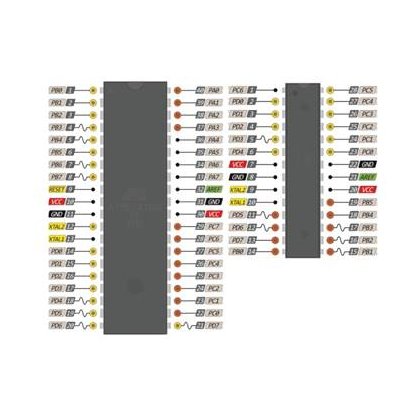
2. Pinout, Package, and Configuration
2.1 Pin Configuration Guide
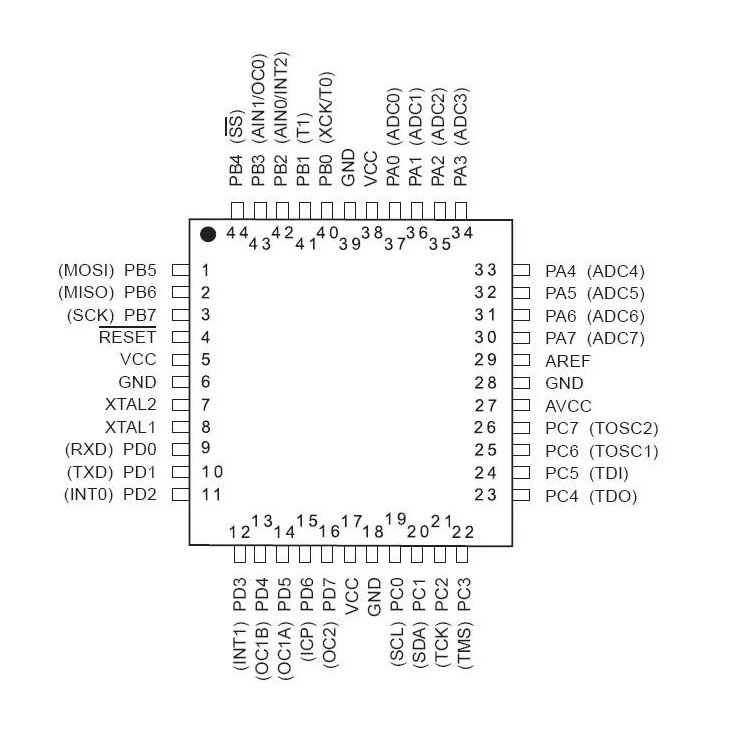
When integrating the part into your CAD software, verifying the schematic symbol against the physical pinout is critical. The 32 I/O pins are grouped into four 8-bit ports (Port A, B, C, and D). - VCC / GND: Main power and ground pins; require immediate decoupling. - AVCC: Power pin for the A/D Converter. Must be externally connected to VCC even if the ADC is not used. - AREF: Analog reference pin for the ADC. - Port Pins (PA, PB, PC, PD): Serve as bidirectional I/O, but also host alternate functions like SPI, USART, I2C (TWI), and hardware PWM outputs.
2.2 Naming Convention & Ordering Codes
Understanding the Part Numbers:Procurement managers must pay attention to the suffixes when ordering: - ATmega: The core 8-bit family. - 324: '32' denotes 32KB of Flash memory; '4' indicates the specific family variant/pinout generation. - P: Stands for "PicoPower," indicating advanced low-power process technology. - Suffixes (e.g., -PU, -AU, -MU): Indicate the package type (PDIP, TQFP, QFN) and RoHS compliance.
2.3 Available Packages
| Package Type | Dimensions | Common Use Case |
|---|---|---|
| 40-pin PDIP | ~52.5 x 13.9 mm | Prototyping, hand-soldering, and legacy through-hole boards. |
| 44-pin TQFP | 10 x 10 mm | Standard surface-mount production; good balance of size and manufacturability. |
| 44-pad VQFN/MLF | 7 x 7 mm | Space-constrained applications; requires machine assembly/reflow. |
3. Design & Integration Guide (For Engineers & Makers)
Pro Tip: Always verify pin compatibility before migrating from older series. While many AVR chips are pin-compatible, alternate functions (like secondary UARTs or specific timer outputs) may shift.
3.1 Hardware Implementation
Bypass Capacitors: A 100nF (0.1µF) ceramic capacitor must be placed as close as possible to the VCC/GND and AVCC/GND pins to filter high-frequency noise.
PCB Layout: For the ADC to achieve full 10-bit accuracy, keep analog traces short and route them away from high-speed digital switching lines. Use a dedicated analog ground plane if possible.
Thermal Management: Given the low power dissipation of the CMOS process, a dedicated heatsink is generally not required within the specified -40°C to 85°C range.
3.2 Common Design Challenges
Issue: Erratic PWM / Interrupt Conflicts Cause: Timer/Counter ISRs (Interrupt Service Routines) can cause missed interrupts or erratic PWM duty cycles if global interrupts are disabled for too long by other routines. Fix: Use hardware PWM pins (OCR1A/B) instead of software toggling. Keep ISR execution times strictly minimal.
Issue: External AREF Configuration Issues Cause: The ADC can read max values (0x3FF) or suffer internal damage if external AREF is improperly configured or tied directly to AVCC in hardware while internal references are selected in software. Fix: Connect a 100nF capacitor to AREF. Select the correct reference via the ADMUX register without ever tying AVCC directly to the AREF pin.
Issue: Poor Floating-Point Performance Cause: Floating-point math consumes excessive CPU cycles and memory on an 8-bit architecture. Fix: Scale equations to use integers or fixed-point math to drastically optimize execution speed and memory usage.
4. Typical Applications & Use Cases
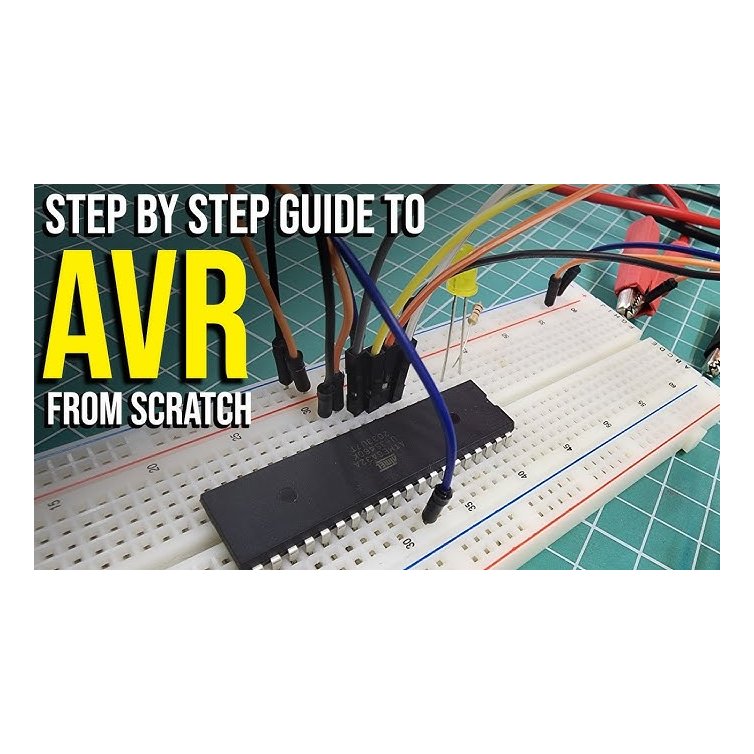
Watch Tutorial: ATMEGA324P
4.1 Real-World Example: Industrial Vending Machine Controller
In an industrial vending machine, the ATmega324P acts as the central state machine. The Motor control systems are driven by the hardware PWM outputs, ensuring precise dispensing mechanisms. The Analog signal measuring capabilities utilize the 10-bit ADC with differential gain to read load cells or coin validators accurately. Furthermore, the robust 1.8V-5.5V tolerance ensures the MCU remains stable even when high-current motors cause slight voltage dips on the shared power rail.
5. Alternatives and Cross-Reference Guide
When evaluating price vs performance or navigating supply chain shortages, consider these direct and functional equivalents. For custom designs, checking the Arduino/STM32 interface compatibility can dictate whether you stay within the AVR ecosystem or migrate to ARM Cortex architectures.
Microchip ATmega328P: The most ubiquitous alternative. It has the same 32KB Flash but fewer I/O pins (28-pin vs 40/44-pin). Excellent for cost reduction if fewer peripherals are needed.
Microchip ATmega644P: A direct drop-in equivalent (pin-compatible in most packages) that doubles the Flash memory to 64KB for code-heavy projects.
Texas Instruments MSP430G2553: A strong competitor if extreme ultra-low power is the absolute priority over 5V logic compatibility.
STMicroelectronics STM8S208: A robust 8-bit alternative offering competitive pricing for high-volume automotive and industrial applications.
Microchip PIC16F18877: A similarly spec'd 8-bit MCU from the PIC architecture side, featuring Core Independent Peripherals (CIPs) which may offload CPU tasks better than standard AVRs.
6. Frequently Asked Questions (FAQ)
Q: What is the difference between AVR ATmega and the ATtiny series? A: The ATmega series is designed for more complex applications requiring more memory (up to 256KB), higher pin counts, and advanced peripherals, whereas ATtiny is optimized for highly space-constrained, low-cost, simple logic replacement.
Q: Can AVR ATmega be used in motor control applications? A: Yes, it is highly suitable for motor control. It features multiple Timer/Counters with dedicated hardware PWM outputs, allowing for smooth DC and stepper motor control without burdening the CPU.
Q: Where can I find the datasheet and library files for AVR ATmega? A: Official datasheets, application notes, and CAD models are available directly on the Microchip Technology website or through major electronic component distributors.
Q: Is AVR ATmega suitable for battery-operated devices? A: Absolutely. With an operating voltage down to 1.8V and six software-selectable sleep modes (including PicoPower technology on 'P' variants), it is highly optimized for battery lifecycle extension.
Q: How do I program/configure the AVR ATmega? A: It can be programmed via its JTAG interface or SPI-based In-System Programming (ISP) using tools like the Atmel-ICE, Microchip Studio, or via a pre-flashed UART bootloader.
7. Resources
Development Tools & Software:
Microchip Studio (formerly Atmel Studio) IDE
MPLAB X IDE
AVR-GCC Compiler
AVRDUDE (Command-line programming tool)
Specifications
Parts with Similar Specs
- ImagePart NumberManufacturerPackage / CaseNumber of PinsData Bus WidthNumber of I/OInterfaceMemory TypeMemory SizeSupply VoltageView Compare
![ATMEGA324PV-10MUR]()
ATMEGA324PV-10MUR
44-VFQFN Exposed Pad
44
8 b
32
I2C, SPI, UART, USART
FLASH, OTP
7 kB
5 V
![ATMEGA164A-MCH]()
44-VQFN Dual Rows, Exposed Pad
44
8 b
32
I2C, SPI, UART, USART
-
16 kB
-
![ATMEGA1284-MUR]()
44-VFQFN Exposed Pad
44
8 b
32
I2C, SPI, UART, USART
-
128 kB
-
![ATMEGA32L-8MU]()
44-VFQFN Exposed Pad
44
8 b
32
2-Wire, I2C, SPI, UART, USART
EEPROM, FLASH
32 kB
3 V


Datasheet PDF
- Datasheets :
- PCN Design/Specification :
- PCN Other :
- PCN Packaging :
- ConflictMineralStatement :
 A Comprehensive Guide to LTC6820HMS#3ZZTRPBF Isolated Communications Interface
06 March 2024540
 CSD18543Q3A Power MOSFET: Features, Pinout, and Datasheet
18 April 20222084
 DS3232 RTC: Pinout, Datasheet and DS3232 vs. DS3231
28 March 20245229
 ISO124 Isolation Amplifiers:Pinout, Price and Datasheet PDF
28 June 20216418
 NXP MPC5xxx (SPC5 Equivalent) 32-bit Automotive MCUs: Performance, Safety, and Datasheet Review
03 March 2026187
 ATMEGA328P-PU Microcontroller: Features, Pinout, and Datasheet
23 September 202323819
 TPS54302DDCR: Synchronous Buck Converter, Pinout
25 February 20225233
 ATTINY1616 IC MCU 8BIT 16KB FLASH 20VQFN:Pinout, Block Diagram, and Datasheet
26 April 20225435
 Silicon Carbide (SiC): The Third-generation Semiconductor Material
30 August 20219332
 Various Reasons for the Failure, Explosion and Burning of Tantalum Capacitors
02 June 202210494
 Nickel-Cadmium Battery: Construction, Features and Working Principle
19 March 202631463
 Constructing Hybrid Photovoltaics from Amorphous Silicon and Hybrid Semiconductor Nanocrystals
24 October 20221560
 Domestic Induction Solution using SSR-Based Power Semiconductor Devices
11 September 20233760
 What Are Buck-Boost Converters?
07 June 2025808
 What is a Projector?
14 October 202115245
 Will MicroLED replace LCD and OLED?
31 August 20213288
Microchip Technology
In Stock: 39
United States
China
Canada
Japan
Russia
Germany
United Kingdom
Singapore
Italy
Hong Kong(China)
Taiwan(China)
France
Korea
Mexico
Netherlands
Malaysia
Austria
Spain
Switzerland
Poland
Thailand
Vietnam
India
United Arab Emirates
Afghanistan
Åland Islands
Albania
Algeria
American Samoa
Andorra
Angola
Anguilla
Antigua & Barbuda
Argentina
Armenia
Aruba
Australia
Azerbaijan
Bahamas
Bahrain
Bangladesh
Barbados
Belarus
Belgium
Belize
Benin
Bermuda
Bhutan
Bolivia
Bonaire, Sint Eustatius and Saba
Bosnia & Herzegovina
Botswana
Brazil
British Indian Ocean Territory
British Virgin Islands
Brunei
Bulgaria
Burkina Faso
Burundi
Cabo Verde
Cambodia
Cameroon
Cayman Islands
Central African Republic
Chad
Chile
Christmas Island
Cocos (Keeling) Islands
Colombia
Comoros
Congo
Congo (DRC)
Cook Islands
Costa Rica
Côte d’Ivoire
Croatia
Cuba
Curaçao
Cyprus
Czechia
Denmark
Djibouti
Dominica
Dominican Republic
Ecuador
Egypt
El Salvador
Equatorial Guinea
Eritrea
Estonia
Eswatini
Ethiopia
Falkland Islands
Faroe Islands
Fiji
Finland
French Guiana
French Polynesia
Gabon
Gambia
Georgia
Ghana
Gibraltar
Greece
Greenland
Grenada
Guadeloupe
Guam
Guatemala
Guernsey
Guinea
Guinea-Bissau
Guyana
Haiti
Honduras
Hungary
Iceland
Indonesia
Iran
Iraq
Ireland
Isle of Man
Israel
Jamaica
Jersey
Jordan
Kazakhstan
Kenya
Kiribati
Kosovo
Kuwait
Kyrgyzstan
Laos
Latvia
Lebanon
Lesotho
Liberia
Libya
Liechtenstein
Lithuania
Luxembourg
Macao(China)
Madagascar
Malawi
Maldives
Mali
Malta
Marshall Islands
Martinique
Mauritania
Mauritius
Mayotte
Micronesia
Moldova
Monaco
Mongolia
Montenegro
Montserrat
Morocco
Mozambique
Myanmar
Namibia
Nauru
Nepal
New Caledonia
New Zealand
Nicaragua
Niger
Nigeria
Niue
Norfolk Island
North Korea
North Macedonia
Northern Mariana Islands
Norway
Oman
Pakistan
Palau
Palestinian Authority
Panama
Papua New Guinea
Paraguay
Peru
Philippines
Pitcairn Islands
Portugal
Puerto Rico
Qatar
Réunion
Romania
Rwanda
Samoa
San Marino
São Tomé & Príncipe
Saudi Arabia
Senegal
Serbia
Seychelles
Sierra Leone
Sint Maarten
Slovakia
Slovenia
Solomon Islands
Somalia
South Africa
South Sudan
Sri Lanka
St Helena, Ascension, Tristan da Cunha
St. Barthélemy
St. Kitts & Nevis
St. Lucia
St. Martin
St. Pierre & Miquelon
St. Vincent & Grenadines
Sudan
Suriname
Svalbard & Jan Mayen
Sweden
Syria
Tajikistan
Tanzania
Timor-Leste
Togo
Tokelau
Tonga
Trinidad & Tobago
Tunisia
Turkey
Turkmenistan
Turks & Caicos Islands
Tuvalu
U.S. Outlying Islands
U.S. Virgin Islands
Uganda
Ukraine
Uruguay
Uzbekistan
Vanuatu
Vatican City
Venezuela
Wallis & Futuna
Yemen
Zambia
Zimbabwe
![ATMEGA8515L-8AU]() ATMEGA8515L-8AU
ATMEGA8515L-8AUMicrochip Technology
![DSPIC30F6014A-30I/PF]() DSPIC30F6014A-30I/PF
DSPIC30F6014A-30I/PFMicrochip Technology
![ATMEGA32A-AU]() ATMEGA32A-AU
ATMEGA32A-AUMicrochip Technology
![ATXMEGA128A1U-AU]() ATXMEGA128A1U-AU
ATXMEGA128A1U-AUMicrochip Technology
![PIC18F46K20-I/PT]() PIC18F46K20-I/PT
PIC18F46K20-I/PTMicrochip Technology
![PIC18F6722-I/PT]() PIC18F6722-I/PT
PIC18F6722-I/PTMicrochip Technology
![PIC16F883-I/SS]() PIC16F883-I/SS
PIC16F883-I/SSMicrochip Technology
![PIC16F877-20I/PT]() PIC16F877-20I/PT
PIC16F877-20I/PTMicrochip Technology
![ATMEGA8535L-8AU]() ATMEGA8535L-8AU
ATMEGA8535L-8AUMicrochip Technology
![PIC18F4685-I/PT]() PIC18F4685-I/PT
PIC18F4685-I/PTMicrochip Technology


