

 Product
 Brand
Brand Articles
 Tools
Tools
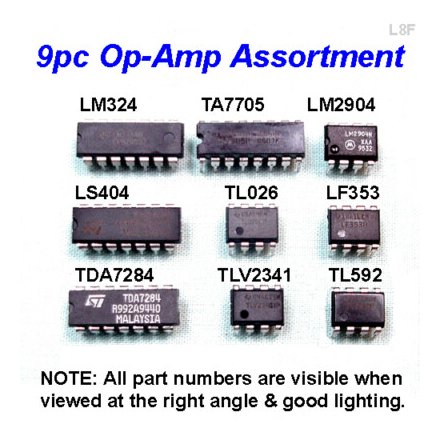
LS404 2.5MHz Quad Op-Amp: Datasheet, Pinout, and Audio Performance Analysis

2 Channels 23mA per Channel 50nA 90 dB Instrumentational OP Amps LS404 14-DIP (0.300, 7.62mm)


2 Channels 23mA per Channel 50nA 90 dB Instrumentational OP Amps LS404 14-DIP (0.300, 7.62mm)
Discover the STMicroelectronics LS404 quad operational amplifier. Explore 2.5MHz GBP specs, pinouts, and equivalents for audio design. Buy or sample today.
- Executive Summary: What is the LS404?
- 1. Technical Specifications & Performance Analysis
- 2. Pinout, Package, and Configuration
- 3. Design & Integration Guide (For Engineers & Makers)
- 4. Typical Applications & Use Cases
- 5. Alternatives and Cross-Reference Guide
- 6. Frequently Asked Questions (FAQ)
- 7. Resources
- Specifications
- Datasheet PDF
Executive Summary: What is the LS404?
The LS404 is a high-performance quad operational amplifier designed by STMicroelectronics for professional audio systems, telecommunications, and active filter applications. Featuring internal frequency and phase compensation, it maintains stable operation even when configured as a voltage follower, making it a highly reliable choice for complex analog signal chains.
Market Position: A proven, high-performance analog workhorse offering an excellent balance of low noise and wide bandwidth compared to general-purpose legacy chips.
Top Features: High gain-bandwidth product (2.5 MHz), ultra-low input voltage noise density (20 nV/√Hz), and wide operating supply voltage (6V to 30V).
Primary Audience: Ideal for analog design engineers, professional audio equipment developers, and advanced hobbyists needing high channel separation.
Supply Status: Active standard component, readily available for BOM inclusion and volume manufacturing.
1. Technical Specifications & Performance Analysis
1.1 Core Architecture (CPU/Logic/Power)
At its core, the LS404 houses four independent, high-gain operational amplifiers within a single monolithic silicon chip. The architecture is specifically optimized for low distortion and high channel separation, preventing crosstalk between the four internal amplifiers. Its internal frequency and phase compensation eliminate the need for external compensation networks, reducing BOM cost and saving valuable PCB real estate.
1.2 Key Electrical Characteristics
When evaluating the LS404 datasheet for power and signal integrity, the following specifications dictate its performance envelope:
Operating Supply Voltage: 6V to 30V for single-supply setups, or ±3V to ±15V for dual/split-supply configurations.
Operating Supply Current: 3 mA (typical total for all four amplifiers), ensuring relatively low power consumption for a high-performance part.
Gain Bandwidth Product (GBP): 2.5 MHz, providing ample bandwidth for high-fidelity audio and fast-response industrial sensors.
Slew Rate: 1 V/µs, allowing the amplifier to track rapid changes in the input signal without introducing severe transient intermodulation distortion.
Input Voltage Noise Density: 20 nV/√Hz, critical for pre-amplifier stages where signal-to-noise ratio (SNR) is paramount.
Common Mode Rejection Ratio (CMRR): 86 dB, offering excellent rejection of common-mode noise, especially in long cable runs or noisy industrial environments.
1.3 Interfaces and Connectivity
As an analog component, the LS404 does not feature digital buses (like SPI or I2C). Instead, it interfaces directly with analog sensors, audio transducers, and mixed-signal ADCs/DACs. Its short-circuit protection ensures that the analog outputs can survive accidental grounding or miswiring during prototyping or field deployment.
2. Pinout, Package, and Configuration
2.1 Pin Configuration Guide
The LS404 follows the industry-standard 14-pin configuration for quad operational amplifiers. Always verify the schematic symbol against the specific datasheet, but the general mapping is:
* Power Pins: VCC+ (Positive Supply) and VCC- (Negative Supply/Ground).
* Channel 1-4 Inputs: Inverting (-) and Non-Inverting (+) inputs for each of the four op-amps.
* Channel 1-4 Outputs: Independent outputs for each amplifier stage.
2.2 Naming Convention & Ordering Codes
Understanding the Part Numbers:Procurement managers must pay attention to the suffix when ordering the LS404 to ensure manufacturing compatibility:
* LS404IN / LS404N: Typically denotes a plastic DIP (Dual In-line Package).
* LS404CD / LS404D: Typically denotes an SOIC (Small Outline Integrated Circuit) surface-mount package.
* Tape and Reel vs. Tube: Additions like "TR" at the end of the part number indicate Tape & Reel packaging for automated pick-and-place machines.
2.3 Available Packages
| Package Type | Dimensions | Common Use Case |
|---|---|---|
| DIP-14 | ~19.05 x 6.35 mm | Breadboarding, hand-soldering, legacy equipment repair. |
| SO-14 (SOIC) | ~8.65 x 3.90 mm | High-density PCBs, automated machine assembly. |
3. Design & Integration Guide (For Engineers & Makers)
Pro Tip: Always verify pin compatibility and supply voltage limits before migrating from older series like the LM324 to the LS404.
3.1 Hardware Implementation
Bypass Capacitors: To ensure stability, place 0.1µF ceramic capacitors as physically close to the VCC+ and VCC- pins as possible.
PCB Layout: Keep input traces short to minimize parasitic capacitance. Use a solid ground plane to maximize the 86 dB CMRR and maintain high channel separation.
Thermal Management: With a 3 mA supply current, the LS404 dissipates very little heat. A heatsink is not required under normal operating conditions.
3.2 Common Design Challenges
Issue: Clipping in Low-Voltage Designs (Not Rail-to-Rail)
Why it happens: The input and output voltages cannot swing fully to the supply rails, limiting dynamic range.
Fix: Ensure sufficient supply voltage headroom (e.g., use a ±12V supply for a ±10V signal). If operating strictly from a 3.3V or 5V source, substitute with a modern rail-to-rail op-amp.
Issue: High-Frequency Oscillation
Why it happens: The 2.5 MHz high-bandwidth nature of the chip makes it susceptible to ringing if power is noisy.
Fix: Implement strict power supply decoupling using the aforementioned 0.1µF bypass capacitors.
Issue: Crossover Distortion on Heavy Loads
Why it happens: Limited output drive current means it may struggle with low-impedance circuits.
Fix: Add a discrete transistor buffer stage (like a push-pull emitter follower) inside the feedback loop to boost output drive capability.
4. Typical Applications & Use Cases
4.1 Real-World Example: Professional Audio Active Crossover
In a professional audio system, the LS404 is frequently used to design active crossover networks. Because it contains four amplifiers, a single LS404 can handle a 2-way stereo crossover (two high-pass filters and two low-pass filters).
The 20 nV/√Hz low noise density ensures that no audible hiss is introduced into the signal chain, while the 2.5 MHz GBP guarantees that high-frequency audio transients (like cymbal crashes) are reproduced with perfect fidelity and zero phase-lag distortion.
5. Alternatives and Cross-Reference Guide
If the LS404 is out of stock, or if you are evaluating price vs performance for your BOM, consider these equivalent quad op-amps:
Texas Instruments TL074: A direct competitor featuring JFET inputs. Excellent for audio applications due to ultra-low input bias current and low noise. Pin-compatible in most scenarios.
Texas Instruments LM324: The ultimate cost-effective option. It is significantly cheaper but has a much lower GBP (~1.2 MHz) and higher distortion. Best for low-frequency industrial automation, not pro audio.
ON Semiconductor MC33274: A strong alternative offering high performance and single-supply operation, often used in similar telecom and medical device applications.
Fairchild RC4156: A legacy equivalent quad op-amp that matches well with the LS404's performance profile in older schematic designs.
6. Frequently Asked Questions (FAQ)
Q: What is the difference between the LS404 and the LM324? A: The LS404 is a higher-performance amplifier with a wider bandwidth (2.5 MHz vs 1.2 MHz) and significantly lower noise and distortion, making it better suited for audio. The LM324 is more cost-effective and optimized for low-power, single-supply general-purpose tasks.
Q: Can the LS404 be used in battery-operated devices? A: Yes, it can operate on a single supply as low as 6V. However, its 3 mA current consumption and lack of rail-to-rail output make it less ideal for ultra-low-power 3.3V IoT devices.
Q: How do I configure the LS404 as a voltage follower? A: Simply connect the inverting input (-) directly to the output pin, and apply your signal to the non-inverting input (+). The LS404 is internally compensated to remain perfectly stable in this configuration.
Q: Where can I find the datasheet and CAD library files for the LS404? A: Datasheets, SPICE models, and schematic symbols/footprints can be downloaded directly from the STMicroelectronics website or major electronics distributors like Digi-Key and Mouser.
7. Resources
Development Tools & Software: SPICE simulation software (like LTspice or TINA-TI) is highly recommended for simulating active filter circuits and verifying phase margins before laying out the PCB for the LS404.
Manufacturer Documentation: Always refer to the latest STMicroelectronics LS404 datasheet for exact thermal resistance values and maximum absolute ratings.
Specifications
Datasheet PDF
- Datasheets :
 STR750Fxx, STR751Fxx, STR752Fxx, STR755Fxx Microcontrollers: Technical Overview and Specifications
29 February 2024199
 Samsung CL21A106KOQNNNE Capacitor Review: 10µF Performance & Reliability Guide
25 September 2025576
 Eliminating Rectifier Heat: LT4320 / LT4320-1 9V-72V Ideal Diode Bridge Controller Deep Dive
25 February 2026861
 MMBTA42 NPN High-Voltage Transistor: NPN, SOT-23, Datasheet
07 February 20222374
 ATTINY85-20SU Microcontroller: Circuit, Pinout, and Datasheet
21 February 20225914
 SN74AXC8T245RJWR Bus Transceiver: Schematic, Pinout, and Datasheet
06 April 20222897
![NRF52840 Bluetooth® 5 Evaluation Board[Video]: Datasheet, Nrf52832 VS Nrf52840, and Applications](https://res.utmel.com/Images/Article/757c2021-e56c-4128-913a-833e360d8a27.png) NRF52840 Bluetooth® 5 Evaluation Board[Video]: Datasheet, Nrf52832 VS Nrf52840, and Applications
NRF52840 Bluetooth® 5 Evaluation Board[Video]: Datasheet, Nrf52832 VS Nrf52840, and Applications08 April 20226495
 DAC081S101CIMKXNOPB:DAC, Piniout, Full-Featured
16 February 2022324
 Yahoo Discontinues Services in Mainland China
13 November 20232867
 What is a Great Choice for Digital Isolators to Build Isolation Barriers?
31 March 20225569
 Methods for measuring the temperature of semiconductor devices
14 November 20222620
 Operational Amplifier Basics: Working Principle and Amplifier Circuit
21 March 202521512
 Leading Fiber Optic Connectors Every Installer Should Know
17 July 20253316
 Introduction to Sensors in the Internet of Things
24 September 20212647
 LDO VS DC to DC Converter
11 March 202212206
 What are the Differences in the Copying Methods of Double-Sided and Multi-Layer PCBs?
18 July 20224731
STMicroelectronics
In Stock
United States
China
Canada
Japan
Russia
Germany
United Kingdom
Singapore
Italy
Hong Kong(China)
Taiwan(China)
France
Korea
Mexico
Netherlands
Malaysia
Austria
Spain
Switzerland
Poland
Thailand
Vietnam
India
United Arab Emirates
Afghanistan
Åland Islands
Albania
Algeria
American Samoa
Andorra
Angola
Anguilla
Antigua & Barbuda
Argentina
Armenia
Aruba
Australia
Azerbaijan
Bahamas
Bahrain
Bangladesh
Barbados
Belarus
Belgium
Belize
Benin
Bermuda
Bhutan
Bolivia
Bonaire, Sint Eustatius and Saba
Bosnia & Herzegovina
Botswana
Brazil
British Indian Ocean Territory
British Virgin Islands
Brunei
Bulgaria
Burkina Faso
Burundi
Cabo Verde
Cambodia
Cameroon
Cayman Islands
Central African Republic
Chad
Chile
Christmas Island
Cocos (Keeling) Islands
Colombia
Comoros
Congo
Congo (DRC)
Cook Islands
Costa Rica
Côte d’Ivoire
Croatia
Cuba
Curaçao
Cyprus
Czechia
Denmark
Djibouti
Dominica
Dominican Republic
Ecuador
Egypt
El Salvador
Equatorial Guinea
Eritrea
Estonia
Eswatini
Ethiopia
Falkland Islands
Faroe Islands
Fiji
Finland
French Guiana
French Polynesia
Gabon
Gambia
Georgia
Ghana
Gibraltar
Greece
Greenland
Grenada
Guadeloupe
Guam
Guatemala
Guernsey
Guinea
Guinea-Bissau
Guyana
Haiti
Honduras
Hungary
Iceland
Indonesia
Iran
Iraq
Ireland
Isle of Man
Israel
Jamaica
Jersey
Jordan
Kazakhstan
Kenya
Kiribati
Kosovo
Kuwait
Kyrgyzstan
Laos
Latvia
Lebanon
Lesotho
Liberia
Libya
Liechtenstein
Lithuania
Luxembourg
Macao(China)
Madagascar
Malawi
Maldives
Mali
Malta
Marshall Islands
Martinique
Mauritania
Mauritius
Mayotte
Micronesia
Moldova
Monaco
Mongolia
Montenegro
Montserrat
Morocco
Mozambique
Myanmar
Namibia
Nauru
Nepal
New Caledonia
New Zealand
Nicaragua
Niger
Nigeria
Niue
Norfolk Island
North Korea
North Macedonia
Northern Mariana Islands
Norway
Oman
Pakistan
Palau
Palestinian Authority
Panama
Papua New Guinea
Paraguay
Peru
Philippines
Pitcairn Islands
Portugal
Puerto Rico
Qatar
Réunion
Romania
Rwanda
Samoa
San Marino
São Tomé & Príncipe
Saudi Arabia
Senegal
Serbia
Seychelles
Sierra Leone
Sint Maarten
Slovakia
Slovenia
Solomon Islands
Somalia
South Africa
South Sudan
Sri Lanka
St Helena, Ascension, Tristan da Cunha
St. Barthélemy
St. Kitts & Nevis
St. Lucia
St. Martin
St. Pierre & Miquelon
St. Vincent & Grenadines
Sudan
Suriname
Svalbard & Jan Mayen
Sweden
Syria
Tajikistan
Tanzania
Timor-Leste
Togo
Tokelau
Tonga
Trinidad & Tobago
Tunisia
Turkey
Turkmenistan
Turks & Caicos Islands
Tuvalu
U.S. Outlying Islands
U.S. Virgin Islands
Uganda
Ukraine
Uruguay
Uzbekistan
Vanuatu
Vatican City
Venezuela
Wallis & Futuna
Yemen
Zambia
Zimbabwe


