

 Product
 Brand
Brand Articles
 Tools
Tools
Buying the AD9958? Read This First — Specs, SPI Traps, and Better Alternatives

56 Termination 0.5mm 1.83.3V Tin Direct Digital Synthesis AD9958 56 Pin 500MHz 1.8V 56-VFQFN Exposed Pad, CSP


56 Termination 0.5mm 1.83.3V Tin Direct Digital Synthesis AD9958 56 Pin 500MHz 1.8V 56-VFQFN Exposed Pad, CSP
The AD9958 delivers dual 500 MSPS synchronized DDS channels with unmatched phase control. It beats using two AD9952s, but beware of specific SPI register traps.
- Quick Verdict: Should You Use the AD9958?
- 1. What Is the AD9958? (30-Second Overview)
- 2. Head-to-Head: AD9958 vs. The Competition
- 3. Under the Hood: Pinout and Design Considerations
- 4. Real-World Performance: Where It Shines (and Where It Struggles)
- 5. Pricing, Availability, and Total Cost of Ownership
- 6. The Decision Matrix: Which Part Should You Actually Buy?
- 7. Frequently Asked Questions
- 8. Final Recommendation
- Specifications
- Parts with Similar Specs
- Datasheet PDF
Quick Verdict: Should You Use the AD9958?
For RF engineers building quadrature communications, phased arrays, or AOTF drivers, achieving perfect channel-to-channel synchronization is notoriously difficult. The Analog Devices AD9958 solves this elegantly by putting two 500 MSPS Direct Digital Synthesis (DDS) channels on a single die with a shared system clock.
Our Verdict: The AD9958 is the best choice for dual-channel RF synthesis where phase and frequency synchronization are critical. Skip it if your application requires more than two channels (upgrade to the AD9959) or if you need output frequencies pushing well beyond 200 MHz (look at the 1 GSPS AD9858). — Rating: 4.6 / 5
✅ Best For:- Agile local oscillators and quadrature communications. - Phased array radars and sonars requiring precise phase offsets. - RF sources for Acousto-Optic Tunable Filters (AOTF).
❌ Not Ideal For:- Massive MIMO or 4+ channel arrays (footprint and routing become inefficient vs. AD9959). - Ultra-high-frequency generation where a 500 MSPS sample rate limits the Nyquist output.
1. What Is the AD9958? (30-Second Overview)
The AD9958 is a high-performance, dual-channel Direct Digital Synthesizer (DDS) capable of operating at up to 500 Mega-Samples Per Second (MSPS). In the procurement landscape, it sits in the premium, specialized RF component tier. It is considered a workhorse for applications where you previously had to painstakingly synchronize two separate single-channel DDS chips—a process prone to thermal drift and layout mismatches.
1.1 The Specs That Actually Differentiate It
Here is how the AD9958 stacks up against typical category expectations and its single-channel siblings.
| Specification | AD9958 | Category Average / AD9952 | Advantage? |
|---|---|---|---|
| Channels | 2 (Synchronized) | 1 | Massive. Eliminates external sync circuitry and PCB trace matching headaches. |
| Sample Rate | 500 MSPS | 400 MSPS (AD9952) | Moderate. 25% higher sample rate pushes the usable Nyquist zone higher. |
| DAC Resolution | 10-bit | 14-bit (AD9952) | Compromise. Lower vertical resolution to fit dual DACs in the thermal/power envelope. |
| Tuning Resolution | 32-bit | 32-bit | Parity. Yields ~0.12 Hz resolution at 500 MSPS. |
| Channel Isolation | >72 dB | N/A (Single channel) | Strong. Excellent crosstalk rejection for a single-die dual-channel IC. |
1.2 What the Datasheet Doesn't Tell You
Based on available data and engineer reports, the AD9958 has a few real-world quirks that won't be obvious from page one of the datasheet:
The Register 3 Trap: Engineers frequently report being unable to write to registers 0x3 through 0xF. In practice, the AD9958 only allows single-channel operations for these registers. You must ensure only one channel bit is enabled at a time during SPI writes, or the chip will stubbornly hold its default values.
High-Frequency Degradation: While the datasheet promises excellent performance, users note signal degradation and amplitude drop-offs above 5 MHz if the power supplies aren't perfectly isolated.
Sweep Accumulator Halts: When using linear phase sweeps, the accumulator stops when the sweep completes. Changing the start point (S0) doesn't automatically reset it, which can introduce unexpected phase steps if not managed in firmware.
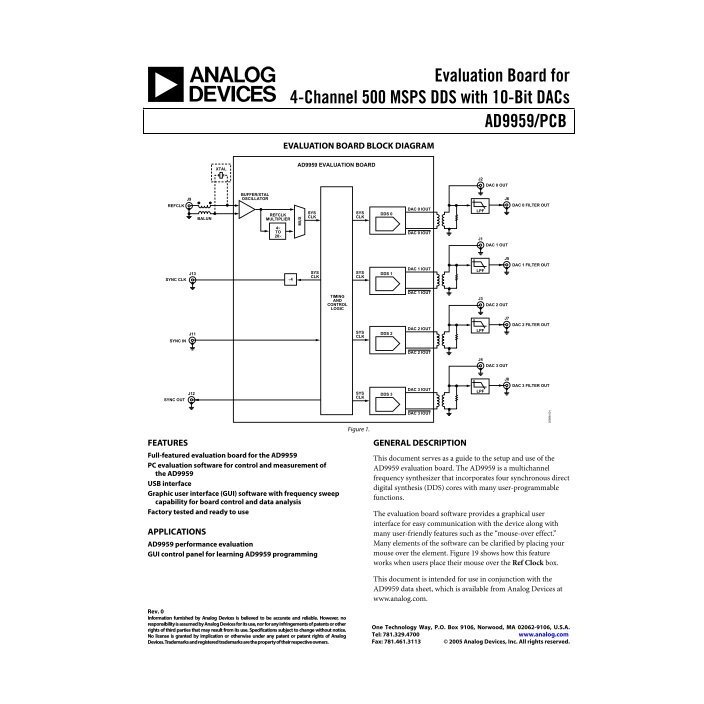
2. Head-to-Head: AD9958 vs. The Competition
When sourcing a DDS, the decision usually comes down to channel count and sample rate. Here is how the AD9958 compares to its closest alternatives.
2.1 vs. Analog Devices AD9959 (The 4-Channel Sibling)
The AD9959 is essentially the exact same silicon architecture, but scaled to four channels instead of two.
| Feature | AD9958 | AD9959 | Winner |
|---|---|---|---|
| Channels | 2 | 4 | AD9959 |
| Sample Rate | 500 MSPS | 500 MSPS | Tie |
| Power Consumption | ~1.5W (Typical) | ~2.0W (Typical) | AD9958 |
| Unit Cost | High | Premium (~30% more) | AD9958 |
Summary: If you need three or four synchronized channels, the AD9959 is the undisputed winner and justifies the price hike. However, if you only need two channels (e.g., standard I/Q quadrature), the AD9958 saves BOM cost and reduces thermal dissipation requirements.
2.2 vs. Analog Devices AD9858 (The Speed King)
The AD9858 is an older but incredibly fast single-channel DDS.
| Feature | AD9958 | AD9858 | Winner |
|---|---|---|---|
| Sample Rate | 500 MSPS | 1 GSPS | AD9858 |
| Channels | 2 | 1 | AD9958 |
| Integration | Dual DACs, Phase control | Includes analog mixer & PFD | Tie (Application dependent) |
| Max Usable Output | ~200 MHz | ~400 MHz | AD9858 |
Summary: For raw frequency output, the AD9858 wins easily. But for phased arrays or synchronized dual-tone generation, buying two AD9858s and trying to sync them is a nightmare compared to the plug-and-play synchronization of the AD9958.
2.3 The One Scenario Each Wins
AD9958 Wins: Standard Quadrature (I/Q) signal generation where perfect phase alignment between two signals is non-negotiable.
AD9959 Wins: Complex phased-array radar systems where maximizing channel density per square inch of PCB is the primary goal.
AD9858 Wins: Fast frequency hopping for single-channel agile local oscillators pushing into the 300-400 MHz range.
3. Under the Hood: Pinout and Design Considerations
From a procurement and layout perspective, the AD9958 requires careful attention to power and control routing.
3.1 Pinout Overview
1.8V Core / 3.3V I/O: The split supply is mandatory. The 1.8V core handles the high-speed digital logic, while the 3.3V handles the SPI and control interfaces.
SYNC_CLK: This pin is critical. If you have "no output" or SPI communication failures, verify the SYNC_CLK is actually running.
3.2 Design Gotchas — What to Watch Out For
Based on common pain points, here is what your design team needs to account for:
Avoid Shared Power Rails: Do not use a single combined power supply for the 1.8V and 3.3V domains using basic voltage dividers or noisy buck converters. Use individual, dedicated ultra-low-noise LDOs. Failure to do so will severely degrade signal quality above 5 MHz.
Cold Solder Joints on the Thermal Pad: The chip dissipates significant heat. A poorly soldered exposed pad will lead to thermal throttling or erratic SPI behavior.
Single-Channel SPI Writes: As mentioned earlier, enforce single-channel bit enabling in firmware when addressing registers 0x3 and above.
Pro Tip: If your prototype is completely dead on arrival despite clean power, check the SPI transition from
FR1toCFTW0. A missed bit transition here is the #1 reason engineers report "no output signal."
4. Real-World Performance: Where It Shines (and Where It Struggles)
Watch Tutorial: AD9958
4.1 Performance in Quadrature Communications
In our assessment, the AD9958 excels in generating Single-Sideband (SSB) suppressed carriers and quadrature signals. Because the two channels share the same system clock, the phase offset resolution (14-bit) allows for incredibly precise tuning—down to 0.022 degrees of phase shift. This level of intrinsic synchronization is nearly impossible to achieve with discrete components without expensive calibration routines.
4.2 Performance in AOTF (Acousto-Optic Tunable Filters)
When used as an RF source for AOTFs, the linear frequency sweeping capability is a massive asset. The chip can sweep frequency, phase, or amplitude with up to 16 levels of modulation (pin-selectable). However, engineers must meticulously program the start and end points for sweeps; the accumulator does not automatically count down or reset gracefully, which can cause jarring RF artifacts if ignored.
5. Pricing, Availability, and Total Cost of Ownership
Unit Price Tier: Premium. The AD9958 is an expensive, specialized piece of silicon.
BOM Impact: High. While it replaces two single-channel DDS chips, it requires a pristine clock source (usually a high-end TCXO or OCXO) and multiple ultra-low-noise LDOs (like the ADM7150) to achieve its datasheet specs.
Supply Chain Risk: Low to Moderate. Analog Devices has a strong track record of supporting RF components for decades, but specialized DDS chips are rarely multi-sourced. You are locked into the ADI ecosystem.
Hidden Costs: PCB layout complexity. Achieving >72 dB of channel isolation requires at least a 4-layer (preferably 6-layer) board with strict impedance control and ground plane management.
6. The Decision Matrix: Which Part Should You Actually Buy?
| Your Situation | Best Choice | Why |
|---|---|---|
| Need 2 perfectly synced channels for I/Q | AD9958 | Built-in sync, lowest footprint for dual-channel. |
| Need 4 channels for a phased array | AD9959 | Same architecture, double the channel density. |
| Need maximum frequency (>200 MHz output) | AD9858 | 1 GSPS sample rate pushes the Nyquist boundary higher. |
| Single channel, care more about DAC resolution | AD9952 | Offers a 14-bit DAC (vs 10-bit) for better SFDR on a single channel. |
| Ultra-high speed multi-channel (>1 GSPS) | TI DAC38J82 | Moves to JESD204B interface; requires an FPGA but offers vastly higher bandwidth. |
7. Frequently Asked Questions
Q: Is the AD9958 better than using two AD9952s? Yes, for synchronization. Syncing two AD9952s requires external hardware and careful trace length matching. The AD9958 handles this internally. However, the AD9952 has a 14-bit DAC, so it wins on raw single-channel spurious-free dynamic range (SFDR).
Q: What are the main weaknesses of the AD9958? The 10-bit DAC resolution is a compromise to fit two channels and a 500 MSPS engine into one thermal envelope. Also, the SPI register routing for channels 3+ is notoriously finicky.
Q: How do I fix the signal degradation at higher frequencies? Isolate your power supplies. Use dedicated, high-PSRR LDOs for the 1.8V and 3.3V rails, and ensure the thermal pad is properly grounded to a massive copper pour.
Q: Can the AD9958 sweep frequency and phase simultaneously? It can perform linear sweeps of frequency, phase, or amplitude, but you must carefully manage the accumulator via SPI to avoid hard stops at the end of a sweep cycle.
8. Final Recommendation
The Analog Devices AD9958 remains a top-tier choice for engineers building dual-channel, synchronized RF systems. By placing two 500 MSPS channels on a single die, it eliminates the most frustrating aspects of quadrature and phased-array design: external synchronization and thermal drift mismatches.
While it requires strict attention to power supply cleanliness and has a few SPI firmware quirks, its performance in agile local oscillators and AOTF drivers is exceptional. If you only need two channels, buy the AD9958. If you need four, scale up to the AD9959.
Development Tools & Reference Designs: We highly recommend starting with the AD9958 Evaluation Board to validate your SPI communication sequences before spinning your own custom PCB.
Specifications
Parts with Similar Specs
- ImagePart NumberManufacturerPackage / CaseNumber of PinsSupply VoltageTerminal PitchMountMounting TypeMoisture Sensitivity Level (MSL)RoHS StatusView Compare
![AD9958BCPZ-REEL7]()
AD9958BCPZ-REEL7
56-VFQFN Exposed Pad, CSP
56
1.8 V
0.5 mm
Surface Mount
Surface Mount
3 (168 Hours)
ROHS3 Compliant
![AD9959BCPZ-REEL7]()
56-VFQFN Exposed Pad, CSP
56
1.8 V
0.5 mm
Surface Mount
Surface Mount
3 (168 Hours)
ROHS3 Compliant
![AD9959BCPZ]()
56-VFQFN Exposed Pad, CSP
56
1.8 V
0.5 mm
Surface Mount
Surface Mount
3 (168 Hours)
ROHS3 Compliant
![CDCU877RHAT]()
40-VFQFN Exposed Pad
40
1.8 V
0.5 mm
Surface Mount
Surface Mount
3 (168 Hours)
ROHS3 Compliant
![AD9911BCPZ-REEL7]()
56-VFQFN Exposed Pad, CSP
56
1.8 V
0.5 mm
Surface Mount
Surface Mount
3 (168 Hours)
ROHS3 Compliant


Datasheet PDF
- Datasheets :
- Design Resources :
- ConflictMineralStatement :
 ESP32 Microcontroller: Datasheet, Pinout and Programming
08 September 202117080
 PAM8403 Audio Amplifier: Datasheet, Price and Pinout
28 July 202122989
 LM2904 Dual Op-Amp: Pinout, Features and Application
22 July 20214832
 MAN6760 Display Modules: Datasheet, Manufacturer, Application
02 November 20213745
 MCP4728 D/A Converter: Datasheet, Pinout and Applications
02 September 20214057
 LM63625 Step-down Voltage Converter: Datasheet, Price, Circuit
02 April 20225914
![GRM155R71H104KE14D Ceramic Capacitor X7R 0402 50V[FAQ]: Datasheet, Features, and Equivalents](https://res.utmel.com/Images/Article/64ebdb7d-ee95-4b46-99ce-05f0ac2cb724.jpg) GRM155R71H104KE14D Ceramic Capacitor X7R 0402 50V[FAQ]: Datasheet, Features, and Equivalents
GRM155R71H104KE14D Ceramic Capacitor X7R 0402 50V[FAQ]: Datasheet, Features, and Equivalents14 March 20221546
 SG3524N IC REG CTRLR MULT TOPOLOGY 16DIP: Datasheet, Circuit, Pinout and Equivalents
16 February 202211417
 15 Key Elements of Diode Selection
26 November 202119011
 A Guide to Selecting the Ideal Microphone for Your Audio Needs
15 May 20232193
 Three-Phase WBG Resonant Converter Integrated with PCB Winding Transformer
20 October 20232658
 Latest Advances in Occupancy Sensor Detection Methods
14 July 20251473
 Basic Guidelines for Mixed-Signal PCB Layout Design
15 March 20246971
 Methodologies for Increasing Efficiency of Fuel Stack Technology for Energy Generation
19 November 20243028
 Why Precision Matters in Analog-to-Digital Conversion
28 May 20251013
 Constructing Hybrid Photovoltaics from Amorphous Silicon and Hybrid Semiconductor Nanocrystals
24 October 20221683
Analog Devices Inc.
In Stock: 3
United States
China
Canada
Japan
Russia
Germany
United Kingdom
Singapore
Italy
Hong Kong(China)
Taiwan(China)
France
Korea
Mexico
Netherlands
Malaysia
Austria
Spain
Switzerland
Poland
Thailand
Vietnam
India
United Arab Emirates
Afghanistan
Åland Islands
Albania
Algeria
American Samoa
Andorra
Angola
Anguilla
Antigua & Barbuda
Argentina
Armenia
Aruba
Australia
Azerbaijan
Bahamas
Bahrain
Bangladesh
Barbados
Belarus
Belgium
Belize
Benin
Bermuda
Bhutan
Bolivia
Bonaire, Sint Eustatius and Saba
Bosnia & Herzegovina
Botswana
Brazil
British Indian Ocean Territory
British Virgin Islands
Brunei
Bulgaria
Burkina Faso
Burundi
Cabo Verde
Cambodia
Cameroon
Cayman Islands
Central African Republic
Chad
Chile
Christmas Island
Cocos (Keeling) Islands
Colombia
Comoros
Congo
Congo (DRC)
Cook Islands
Costa Rica
Côte d’Ivoire
Croatia
Cuba
Curaçao
Cyprus
Czechia
Denmark
Djibouti
Dominica
Dominican Republic
Ecuador
Egypt
El Salvador
Equatorial Guinea
Eritrea
Estonia
Eswatini
Ethiopia
Falkland Islands
Faroe Islands
Fiji
Finland
French Guiana
French Polynesia
Gabon
Gambia
Georgia
Ghana
Gibraltar
Greece
Greenland
Grenada
Guadeloupe
Guam
Guatemala
Guernsey
Guinea
Guinea-Bissau
Guyana
Haiti
Honduras
Hungary
Iceland
Indonesia
Iran
Iraq
Ireland
Isle of Man
Israel
Jamaica
Jersey
Jordan
Kazakhstan
Kenya
Kiribati
Kosovo
Kuwait
Kyrgyzstan
Laos
Latvia
Lebanon
Lesotho
Liberia
Libya
Liechtenstein
Lithuania
Luxembourg
Macao(China)
Madagascar
Malawi
Maldives
Mali
Malta
Marshall Islands
Martinique
Mauritania
Mauritius
Mayotte
Micronesia
Moldova
Monaco
Mongolia
Montenegro
Montserrat
Morocco
Mozambique
Myanmar
Namibia
Nauru
Nepal
New Caledonia
New Zealand
Nicaragua
Niger
Nigeria
Niue
Norfolk Island
North Korea
North Macedonia
Northern Mariana Islands
Norway
Oman
Pakistan
Palau
Palestinian Authority
Panama
Papua New Guinea
Paraguay
Peru
Philippines
Pitcairn Islands
Portugal
Puerto Rico
Qatar
Réunion
Romania
Rwanda
Samoa
San Marino
São Tomé & Príncipe
Saudi Arabia
Senegal
Serbia
Seychelles
Sierra Leone
Sint Maarten
Slovakia
Slovenia
Solomon Islands
Somalia
South Africa
South Sudan
Sri Lanka
St Helena, Ascension, Tristan da Cunha
St. Barthélemy
St. Kitts & Nevis
St. Lucia
St. Martin
St. Pierre & Miquelon
St. Vincent & Grenadines
Sudan
Suriname
Svalbard & Jan Mayen
Sweden
Syria
Tajikistan
Tanzania
Timor-Leste
Togo
Tokelau
Tonga
Trinidad & Tobago
Tunisia
Turkey
Turkmenistan
Turks & Caicos Islands
Tuvalu
U.S. Outlying Islands
U.S. Virgin Islands
Uganda
Ukraine
Uruguay
Uzbekistan
Vanuatu
Vatican City
Venezuela
Wallis & Futuna
Yemen
Zambia
Zimbabwe
![AD9834BRUZ]() AD9834BRUZ
AD9834BRUZAnalog Devices Inc.
![AD9850BRSZ]() AD9850BRSZ
AD9850BRSZAnalog Devices Inc.
![AD9832BRUZ]() AD9832BRUZ
AD9832BRUZAnalog Devices Inc.
![AD9834CRUZ]() AD9834CRUZ
AD9834CRUZAnalog Devices Inc.
![AD9833BRMZ-REEL7]() AD9833BRMZ-REEL7
AD9833BRMZ-REEL7Analog Devices Inc.
![AD9834BRUZ-REEL]() AD9834BRUZ-REEL
AD9834BRUZ-REELAnalog Devices Inc.
![AD5932YRUZ]() AD5932YRUZ
AD5932YRUZAnalog Devices Inc.
![AD9837BCPZ-RL7]() AD9837BCPZ-RL7
AD9837BCPZ-RL7Analog Devices Inc.
![AD9858BSVZ]() AD9858BSVZ
AD9858BSVZAnalog Devices Inc.
![AD9852ASVZ]() AD9852ASVZ
AD9852ASVZAnalog Devices Inc.


