

 Product
 Brand
Brand Articles
 Tools
Tools
LMT01LPG Temperature Sensor: Pinout, Specification, and Datasheet

Bulk Digital, Local 2V~5.5V Through Hole -50°C~150°C PWM ±0.5°C (±0.6875°C) 0.0625°C Not Applicable
Unit Price: $2.854333
Ext Price: $2.85


Bulk Digital, Local 2V~5.5V Through Hole -50°C~150°C PWM ±0.5°C (±0.6875°C) 0.0625°C Not Applicable
The LMT01 is a high-accuracy, 2-pin temperature sensor with an easy-to-use pulse count interface which makes it an ideal digital replacement for PTC or NTC thermistors both on and off-board in automotive, industrial, and consumer markets.
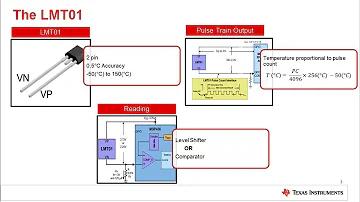
How to interface the LMT01 temperature sensor with Arduino
LMT01LPG Description
The LMT01 digital pulse count output and high accuracy over a wide temperature range allow pairing with any MCU without concern for integrated ADC quality or availability while minimizing software overhead. TI’s LMT01 achieves flat ±0.5°C accuracy with very fine resolution (0.0625°C) over a wide temperature range of -20°C to 90°C without system calibration or hardware/software compensation.
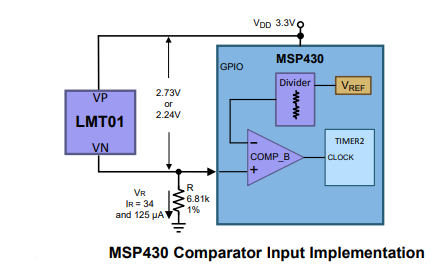
Unlike other digital IC temperature sensors, LMT01’s single wire interface is designed to directly interface with a GPIO or comparator input, thereby simplifying hardware implementation. Similarly, the LMT01's integrated EMI suppression and simple 2-pin architecture make it ideal for on-board and off-board temperature sensing. The LMT01 offers all the simplicity of analog NTC or PTC thermistors with the added benefits of a digital interface, wide specified performance, EMI immunity, and minimum processor resources.
LMT01LPG Features
• High accuracy over –50°C to 150°C wide temperature range
– –20°C to 90°C: ±0.5°C (max)
– 90°C to 150°C: ±0.62°C (max)
– –50°C to –20°C: ±0.7°C (max)
• Precision digital temperature measurement simplified in a 2-Pin package
• Single-wire pulse count digital output easily read with processor timer input
• Number of output pulses is proportional to temperature with 0.0625°C resolution
• Communication frequency: 88 kHz
• Continuous conversion plus data-transmission period: 100 ms
• Conversion current: 34 µA
• Floating 2 V to 5.5 V (VP–VN) supply operation with Integrated EMI Immunity
• 2-Pin package offering TO-92/LPG (3.1 mm × 4 mm × 1.5 mm) – ½ the size of traditional TO-92
LMT01LPG Applications
• Digital output wired probes
• White goods
• HVAC
• Power supplies
• Industrial Internet of Things (IoT)
• Automotive
• Battery management
LMT01LPG Pinout


LMT01LPG CAD Model
Symbol

Footprint

3D Model

Specifications
- TypeParameter
- Lifecycle Status
Lifecycle Status refers to the current stage of an electronic component in its product life cycle, indicating whether it is active, obsolete, or transitioning between these states. An active status means the component is in production and available for purchase. An obsolete status indicates that the component is no longer being manufactured or supported, and manufacturers typically provide a limited time frame for support. Understanding the lifecycle status is crucial for design engineers to ensure continuity and reliability in their projects.
ACTIVE (Last Updated: 4 days ago) - Factory Lead Time6 Weeks
- Mounting Type
The "Mounting Type" in electronic components refers to the method used to attach or connect a component to a circuit board or other substrate, such as through-hole, surface-mount, or panel mount.
Through Hole - Package / Case
refers to the protective housing that encases an electronic component, providing mechanical support, electrical connections, and thermal management.
TO-226-2, TO-92-2 (TO-226AC) Short Body - Surface Mount
having leads that are designed to be soldered on the side of a circuit board that the body of the component is mounted on.
NO - Number of Pins2
- Test Conditions-20°C ~ 90°C (-50°C)
- Operating Temperature
The operating temperature is the range of ambient temperature within which a power supply, or any other electrical equipment, operate in. This ranges from a minimum operating temperature, to a peak or maximum operating temperature, outside which, the power supply may fail.
-50°C~150°C - Packaging
Semiconductor package is a carrier / shell used to contain and cover one or more semiconductor components or integrated circuits. The material of the shell can be metal, plastic, glass or ceramic.
Bulk - JESD-609 Code
The "JESD-609 Code" in electronic components refers to a standardized marking code that indicates the lead-free solder composition and finish of electronic components for compliance with environmental regulations.
e3 - Pbfree Code
The "Pbfree Code" parameter in electronic components refers to the code or marking used to indicate that the component is lead-free. Lead (Pb) is a toxic substance that has been widely used in electronic components for many years, but due to environmental concerns, there has been a shift towards lead-free alternatives. The Pbfree Code helps manufacturers and users easily identify components that do not contain lead, ensuring compliance with regulations and promoting environmentally friendly practices. It is important to pay attention to the Pbfree Code when selecting electronic components to ensure they meet the necessary requirements for lead-free applications.
yes - Part Status
Parts can have many statuses as they progress through the configuration, analysis, review, and approval stages.
Active - Moisture Sensitivity Level (MSL)
Moisture Sensitivity Level (MSL) is a standardized rating that indicates the susceptibility of electronic components, particularly semiconductors, to moisture-induced damage during storage and the soldering process, defining the allowable exposure time to ambient conditions before they require special handling or baking to prevent failures
Not Applicable - Number of Terminations2
- ECCN Code
An ECCN (Export Control Classification Number) is an alphanumeric code used by the U.S. Bureau of Industry and Security to identify and categorize electronic components and other dual-use items that may require an export license based on their technical characteristics and potential for military use.
EAR99 - Terminal Finish
Terminal Finish refers to the surface treatment applied to the terminals or leads of electronic components to enhance their performance and longevity. It can improve solderability, corrosion resistance, and overall reliability of the connection in electronic assemblies. Common finishes include nickel, gold, and tin, each possessing distinct properties suitable for various applications. The choice of terminal finish can significantly impact the durability and effectiveness of electronic devices.
Matte Tin (Sn) - Voltage - Supply
Voltage - Supply refers to the range of voltage levels that an electronic component or circuit is designed to operate with. It indicates the minimum and maximum supply voltage that can be applied for the device to function properly. Providing supply voltages outside this range can lead to malfunction, damage, or reduced performance. This parameter is critical for ensuring compatibility between different components in a circuit.
2V~5.5V - Base Part Number
The "Base Part Number" (BPN) in electronic components serves a similar purpose to the "Base Product Number." It refers to the primary identifier for a component that captures the essential characteristics shared by a group of similar components. The BPN provides a fundamental way to reference a family or series of components without specifying all the variations and specific details.
LMT01 - Output Type
The "Output Type" parameter in electronic components refers to the type of signal or data that is produced by the component as an output. This parameter specifies the nature of the output signal, such as analog or digital, and can also include details about the voltage levels, current levels, frequency, and other characteristics of the output signal. Understanding the output type of a component is crucial for ensuring compatibility with other components in a circuit or system, as well as for determining how the output signal can be utilized or processed further. In summary, the output type parameter provides essential information about the nature of the signal that is generated by the electronic component as its output.
PWM - Termination Type
Termination Type in electronic components refers to the method used to connect the component to a circuit board or other electronic devices. It specifies how the component's leads or terminals are designed for soldering or mounting onto a PCB. Common termination types include through-hole, surface mount, and wire lead terminations. The termination type is an important consideration when selecting components for a circuit design, as it determines how the component will be physically connected within the circuit. Different termination types offer varying levels of durability, ease of assembly, and suitability for specific applications.
SOLDER - Output Current
The rated output current is the maximum load current that a power supply can provide at a specified ambient temperature. A power supply can never provide more current that it's rated output current unless there is a fault, such as short circuit at the load.
143μA - Number of Bits13
- Quiescent Current
The quiescent current is defined as the current level in the amplifier when it is producing an output of zero.
34μA - Resolution
Resolution in electronic components refers to the smallest increment of measurement or change that can be detected or represented by the component. It is a crucial specification in devices such as sensors, displays, and converters, as it determines the level of detail or accuracy that can be achieved. For example, in a digital camera, resolution refers to the number of pixels that make up an image, with higher resolution indicating a greater level of detail. In analog-to-digital converters, resolution is the number of discrete values that can be represented in the digital output, determining the precision of the conversion process. Overall, resolution plays a significant role in determining the performance and capabilities of electronic components in various applications.
0.0625°C - Sensor Type
In electronic components, the parameter "Sensor Type" refers to the specific type of sensor technology used in a particular component to detect and measure physical phenomena such as light, temperature, pressure, motion, or proximity. Different sensor types utilize various principles and mechanisms to convert the detected input into an electrical signal that can be processed by the electronic component. Common sensor types include photodiodes, thermistors, accelerometers, and proximity sensors, each designed for specific applications and environments. Understanding the sensor type is crucial for selecting the right component for a given task and ensuring accurate and reliable sensing capabilities in electronic systems.
Digital, Local - Sensors/Transducers Type
In electronic components, the parameter "Sensors/Transducers Type" refers to the specific type of sensor or transducer that is integrated into the component. Sensors are devices that detect changes in physical properties and convert them into electrical signals, while transducers are devices that convert one form of energy into another. The type of sensor or transducer used in an electronic component can vary widely depending on the intended application, such as temperature sensors, pressure sensors, proximity sensors, accelerometers, and more. Understanding the Sensors/Transducers Type parameter is crucial for selecting the right component for a particular electronic system or device, as different types of sensors/transducers have different functionalities and performance characteristics.
TEMPERATURE SENSOR,SWITCH/DIGITAL OUTPUT,SERIAL - Accuracy - Highest (Lowest)
In electronic components, "Accuracy - Highest (Lowest)" refers to the range within which the actual value of a parameter can deviate from the ideal or specified value. The term "Highest" indicates the upper limit of this range, while "Lowest" indicates the lower limit. For example, if a component has an accuracy of ±5%, the highest accuracy would mean that the actual value could be within 5% above the specified value, while the lowest accuracy would mean it could be within 5% below the specified value. This parameter is crucial for ensuring the reliability and performance of electronic devices by determining how closely the component's output matches the desired value.
±0.5°C (±0.6875°C) - Sensing Temperature - Local
Sensing Temperature - Local refers to the capability of an electronic component to measure the temperature in its immediate environment or vicinity. This parameter is crucial for applications that require monitoring of temperature for performance, safety, or stability purposes. It often involves temperature sensors integrated within components like microcontrollers, power regulators, or other integrated circuits. The local sensing allows for accurate temperature readings that help in adjusting operational conditions, ensuring optimal performance, and preventing thermal-related failures.
-50°C~150°C - Accuracy-Max
Accuracy-Max refers to the maximum permissible error in the output of an electronic component or system, typically expressed as a percentage of the nominal value. It indicates the extent to which the measured or calculated value can deviate from the true value under specified conditions. This parameter is crucial for ensuring reliable performance, especially in applications where precision is critical. A lower Accuracy-Max signifies better accuracy and higher quality in measurement and control processes.
0.7 Cel - Height5.05mm
- Length4mm
- Width3.15mm
- Thickness
Thickness in electronic components refers to the measurement of how thick a particular material or layer is within the component structure. It can pertain to various aspects, such as the thickness of a substrate, a dielectric layer, or conductive traces. This parameter is crucial as it impacts the electrical, mechanical, and thermal properties of the component, influencing its performance and reliability in electronic circuits.
1.52mm - REACH SVHC
The parameter "REACH SVHC" in electronic components refers to the compliance with the Registration, Evaluation, Authorization, and Restriction of Chemicals (REACH) regulation regarding Substances of Very High Concern (SVHC). SVHCs are substances that may have serious effects on human health or the environment, and their use is regulated under REACH to ensure their safe handling and minimize their impact.Manufacturers of electronic components need to declare if their products contain any SVHCs above a certain threshold concentration and provide information on the safe use of these substances. This information allows customers to make informed decisions about the potential risks associated with using the components and take appropriate measures to mitigate any hazards.Ensuring compliance with REACH SVHC requirements is essential for electronics manufacturers to meet regulatory standards, protect human health and the environment, and maintain transparency in their supply chain. It also demonstrates a commitment to sustainability and responsible manufacturing practices in the electronics industry.
No SVHC - RoHS Status
RoHS means “Restriction of Certain Hazardous Substances” in the “Hazardous Substances Directive” in electrical and electronic equipment.
ROHS3 Compliant - Lead Free
Lead Free is a term used to describe electronic components that do not contain lead as part of their composition. Lead is a toxic material that can have harmful effects on human health and the environment, so the electronics industry has been moving towards lead-free components to reduce these risks. Lead-free components are typically made using alternative materials such as silver, copper, and tin. Manufacturers must comply with regulations such as the Restriction of Hazardous Substances (RoHS) directive to ensure that their products are lead-free and environmentally friendly.
Lead Free
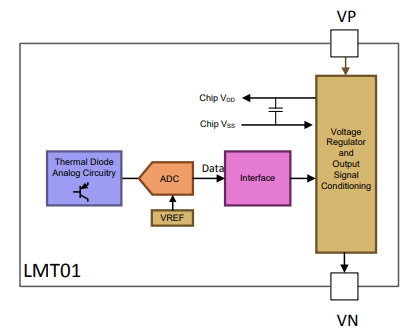
LMT01LPG Functional Block Diagram
LMT01LPG Typical Application
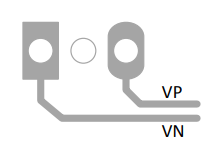
LMT01LPG Layout
LMT01LPG Manufacturer
Trend Analysis
Datasheet PDF
- Datasheets :
- PCN Design/Specification :
 How to use ATTINY85 Microcontroller?
08 April 20224017
 Overcoming Interrupt Conflicts with AVR ATmega: An Advanced 8-Bit Design Tutorial
13 April 2026310
 NCP1117ST50T3G: Overview, Features, and Applications
01 November 20231337
 DS18S20 Temperature Sensor: Datasheet, Pinout and Comparison
01 November 20213069
 T2050H-6G Triac: Datasheet, Pinout, Features
06 August 20211125
![What you need to know about the use of the BS250 P-Channel MOSFET[FAQ]](https://res.utmel.com/Images/Article/a9cca941-e618-4ad6-ae31-15bcc55bff75.jpg) What you need to know about the use of the BS250 P-Channel MOSFET[FAQ]
What you need to know about the use of the BS250 P-Channel MOSFET[FAQ]31 March 20225343
 LM7805 Voltage Regulator: Datasheet, Pinout, Circuit
28 December 202117341
 2N2907A Bipolar Transistor PNP TO-18: Datasheet, Pinout, and Equivalents
09 February 20222553
 Unveiling the Magic Behind TWS Earbuds: An Analysis of Their Market, Working, and Core Components
24 July 20235995
 Transfer Learning Method for detailed defect classification in semiconductor manufacturing based on Convolution Neural Network
13 January 20233593
 Global Ceramic Capacitors Market In-Depth Analysis to 2025
10 December 20258052
 Kyoto University Successfully Demonstrates That SiC Can Also Work at 350°C
26 March 2022841
 The Introduction of Car Fuse
09 October 20216957
 The Comprehensive Guide to MOSFETs: Principles, Types, and Parameters (2026 Edition)
16 January 202620553
 Working Principle and Development of Magnetic Sensors
31 October 20254722
 All You Need to Know About Rectifier Circuit
24 April 202517851
Texas Instruments
In Stock: 20000
Minimum: 1 Multiples: 1
Qty
Unit Price
Ext Price
1
$2.854333
$2.85
10
$2.692767
$26.93
100
$2.540346
$254.03
500
$2.396553
$1,198.28
1000
$2.260899
$2,260.90
Not the price you want? Send RFQ Now and we'll contact you ASAP.
Inquire for More Quantity
![LM50CIM3/NOPB]() LM50CIM3/NOPB
LM50CIM3/NOPBTexas Instruments
![TMP101NA/250]() TMP101NA/250
TMP101NA/250Texas Instruments
![TMP100NA/250]() TMP100NA/250
TMP100NA/250Texas Instruments
![TMP275AIDGKT]() TMP275AIDGKT
TMP275AIDGKTTexas Instruments
![LM35DMX/NOPB]() LM35DMX/NOPB
LM35DMX/NOPBTexas Instruments
![LM60CIM3/NOPB]() LM60CIM3/NOPB
LM60CIM3/NOPBTexas Instruments
![LM75BIMM-3/NOPB]() LM75BIMM-3/NOPB
LM75BIMM-3/NOPBTexas Instruments
![LM20BIM7/NOPB]() LM20BIM7/NOPB
LM20BIM7/NOPBTexas Instruments
![LM56BIMM/NOPB]() LM56BIMM/NOPB
LM56BIMM/NOPBTexas Instruments
![TMP100NA/3K]() TMP100NA/3K
TMP100NA/3KTexas Instruments


