

 Product
 Brand
Brand Articles
 Tools
Tools
Buying the LTM8064? Read This First — Specs, Thermal Traps, and Cheaper Alternatives


DC DC CONVERTER 1.2-36V
At $50+, the LTM8064 is a premium 2-quadrant CVCC µModule. It beats standard step-downs for Peltier and battery driving, but beware of its thermal and BGA traps.
- Quick Verdict: Should You Use the LTM8064?
- 1. What Is the LTM8064? (30-Second Overview)
- 2. Head-to-Head: LTM8064 vs. The Competition
- 3. Under the Hood: Pinout and Design Considerations
- 4. Real-World Performance: Where It Shines (and Where It Struggles)
- 5. Pricing, Availability, and Total Cost of Ownership
- 6. The Decision Matrix: Which Part Should You Actually Buy?
- 7. Frequently Asked Questions
- 8. Final Recommendation
- Specifications
- Datasheet PDF
Quick Verdict: Should You Use the LTM8064?
The LTM8064 is a highly specialized, premium 58V input µModule that does something most buck regulators cannot: it operates in two quadrants, seamlessly sourcing up to 7A and sinking up to 9.1A. If you are designing for active thermal control (Peltier drivers) or complex energy storage (battery/supercap balancing), this module replaces a massive discrete circuit—but at $45 to $70 per unit, it is an absolute waste of money for a simple point-of-load (POL) power rail.
Our Verdict: The LTM8064 is the best choice for high-power, two-quadrant applications like TEC/Peltier driving and supercap charging where board space is at a premium and engineering time is tight. Skip it if you just need a standard step-down buck converter, as cheaper, easier-to-solder alternatives exist. — Rating: 4.2 / 5
✅ Best For:- Peltier (TEC) drivers requiring seamless heating and cooling transitions. - Supercap and battery charging/cell balancing (thanks to precise CVCC control). - Industrial systems requiring strict short-circuit protection and accurate current limits.
❌ Not Ideal For:- Standard 24V-to-5V or 12V-to-3.3V point-of-load step-down conversions. - Highly cost-sensitive consumer or commercial BOMs. - Manufacturing setups lacking X-ray BGA inspection capabilities.
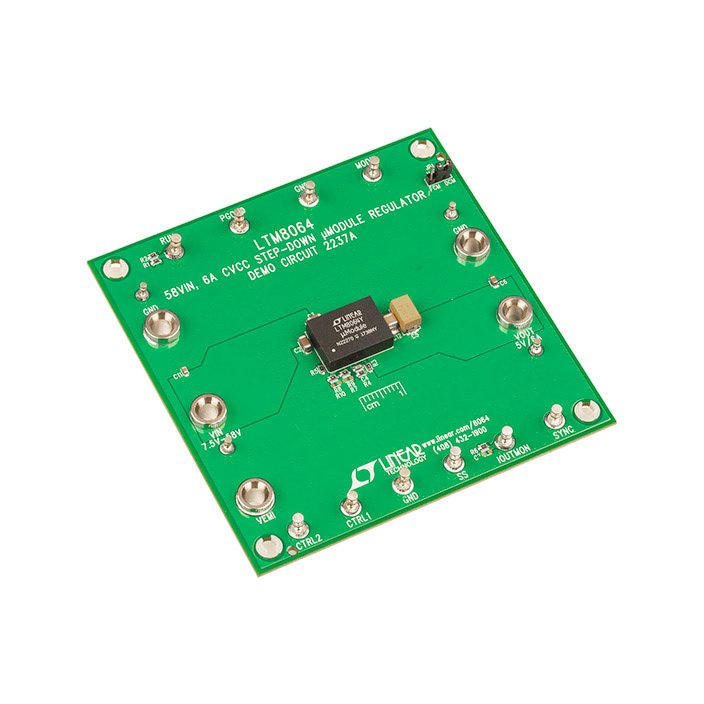
1. What Is the LTM8064? (30-Second Overview)
The Analog Devices (formerly Linear Technology) LTM8064 is a 58VIN, 6A constant-voltage, constant-current (CVCC) step-down µModule regulator packaged in a compact 16mm × 11.9mm BGA. In the procurement landscape, it sits firmly in the premium, high-integration tier. It is not a generic workhorse; rather, it is a specialized problem-solver designed to collapse complex, multi-component two-quadrant power stages into a single IC.
1.1 The Specs That Actually Differentiate It
When evaluating the LTM8064, its 58V input isn't the star of the show—its ability to sink current and strictly regulate it is what justifies the price tag.
| Specification | LTM8064 | Category Average (Standard Buck µModule) | Advantage? |
|---|---|---|---|
| Input Voltage | 6V to 58V | 4.5V to 36V | Yes (Survives harsh 48V industrial transients) |
| Output Current | 7A Source / 9.1A Sink | 3A to 5A Source Only | Massive (2-quadrant operation is rare in this class) |
| Control Scheme | Constant-Voltage / Constant-Current | Constant-Voltage Only | Yes (Eliminates external current-sense amplifiers) |
| Package | 108-Pad BGA (16x11.9mm) | QFN or smaller BGA | No (Larger footprint, harder to inspect) |
1.2 What the Datasheet Doesn't Tell You
Based on available data and field reports from power engineers, here is how the LTM8064 behaves in the real world: * The "Sink" Heat Penalty: Sinking 9.1A generates significant heat. The datasheet assumes a pristine, multi-layer board with massive copper planes. In practice, if you don't dedicate serious PCB real estate to thermal vias, the module will hit thermal shutdown well before its maximum rating. * BGA Rework Nightmares: The 108-pad footprint is dense. If a board fails QC, reworking this module without a high-end BGA rework station and X-ray inspection is nearly impossible, driving up hidden manufacturing costs. * Acoustic Noise: In certain CVCC transition states or under light loads, engineers occasionally report audible switching noise if the output capacitors aren't perfectly damped.
2. Head-to-Head: LTM8064 vs. The Competition
If you are signing off on a $50 power module, you need to be certain a $10 alternative won't do the job. Here is how the LTM8064 stacks up against key rivals.
2.1 vs. Texas Instruments LMZM33606
The TI LMZM33606 is a highly popular 36V, 6A step-down power module. It is frequently cross-referenced by buyers looking for high-current POL solutions.
| Feature | LTM8064 | TI LMZM33606 | Winner |
|---|---|---|---|
| Max Input Voltage | 58V | 36V | LTM8064 |
| 2-Quadrant (Sink/Source) | Yes (7A / 9.1A) | No (Source Only) | LTM8064 |
| Unit Cost (Volume) | ~$45.00+ | ~$9.00 - $12.00 | TI LMZM33606 |
| Ease of Manufacturing | Difficult (108-pad BGA) | Easier (QFN-style / LGA) | TI LMZM33606 |
Summary: If you only need a standard 24V-to-5V step-down rail, the TI LMZM33606 wins flawlessly on price and ease of use. However, if your application requires sinking current (like driving a Peltier) or surviving a 48V telecom rail, the TI part simply cannot compete, making the LTM8064 the mandatory choice.
2.2 vs. Analog Devices LTM8056
The LTM8056 is a sibling in the ADI µModule family, but operates as a buck-boost regulator.
| Feature | LTM8064 | ADI LTM8056 | Winner |
|---|---|---|---|
| Topology | Step-Down (Buck) | Buck-Boost | LTM8056 |
| Max Input Voltage | 58V | 58V | Tie |
| Current Control | CVCC (Source & Sink) | CVCC (Source Only) | LTM8064 |
| Application Focus | TEC/Peltier, Battery Eval | Fluctuating inputs (Solar) | Context Dependent |
Summary: The LTM8056 is the winner if your input voltage can dip below your output voltage (e.g., a discharging battery). But if your input is always higher than your output and you need to sink current, the LTM8064 takes the crown.
2.3 The One Scenario Each Wins
LTM8064 Wins: Driving a high-power Peltier element in a medical thermal cycler where heating (sourcing) and cooling (sinking) must be perfectly, seamlessly controlled.
TI LMZM33606 Wins: Powering an FPGA or MCU array on a cost-sensitive industrial control board operating off a stable 24V rail.
ADI LTM8056 Wins: Regulating a clean 24V output from a solar panel array where the input might swing from 15V up to 45V depending on cloud cover.
3. Under the Hood: Pinout and Design Considerations
Procurement needs to know if a part will cause design delays. The LTM8064 is highly integrated, which reduces BOM count, but its physical layout requires strict adherence to best practices.
3.1 Pinout Overview
VIN / VOUT Pads: Massive arrays of pads dedicated to power. They must be tied to large copper planes.
CTRL1 / CTRL2 (Current Control): These are the magic pins that allow you to set precise sourcing and sinking current limits using simple external resistors.
SYNC: Allows synchronization to an external clock (100kHz to 1MHz) to keep switching noise out of sensitive frequency bands in your system.
3.2 Design Gotchas — What to Watch Out For
Thermal Vias are Mandatory: You cannot just route the VOUT and GND pins on the top layer. You must use a grid of thermal vias directly under the BGA to dump heat into internal layers.
X-Ray Inspection is Required: Due to the 108-pad BGA, bridging underneath the module during reflow is a real risk. Ensure your CM (Contract Manufacturer) has X-ray inspection capabilities.
Capacitor Selection: While it's a "module," it still requires external input and output capacitors. Skimping on the ESR of these capacitors will degrade the CVCC loop stability.
Pro Tip: If you are using the LTM8064 for supercap charging, use the programmable soft-start feature. Supercaps look like a dead short when empty; the CVCC loop handles this, but a gentle soft-start prevents initial inrush spikes that could trip upstream power supplies.
4. Real-World Performance: Where It Shines (and Where It Struggles)
4.1 Performance in Peltier (TEC) Driving
In a Peltier cooler application, the LTM8064 is a masterclass in integration. Traditional discrete TEC drivers require an H-bridge of four MOSFETs, a controller, and complex current-sense circuitry. The LTM8064 replaces all of this. Because it can source 7A and sink 9.1A, it can seamlessly flip a Peltier element from heating to cooling without any relay clicking or H-bridge dead-time issues. Efficiency typically hovers around 88-92% depending on the step-down ratio, but the real win is the massive reduction in PCB space.
4.2 Performance in Battery & Supercap Charging
When charging a massive supercapacitor bank, the voltage starts at 0V. Standard buck converters will often go into "hiccup mode" thinking there is a short circuit. The LTM8064's CVCC (Constant Current) mode smoothly limits the current to your programmed maximum (e.g., 6A) until the voltage rises, smoothly transitioning to Constant Voltage mode to top off the caps. It behaves flawlessly here, though thermal management during that prolonged high-current charge phase is critical.
5. Pricing, Availability, and Total Cost of Ownership
For procurement professionals, the LTM8064 presents a classic "Capex vs. Opex" BOM dilemma.
Unit Price Tier: Ultra-Premium. At roughly $45 to $70 per unit (depending on volume), this is one of the most expensive single components you will put on a board outside of a processor or FPGA.
BOM Impact: It drastically simplifies the BOM. By eliminating discrete MOSFETs, inductors, current-sense resistors, and op-amps, you reduce your vendor count and simplify inventory management.
Supply Chain Risk: Moderate. As an Analog Devices µModule, it is single-sourced. There is no direct "drop-in" pin-compatible replacement from TI or Infineon. If ADI faces lead-time issues, your production line stops.
Hidden Costs: The component requires high-end PCB manufacturing (multi-layer, heavy copper) and automated X-ray inspection during assembly, which drives up the per-board manufacturing cost.
6. The Decision Matrix: Which Part Should You Actually Buy?
| Your Situation | Best Choice | Why |
|---|---|---|
| Basic 24V-to-5V step-down, tight budget | TI LMZM33606 | Costs 80% less, easier to solder, perfectly adequate for POL. |
| Need seamless heating/cooling for a Peltier | LTM8064 | 2-quadrant source/sink capability replaces complex H-bridge designs. |
| Charging supercaps from a 48V industrial rail | LTM8064 | 58V input tolerance combined with strict CVCC short-circuit survival. |
| Input voltage fluctuates above and below output | ADI LTM8056 | True buck-boost topology maintains output during input dips. |
| Extreme space constraints for a high-power LED | LTM8064 | Highly integrated; accurate current limiting prevents LED burnout. |
7. Frequently Asked Questions
Q: Is the LTM8064 better than the LMZM33606? It is more capable, but not universally "better." If you need to sink current or handle 58V inputs, the LTM8064 wins. If you just need a standard buck regulator, the LMZM33606 is far more cost-effective.
Q: What are the main weaknesses of the LTM8064? Its extremely high unit cost, the difficulty of inspecting its 108-pad BGA package, and its heavy reliance on PCB copper for thermal dissipation.
Q: Can I use the LTM8064 as a standard voltage regulator? Yes, but it is massive overkill. You are paying a premium for CVCC and 2-quadrant features you aren't using.
Q: How do I manage the heat at 7A? You must use a multi-layer PCB (4 to 6 layers recommended) with solid copper ground planes and an array of thermal vias directly beneath the module's ground pads.
8. Final Recommendation
The LTM8064 is an engineering marvel that carries a price tag to match. If your project involves precise battery charging, supercap cell balancing, or driving Peltier elements, this µModule will save you weeks of engineering time and significantly shrink your board size. However, procurement teams must ensure that the engineering requirement for 2-quadrant, CVCC operation is genuine before approving this part for the BOM.
Our Verdict: Buy the LTM8064 for Peltier driving and complex battery/supercap management. Look elsewhere for standard point-of-load power. — Rating: 4.2 / 5
Development Tools & Reference Designs: Engineers should evaluate the part using the DC2263A demonstration board before committing to a custom PCB layout.
Specifications
Datasheet PDF
- Datasheets :
- PCN Assembly/Origin :
 A Comprehensive Guide to LTM9008CY-14#PBF 14-Bit Simultaneous Sampling ADC
06 March 2024235
 IRF540 N-Channel MOSFET: Circuit, Datasheet, and Pinout
06 August 202119751
![Difference between ADS1115 and ADS1015 ADS1115 VS ADS1015[Video]](https://res.utmel.com/Images/Article/2a7a0080-ee2c-41dd-8576-d6c565fbe343.png) Difference between ADS1115 and ADS1015 ADS1115 VS ADS1015[Video]
Difference between ADS1115 and ADS1015 ADS1115 VS ADS1015[Video]22 April 20258422
 MAX232ACSE Driver/Receiver: Features, Pinout, and Datasheet
17 April 2025940
 NJM4560 Dual OP-AMP: Datasheet, Equivalent and Circuit
03 November 202110697
 STM32F072CBT6 Microcontroller: 40μA,48-LQFP, Pinout and Features
17 February 20222851
 Delving into the Technical Specifications of the Microchip PIC16C74B20PQ Microcontroller
29 February 2024194
 RS485 Communication Module: Pinout, Cable and Wiring
28 September 202144822
 Hall Effect: Definition, Principle, Measurement Methods
08 November 202211977
 What is Bluetooth Low Energy (BLE) Audio Technology?
26 April 20227358
 Understanding Electronic Speed Controllers (ESCs): Working Principles, Key Specifications, and Sourcing Guide
15 June 20261354
 Ohmic Resistors: Differences, Laws, and Applications
08 June 202619386
 Diode Basis: Symbol, Types and Applications
09 January 202615753
 Introduction to PIC Microcontroller: Architecture, Features, and Applications
08 April 202514188
 Infrared Thermometer: How it Works? How to Use it?
12 August 20219751
 What is inductor: Symbol, Applications and Types
04 January 202211200
Linear Technology/Analog Devices
In Stock: 86
United States
China
Canada
Japan
Russia
Germany
United Kingdom
Singapore
Italy
Hong Kong(China)
Taiwan(China)
France
Korea
Mexico
Netherlands
Malaysia
Austria
Spain
Switzerland
Poland
Thailand
Vietnam
India
United Arab Emirates
Afghanistan
Åland Islands
Albania
Algeria
American Samoa
Andorra
Angola
Anguilla
Antigua & Barbuda
Argentina
Armenia
Aruba
Australia
Azerbaijan
Bahamas
Bahrain
Bangladesh
Barbados
Belarus
Belgium
Belize
Benin
Bermuda
Bhutan
Bolivia
Bonaire, Sint Eustatius and Saba
Bosnia & Herzegovina
Botswana
Brazil
British Indian Ocean Territory
British Virgin Islands
Brunei
Bulgaria
Burkina Faso
Burundi
Cabo Verde
Cambodia
Cameroon
Cayman Islands
Central African Republic
Chad
Chile
Christmas Island
Cocos (Keeling) Islands
Colombia
Comoros
Congo
Congo (DRC)
Cook Islands
Costa Rica
Côte d’Ivoire
Croatia
Cuba
Curaçao
Cyprus
Czechia
Denmark
Djibouti
Dominica
Dominican Republic
Ecuador
Egypt
El Salvador
Equatorial Guinea
Eritrea
Estonia
Eswatini
Ethiopia
Falkland Islands
Faroe Islands
Fiji
Finland
French Guiana
French Polynesia
Gabon
Gambia
Georgia
Ghana
Gibraltar
Greece
Greenland
Grenada
Guadeloupe
Guam
Guatemala
Guernsey
Guinea
Guinea-Bissau
Guyana
Haiti
Honduras
Hungary
Iceland
Indonesia
Iran
Iraq
Ireland
Isle of Man
Israel
Jamaica
Jersey
Jordan
Kazakhstan
Kenya
Kiribati
Kosovo
Kuwait
Kyrgyzstan
Laos
Latvia
Lebanon
Lesotho
Liberia
Libya
Liechtenstein
Lithuania
Luxembourg
Macao(China)
Madagascar
Malawi
Maldives
Mali
Malta
Marshall Islands
Martinique
Mauritania
Mauritius
Mayotte
Micronesia
Moldova
Monaco
Mongolia
Montenegro
Montserrat
Morocco
Mozambique
Myanmar
Namibia
Nauru
Nepal
New Caledonia
New Zealand
Nicaragua
Niger
Nigeria
Niue
Norfolk Island
North Korea
North Macedonia
Northern Mariana Islands
Norway
Oman
Pakistan
Palau
Palestinian Authority
Panama
Papua New Guinea
Paraguay
Peru
Philippines
Pitcairn Islands
Portugal
Puerto Rico
Qatar
Réunion
Romania
Rwanda
Samoa
San Marino
São Tomé & Príncipe
Saudi Arabia
Senegal
Serbia
Seychelles
Sierra Leone
Sint Maarten
Slovakia
Slovenia
Solomon Islands
Somalia
South Africa
South Sudan
Sri Lanka
St Helena, Ascension, Tristan da Cunha
St. Barthélemy
St. Kitts & Nevis
St. Lucia
St. Martin
St. Pierre & Miquelon
St. Vincent & Grenadines
Sudan
Suriname
Svalbard & Jan Mayen
Sweden
Syria
Tajikistan
Tanzania
Timor-Leste
Togo
Tokelau
Tonga
Trinidad & Tobago
Tunisia
Turkey
Turkmenistan
Turks & Caicos Islands
Tuvalu
U.S. Outlying Islands
U.S. Virgin Islands
Uganda
Ukraine
Uruguay
Uzbekistan
Vanuatu
Vatican City
Venezuela
Wallis & Futuna
Yemen
Zambia
Zimbabwe
![LTM4622EY#PBF]() LTM4622EY#PBF
LTM4622EY#PBFLinear Technology/Analog Devices
![LTM4625IY#PBF]() LTM4625IY#PBF
LTM4625IY#PBFLinear Technology/Analog Devices
![LTM4676AEY#PBF]() LTM4676AEY#PBF
LTM4676AEY#PBFLinear Technology/Analog Devices
![LTM4677IY#PBF]() LTM4677IY#PBF
LTM4677IY#PBFLinear Technology/Analog Devices
![LTM4630IY#PBF]() LTM4630IY#PBF
LTM4630IY#PBFLinear Technology/Analog Devices
![LTM4675IY#PBF]() LTM4675IY#PBF
LTM4675IY#PBFLinear Technology/Analog Devices
![LTM4634EY#PBF]() LTM4634EY#PBF
LTM4634EY#PBFLinear Technology/Analog Devices
![LTM4650IY#PBF]() LTM4650IY#PBF
LTM4650IY#PBFLinear Technology/Analog Devices
![LTM4632IY#PBF]() LTM4632IY#PBF
LTM4632IY#PBFLinear Technology/Analog Devices
![LTM8056EY#PBF]() LTM8056EY#PBF
LTM8056EY#PBFLinear Technology/Analog Devices


