

 Product
 Brand
Brand Articles
 Tools
Tools
74HC164 Register: Equivalent, Pinout and Truth Table

Toshiba Semiconductor and Storage
8 Bit Shift Register -40°C~125°C Shift Register 74HC Series 14 Pin 4.5V 14-SOIC (0.154, 3.90mm Width)
Unit Price: $0.559855
Ext Price: $0.56


8 Bit Shift Register -40°C~125°C Shift Register 74HC Series 14 Pin 4.5V 14-SOIC (0.154, 3.90mm Width)
Hello, everyone. I am Rose. Today I will introduce 74HC164 to you. 74HC164 is an 8-BIT Sarallel-out Serial Shift Register. This article mainly introduces equivalent, pinout, truth table, and other detailed information about Toshiba Semiconductor Storage 74HC164.

Experiments 5.2: Arduino - Serial to Parallel Conversion (74HC164 & 74HC595)
74HC164 Description
74HC164 is a CMOS Level 8-Bit, two serial inputs based and parallel output shift register that can be used to increase the output pins of the microcontroller unit.
The specification can be found on the part number itself where 74 is derived from the 7400 logic family and the HC stands for the High-Speed CMOS operation.
Since it is 8-bit, it has 8 output pins which can be assumed as 8 output pins of any microcontroller unit. Thus, it can asynchronously have data serially in its input pins microcontrollers and provide output on 8 different output pins which can be further connected to Transistor switches, LEDs, or in other input pins of sensor or parallel interfaces.
One of the best use cases is controlling LED arrays or LCDs that support 8-bit parallel inputs. So, if in your application, you are running out of output pins, then this 74HC164 8-Bit Parallel out / serial-in shift register might be the right choice for you.
74HC164 Pinout

74HC164 Pinout
 74HC164 Pin Descriptions
74HC164 CAD Model

Symbol

Footprint
74HC164 Features
-Operating Voltage: 2V to 6V
-Current Consumption: 100uA (max)
-Output current Source: ±25mA
-Input and Output Voltage is equal to Operating voltage (Can be 0 and VCC)
-High-level Output Voltage: 4.4V @(Vcc=4.5V)(Minimum)
-Low-level Output Voltage: 0.1V @(Vcc=4.5V)(Maximum)
-Clock Frequency: 54Mhz @4.5V(Maximum)
-Package type: 14-pin PDIP, FK, SSOP, CDIP, SOIC
-Sinks or Sources 4mA at VCC = 4.5V
-CMOS Low Power Consumption
-Schmitt Trigger Action at all Inputs
-ESD Protection Exceeds JESD 22
Specifications
- TypeParameter
- Factory Lead Time12 Weeks
- Mounting Type
The "Mounting Type" in electronic components refers to the method used to attach or connect a component to a circuit board or other substrate, such as through-hole, surface-mount, or panel mount.
Surface Mount - Package / Case
refers to the protective housing that encases an electronic component, providing mechanical support, electrical connections, and thermal management.
14-SOIC (0.154, 3.90mm Width) - Surface Mount
having leads that are designed to be soldered on the side of a circuit board that the body of the component is mounted on.
YES - Number of Pins14
- Number of Elements1
- Operating Temperature
The operating temperature is the range of ambient temperature within which a power supply, or any other electrical equipment, operate in. This ranges from a minimum operating temperature, to a peak or maximum operating temperature, outside which, the power supply may fail.
-40°C~125°C - Packaging
Semiconductor package is a carrier / shell used to contain and cover one or more semiconductor components or integrated circuits. The material of the shell can be metal, plastic, glass or ceramic.
Cut Tape (CT) - Series
In electronic components, the "Series" refers to a group of products that share similar characteristics, designs, or functionalities, often produced by the same manufacturer. These components within a series typically have common specifications but may vary in terms of voltage, power, or packaging to meet different application needs. The series name helps identify and differentiate between various product lines within a manufacturer's catalog.
74HC - Published2016
- Part Status
Parts can have many statuses as they progress through the configuration, analysis, review, and approval stages.
Active - Moisture Sensitivity Level (MSL)
Moisture Sensitivity Level (MSL) is a standardized rating that indicates the susceptibility of electronic components, particularly semiconductors, to moisture-induced damage during storage and the soldering process, defining the allowable exposure time to ambient conditions before they require special handling or baking to prevent failures
1 (Unlimited) - Number of Terminations14
- Voltage - Supply
Voltage - Supply refers to the range of voltage levels that an electronic component or circuit is designed to operate with. It indicates the minimum and maximum supply voltage that can be applied for the device to function properly. Providing supply voltages outside this range can lead to malfunction, damage, or reduced performance. This parameter is critical for ensuring compatibility between different components in a circuit.
2V~6V - Terminal Position
In electronic components, the term "Terminal Position" refers to the physical location of the connection points on the component where external electrical connections can be made. These connection points, known as terminals, are typically used to attach wires, leads, or other components to the main body of the electronic component. The terminal position is important for ensuring proper connectivity and functionality of the component within a circuit. It is often specified in technical datasheets or component specifications to help designers and engineers understand how to properly integrate the component into their circuit designs.
DUAL - Terminal Form
Occurring at or forming the end of a series, succession, or the like; closing; concluding.
GULL WING - Peak Reflow Temperature (Cel)
Peak Reflow Temperature (Cel) is a parameter that specifies the maximum temperature at which an electronic component can be exposed during the reflow soldering process. Reflow soldering is a common method used to attach electronic components to a circuit board. The Peak Reflow Temperature is crucial because it ensures that the component is not damaged or degraded during the soldering process. Exceeding the specified Peak Reflow Temperature can lead to issues such as component failure, reduced performance, or even permanent damage to the component. It is important for manufacturers and assemblers to adhere to the recommended Peak Reflow Temperature to ensure the reliability and functionality of the electronic components.
NOT SPECIFIED - Supply Voltage
Supply voltage refers to the electrical potential difference provided to an electronic component or circuit. It is crucial for the proper operation of devices, as it powers their functions and determines performance characteristics. The supply voltage must be within specified limits to ensure reliability and prevent damage to components. Different electronic devices have specific supply voltage requirements, which can vary widely depending on their design and intended application.
4.5V - Frequency
In electronic components, the parameter "Frequency" refers to the rate at which a signal oscillates or cycles within a given period of time. It is typically measured in Hertz (Hz) and represents how many times a signal completes a full cycle in one second. Frequency is a crucial aspect in electronic components as it determines the behavior and performance of various devices such as oscillators, filters, and communication systems. Understanding the frequency characteristics of components is essential for designing and analyzing electronic circuits to ensure proper functionality and compatibility with other components in a system.
78MHz - Time@Peak Reflow Temperature-Max (s)
Time@Peak Reflow Temperature-Max (s) refers to the maximum duration that an electronic component can be exposed to the peak reflow temperature during the soldering process, which is crucial for ensuring reliable solder joint formation without damaging the component.
NOT SPECIFIED - Function
The parameter "Function" in electronic components refers to the specific role or purpose that the component serves within an electronic circuit. It defines how the component interacts with other elements, influences the flow of electrical signals, and contributes to the overall behavior of the system. Functions can include amplification, signal processing, switching, filtering, and energy storage, among others. Understanding the function of each component is essential for designing effective and efficient electronic systems.
Serial to Parallel - Output Type
The "Output Type" parameter in electronic components refers to the type of signal or data that is produced by the component as an output. This parameter specifies the nature of the output signal, such as analog or digital, and can also include details about the voltage levels, current levels, frequency, and other characteristics of the output signal. Understanding the output type of a component is crucial for ensuring compatibility with other components in a circuit or system, as well as for determining how the output signal can be utilized or processed further. In summary, the output type parameter provides essential information about the nature of the signal that is generated by the electronic component as its output.
Push-Pull - Supply Voltage-Max (Vsup)
The parameter "Supply Voltage-Max (Vsup)" in electronic components refers to the maximum voltage that can be safely applied to the component without causing damage. It is an important specification to consider when designing or using electronic circuits to ensure the component operates within its safe operating limits. Exceeding the maximum supply voltage can lead to overheating, component failure, or even permanent damage. It is crucial to adhere to the specified maximum supply voltage to ensure the reliable and safe operation of the electronic component.
6V - Supply Voltage-Min (Vsup)
The parameter "Supply Voltage-Min (Vsup)" in electronic components refers to the minimum voltage level required for the component to operate within its specified performance range. This parameter indicates the lowest voltage that can be safely applied to the component without risking damage or malfunction. It is crucial to ensure that the supply voltage provided to the component meets or exceeds this minimum value to ensure proper functionality and reliability. Failure to adhere to the specified minimum supply voltage may result in erratic behavior, reduced performance, or even permanent damage to the component.
2V - Number of Circuits8
- Number of Bits8
- Family
In electronic components, the parameter "Family" typically refers to a categorization or classification system used to group similar components together based on their characteristics, functions, or applications. This classification helps users easily identify and select components that meet their specific requirements. The "Family" parameter can include various subcategories such as resistors, capacitors, diodes, transistors, integrated circuits, and more. Understanding the "Family" of an electronic component can provide valuable information about its compatibility, performance specifications, and potential uses within a circuit or system. It is important to consider the "Family" parameter when designing or troubleshooting electronic circuits to ensure proper functionality and compatibility with other components.
HC/UH - Logic Type
Logic Type in electronic components refers to the classification of circuits based on the logical operations they perform. It includes types such as AND, OR, NOT, NAND, NOR, XOR, and XNOR, each defining the relationship between binary inputs and outputs. The logic type determines how the inputs affect the output state based on specific rules of Boolean algebra. This classification is crucial for designing digital circuits and systems, enabling engineers to select appropriate components for desired functionalities.
Shift Register - Output Polarity
Output polarity in electronic components refers to the orientation of the output signal in relation to the ground or reference voltage. It indicates whether the output voltage is positive or negative with respect to the ground. Positive output polarity means the signal is higher than the ground potential, while negative output polarity signifies that the signal is lower than the ground. This characteristic is crucial for determining compatibility with other components in a circuit and ensuring proper signal processing.
TRUE - Trigger Type
Trigger Type in electronic components refers to the mechanism or method by which a device, such as a flip-flop or timer, responds to an input signal. It defines how the device transitions between states based on specific conditions, such as rising or falling edges of a signal, levels, or pulses. Different trigger types such as edge-triggered, level-triggered, or pulse-triggered influence the timing and behavior of the circuit, thereby determining how input signals affect the output in various applications.
POSITIVE EDGE - Propagation Delay (tpd)
Propagation delay (tpd) is a crucial parameter in electronic components, especially in digital circuits. It refers to the time taken for a signal to travel from the input of a component to its output. This delay is caused by various factors such as the internal circuitry, interconnections, and the physical properties of the component. Propagation delay is essential to consider in designing circuits to ensure proper timing and functionality. It is typically measured in nanoseconds or picoseconds and plays a significant role in determining the overall performance and speed of electronic systems.
240 ns - fmax-Min
fmax-Min refers to the frequency range that an electronic component or system can operate within. It represents the difference between the maximum frequency (fmax) and the minimum frequency (Min) limits of operation. This parameter is crucial in defining the bandwidth of the component, indicating how effectively it can transmit or receive signals over that range. A wider fmax-Min value typically signifies better performance for applications that require broad frequency response.
24 MHz - Count Direction
Count Direction in electronic components refers to the direction in which a counter or digital circuit increments or decrements its count. It indicates whether the counting process moves forward (upward count) or backward (downward count). This parameter is crucial in applications such as timers, event counters, and digital clocks, where precise control over the counting sequence is necessary. The count direction can usually be set or controlled through external inputs, allowing for flexibility in circuit operation.
RIGHT - Width3.9mm
- REACH SVHC
The parameter "REACH SVHC" in electronic components refers to the compliance with the Registration, Evaluation, Authorization, and Restriction of Chemicals (REACH) regulation regarding Substances of Very High Concern (SVHC). SVHCs are substances that may have serious effects on human health or the environment, and their use is regulated under REACH to ensure their safe handling and minimize their impact.Manufacturers of electronic components need to declare if their products contain any SVHCs above a certain threshold concentration and provide information on the safe use of these substances. This information allows customers to make informed decisions about the potential risks associated with using the components and take appropriate measures to mitigate any hazards.Ensuring compliance with REACH SVHC requirements is essential for electronics manufacturers to meet regulatory standards, protect human health and the environment, and maintain transparency in their supply chain. It also demonstrates a commitment to sustainability and responsible manufacturing practices in the electronics industry.
No SVHC - RoHS Status
RoHS means “Restriction of Certain Hazardous Substances” in the “Hazardous Substances Directive” in electrical and electronic equipment.
RoHS Compliant - Lead Free
Lead Free is a term used to describe electronic components that do not contain lead as part of their composition. Lead is a toxic material that can have harmful effects on human health and the environment, so the electronics industry has been moving towards lead-free components to reduce these risks. Lead-free components are typically made using alternative materials such as silver, copper, and tin. Manufacturers must comply with regulations such as the Restriction of Hazardous Substances (RoHS) directive to ensure that their products are lead-free and environmentally friendly.
Lead Free
74HC164 Alternatives
| Part Number | Description | Manufacturer |
| MC74HC164ADR2GLOGIC | HC/UH SERIES, 8-BIT RIGHT SERIAL IN PARALLEL-OUT SHIFT REGISTER, TRUE OUTPUT, PDSO14, HALOGEN FREE AND ROHS COMPLIANT, SOIC-14 | Rochester Electronics LLC |
| CD74HC164M96G4LOGIC | High-Speed CMOS Logic 8-Bit Serial-In/Parallel-Out Shift Register 14-SOIC -55 to 125 | Texas Instruments |
| MM74HC164MXLOGIC | HC/UH SERIES, 8-BIT RIGHT SERIAL IN PARALLEL-OUT SHIFT REGISTER, TRUE OUTPUT, PDSO14, PLASTIC, SO-14 | Texas Instruments |
| MC74HC164DLOGIC | Serial In Parallel Out, HC/UH Series, 8-Bit, Right Direction, True Output, CMOS, PDSO14, 0.150 INCH, PLASTIC, SOIC-14 | Motorola Semiconductor Products |
| CD74HC164MLOGIC | Logic Circuit | Thomson Consumer Electronics |
| MC74HC164ADLOGIC | HC/UH SERIES, 8-BIT RIGHT SERIAL IN PARALLEL-OUT SHIFT REGISTER, TRUE OUTPUT, PDSO14, 0.150 INCH, PLASTIC, SOIC-14 | Rochester Electronics LLC |
| MM74HC164M_NLLOGIC | Serial In Parallel Out, HC/UH Series, 8-Bit, Right Direction, True Output, CMOS, PDSO14, 0.150 INCH, LEAD-FREE, MS-012, SOIC-14 | Fairchild Semiconductor Corporation |
| 933714070652LOGIC | IC HC/UH SERIES, 8-BIT RIGHT SERIAL IN PARALLEL OUT SHIFT REGISTER, TRUE OUTPUT, PDSO14, SOT-108-1, SO-14, Shift Register | NXP Semiconductors |
How to use 74HC164?
74HC164 is easy to interface with. It is very useful for microcontrollers or microprocessors. This device takes Two inputs across an AND Gate and sends the data to its 8-bit parallel output pins. To provide the serial data into its parallel output pins, it requires a clock signal. The 8-bit data output is only available when Pin 1, B is enabled. To provide the clocking, a low-to-high transition can be applied in CLK input while sending the data over its serial input pins. Each new cycle of data is started with the high to low transition in the Clear Pin pin. The state of the pins can be seen properly in the image given below, which is taken from the 74HC164 datasheet.

The CLK pin is constantly getting the Clock input, the data enable pin B is high and the data input pin A is receiving the serial data which is reflected on the 8-bit parallel port. For connection, the schematic given below can be useful for interfacing with a microcontroller or microprocessor.

As we can see in the above image, only 4 pins are required for connecting the 74HC164 with a microcontroller or microprocessor. Appropriate logic levels enable the data input from 8 buttons, and the serial data can be harvested from the output pin of the 74HC164.
74HC164 Truth Table

74HC164 Truth Table
74HC164 Applications
●Used in General Purpose Logic
●Used in Wide Array of Products Such as: PCs, Networking, Notebooks, Netbooks, Computer Peripherals, Hard Drives, CD/DVD ROM, TV, DVD, DVR, Set-Top Box
74HC164 Package
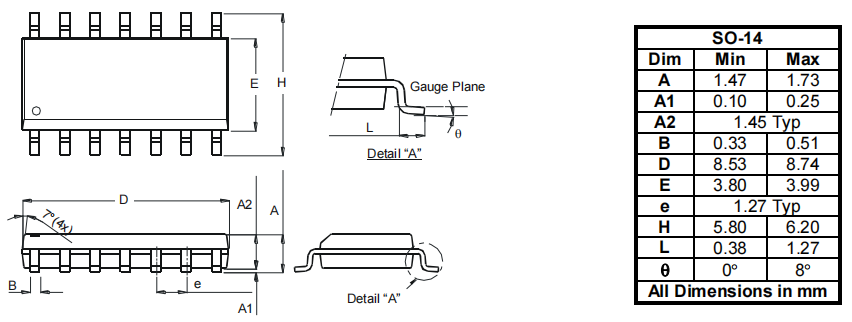
74HC164 Package
74HC164 Manufacturer
Toshiba Corporation (Kabushiki Kaisha Tōshiba, Toshiba Corporation, English: /təˈʃiːbə, tɒ-, toʊ-/) is a Japanese multinational enterprise group headquartered in Minato-ku, Tokyo. Its diversified products and services include power, industrial and social infrastructure systems, elevators and escalators, electronic components, semiconductors, hard disk drives, printers, batteries, lighting, and IT solutions such as quantum cryptography. It is one of the largest manufacturers of personal computers, consumer electronics, household appliances, and medical equipment. As a semiconductor company and the inventor of flash memory, Toshiba has been one of the top 10 in the chip industry until its flash memory division was split into Toshiba Memory, later Kioxia in the late 2010s.
Trend Analysis
Datasheet PDF
- Datasheets :
Parts with Similar Specs
- ImagePart NumberManufacturerPackage / CaseNumber of PinsNumber of ElementsSupply VoltageTechnologyLogic TypeNumber of TerminationsTerminal PositionView Compare
![74HC164D]()
74HC164D
14-SOIC (0.154, 3.90mm Width)
14
1
4.5 V
CMOS
Shift Register
14
DUAL
![SN74HC164D]()
14-SOIC (0.154, 3.90mm Width)
14
1
5 V
CMOS
Shift Register
14
DUAL
![SN74HC164DR]()
14-SOIC (0.154, 3.90mm Width)
14
1
5 V
CMOS
Shift Register
14
DUAL
![74HCT164S14-13]()
14-SOIC (0.154, 3.90mm Width)
14
1
2.5 V
CMOS
Shift Register
14
DUAL
![SN74LV164AD]()
14-SOIC (0.154, 3.90mm Width)
14
1
5 V
CMOS
Shift Register
14
DUAL


1.What’s the difference between 74LS164 chip and 74HC164 chip?
The 74LS164 chip is a TTL chip, and the power supply voltage is 5V. 74HC164 chip is a CMOS device chip, the power supply voltage is 2V ~ 6V.
2.What’s the difference between 74HC164 and 74HC595?
The main differences between 74HC595 and 74HC164 are:
(1)74HC595 has a latch, so the output can remain unchanged during the shift process; while 74HC164 has no latch, so it changes every time a shift clock output is generated. This is the biggest difference between the two
(2)74HC595 uses dedicated Q7' pin to realize multi-chip cascade; 74HC164 directly uses output pin Q7 to cascade
(3) 74HC595 has enabled OE, when OE is invalid, the output pin is in a high impedance state; while 74HC164 has no enable pin
(4)The reset of 74HC595 is for the shift register. If you want to reset the LATCH register, you must load the shift register content to the latch register on the rising edge of ST_CP; that is to say: the reset of 74HC595 is synchronous, and the reset of 74HC164 is asynchronous. , So the reset of 74HC164 is easier
(5)74HC164 has a corresponding 74HC165 parallel-to-serial chip
3.What is 74HC164?
The 74HC164 is a 8-bit edge-triggered shift registers with serial data entry and an output from each of the eight stages. Data is entered serially through one of two inputs (DSA or DSB); either input can be used as an active HIGH enable for data entry through the other input.
 Unraveling the Microchip ATSAMD21E17AMUT Microcontroller
28 February 2024266
 CSR8675 Premium Single-Chip : Datasheet, Features and Specifications
28 July 202110278
 STM32F072RBT6 Microcontroller: 48MHz, 64-LQFP, Pinout and Datasheet
14 February 20223734
 LM393 - Low Offset Voltage Dual Comparator IC
02 December 202114360
 MAX3311 Transceiver: Pinout, Equivalent and Datasheet
21 January 2022741
 STM32H750 Value Line 480 MHz MCU: Maximizing 1MB RAM for High-Performance Designs
05 February 2026368
 SI4463 Transceiver: Features, Pinout, and Datasheet
28 October 202113571
 TDA2030A: 22 kHz, 80mA, Pinout and Datasheet
27 April 20227396
 Ten Smart Sensor Technology Trends for IoT Applications
20 November 20216551
 What is SPI (Serial Perripheral Interface)?
25 November 20215245
 Vibration Isolator: Types and Applications
13 January 202112880
 A Beginner's Guide to the 2N5551 Transistor and Its Uses
27 May 20256303
 Optimizing Energy Exchange with Vehicle-to-Grid Technology
25 April 20233295
 What is an Optical Sensor?
19 March 20217249
 The Reason for the Leakage Current of MOS Tube
26 March 20229477
 Introduction to PIC Microcontroller: Architecture, Features, and Applications
08 April 202513832
Toshiba Semiconductor and Storage
In Stock: 10000
Minimum: 1 Multiples: 1
Qty
Unit Price
Ext Price
1
$0.559855
$0.56
10
$0.528165
$5.28
100
$0.498269
$49.83
500
$0.470065
$235.03
1000
$0.443458
$443.46
Not the price you want? Send RFQ Now and we'll contact you ASAP.
Inquire for More Quantity
![74VHC164FT]() 74VHC164FT
74VHC164FTToshiba Semiconductor and Storage
![74VHC595FT]() 74VHC595FT
74VHC595FTToshiba Semiconductor and Storage
![TC74HC595AFN]() TC74HC595AFN
TC74HC595AFNToshiba
![74VHC165FT]() 74VHC165FT
74VHC165FTToshiba Semiconductor and Storage
![TC74VHC595F(EL,K,F]() TC74VHC595F(EL,K,F
TC74VHC595F(EL,K,FToshiba Semiconductor and Storage
![74HC166D]() 74HC166D
74HC166DToshiba Semiconductor and Storage
![74HC595D(BJ)]() 74HC595D(BJ)
74HC595D(BJ)Toshiba
![TC74HC165AP(F)]() TC74HC165AP(F)
TC74HC165AP(F)Toshiba Semiconductor and Storage
![TC74HC165AF(EL,F)]() TC74HC165AF(EL,F)
TC74HC165AF(EL,F)Toshiba Semiconductor and Storage


