

 Product
 Brand
Brand Articles
 Tools
Tools
Designing with ATmega328PB: Datasheet, Pinout, and IoT Node Guide

32KB 16K x 16 FLASH AVR 8-Bit Microcontroller Automotive, AEC-Q100, AVR® ATmega Series 5V 32-VFQFN Exposed Pad


32KB 16K x 16 FLASH AVR 8-Bit Microcontroller Automotive, AEC-Q100, AVR® ATmega Series 5V 32-VFQFN Exposed Pad
Discover the Microchip ATmega328PB 8-bit MCU. Features dual communication interfaces and picoPower for IoT. Download the datasheet and design cost-effective nodes today.
- Executive Summary: What is the ATmega328PB?
- 1. Technical Specifications & Performance Analysis
- 2. Pinout, Package, and Configuration
- 3. Design & Integration Guide (For Engineers & Makers)
- 4. Typical Applications & Use Cases
- 5. Alternatives and Cross-Reference Guide
- 6. Frequently Asked Questions (FAQ)
- 7. Datasheets & Resources
- Specifications
Executive Summary: What is the ATmega328PB?
The ATmega328PB is a high-performance, low-power 8-bit AVR RISC microcontroller designed by Microchip Technology as an enhanced, backward-compatible successor to the ubiquitous ATmega328P. It is widely utilized in cost-sensitive applications requiring extended connectivity and robust power efficiency.
Market Position: Positioned as a versatile "workhorse" MCU, it bridges the gap between legacy Arduino-compatible hardware and modern low-power industrial demands.
Top Features: Features dual digital interfaces (2x USART, 2x I2C, 2x SPI), a Peripheral Touch Controller (PTC) for capacitive touch, and optimized picoPower technology.
Primary Audience: Ideal for embedded engineers designing IoT sensors, home automation developers, and makers upgrading from the standard Arduino Uno R3 platform.
Supply Status: Active. (High search volume indicates strong ongoing demand; always verify current stock levels with authorized distributors to avoid counterfeits).
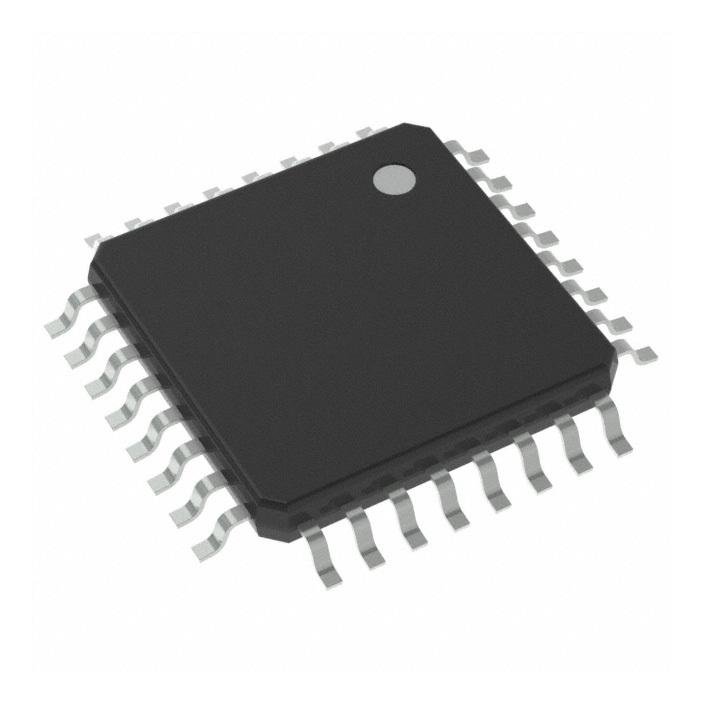
ATmega328PB product
1. Technical Specifications & Performance Analysis
1.1 Core Architecture (CPU/Logic/Power)
The ATmega328PB utilizes the proven AVR 8-bit RISC architecture, executing powerful instructions in a single clock cycle. This allows the MCU to achieve throughputs approaching 1 MIPS per MHz, balancing power consumption with processing speed. With 32KB In-System Self-Programmable Flash, 2KB SRAM, and 1KB EEPROM, it retains the memory footprint of the standard 328P but optimizes the internal logic for better energy efficiency.
1.2 Key Electrical Characteristics
Engineers must pay close attention to the voltage-frequency curve to ensure system stability. - Operating Voltage: 1.8V to 5.5V (Full operating range) - Max Operating Frequency: 20 MHz (Requires 4.5V – 5.5V) - Power Consumption: Utilizes picoPower technology, making it suitable for battery-operated devices. - ADC Capabilities: Features an 8-channel, 10-bit ADC, allowing for precise analog sensor interfacing without external converters.
1.3 Interfaces and Connectivity
The standout feature of the "PB" variant is the duplication of communication peripherals, expanding design flexibility:
UART: 2x USART (Enables simultaneous debug and module communication)
SPI: 2x Serial Peripheral Interface
I2C (TWI): 2x Two-Wire Interface
Touch Sensing: Integrated Peripheral Touch Controller (PTC) for implementing buttons, sliders, and wheels.
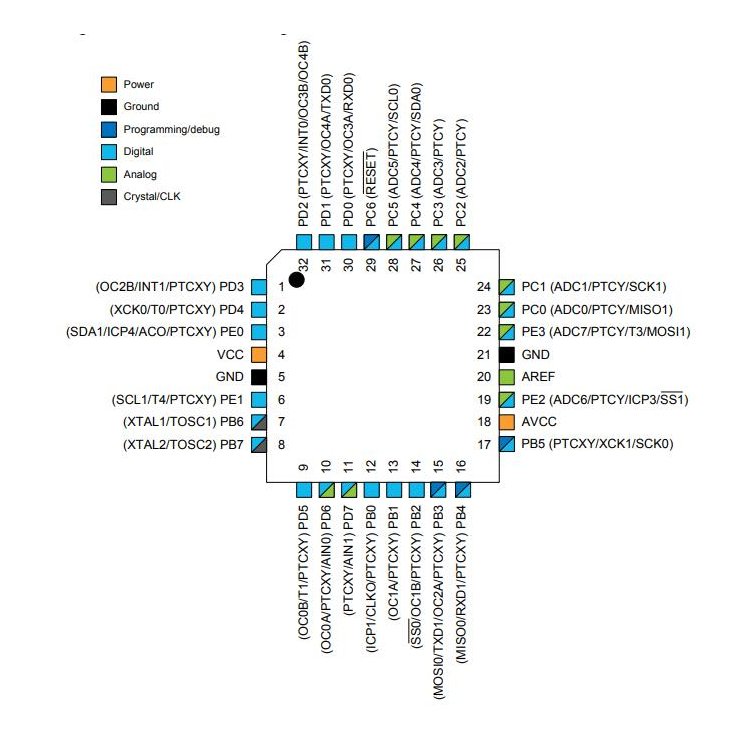
ATmega328PB functional block diagram
2. Pinout, Package, and Configuration
2.1 Pin Configuration Guide
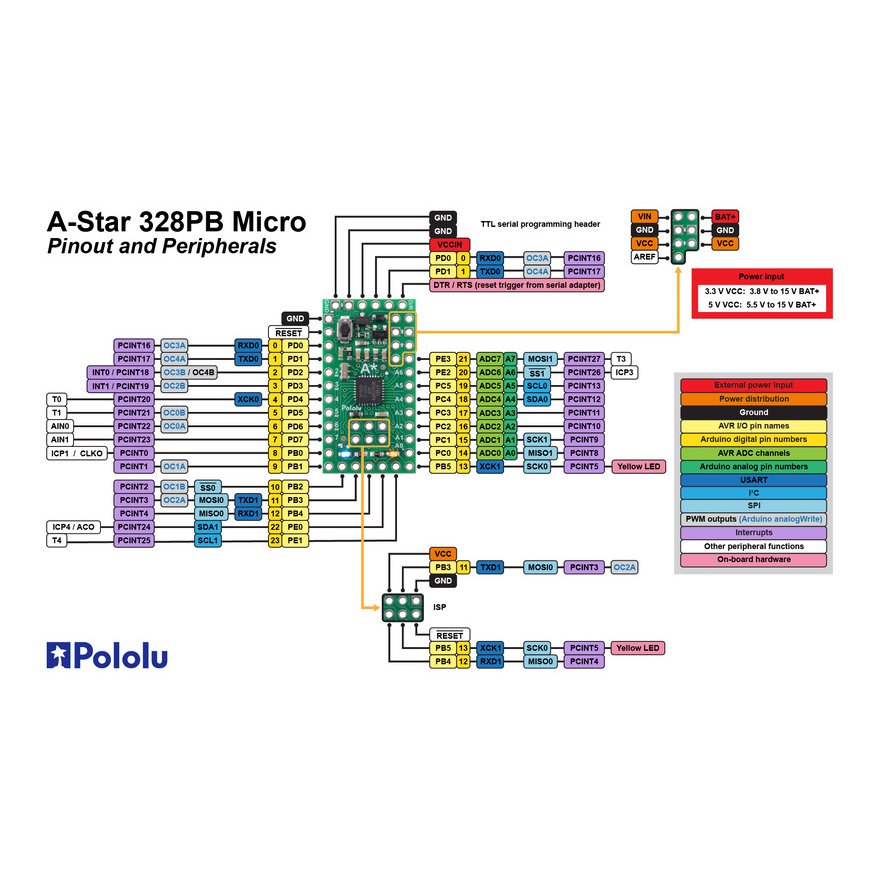
ATmega328PB pinout diagram
The ATmega328PB largely retains the pinout familiar to ATmega328P users but repurposes specific pins to accommodate the extra communication interfaces. - Power: VCC, GND - Port B, C, D: General Purpose I/O (Total 27 I/O pins) - Special Functions: Pins PE0 and PE1 are unique to the PB variant to support the additional interfaces.
2.2 Naming Convention & Ordering Codes
Understanding the Part Numbers:The suffix indicates packaging and temperature grading. Procurement managers should note:
"PB": Indicates the enhanced version (Not direct drop-in for all 'P' programmers).
"U" or "N": Indicates RoHS compliant / Lead-free status.
Temperature: Standard industrial range (-40°C to +85°C) is typical; specific suffixes denote extended ranges.
2.3 Available Packages
| Package Type | Dimensions | Common Use Case |
|---|---|---|
| ATMEGA328PB-AU | 32-lead TQFP | Surface mount, hand-soldering feasible, Industrial PCBs |
| ATMEGA328PB-MU | 32-pad VQFN | High-density consumer electronics, space-constrained IoT |
| ATMEGA328PB-MN | 32-pad VQFN | Extended temperature applications |
| ATMEGA328PB-AN | 32-lead TQFP | Extended temperature industrial controls |
3. Design & Integration Guide (For Engineers & Makers)
Pro Tip: While code-compatible, the ATmega328PB has a different Device Signature than the ATmega328P. Programmers must be configured correctly.
3.1 Hardware Implementation
Bypass Capacitors: Place 100nF ceramic capacitors as close as possible to VCC pins to filter noise.
PCB Layout: Use a solid ground plane to minimize EMI, especially when utilizing the 20 MHz clock speed.
Touch Design: If using the PTC, ensure traces are kept away from high-frequency signal lines to prevent interference.
3.2 Common Design Challenges
1. Signature Byte Mismatch (Critical)- Issue: The ATmega328PB signature is 0x1E 0x95 0x16, whereas the ATmega328P is 0x1E 0x95 0x0F. Tools like AVRDUDE may fail with a "Device signature check failed" error.
- Fix: Update avrdude.conf to recognize the PB signature or use a board definition package (like MiniCore for Arduino) that explicitly supports the PB variant.
2. Sleep Current Inconsistency- Issue: Users have reported varying sleep currents across different batches or board copies. - Fix: Ensure all unused peripherals—especially the new 2nd USART and PTC—are explicitly disabled in firmware before entering sleep modes to prevent leakage.
3. Counterfeit Risks- Issue: The market is flooded with clones (e.g., re-badged generic chips) due to high demand. - Fix: Source strictly from authorized distributors (Mouser, Digi-Key) and verify die markings against the official datasheet.
4. Typical Applications & Use Cases
📺 Video Recommendation: ATMEGA328PB Guide
4.1 Real-World Example: Low-Power IoT Sensor Node
In a Remote Weather Station, the ATmega328PB serves as the central controller. - Role: It reads data from temperature and humidity sensors via I2C0.
Connectivity: It transmits data via a LoRaWAN module connected to UART1, leaving UART0 free for debugging or firmware updates.
Power: The picoPower features put the chip into deep sleep between readings to extend battery life, operating efficiently on a regulated 3.3V supply.
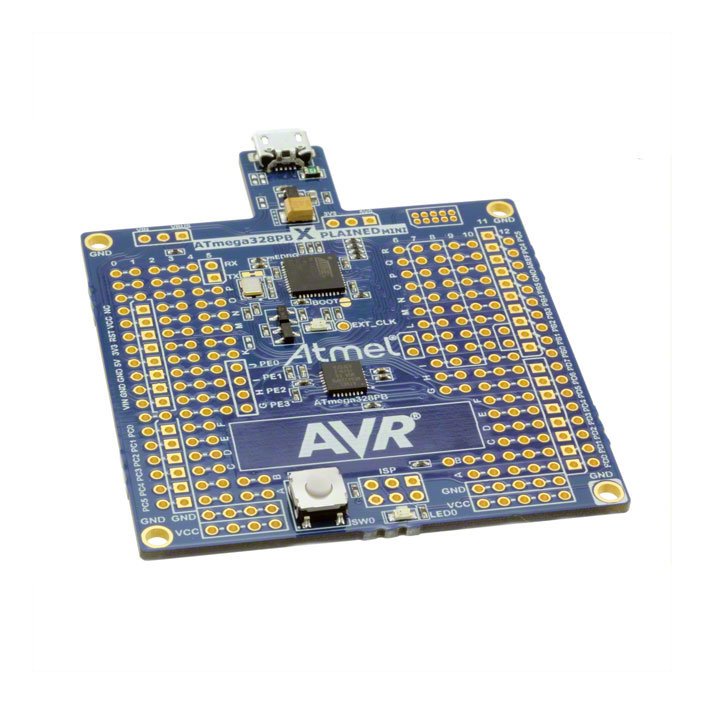
ATmega328PB application circuit schematic
5. Alternatives and Cross-Reference Guide
Direct Replacements (with caveats):
ATmega328P: The predecessor. Pin-compatible for most basic pins, but lacks the extra interfaces and PTC.
LGT8F328P: A logic clone often found in cheaper boards. Warning: Not a direct silicon copy; requires different libraries and tolerates different voltages.
Better Performance:
ESP8266/ESP32: If Wi-Fi is required onboard.
STM32 Series (e.g., STM8S003): For higher processing power requirements at similar price points.
Cost-Effective Options:
MSP430G2553: excellent low-power alternative from Texas Instruments for simple sensing tasks.
PIC18F25K22: A comparable 8-bit MCU from Microchip with different architecture.
6. Frequently Asked Questions (FAQ)
Q: What is the difference between ATmega328PB and ATmega328P?
The PB version adds 2x UART, 2x I2C, 2x SPI, and the Peripheral Touch Controller (PTC). It is not fully drop-in compatible regarding the device signature.
Q: Can ATmega328PB be used in Arduino IDE?
Yes, but you must install a third-party board core (like MiniCore) that supports the ATmega328PB signature and registers.
Q: Where can I find the datasheet and library files for ATmega328PB?
The official datasheet (ID: 40001907A) is available on the Microchip website and major distributor pages.
Q: Is ATmega328PB suitable for battery-operated devices?
Yes, its picoPower technology and wide operating voltage (1.8V-5.5V) make it excellent for battery-powered IoT nodes.
Q: How do I program/configure the ATmega328PB?
It supports In-System Programming (ISP) via SPI. Ensure your programmer (e.g., USBasp, AVRISP mkII) supports the specific signature byte of the PB.
7. Datasheets & Resources
Official Datasheet: 40001907A
Development Tools & Software: Microchip Studio, MPLAB X, Arduino IDE (with board support package)
Specifications
 LPC2148 Microcontroller: Datasheet, Price and Pinout
04 November 20217722
![What is TDA2009A 10 +10W STEREO AMPLIFIER? [FAQ&Video]](https://res.utmel.com/Images/Article/3e83d4ed-c8b7-4321-8a46-f24003f1dcb1.jpg) What is TDA2009A 10 +10W STEREO AMPLIFIER? [FAQ&Video]
What is TDA2009A 10 +10W STEREO AMPLIFIER? [FAQ&Video]25 April 202211896
 BF245 Transistors: Replacement, Pinout and Datasheet
02 September 202117493
 Essential Tips for Resolving STM32F407ZET6 Connectivity Issues
24 July 2025563
 MIC5205 150mA Low-Noise LDO Regulator: Pinout, Datasheet pdf and Circuit
25 November 20213119
 CD40106BC Hex Schmitt Trigger: Pinout, Features and Datasheet
27 May 20222119
 STM32H743I-EVAL: Specifications, Features and Applications
23 July 2025603
![The Overview of LSM6DSL [FAQ]](https://res.utmel.com/Images/Article/59a17e36-1515-4fb1-add5-9ccc80e48790.jpg) The Overview of LSM6DSL [FAQ]
The Overview of LSM6DSL [FAQ]12 July 20213176
 Always charge the battery to 100%? Stop it!
15 October 20214586
 Tantalum Capacitors Explained: How They Work, Where They Fit, and How to Use Them Safely
14 July 202613470
 What Makes Rocker Switches Unique
18 July 20251301
 What Size Wire for a 60 Amp Breaker? The Complete NEC Guide
22 May 20263634
 UTMEL Showcases One-Stop Electronic Component Sourcing Services at electronica Shanghai 2026
07 July 2026167
 The Difference and Application of SPI, UART, I2C Communication
15 October 202511980
 15 Key Elements of Diode Selection
26 November 202118971
 Power Management ICs Trends 2026: AI Demand, Supply Risks, and Sourcing Strategies
06 July 2026758
Microchip Technology
In Stock: 3300
United States
China
Canada
Japan
Russia
Germany
United Kingdom
Singapore
Italy
Hong Kong(China)
Taiwan(China)
France
Korea
Mexico
Netherlands
Malaysia
Austria
Spain
Switzerland
Poland
Thailand
Vietnam
India
United Arab Emirates
Afghanistan
Åland Islands
Albania
Algeria
American Samoa
Andorra
Angola
Anguilla
Antigua & Barbuda
Argentina
Armenia
Aruba
Australia
Azerbaijan
Bahamas
Bahrain
Bangladesh
Barbados
Belarus
Belgium
Belize
Benin
Bermuda
Bhutan
Bolivia
Bonaire, Sint Eustatius and Saba
Bosnia & Herzegovina
Botswana
Brazil
British Indian Ocean Territory
British Virgin Islands
Brunei
Bulgaria
Burkina Faso
Burundi
Cabo Verde
Cambodia
Cameroon
Cayman Islands
Central African Republic
Chad
Chile
Christmas Island
Cocos (Keeling) Islands
Colombia
Comoros
Congo
Congo (DRC)
Cook Islands
Costa Rica
Côte d’Ivoire
Croatia
Cuba
Curaçao
Cyprus
Czechia
Denmark
Djibouti
Dominica
Dominican Republic
Ecuador
Egypt
El Salvador
Equatorial Guinea
Eritrea
Estonia
Eswatini
Ethiopia
Falkland Islands
Faroe Islands
Fiji
Finland
French Guiana
French Polynesia
Gabon
Gambia
Georgia
Ghana
Gibraltar
Greece
Greenland
Grenada
Guadeloupe
Guam
Guatemala
Guernsey
Guinea
Guinea-Bissau
Guyana
Haiti
Honduras
Hungary
Iceland
Indonesia
Iran
Iraq
Ireland
Isle of Man
Israel
Jamaica
Jersey
Jordan
Kazakhstan
Kenya
Kiribati
Kosovo
Kuwait
Kyrgyzstan
Laos
Latvia
Lebanon
Lesotho
Liberia
Libya
Liechtenstein
Lithuania
Luxembourg
Macao(China)
Madagascar
Malawi
Maldives
Mali
Malta
Marshall Islands
Martinique
Mauritania
Mauritius
Mayotte
Micronesia
Moldova
Monaco
Mongolia
Montenegro
Montserrat
Morocco
Mozambique
Myanmar
Namibia
Nauru
Nepal
New Caledonia
New Zealand
Nicaragua
Niger
Nigeria
Niue
Norfolk Island
North Korea
North Macedonia
Northern Mariana Islands
Norway
Oman
Pakistan
Palau
Palestinian Authority
Panama
Papua New Guinea
Paraguay
Peru
Philippines
Pitcairn Islands
Portugal
Puerto Rico
Qatar
Réunion
Romania
Rwanda
Samoa
San Marino
São Tomé & Príncipe
Saudi Arabia
Senegal
Serbia
Seychelles
Sierra Leone
Sint Maarten
Slovakia
Slovenia
Solomon Islands
Somalia
South Africa
South Sudan
Sri Lanka
St Helena, Ascension, Tristan da Cunha
St. Barthélemy
St. Kitts & Nevis
St. Lucia
St. Martin
St. Pierre & Miquelon
St. Vincent & Grenadines
Sudan
Suriname
Svalbard & Jan Mayen
Sweden
Syria
Tajikistan
Tanzania
Timor-Leste
Togo
Tokelau
Tonga
Trinidad & Tobago
Tunisia
Turkey
Turkmenistan
Turks & Caicos Islands
Tuvalu
U.S. Outlying Islands
U.S. Virgin Islands
Uganda
Ukraine
Uruguay
Uzbekistan
Vanuatu
Vatican City
Venezuela
Wallis & Futuna
Yemen
Zambia
Zimbabwe
![ATMEGA8515L-8AU]() ATMEGA8515L-8AU
ATMEGA8515L-8AUMicrochip Technology
![DSPIC30F6014A-30I/PF]() DSPIC30F6014A-30I/PF
DSPIC30F6014A-30I/PFMicrochip Technology
![ATMEGA32A-AU]() ATMEGA32A-AU
ATMEGA32A-AUMicrochip Technology
![ATXMEGA128A1U-AU]() ATXMEGA128A1U-AU
ATXMEGA128A1U-AUMicrochip Technology
![PIC18F46K20-I/PT]() PIC18F46K20-I/PT
PIC18F46K20-I/PTMicrochip Technology
![PIC18F6722-I/PT]() PIC18F6722-I/PT
PIC18F6722-I/PTMicrochip Technology
![PIC16F883-I/SS]() PIC16F883-I/SS
PIC16F883-I/SSMicrochip Technology
![PIC16F877-20I/PT]() PIC16F877-20I/PT
PIC16F877-20I/PTMicrochip Technology
![ATMEGA8535L-8AU]() ATMEGA8535L-8AU
ATMEGA8535L-8AUMicrochip Technology
![PIC18F4685-I/PT]() PIC18F4685-I/PT
PIC18F4685-I/PTMicrochip Technology


