

 Product
 Brand
Brand Articles
 Tools
Tools
AD633: Datasheet, Pinout, and Modulation Guide

1.27mm 8 Analog Multiplier AD636 8 Pin 15V 8-SOIC (0.154, 3.90mm Width)
Unit Price: $16.398690
Ext Price: $16.40


1.27mm 8 Analog Multiplier AD636 8 Pin 15V 8-SOIC (0.154, 3.90mm Width)
Design with the AD633 4-quadrant analog multiplier. Access specs, pinout maps, and modulation circuit guides. Buy active stock or find robust replacements here.
- Executive Summary: What is the AD633?
- 1. Technical Specifications & Performance Analysis
- 2. Pinout, Package, and Configuration
- 3. Design & Integration Guide (For Engineers & Makers)
- 4. Typical Applications & Use Cases
- 5. Alternatives and Cross-Reference Guide
- 6. Frequently Asked Questions (FAQ)
- 7. Datasheets & Resources
- Specifications
- Datasheet PDF
Executive Summary: What is the AD633?
The AD633 is a low-cost, functionally complete, four-quadrant analog multiplier designed for real-time operations such as modulation, demodulation, and power measurement without the need for complex external components.
Market Position: An industry-standard, low-cost solution for analog signal processing, balancing price with laser-trimmed accuracy.
Top Features: High impedance differential X and Y inputs (10 MΩ), 10 V full-scale output, and complete monolithic integration (no external trimming required).
Primary Audience: Ideal for analog design engineers, audio synthesizer developers (Eurorack), and students working on instrumentation projects.
Supply Status: Active and In Stock. (Refer to distributor listings for real-time quantities).
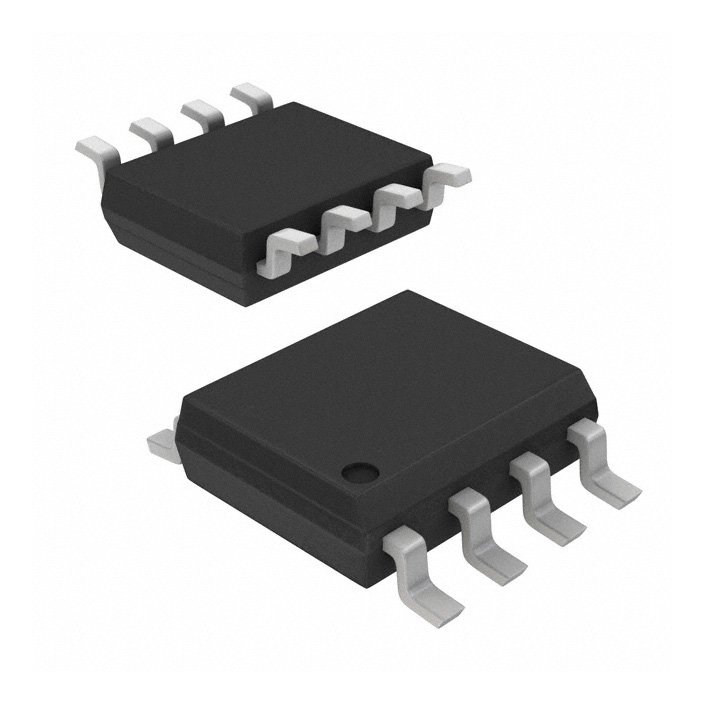
AD633 product photo
1. Technical Specifications & Performance Analysis
1.1 Core Architecture (Functionality)
The AD633 operates as a translinear analog multiplier. Unlike earlier generations that required extensive external circuitry, it includes a buried Zener reference and a unity gain summing amplifier. It performs the transfer function $W = \frac{(X1-X2)(Y1-Y2)}{10V} + Z$, making it incredibly versatile for algebraic analog operations. The "Brain" of this chip is its ability to handle four-quadrant multiplication, meaning it accepts positive and negative voltages on both inputs.
1.2 Key Electrical Characteristics
Engineers must verify these operating limits to ensure design stability:
Supply Voltage: ±8 V to ±18 V (Dual supply required).
Bandwidth: 1 MHz (-3 dB small signal).
Slew Rate: 20 V/µs typical.
Total Error: Within 2% of full scale (Laser-trimmed).
Input Impedance: 10 MΩ on X and Y inputs, minimizing loading effects on source signals.
1.3 Interfaces and Connectivity
The AD633 is a purely analog device. It does not use digital buses like I2C or SPI. - Inputs: Differential high-impedance inputs (X1, X2, Y1, Y2) allow for easy interfacing with op-amps and sensors. - Summing Input: The Z input allows the cascading of multipliers or the addition of signals for mixing applications. - Output: Low impedance output (W) drives loads directly (nominal 10 V full scale).
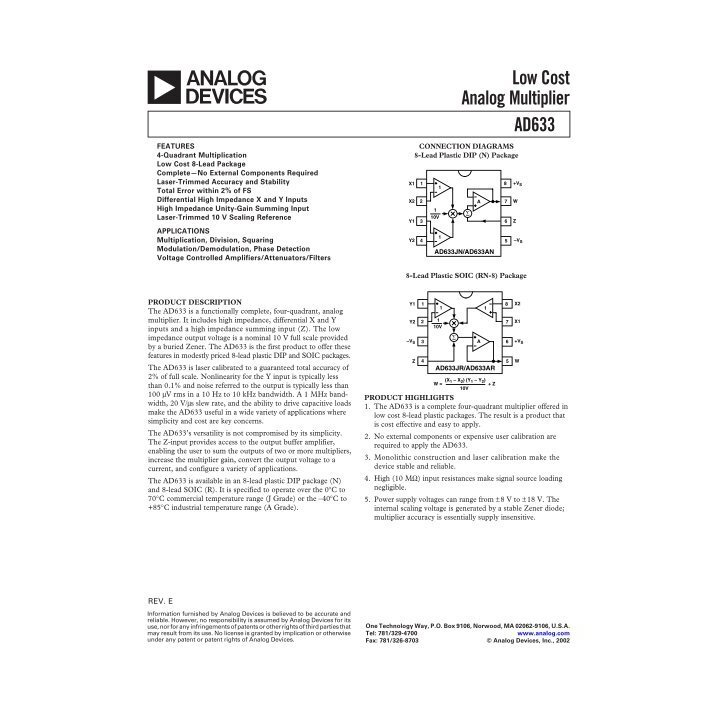
AD633 functional block diagram
2. Pinout, Package, and Configuration
2.1 Pin Configuration Guide
The AD633 typically comes in an 8-lead package. Understanding the differential inputs is key to avoiding ground loops.
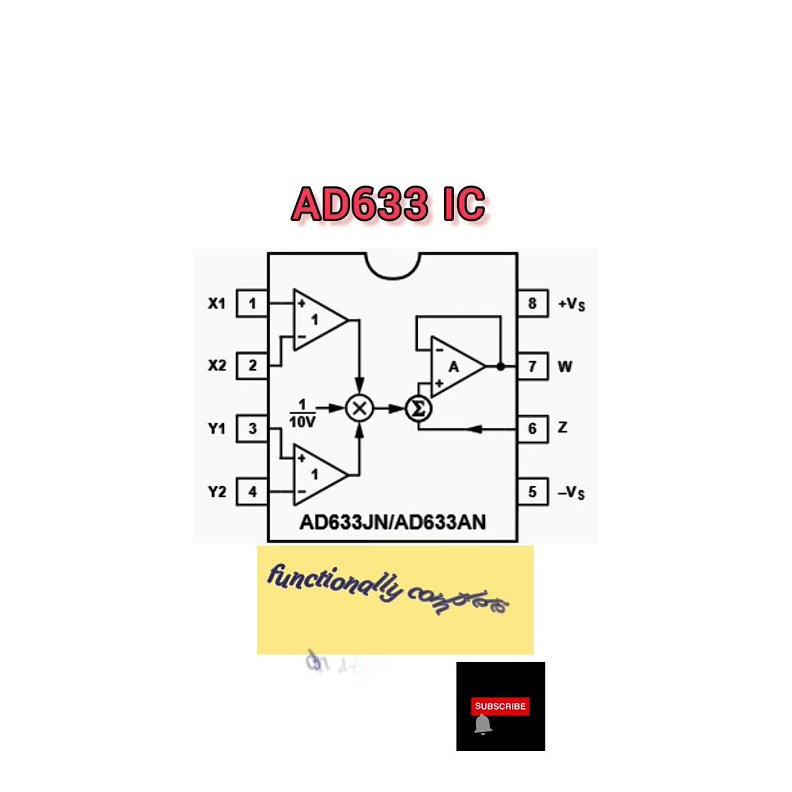
AD633 pinout diagram
Pin 1 & 2 (X1, X2): Differential X inputs.
Pin 3 & 4 (Y1, Y2): Differential Y inputs.
Pin 5 (V-): Negative Power Supply (e.g., -15V).
Pin 6 (Z): Summing Input.
Pin 7 (W): Product Output.
Pin 8 (V+): Positive Power Supply (e.g., +15V).
2.2 Naming Convention & Ordering Codes
Understanding the Part Numbers:
Suffix "A" vs "J": Denotes accuracy grade and temperature range.
Suffix "N": PDIP Package (Plastic Dual In-Line Package).
Suffix "R" or "RZ": SOIC Package (Small Outline typical for SMD). "Z" indicates RoHS/Lead-Free.
Suffix "EP": Enhanced Product (Aerospace/Defense grade).
2.3 Available Packages
| Package Type | Dimensions (Ref) | Common Use Case |
|---|---|---|
| AD633AN | 8-Lead PDIP | Breadboarding, prototyping, and DIP socket legacy repairs. |
| AD633AR/ARZ | 8-Lead SOIC | Modern mass production, compact PCBs. |
| AD633JRZ | 8-Lead SOIC | Commercial temperature range applications. |
| AD633-EP | 8-Lead SOIC | High-reliability defense and aerospace systems. |
3. Design & Integration Guide (For Engineers & Makers)
Pro Tip: While the AD633 is robust, it is sensitive to power supply noise. Always verify pin compatibility if migrating from the AD534, as pinouts differ.
3.1 Hardware Implementation
Bypass Capacitors: Place 0.1 µF ceramic capacitors in parallel with 10 µF electrolytic capacitors as close as possible to Pin 5 (V-) and Pin 8 (V+) to filter supply ripple.
PCB Layout: Use a solid ground plane. Keep the input traces (X/Y) away from high-current switching traces to prevent capacitive coupling.
Thermal Management: The standard SOIC/PDIP packages generally operate without heatsinks under normal load conditions given the low quiescent current.
3.2 Common Design Challenges
Below are common issues reported by designers, with solutions derived from technical forums and datasheets.
Issue: Noise Floor in Audio Applications
Symptom: Audible hiss in synthesizer VCA designs.
Fix: The AD633 is general-purpose. For high-fidelity audio, consider a dedicated VCA like the THAT2181 or implement aggressive low-pass filtering on the output.
Issue: Bandwidth Limitations (RF)
Symptom: Signal roll-off when working with frequencies >1 MHz.
Fix: The 1 MHz bandwidth is insufficient for RF. Switch to high-speed multipliers like the AD835 for MHz-range signals.
Issue: Feedthrough Leakage
Symptom: Signal leaks from Input X to Output W even when Input Y is zero.
Fix: Utilize the Z-input for offset nulling to cancel out feedthrough or select higher-grade variants.
4. Typical Applications & Use Cases
The AD633 is extensively used in:
Analog Computing: Real-time squaring and division.
Modulation: Amplitude Modulation (AM) and Ring Modulation.
Power Measurement: Instantaneous power calculation ($P = V \times I$).
4.1 Real-World Example: Voltage-Controlled Amplifier (VCA)
In analog synthesizers, the AD633 acts as a VCA. An audio signal is applied to the X input, and a control voltage (Envelope Generator) is applied to the Y input. The multiplier scales the audio amplitude based on the control voltage, effectively controlling the "volume" dynamically to create the note's envelope (Attack, Decay, Sustain, Release).
5. Alternatives and Cross-Reference Guide
Direct Replacements & Competitors:
Texas Instruments MPY634: Extremely popular alternative, often used in similar sockets.
Renesas HA-2556: Another 4-quadrant analog multiplier option.
Burr-Brown (TI) MPY100: Legacy alternative.
High-Precision Upgrade:
Analog Devices AD534: Offers higher precision and lower trim errors but at a higher cost.
Cost-Effective/Maker Options:
Basic "Euro-rack" style diode ring modulators (discrete components) can substitute for the AD633 in Lo-Fi audio if cost is the only driver, though accuracy drops significantly.
6. Frequently Asked Questions (FAQ)
Q: What is the main difference between AD633 and AD534?
The AD534 is a higher precision, lower noise part with a different pinout. The AD633 is the low-cost, industry-standard version.
Q: Can the AD633 be used in single-supply applications?
Generally, no. The definition specifies a dual supply (±8V to ±18V) is required for proper 4-quadrant operation.
Q: How do I calculate the output voltage?
The formula is $W = \frac{(X1-X2)(Y1-Y2)}{10} + Z$. The division by 10V is the scaling factor.
Q: Is the AD633 suitable for Arduino or STM32 interfacing?
Directly, no. It requires analog voltages. You would need Dual DACs (Digital-to-Analog Converters) to drive the X/Y inputs from a microcontroller.
Q: Where can I find the datasheet for the AD633?
The official datasheet is available from Analog Devices or authorized distributors like Mouser/DigiKey.
7. Datasheets & Resources
Official Datasheet: AD633 PDF Download
Development Tools: Look for "Analog Multiplier Breakout" boards or generic SOIC-to-DIP adapters for testing.
Specifications
Datasheet PDF
- Datasheets :
- ConflictMineralStatement :
 TIP102 NPN Transistor: Datasheet, Pinout, and Application
05 November 20216539
 STM32F051C8T6 Microcontroller: Features, Applications and Datasheet
08 December 2023836
 HEF4094BT Shift Register: Pinout, Datasheet, Functional Diagram
16 February 20226421
 MCP23008 Expander: Features, Pinout, and Datasheet
23 December 20214718
 CA3130 Operational Amplifier IC: Pinout, Equivalent and Datasheet
15 September 20219822
 74HC73 Dual JK Flip-flop Trigger: Pinout, Equivalent and Datasheet
26 November 202113475
 LM35 Sensor: Pinout, Alternatives and Datasheet
26 August 202113569
 STM32F103xx Performance Line Microcontroller: A Comprehensive Technical Examination
29 February 2024186
 The Era of UFS 4.0, Announced?
06 May 20227425
 General PCB Layout Design Guidelines for RF and Digital-to-Analog Circuits
20 January 202214174
 What is Transceiver?
30 September 20214051
 Utmel Christmas and New Year Carnival
07 December 20204096
 Working Principle and Application of Infrared Sensors
27 October 202517168
 What is RFID?
23 March 20217072
 800G Optical Transceivers: The Guide for AI Data Centers
24 December 202510358
 Advanced Aircraft Power Electronics Systems and Influence of Simulation, Standards, and Wide Band-Gap Devices
18 February 20242905
Analog Devices Inc.
In Stock: 129
Minimum: 1 Multiples: 1
Qty
Unit Price
Ext Price
1
$16.398690
$16.40
10
$15.470462
$154.70
100
$14.594776
$1,459.48
500
$13.768656
$6,884.33
1000
$12.989298
$12,989.30
Not the price you want? Send RFQ Now and we'll contact you ASAP.
Inquire for More Quantity
![AD534SD]() AD534SD
AD534SDAnalog Devices Inc.
![AD633ARZ]() AD633ARZ
AD633ARZAnalog Devices Inc.
![AD534KHZ]() AD534KHZ
AD534KHZAnalog Devices Inc.
![AD633ARZ-R7]() AD633ARZ-R7
AD633ARZ-R7Analog Devices Inc.
![AD633JNZ]() AD633JNZ
AD633JNZAnalog Devices Inc.
![AD633JRZ]() AD633JRZ
AD633JRZAnalog Devices Inc.
![AD633JRZ-R7]() AD633JRZ-R7
AD633JRZ-R7Analog Devices Inc.
![AD835ARZ]() AD835ARZ
AD835ARZAnalog Devices Inc.
![AD633JRZ-RL]() AD633JRZ-RL
AD633JRZ-RLAnalog Devices Inc.
![AD633ARZ-RL]() AD633ARZ-RL
AD633ARZ-RLAnalog Devices Inc.


