

 Product
 Brand
Brand Articles
 Tools
Tools
AD9833: Detailed Datasheet, Pinout, and Alternatives Guide

10 Termination 0.5mm Gold Direct Digital Synthesis AD9833 10 Pin 25MHz 2.5V 10-TFSOP, 10-MSOP (0.118, 3.00mm Width)


10 Termination 0.5mm Gold Direct Digital Synthesis AD9833 10 Pin 25MHz 2.5V 10-TFSOP, 10-MSOP (0.118, 3.00mm Width)
Explore the AD9833 DDS waveform generator datasheet. Get comprehensive pinout details, electrical specs, and design tips for low-power applications.
- Executive Summary: What is the AD9833?
- 1. Technical Specifications & Performance Analysis
- 2. Pinout, Package, and Configuration
- 3. Design & Integration Guide (For Engineers & Makers)
- 4. Typical Applications & Use Cases
- 5. Alternatives and Cross-Reference Guide
- 6. Frequently Asked Questions (FAQ)
- 7. Datasheets & Resources
- Specifications
- Parts with Similar Specs
- Datasheet PDF
Executive Summary: What is the AD9833?
The AD9833 is a low-power, programmable Direct Digital Synthesis (DDS) waveform generator capable of producing sine, triangular, and square wave outputs, widely used in frequency stimulus and sensing applications. It is engineered to provide a high-precision analog output from a digital reference clock.
Market Position: A highly efficient, low-cost solution for generating signals up to 12.5 MHz without the power overhead of legacy DDS chips.
Top Features:
Ultra-low power consumption of 12.65 mW at 3 V.
High precise 28-bit resolution (0.1 Hz tuning at 25 MHz clock).
Simple 3-wire SPI interface compatible with most microcontrollers.
Primary Audience: Ideal for IoT designers, test equipment engineers, and makers building portable signal generators.
Supply Status: Active. Available in standard industrial and automotive-qualified variants.
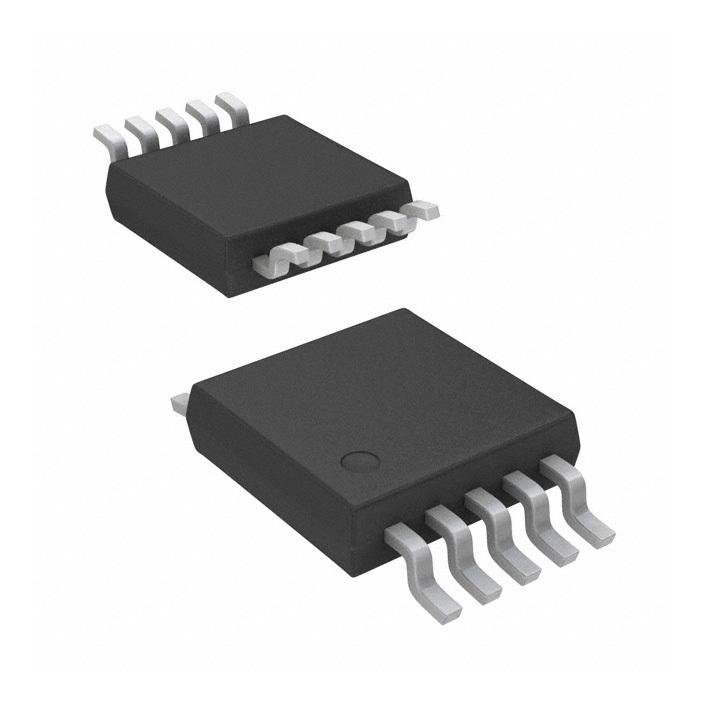
AD9833 product photo
1. Technical Specifications & Performance Analysis
1.1 Core Architecture (CPU/Logic/Power)
The AD9833 operates on the principle of Direct Digital Synthesis. It utilizes a numerical controlled oscillator (NCO) or phase accumulator to determine the frequency of the output signal. The digital phase information is converted into a digital amplitude via an on-chip SIN ROM look-up table, which is then passed through a digital-to-analog converter (DAC). This architecture allows for rapid frequency switching and fine resolution tuning, making it superior to analog oscillators in digital systems.
1.2 Key Electrical Characteristics
For portable and battery-operated designs, the AD9833 is a standout performer regarding power efficiency.
Input Voltage (VDD): 2.3 V to 5.5 V (Broad compatibility with 3.3V and 5V logic).
Power Dissipation: 12.65 mW at 3 V (Critical for thermal management in dense PCBs).
Output Frequency Range: 0 MHz to 12.5 MHz (Assuming a 25 MHz Master Clock).
Operating Temperature: -40°C to +105°C (Industrial and Automotive grade resilience).
1.3 Interfaces and Connectivity
The device communicates via a standard 3-wire SPI interface (Serial Peripheral Interface). This serial interface operates at clock rates up to 40 MHz, facilitating fast frequency modulation.
Control: Fully programmable frequency and phase registers.
Power Management: Includes a software-controlled SLEEP function to power down unused sections of the DAC, minimizing current draw when idle.
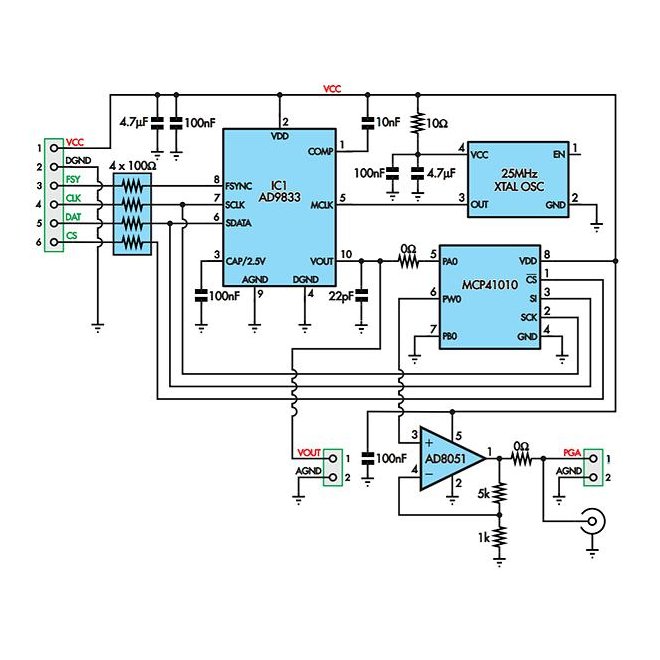
AD9833 functional block diagram
2. Pinout, Package, and Configuration
2.1 Pin Configuration Guide
The AD9833 is packed into a compact 10-lead MSOP. Below are the critical pin groupings:
Power Supply (VDD, AGND, DGND): Pins to supply 2.3 V - 5.5 V. Proper grounding is essential to minimize noise on the analog output.
Digital Interface (SDATA, SCLK, FSYNC): The SPI lines. FSYNC acts as the chip select.
Clock Input (MCLK): The reference clock (master clock) input, typically 25 MHz.
Analog Output (VOUT): The pin carrying the generated waveform.
Programming (CAP/2.5V): Internal regulator bypass or connection point.
2.2 Naming Convention & Ordering Codes
Understanding the Part Numbers:Analog Devices uses specific suffixes to denote package and qualification levels. Procurement managers should note:
BRUZ: Industrial temperature range, RoHS compliant.
WBRUZ: Automotive qualified.
REEL: Tape and Reel packaging format for automated assembly.
-EP: Enhanced Product (Defense/Aerospace specs).
2.3 Available Packages
| Package Type | Dimensions | Common Use Case |
|---|---|---|
| AD9833BRUZ | 10-lead MSOP | General consumer and industrial electronics. |
| AD9833WBRUZ | 10-lead MSOP | Automotive applications requiring AEC-Q100 compliance. |
| AD9833-EP | 10-lead MSOP | High-reliability defense and aerospace systems. |
3. Design & Integration Guide (For Engineers & Makers)
Pro Tip: While the AD9833 is versatile, its direct output is unbuffered and has a DC offset. Always verify signal conditioning circuitry before connecting to a load.
3.1 Hardware Implementation
Bypass Capacitors: Place a 100 nF ceramic capacitor and a 10 µF tantalum capacitor as close as possible to the VDD pin to decouple high-frequency noise.
PCB Layout: Separate analog and digital ground planes are recommended to prevent digital switching noise from coupling into the VOUT signal.
Thermal Management: Due to low power dissipation (12.65 mW), a heatsink is generally not required.
3.2 Common Design Challenges
Based on data from engineering forums and application notes, here are the top "Pain Points" and solutions:
Significant DC Offset
The Issue: The output signal rides on a DC level (typically approx 0.6V to 0.65V bias), which prevents it from being centered around 0V.
The Fix: Use a coupling capacitor for AC-only requirements, or implement an active op-amp circuit with offset nulling for DC-coupled applications.
Low Output Amplitude
The Issue: The peak-to-peak output voltage is roughly 0.6V pp, which is insufficient for driving substantial loads directly.
The Fix: Integrate a high-speed operational amplifier (like the AD8051) in a non-inverting gain configuration to buffer and amplify the signal.
Waveform Distortion at High Frequencies
The Issue: As frequency nears the Nyquist limit, aliasing images appear in the spectrum.
The Fix: Design a steep low-pass reconstruction filter (Elliptic or Butterworth) placed after the output to suppress clock feedthrough and images.
Complex Register Configuration
The Issue: Direct SPI bit-banging of the 16-bit control words can be error-prone.
The Fix: Use established software libraries (e.g., specific STM32 HAL drivers or Arduino libraries like
MD_AD9833) to abstract the bit manipulation.
4. Typical Applications & Use Cases
📺 Video Recommendation: AD9833 Guide
4.1 Real-World Example: Liquid Flow Measurement
In industrial flow meters, the AD9833 is utilized to generate a specific frequency excitation signal for ultrasonic or electromagnetic transducers. - The Role: The chip provides a stable, drift-free sine wave stimulus. - The Benefit: Its ability to rapidly change phase enables precise time-of-flight measurements, critical for determining flow velocity.
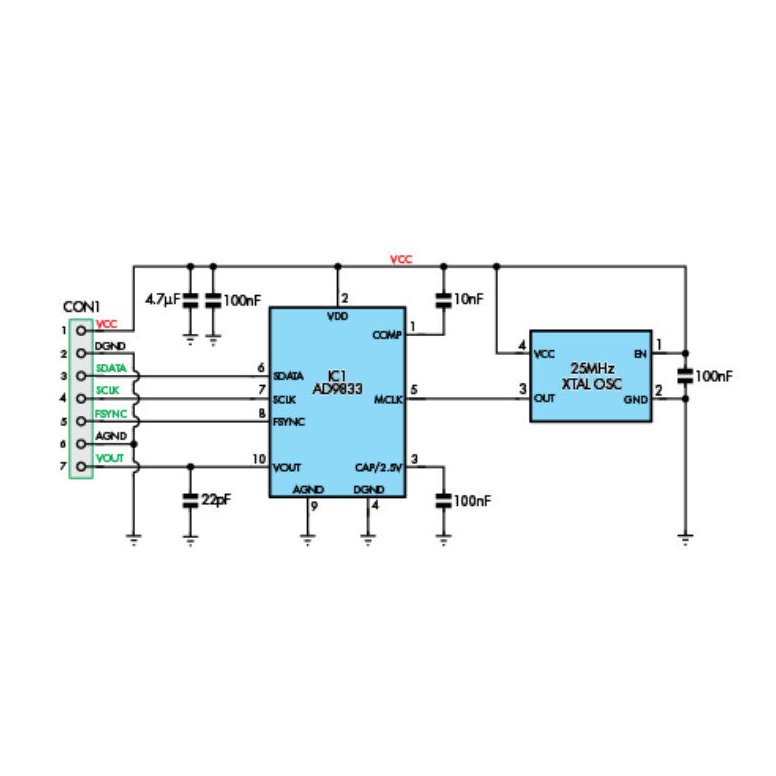
AD9833 application circuit schematic
5. Alternatives and Cross-Reference Guide
If the AD9833 is out of stock or does not meet specific frequency requirements, consider these alternatives:
Direct Competitors/Family:
AD9834: Similar to AD9833 but adds a comparator on-chip, useful for generating square waves with variable duty cycles.
AD9850/AD9851: Older generation, higher power consumption but often easier to find in hobbyist modules.
Different Technology:
Si5351A: A clock generator rather than a true DDS waveform generator. It produces square waves only (no native sine/triangle) but offers multiple outputs and higher frequencies.
Obsolete Parts:
MAX038: A legendary function generator chip, now obsolete. The AD9833 is a modern, digital replacement for many of its low-frequency functions.
6. Frequently Asked Questions (FAQ)
Q: What is the difference between AD9833 and AD9850? The AD9833 is significantly lower power (12.65 mW vs ~380 mW for AD9850) and smaller, but the AD9850 can handle higher clock rates in some configurations.
Q: Can AD9833 be used in automotive applications? Yes, but you must specify the AD9833WBRUZ variant which is qualified for automotive environments.
Q: Is AD9833 suitable for battery-operated devices? Absolutely. With a power-down SLEEP mode and low operating current, it is designed for portable equipment.
Q: How do I remove the DC offset from the output? You must use an external circuit, such as a series capacitor (high-pass filter) or an op-amp level shifter, as the DAC output is unipolar.
Q: What libraries are available for development? For Arduino users, the
MD_AD9833library is a popular choice that simplifies setting frequency and wave shape.
7. Datasheets & Resources
Official Datasheet: AD9833 PDF Download
Development Tools: Look for "AD9833 Breakout" or "DDS Module" for rapid prototyping.
AD9833 footprint symbol
Specifications
Parts with Similar Specs
- ImagePart NumberManufacturerPackage / CaseNumber of PinsSupply VoltageTerminal PitchMoisture Sensitivity Level (MSL)LengthTerminal PositionPin CountView Compare
![AD9833SRMZ-EP-RL7]()
AD9833SRMZ-EP-RL7
10-TFSOP, 10-MSOP (0.118, 3.00mm Width)
10
2.5 V
0.5 mm
1 (Unlimited)
3 mm
DUAL
10
![MCP4728-E/UN]()
10-TFSOP, 10-MSOP (0.118, 3.00mm Width)
10
3 V
0.5 mm
1 (Unlimited)
3 mm
DUAL
10
![AD5161BRMZ10]()
10-TFSOP, 10-MSOP (0.118, 3.00mm Width)
10
3 V
0.5 mm
1 (Unlimited)
3 mm
DUAL
10
![AD9833BRMZ]()
10-TFSOP, 10-MSOP (0.118, 3.00mm Width)
10
2.5 V
0.5 mm
1 (Unlimited)
3 mm
DUAL
10
![AD5161BRMZ100]()
10-TFSOP, 10-MSOP (0.118, 3.00mm Width)
10
5 V
0.5 mm
1 (Unlimited)
3 mm
DUAL
10


Datasheet PDF
- Datasheets :
- ConflictMineralStatement :
 LM1117MP-3.3 Voltage Regulator: Pinout, Datasheet and Schematic
06 September 202110524
 S8050 NPN Silicon Transistors: Datasheet, Pinout and Equivalent
30 August 2021134930
 NEMA17: Stepper Motor, Applications, Features
31 March 20229202
 TPS4H160BQPWPRQ1: 28-PowerTSSOP Package, High-Side Switch, FETs
28 February 2022852
 Introduction to MSP430G2x11 and MSP430G2x01 Mixed-Signal Microcontrollers
29 February 2024186
 SE200 Gas Discharge Tube: Datasheet, Application, Advantage
31 July 20211140
 CR1220 Lithium Coin Battery:Equivalent, Application, Datasheet
17 August 202112214
 STM32F103RCT6 Microcontroller: 72MHz, 64-LQFP, Pinout and Datasheet
07 February 20228950
 What is a Motherboard Chipset? A Guide to 2026 Architecture
12 June 20267566
 SR626SW Battery Equivalent: Technical Specs, Chemistries, and Selection Guide
26 May 20261694
 Arduino Based Gas Leakage Detection
29 August 202310135
 How to Generate Negative Voltage: 5V to -5V Circuit Analysis & Schemes
05 January 202610461
 What is LED Drive Power?
18 March 2022900
 Bridge Rectifier: Functions, Circuits and Applications
03 November 202016046
 UTMEL 2024 Annual gala: Igniting Passion, Renewing Brilliance
18 January 20245026
 What is First In First Out (FIFO)?
30 November 20213852
Analog Devices Inc.
In Stock
United States
China
Canada
Japan
Russia
Germany
United Kingdom
Singapore
Italy
Hong Kong(China)
Taiwan(China)
France
Korea
Mexico
Netherlands
Malaysia
Austria
Spain
Switzerland
Poland
Thailand
Vietnam
India
United Arab Emirates
Afghanistan
Åland Islands
Albania
Algeria
American Samoa
Andorra
Angola
Anguilla
Antigua & Barbuda
Argentina
Armenia
Aruba
Australia
Azerbaijan
Bahamas
Bahrain
Bangladesh
Barbados
Belarus
Belgium
Belize
Benin
Bermuda
Bhutan
Bolivia
Bonaire, Sint Eustatius and Saba
Bosnia & Herzegovina
Botswana
Brazil
British Indian Ocean Territory
British Virgin Islands
Brunei
Bulgaria
Burkina Faso
Burundi
Cabo Verde
Cambodia
Cameroon
Cayman Islands
Central African Republic
Chad
Chile
Christmas Island
Cocos (Keeling) Islands
Colombia
Comoros
Congo
Congo (DRC)
Cook Islands
Costa Rica
Côte d’Ivoire
Croatia
Cuba
Curaçao
Cyprus
Czechia
Denmark
Djibouti
Dominica
Dominican Republic
Ecuador
Egypt
El Salvador
Equatorial Guinea
Eritrea
Estonia
Eswatini
Ethiopia
Falkland Islands
Faroe Islands
Fiji
Finland
French Guiana
French Polynesia
Gabon
Gambia
Georgia
Ghana
Gibraltar
Greece
Greenland
Grenada
Guadeloupe
Guam
Guatemala
Guernsey
Guinea
Guinea-Bissau
Guyana
Haiti
Honduras
Hungary
Iceland
Indonesia
Iran
Iraq
Ireland
Isle of Man
Israel
Jamaica
Jersey
Jordan
Kazakhstan
Kenya
Kiribati
Kosovo
Kuwait
Kyrgyzstan
Laos
Latvia
Lebanon
Lesotho
Liberia
Libya
Liechtenstein
Lithuania
Luxembourg
Macao(China)
Madagascar
Malawi
Maldives
Mali
Malta
Marshall Islands
Martinique
Mauritania
Mauritius
Mayotte
Micronesia
Moldova
Monaco
Mongolia
Montenegro
Montserrat
Morocco
Mozambique
Myanmar
Namibia
Nauru
Nepal
New Caledonia
New Zealand
Nicaragua
Niger
Nigeria
Niue
Norfolk Island
North Korea
North Macedonia
Northern Mariana Islands
Norway
Oman
Pakistan
Palau
Palestinian Authority
Panama
Papua New Guinea
Paraguay
Peru
Philippines
Pitcairn Islands
Portugal
Puerto Rico
Qatar
Réunion
Romania
Rwanda
Samoa
San Marino
São Tomé & Príncipe
Saudi Arabia
Senegal
Serbia
Seychelles
Sierra Leone
Sint Maarten
Slovakia
Slovenia
Solomon Islands
Somalia
South Africa
South Sudan
Sri Lanka
St Helena, Ascension, Tristan da Cunha
St. Barthélemy
St. Kitts & Nevis
St. Lucia
St. Martin
St. Pierre & Miquelon
St. Vincent & Grenadines
Sudan
Suriname
Svalbard & Jan Mayen
Sweden
Syria
Tajikistan
Tanzania
Timor-Leste
Togo
Tokelau
Tonga
Trinidad & Tobago
Tunisia
Turkey
Turkmenistan
Turks & Caicos Islands
Tuvalu
U.S. Outlying Islands
U.S. Virgin Islands
Uganda
Ukraine
Uruguay
Uzbekistan
Vanuatu
Vatican City
Venezuela
Wallis & Futuna
Yemen
Zambia
Zimbabwe
![AD9834BRUZ]() AD9834BRUZ
AD9834BRUZAnalog Devices Inc.
![AD9850BRSZ]() AD9850BRSZ
AD9850BRSZAnalog Devices Inc.
![AD9832BRUZ]() AD9832BRUZ
AD9832BRUZAnalog Devices Inc.
![AD9834CRUZ]() AD9834CRUZ
AD9834CRUZAnalog Devices Inc.
![AD9833BRMZ-REEL7]() AD9833BRMZ-REEL7
AD9833BRMZ-REEL7Analog Devices Inc.
![AD9834BRUZ-REEL]() AD9834BRUZ-REEL
AD9834BRUZ-REELAnalog Devices Inc.
![AD5932YRUZ]() AD5932YRUZ
AD5932YRUZAnalog Devices Inc.
![AD9837BCPZ-RL7]() AD9837BCPZ-RL7
AD9837BCPZ-RL7Analog Devices Inc.
![AD9858BSVZ]() AD9858BSVZ
AD9858BSVZAnalog Devices Inc.
![AD9852ASVZ]() AD9852ASVZ
AD9852ASVZAnalog Devices Inc.


