

AD8232 Single-Lead ECG Front End Design Guide

20 Terminations ECG Front End 20 Pin AD8232 Specialized ICs 1 Functions 3V Min 2V V Max 3.5V V


20 Terminations ECG Front End 20 Pin AD8232 Specialized ICs 1 Functions 3V Min 2V V Max 3.5V V
The AD8232 is an ultra-low power biopotential AFE for wearable heart rate monitors. Master noise rejection, RLD filtering, and PCB layout integration.
- Key Takeaway
- 1. Technical Architecture and Core Advantages
- 2. Naming / Variant Map and Selection Guide
- 3. Key Specifications Explained
- 4. Design Notes and Common Integration Issues
- 5. Typical Applications
- 6. Competitors and Alternatives
- 7. FAQ
- 8. Resources and Downloads
- Specifications
- Parts with Similar Specs
- Datasheet PDF
Key Takeaway
Here is the executive summary for hardware engineers evaluating the Analog Devices AD8232:
Positioning: Designed exclusively for biopotential signal acquisition (ECG/EKG) in wearables where size and power are constrained. It replaces discrete instrumentation amplifiers with a single-chip solution optimized for motion artifact rejection.
Key Spec Highlight: 170 µA typical supply current, enabling extended continuous monitoring on coin-cell batteries.
Supply Chain Status: Active. Highly popular in both professional medical prototyping and the "Maker" community (SparkFun/Arduino ecosystems), though designers should verify authorized distributors to avoid generic clone modules.
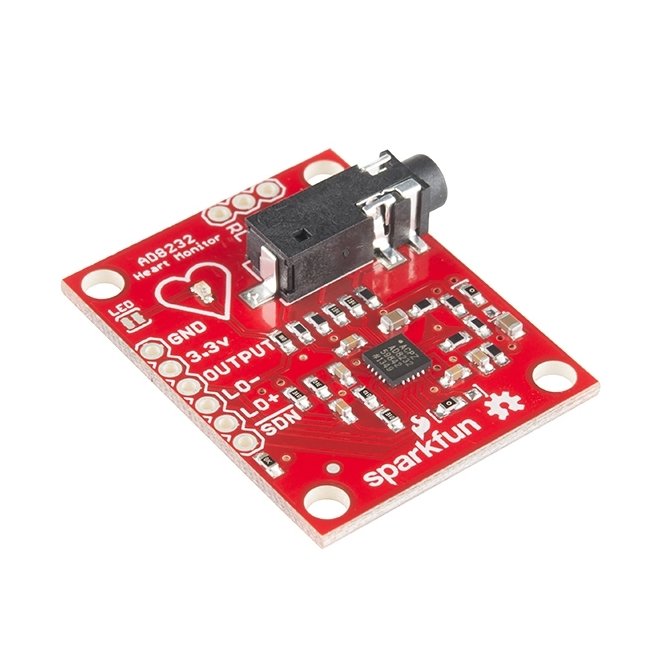
AD8232 product photo
1. Technical Architecture and Core Advantages
The AD8232 is an integrated analog front end (AFE) designed to extract, amplify, and filter small biopotential signals in mechanically noisy environments (such as a person walking or exercising). Unlike general-purpose instrumentation amplifiers, the AD8232 includes specific circuitry to combat motion artifacts and electrode offsets.
1.1 Processing & Control (Analog Architecture)
The AD8232 is not a microcontroller; it is a signal conditioning block. It does not contain a CPU or Flash memory.
Core Function: It operates as a composite amplifier consisting of a specialized instrumentation amplifier (InAmp) front end and an operational amplifier for additional gain and filtering.
Digital Interaction: While the signal chain is analog, it includes digital control pins for Low Power Shutdown (SDN) and Lead-Off Detection (LO+, LO-), allowing a host MCU to put the chip to sleep or detect if electrodes are disconnected.
1.2 Peripherals & Interfaces
The device bridges the gap between biological signals and digital processing.
Output Interface: Provides a conditioned single-ended analog voltage output compatible with the ADC of standard microcontrollers (e.g., STM32, ESP32, or ATmega).
Right Leg Drive (RLD): A dedicated amplifier that drives an opposing signal into the patient to cancel common-mode interference (like 50Hz/60Hz mains hum), significantly improving the Common-Mode Rejection Ratio (CMRR).
Fast Restore: A feature that automatically adjusts the filter cutoff to recover the signal quickly after a "lead-off" event (e.g., user adjusting electrodes).
2. Naming / Variant Map and Selection Guide
2.1 Part Number Decoding
The specific suffix determines the packaging and shipping method.
AD8232: Base Part Number (Single-Lead Heart Rate Monitor Front End).
A: Product Grade (Industrial temperature range -40°C to +85°C).
CPZ: Package Designator (LFCSP, Lead Frame Chip Scale Package).
-R7: Tape and Reel (7-inch reel).
-WP: Waffle Pack (Tray).
-EVALZ: Evaluation Board.
2.2 Core Variant Comparison
| Variant | Key Differences | Package | Target Use |
|---|---|---|---|
| AD8232ACPZ-R7 | 7-inch Tape & Reel | 20-Lead LFCSP (4mm x 4mm) | High-volume Automated Manufacturing |
| AD8232ACPZ-WP | Waffle Pack / Tray | 20-Lead LFCSP (4mm x 4mm) | Prototyping / Low-volume Assembly |
| AD8232-EVALZ | Full PCB with connectors | N/A (Dev Board) | Initial testing & Firmware development |
3. Key Specifications Explained
Engineer's Note: Values below are typical. Always consult the specific datasheet for max/min limits.
3.1 Power & Operating Conditions
The AD8232 is optimized for battery-operated portable devices.
Supply Voltage: 2.0 V to 3.5 V. This range is perfect for single Lithium-Polymer (LiPo) cells (nominally 3.7V, regulated down) or CR2032 coin cells (3.0V).
Supply Current: 170 µA (typical). This ultra-low consumption allows for "always-on" monitoring capability in fitness trackers without draining the battery rapidly.
3.2 Performance & Efficiency
Common-Mode Rejection Ratio (CMRR): 80 dB (DC to 60 Hz). This is the critical metric for ECG applications, indicating the chip's ability to reject line noise picked up by the human body acting as an antenna.
Internal Gain: The instrumentation amplifier provides a fixed gain of 100 V/V, with capability for additional gain adjustment via external circuitry.
Input Impedance: High impedance (>10 GΩ) is maintained to prevent signal degradation from dry skin contact resistance.
4. Design Notes and Common Integration Issues
4.1 PCB Layout Guidelines
Bipotential signals are in the microvolt/millivolt range, making layout critical.
Power Rails: Decouple VDD with a 0.1µF ceramic capacitor placed as close as possible to the supply pin (Pin 10) and ground. Use a 1µF or larger bulk capacitor nearby to stabilize source fluctuations.
Grounding: Use a solid ground plane. Keep the analog signal path away from high-switching digital traces (like clock lines or PWM outputs) to prevent inductive coupling.
Input Symmetry: Keep the traces for IN+ and IN- symmetrical and close together to maximize noise rejection.
Shielding: If using long cables to electrodes, consider driving the cable shield with the output of the RLD amplifier (buffered) to reduce capacitance effects.
4.2 Debugging Common Faults (Pain Points)
Problem 1: 50Hz/60Hz Power Line Interference- Symptom: A strong 50Hz/60Hz square wave or "buzz" dominates the output signal, obscuring the heartbeat. - Root Cause: The body acts as an antenna for mains voltage. Floating inputs or lack of common-mode suppression. - Fix: Connect the Right Leg Drive (RLD) electrode to the user. This actively drives the body potential to cancel out the interference. Additionally, use shielded electrode cables.
Problem 2: Filter Configuration Complexity- Symptom: The signal looks distorted, or the baseline wanders too much (high-pass issue), or high-frequency noise remains (low-pass issue).
Root Cause: The AD8232 relies on external Resistor (R) and Capacitor (C) values to set the high-pass and low-pass filter cutoffs. The default values for ECG might not fit EMG or other biopotentials.
Fix: Recalculate component values. The device uses a two-pole high-pass and a three-pole low-pass filter topology. Use the formulas in the datasheet to tune the bandwidth (e.g., 0.5Hz – 40Hz for monitoring vs. 0.05Hz – 100Hz for diagnostic).
5. Typical Applications
📺 Video Recommendation: AD8232 Guide
5.1 System Integration Analysis
Target Application: Portable Fitness Heart Rate Monitor. In this application, the AD8232 solves the problem of motion artifacts. When a user runs, the skin-electrode interface voltage changes, creating large low-frequency artifacts.
Solution: The AD8232 utilizes a two-pole high-pass filter embedded within the gain stage. This allows high gain (100x) on the small AC heart signal while rejecting the large DC electrode offsets created by movement.
Signal Chain: Electrodes -> AD8232 (Filter & Amplify) -> ADC of MCU (e.g., nRF52 or ESP32) -> Bluetooth LE to Phone.
6. Competitors and Alternatives
The biopotential market has several tiers of integration.
Vs. TI ADS1291: The ADS1291 is a "fully integrated" AFE that includes the Delta-Sigma ADC inside the chip, outputting digital data via SPI. The AD8232 outputs analog voltage. Choose the ADS1291 for higher precision diagnostics; choose the AD8232 for lower cost, simpler analog integration, or if your MCU already has a decent ADC.
Vs. TI INA333: The INA333 is a precision, general-purpose instrumentation amplifier. It offers excellent specs but requires more external passive components to build the same filtering and RLD drive capabilities found inherently in the AD8232.
Vs. Maxim MAX30101: This is an optical (PPG) sensor, not electrical (ECG). It measures heart rate via light through the skin. AD8232 (ECG) is generally more accurate for heart rate variability (HRV) but requires chest or dual-hand contact.
7. FAQ
Q: What is the absolute maximum voltage for the AD8232?The absolute maximum supply voltage is 3.6V. Exceeding this may permanently damage the device.
Q: Does the AD8232 have a built-in ADC?No, the AD8232 outputs an analog voltage. You must connect the output pin to an ADC on your microcontroller to digitize the data.
Q: Can the AD8232 be used for 12-lead ECG??No, the AD8232 is a single-channel device designed for single-lead (2 or 3 electrode) monitoring. 12-lead systems require multiple channels or multiplexed AFEs like the ADS1298.
Q: What represents the main difference between AD8232ACPZ-R7 and AD8232ACPZ-WP?The difference is solely in packaging for delivery. R7 is Tape & Reel (for pick-and-place machines), while WP is a waffle pack tray for lower volume handling. The silicon is identical.
Q: Why do I see a flat line output on the AD8232?This often triggers the "Lead-Off Detection". If electrodes are not properly connected to the skin, or the
LOD+/LOD-pins are triggered, the output may rail or stay flat depending on configuration.
8. Resources and Downloads
Datasheet: AD8232 Data and Specs (AD8232-249055.pdf)
Dev Tools: SparkFun Single Lead Heart Rate Monitor (AD8232 Breakout), AD8232-EVALZ.
Specifications
Parts with Similar Specs
- ImagePart NumberManufacturerPackage / CaseNumber of PinsInput Offset Voltage (Vos)Power Supply Rejection Ratio (PSRR)Common Mode Rejection RatioMin Supply VoltageSupply VoltageMax Supply VoltageView Compare
![AD8232ACPZ-R7]()
AD8232ACPZ-R7
20-WFQFN Exposed Pad, CSP
20
3 mV
90 dB
80 dB
2 V
3 V
3.5 V
![ADA4691-4ACPZ-R7]()
16-WFQFN Exposed Pad, CSP
16
2.5 mV
90 dB
98 dB
-
5 V
-
![ADA4691-4ACPZ-RL]()
16-WFQFN Exposed Pad, CSP
16
2.5 mV
90 dB
98 dB
-
5 V
-
![ADA4691-4ACPZ-R2]()
16-WFQFN Exposed Pad, CSP
16
2.5 mV
90 dB
98 dB
-
5 V
-


Datasheet PDF
- Datasheets :
- PCN Assembly/Origin :
- ConflictMineralStatement :
 NE555 Precision Timer: Features, Specifications and Applications
11 May 20211329
 LIS3DHTR accelerometer: Datasheet, Pinout and Features
20 July 20212329
 LP2951 Voltage Regulator: Pinout, Equivalent and Datasheet
23 October 20213001
 ATmega16 Microcontroller: Datasheet, Pinout and Alternatives
16 July 20218517
 TDA7563 Amplifier: Circuit, Pinout, and Datasheet
28 December 20215556
 LM2575 Step-Down Switching Regulators: Datasheet pdf, Equivalents and Circuit
03 December 20214770
 2N6488 Transistor: 2N6488, 80V, Datasheet, Equivalent
04 January 20222180
 74HC132 Trigger: Circuit, Pinout, and Datasheet
18 December 20213714
 Apple Will Help TSMC to Be in the Leading Position in the Next Era
16 March 20221999
 How Fast is Wi-Fi 6?
07 June 20214991
 Surge Protection Devices (SPD): The Complete 2025 Guide
25 December 202526756
 Classification and Working Principle of Ballast Resistor
18 November 20205578
 An Overview of Common Mode Chokes
10 August 202013243
 Inverter Introduction: Structures, Working Principles and Features
18 February 202234690
 Use of WBG Semiconductor Power Converters in DC Microgrid Applications
12 December 20232097
 New Crisis in Semiconductors: Neon Gas Prices Soar 9 Times
21 March 20225580
Analog Devices Inc.
In Stock: 6000
United States
China
Canada
Japan
Russia
Germany
United Kingdom
Singapore
Italy
Hong Kong(China)
Taiwan(China)
France
Korea
Mexico
Netherlands
Malaysia
Austria
Spain
Switzerland
Poland
Thailand
Vietnam
India
United Arab Emirates
Afghanistan
Åland Islands
Albania
Algeria
American Samoa
Andorra
Angola
Anguilla
Antigua & Barbuda
Argentina
Armenia
Aruba
Australia
Azerbaijan
Bahamas
Bahrain
Bangladesh
Barbados
Belarus
Belgium
Belize
Benin
Bermuda
Bhutan
Bolivia
Bonaire, Sint Eustatius and Saba
Bosnia & Herzegovina
Botswana
Brazil
British Indian Ocean Territory
British Virgin Islands
Brunei
Bulgaria
Burkina Faso
Burundi
Cabo Verde
Cambodia
Cameroon
Cayman Islands
Central African Republic
Chad
Chile
Christmas Island
Cocos (Keeling) Islands
Colombia
Comoros
Congo
Congo (DRC)
Cook Islands
Costa Rica
Côte d’Ivoire
Croatia
Cuba
Curaçao
Cyprus
Czechia
Denmark
Djibouti
Dominica
Dominican Republic
Ecuador
Egypt
El Salvador
Equatorial Guinea
Eritrea
Estonia
Eswatini
Ethiopia
Falkland Islands
Faroe Islands
Fiji
Finland
French Guiana
French Polynesia
Gabon
Gambia
Georgia
Ghana
Gibraltar
Greece
Greenland
Grenada
Guadeloupe
Guam
Guatemala
Guernsey
Guinea
Guinea-Bissau
Guyana
Haiti
Honduras
Hungary
Iceland
Indonesia
Iran
Iraq
Ireland
Isle of Man
Israel
Jamaica
Jersey
Jordan
Kazakhstan
Kenya
Kiribati
Kosovo
Kuwait
Kyrgyzstan
Laos
Latvia
Lebanon
Lesotho
Liberia
Libya
Liechtenstein
Lithuania
Luxembourg
Macao(China)
Madagascar
Malawi
Maldives
Mali
Malta
Marshall Islands
Martinique
Mauritania
Mauritius
Mayotte
Micronesia
Moldova
Monaco
Mongolia
Montenegro
Montserrat
Morocco
Mozambique
Myanmar
Namibia
Nauru
Nepal
New Caledonia
New Zealand
Nicaragua
Niger
Nigeria
Niue
Norfolk Island
North Korea
North Macedonia
Northern Mariana Islands
Norway
Oman
Pakistan
Palau
Palestinian Authority
Panama
Papua New Guinea
Paraguay
Peru
Philippines
Pitcairn Islands
Portugal
Puerto Rico
Qatar
Réunion
Romania
Rwanda
Samoa
San Marino
São Tomé & Príncipe
Saudi Arabia
Senegal
Serbia
Seychelles
Sierra Leone
Sint Maarten
Slovakia
Slovenia
Solomon Islands
Somalia
South Africa
South Sudan
Sri Lanka
St Helena, Ascension, Tristan da Cunha
St. Barthélemy
St. Kitts & Nevis
St. Lucia
St. Martin
St. Pierre & Miquelon
St. Vincent & Grenadines
Sudan
Suriname
Svalbard & Jan Mayen
Sweden
Syria
Tajikistan
Tanzania
Timor-Leste
Togo
Tokelau
Tonga
Trinidad & Tobago
Tunisia
Turkey
Turkmenistan
Turks & Caicos Islands
Tuvalu
U.S. Outlying Islands
U.S. Virgin Islands
Uganda
Ukraine
Uruguay
Uzbekistan
Vanuatu
Vatican City
Venezuela
Wallis & Futuna
Yemen
Zambia
Zimbabwe
![AD5560JSVUZ]() AD5560JSVUZ
AD5560JSVUZAnalog Devices Inc.
![AD9963BCPZ]() AD9963BCPZ
AD9963BCPZAnalog Devices Inc.
![AD5522JSVDZ]() AD5522JSVDZ
AD5522JSVDZAnalog Devices Inc.
![AD8233ACBZ-R7]() AD8233ACBZ-R7
AD8233ACBZ-R7Analog Devices Inc.
![AD9963BCPZRL]() AD9963BCPZRL
AD9963BCPZRLAnalog Devices Inc.
![AD5560JSVUZ-REEL]() AD5560JSVUZ-REEL
AD5560JSVUZ-REELAnalog Devices Inc.
![AD8452ASTZ]() AD8452ASTZ
AD8452ASTZAnalog Devices Inc.
![AD5522JSVUZ]() AD5522JSVUZ
AD5522JSVUZAnalog Devices Inc.
![AD5522JSVUZ-RL]() AD5522JSVUZ-RL
AD5522JSVUZ-RLAnalog Devices Inc.


