

 Product
 Brand
Brand Articles
 Tools
Tools
STM32H743: Detailed Datasheet, Pinout, and Alternatives Guide


STM32H743XIH6 EVAL BRD
Explore the high-performance STM32H743 microcontroller. Review 480 MHz specs, pinout diagrams, and cost-effective alternatives for your next industrial design.
- Executive Summary: What is the STM32H743?
- 1. Technical Specifications & Performance Analysis
- 2. Pinout, Package, and Configuration
- 3. Design & Integration Guide (For Engineers & Makers)
- 4. Typical Applications & Use Cases
- 5. Alternatives and Cross-Reference Guide
- 6. Frequently Asked Questions (FAQ)
- 7. Datasheets & Resources
- Specifications
- Datasheet PDF
Executive Summary: What is the STM32H743?
The STM32H743 is a high-performance 32-bit microcontroller manufactured by STMicroelectronics, featuring an ARM Cortex-M7 RISC core operating at up to 480 MHz, specifically designed for demanding industrial automation, medical equipment, and advanced multimedia applications. It bridges the gap between standard MCUs and application processors by integrating DSP instructions and a floating-point unit (FPU).
Market Position: High-end performance segment; bridges the gap between MCUs and MPUs.
Top Features:
Speed: 480 MHz Core Frequency for heavy computational tasks.
Memory: Massive 2 MB Dual-bank Flash and 1 MB RAM.
Precision: 3x 16-bit ADCs for high-fidelity signal acquisition.
Primary Audience: Ideal for embedded developers working on Human Machine Interfaces (HMIs), motor control, and high-fidelity audio systems.
Supply Status: Active (Refer to specific distributors for real-time stock).
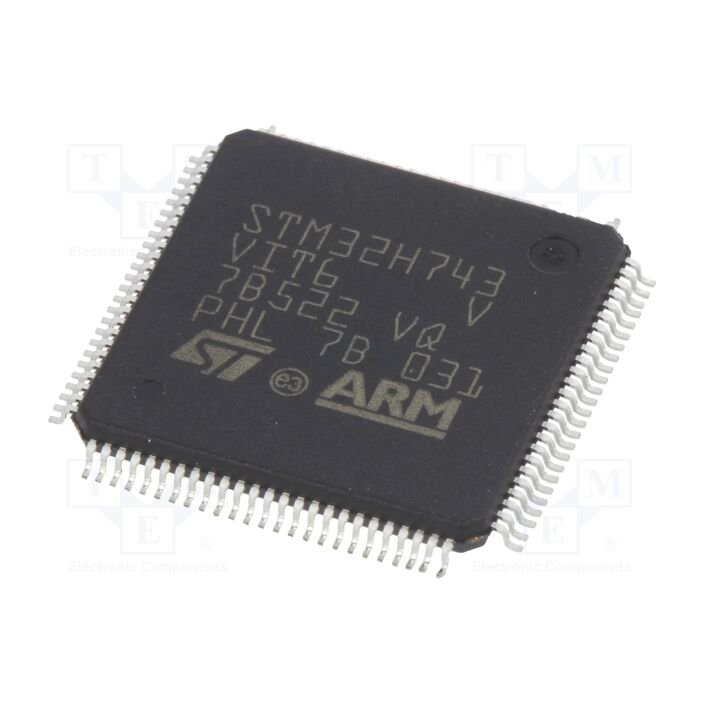
STM32H743 product photo
1. Technical Specifications & Performance Analysis
1.1 Core Architecture (CPU/Logic/Power)
The STM32H743 utilizes the 32-bit ARM Cortex-M7 core. Running at 480 MHz, it delivers exceptional processing power required for real-time applications. The architecture includes a double-precision Floating-Point Unit (FPU) and a complete set of DSP instructions, making it highly capable of handling complex algorithms locally without needing an external DSP chip. It also features the Chrom-ART Accelerator™ for enhanced graphic content creation (DMA2D).
1.2 Key Electrical Characteristics
Engineers must note the power and memory specifications that define the operational limits of this component:
Core Frequency: 480 MHz (Maximum operating frequency).
Flash Memory: 2 MB (Dual bank architecture allows Read-While-Write).
RAM: 1 MB (Total SRAM, including 192 KB of TCM RAM for critical real-time routines).
ADC Resolution: 16-bit (Up to 36 channels, crucial for precision instrumentation).
Voltage Supply: Typically 1.62 V to 3.6 V (Check specific datasheet for VDD ranges).
1.3 Interfaces and Connectivity
The STM32H743 is packed with advanced peripherals to support complex connectivity requirements:
Audio/Visual: LCD-TFT controller, I2S/SAI for high-end audio.
Data Transfer: USB 2.0 OTG, Ethernet MAC.
Industrial: High-resolution timers for motor control.
Standard: SPI, I2C, UART, CAN FD.
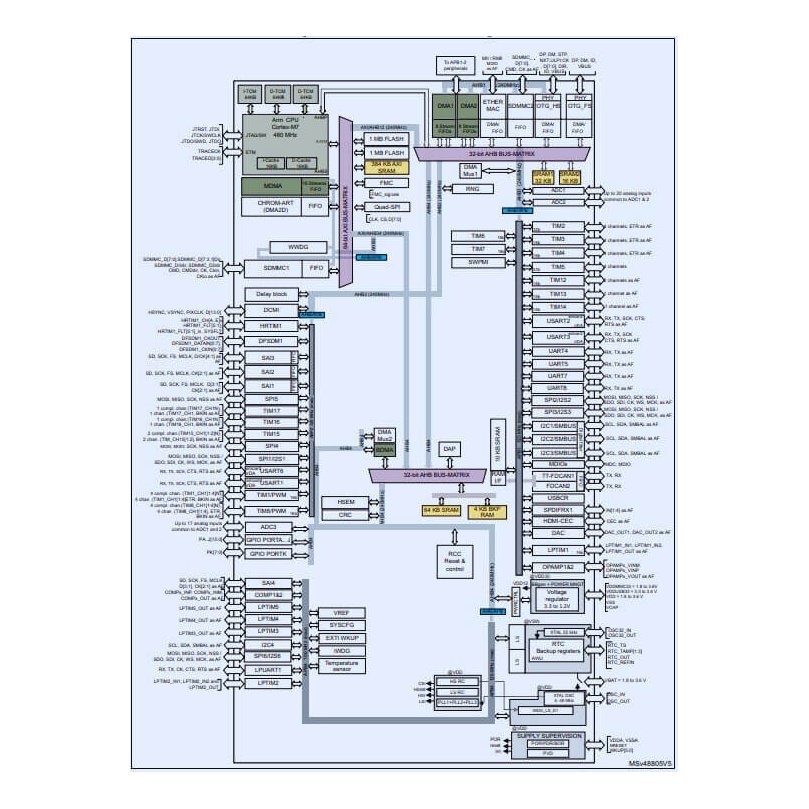
STM32H743 functional block diagram
2. Pinout, Package, and Configuration
2.1 Pin Configuration Guide
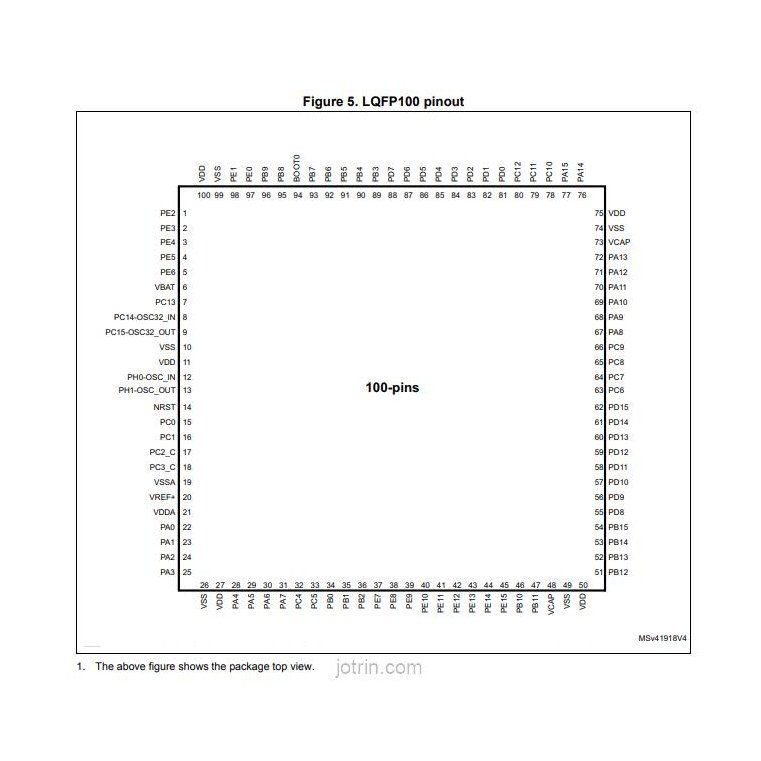
STM32H743 pinout diagram
The pin distribution typically follows ST's high-density layout:
Power Pins (VDD/VSS): Distributed around the package to minimize noise; require local decoupling.
Analog Pins (VDDA/VREF+): Dedicated pins for the ADC/DAC subsystems; keep traces short.
Control Pins: Reset, Boot0 modes, and JTAG/SWD debug pins are prioritized for accessibility.
2.2 Naming Convention & Ordering Codes
Understanding the Part Numbers:The suffix in the part number (e.g., STM32H743IIT6) dictates the package limits and temperature range. - H743: Series family (High-perf M7).
I/V/Z/B: Pin count identifier (e.g., I = 176 pins, Z = 144 pins).
T/G: Package type (T = LQFP, H = TFBGA).
6: Temperature range (Industrial -40°C to 85°C).
2.3 Available Packages
| Package Type | Dimensions | Common Use Case |
|---|---|---|
| STM32H743VGH6 (TFBGA-100) | Compact Grid Array | Space-constrained mobile devices |
| STM32H743ZIT6 (LQFP-144) | Surface Mount | General industrial control boards |
| STM32H743IIT6 (LQFP-176) | High I/O Count | Complex HMI with external memory |
| STM32H743BIT6 (LQFP-208) | Max I/O | Legacy upgrades and extensive peripheral use |
3. Design & Integration Guide (For Engineers & Makers)
Pro Tip: Always verify pin compatibility before migrating from older series (like F7 or F4), as power domains may differ.
3.1 Hardware Implementation
Bypass Capacitors: Place 100nF ceramic capacitors as close as possible to each VDD pin. A bulk capacitor (4.7µF or 10µF) is recommended per power domain.
PCB Layout: Use a solid ground plane. For the 480 MHz operation, impedance matching on high-speed lines (USB, SDMMC) is critical.
Thermal Management: While LQFP packages generally dissipate heat well, the high-frequency operation at 480 MHz may require thermal vias or a small heatsink in enclosed environments.
3.2 Common Design Challenges
Based on user reports and community feedback, here are known pain points and fixes:
1. SPI Master Configuration Complexity- Issue: Users often report that SPI master settings look correct in registers but produce no output.
Fix: Verify GPIO Alternate Function (AF) mapping specifically for the H7 series. Unlike older families, the H7 requires strict sequencing of the Master Transfer Start bit after the peripheral is enabled.
2. ADC Performance Limitations- Issue: Getting the full 16-bit effective number of bits (ENOB) is difficult; results may be noisy.
Fix: Consult the "ADC characteristics" section of the datasheet strictly. Performance depends heavily on the clock source, sampling time, and low-impedance input sources.
3. I2S/Audio Codec Integration- Issue: Difficulty syncing with external codecs (e.g., PCM3060) via I2S/SAI.
Fix: The issue is often the clock tree. Ensure the PLLs are configured to provide the exact MCLK/LRCK ratios required by the specific codec.
4. Typical Applications & Use Cases
📺 Video Recommendation: STM32H743 Guide
The STM32H743 is versatile, but it shines in scenarios requiring heavy math or meaningful graphics:
Industrial Automation: PLC modules and motor drive controllers.
Medical Devices: Portable monitoring equipment requiring precise ADC readings.
Consumer Electronics: High-end audio DACs and smart appliances.
4.1 Real-World Example
High-End Audio Mixer:In a digital mixing console, the STM32H743 uses its SAI (Serial Audio Interface) to ingest multiple audio streams. The 480 MHz Cortex-M7 processes EQ and reverb effects via DSP instructions in real-time, while the Chrom-ART Accelerator drives a color touchscreen interface for the user, all on a single chip.
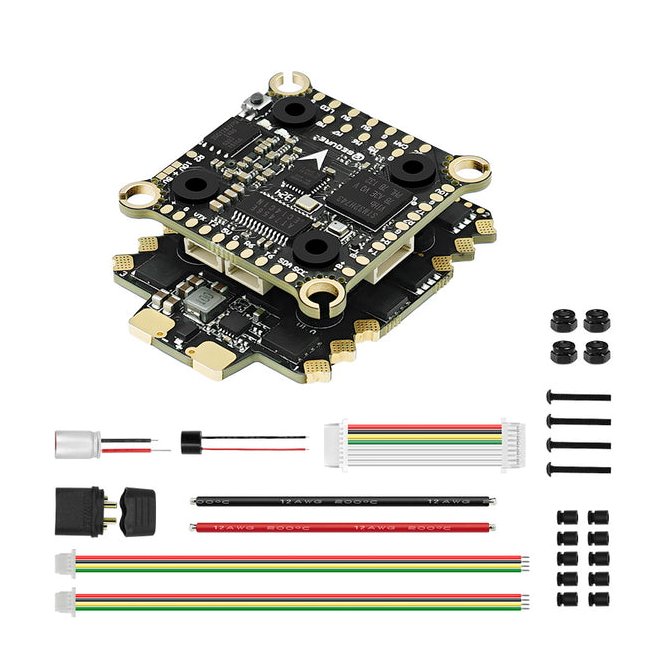
STM32H743 application circuit schematic
5. Alternatives and Cross-Reference Guide
If stock is unavailable or the price point doesn't match your BOM target, consider these alternatives:
NXP i.MX RT1060: A strong "Crossover MCU" competitor. Often boasts higher clock speeds but different peripheral sets.
Microchip SAM E70: Another Cortex-M7 option. Good for legacy designs accustomed to the PIC/SAM ecosystem.
Texas Instruments AM243x: Offers strong industrial communication protocols if real-time networking is a priority.
Renesas RA6M5: A viable alternative focusing on security and IoT integration.
Selection Advice: Stick with the STM32H743 if you are heavily invested in the STM32Cube ecosystem, as porting software to NXP or TI can be time-consuming.
6. Frequently Asked Questions (FAQ)
Q: What is the difference between STM32H743 and STM32F7? A: The H743 is significantly faster (480 MHz vs ~216 MHz) and includes more advanced power management and bus architectures compared to the older F7 series.
Q: Can STM32H743 be used in Automotive applications? A: While suitable for harsh environments, always check for specific "Automotive Grade" part numbers (often starting with SPC or specific suffixes) if AEC-Q100 certification is required.
Q: Where can I find the datasheet and library files for STM32H743? A: Official datasheets are available from STMicroelectronics. Libraries are found within the STM32CubeH7 MCU Package.
Q: Is STM32H743 suitable for battery-operated devices? A: Yes, but it is a high-performance chip. Strict use of low-power modes (Stop, Standby) is necessary to conserve battery when the 480 MHz speed is not needed.
Q: How do I program/configure the STM32H743? A: The primary tool is STM32CubeMX for configuration and code generation, supported by IDEs like STM32CubeIDE, Keil MDK, or IAR.
7. Datasheets & Resources
Official Datasheet: STM32H743xI/G (Search ID)
Development Tools & Software: STM32CubeMX, STM32CubeIDE.
Evaluation Boards: Nucleo-H743ZI2, STM32H743I-EVAL, STM32H743I-DISCO.
Specifications
Datasheet PDF
- Datasheets :
- Design Resources :
 Kintex-7 XC7K410T Series: An Evergreen Mainstream Solution in FPGA
14 January 20261689
 MCF532x ColdFire® Microprocessor Datasheet Overview
29 February 2024189
 BD237: 3MHz,350mW, Pinout and Datasheet
15 April 2022584
 1N5399 Rectifier Diode: Pinout, Datasheet, and Specifications
17 August 202124820
 74LS00 Quad 2 Input NAND Gate: Datasheet, Pinout and Schematic
26 October 202116228
 PMEG6010CEJ Schottky Diode: Datasheet PDF, Application, Alternative
15 February 20222791
![Arduino Micro microcontroller:Datasheet, Features, Applications[FAQs]](https://res.utmel.com/Images/Article/f79ca8c5-8312-4d43-902e-814e3493e6e2.png) Arduino Micro microcontroller:Datasheet, Features, Applications[FAQs]
Arduino Micro microcontroller:Datasheet, Features, Applications[FAQs]06 October 20234094
 An In-depth Look at LTC7003IMSE#TRPBF Gate Driver: Features, Applications, and Reference Designs
06 March 2024431
 Understanding the Flight Sensing Modules of Drones
06 September 20212136
 8051 Microcontroller: History, Architecture, Applications, and Features
20 February 202122214
 H-bridge: Working, Circuits and Applications
03 December 202146945
 What is PLL(Phase Locked Loop)?
29 November 20217025
 AI Server Components: Engineering Next-Gen Data Center Hardware for 100kW Racks
15 May 2026949
 Optical Gates for High-Speed Optical Processing Using Semiconductor-Based Amplifiers
30 December 20222140
 SMD Resistors: Codes, Size, Testing, Tolerance and Selection
08 June 202655321
 Differential Amplifier vs Current Sense Amplifier
07 April 20227797
STMicroelectronics
In Stock
United States
China
Canada
Japan
Russia
Germany
United Kingdom
Singapore
Italy
Hong Kong(China)
Taiwan(China)
France
Korea
Mexico
Netherlands
Malaysia
Austria
Spain
Switzerland
Poland
Thailand
Vietnam
India
United Arab Emirates
Afghanistan
Åland Islands
Albania
Algeria
American Samoa
Andorra
Angola
Anguilla
Antigua & Barbuda
Argentina
Armenia
Aruba
Australia
Azerbaijan
Bahamas
Bahrain
Bangladesh
Barbados
Belarus
Belgium
Belize
Benin
Bermuda
Bhutan
Bolivia
Bonaire, Sint Eustatius and Saba
Bosnia & Herzegovina
Botswana
Brazil
British Indian Ocean Territory
British Virgin Islands
Brunei
Bulgaria
Burkina Faso
Burundi
Cabo Verde
Cambodia
Cameroon
Cayman Islands
Central African Republic
Chad
Chile
Christmas Island
Cocos (Keeling) Islands
Colombia
Comoros
Congo
Congo (DRC)
Cook Islands
Costa Rica
Côte d’Ivoire
Croatia
Cuba
Curaçao
Cyprus
Czechia
Denmark
Djibouti
Dominica
Dominican Republic
Ecuador
Egypt
El Salvador
Equatorial Guinea
Eritrea
Estonia
Eswatini
Ethiopia
Falkland Islands
Faroe Islands
Fiji
Finland
French Guiana
French Polynesia
Gabon
Gambia
Georgia
Ghana
Gibraltar
Greece
Greenland
Grenada
Guadeloupe
Guam
Guatemala
Guernsey
Guinea
Guinea-Bissau
Guyana
Haiti
Honduras
Hungary
Iceland
Indonesia
Iran
Iraq
Ireland
Isle of Man
Israel
Jamaica
Jersey
Jordan
Kazakhstan
Kenya
Kiribati
Kosovo
Kuwait
Kyrgyzstan
Laos
Latvia
Lebanon
Lesotho
Liberia
Libya
Liechtenstein
Lithuania
Luxembourg
Macao(China)
Madagascar
Malawi
Maldives
Mali
Malta
Marshall Islands
Martinique
Mauritania
Mauritius
Mayotte
Micronesia
Moldova
Monaco
Mongolia
Montenegro
Montserrat
Morocco
Mozambique
Myanmar
Namibia
Nauru
Nepal
New Caledonia
New Zealand
Nicaragua
Niger
Nigeria
Niue
Norfolk Island
North Korea
North Macedonia
Northern Mariana Islands
Norway
Oman
Pakistan
Palau
Palestinian Authority
Panama
Papua New Guinea
Paraguay
Peru
Philippines
Pitcairn Islands
Portugal
Puerto Rico
Qatar
Réunion
Romania
Rwanda
Samoa
San Marino
São Tomé & Príncipe
Saudi Arabia
Senegal
Serbia
Seychelles
Sierra Leone
Sint Maarten
Slovakia
Slovenia
Solomon Islands
Somalia
South Africa
South Sudan
Sri Lanka
St Helena, Ascension, Tristan da Cunha
St. Barthélemy
St. Kitts & Nevis
St. Lucia
St. Martin
St. Pierre & Miquelon
St. Vincent & Grenadines
Sudan
Suriname
Svalbard & Jan Mayen
Sweden
Syria
Tajikistan
Tanzania
Timor-Leste
Togo
Tokelau
Tonga
Trinidad & Tobago
Tunisia
Turkey
Turkmenistan
Turks & Caicos Islands
Tuvalu
U.S. Outlying Islands
U.S. Virgin Islands
Uganda
Ukraine
Uruguay
Uzbekistan
Vanuatu
Vatican City
Venezuela
Wallis & Futuna
Yemen
Zambia
Zimbabwe
![NUCLEO-F030R8]() NUCLEO-F030R8
NUCLEO-F030R8STMicroelectronics
![SPC560B-DIS]() SPC560B-DIS
SPC560B-DISSTMicroelectronics
![NUCLEO-L152RE]() NUCLEO-L152RE
NUCLEO-L152RESTMicroelectronics
![NUCLEO-F411RE]() NUCLEO-F411RE
NUCLEO-F411RESTMicroelectronics
![NUCLEO-F767ZI]() NUCLEO-F767ZI
NUCLEO-F767ZISTMicroelectronics
![NUCLEO-F401RE]() NUCLEO-F401RE
NUCLEO-F401RESTMicroelectronics
![NUCLEO-F412ZG]() NUCLEO-F412ZG
NUCLEO-F412ZGSTMicroelectronics
![STM32F769I-DISCO]() STM32F769I-DISCO
STM32F769I-DISCOSTMicroelectronics
![NUCLEO-F429ZI]() NUCLEO-F429ZI
NUCLEO-F429ZISTMicroelectronics
![STM32F746G-DISCO]() STM32F746G-DISCO
STM32F746G-DISCOSTMicroelectronics


