

 Product
 Brand
Brand Articles
 Tools
Tools
ADAU1701: Detailed Datasheet, Pinout, and Alternatives Guide


BOARD EVAL SIGMADSP AUD ADAU1701
Explore the ADAU1701 SigmaDSP audio processor. Access the complete datasheet, pinout specs, and design alternatives for cost-effective audio systems.
- Executive Summary: What is the ADAU1701?
- 1. Technical Specifications & Performance Analysis
- 2. Pinout, Package, and Configuration
- 3. Design & Integration Guide (For Engineers & Makers)
- 4. Typical Applications & Use Cases
- 5. Alternatives and Cross-Reference Guide
- 6. Frequently Asked Questions (FAQ)
- 7. Datasheets & Resources
- Specifications
- Datasheet PDF
Executive Summary: What is the ADAU1701?
The ADAU1701 is a complete single-chip audio system featuring a 28-/56-bit SigmaDSP audio processor, integrated ADCs/DACs, and microcontroller-like control interfaces designed to simplify complex audio signal processing tasks. It stands as a "system-on-chip" solution that dramatically reduces Bill of Materials (BOM) complexity by eliminating the need for external converters in many applications. - Market Position: High-value, cost-effective DSP widely used in consumer audio and by the specialized DIY maker community (e.g., FreeDSP).
Top Features:
Integrated 2 ADCs (100 dB SNR) and 4 DACs (104 dB SNR).
Self-boot capability from serial EEPROM (no external microcontroller required).
50 MIPS processing power optimized for audio filtering and dynamics processing.
Primary Audience: Audio design engineers, automotive infotainment developers, and advanced hobbyists building active crossovers.
Supply Status: Active (Available in Commercial and Automotive grades).
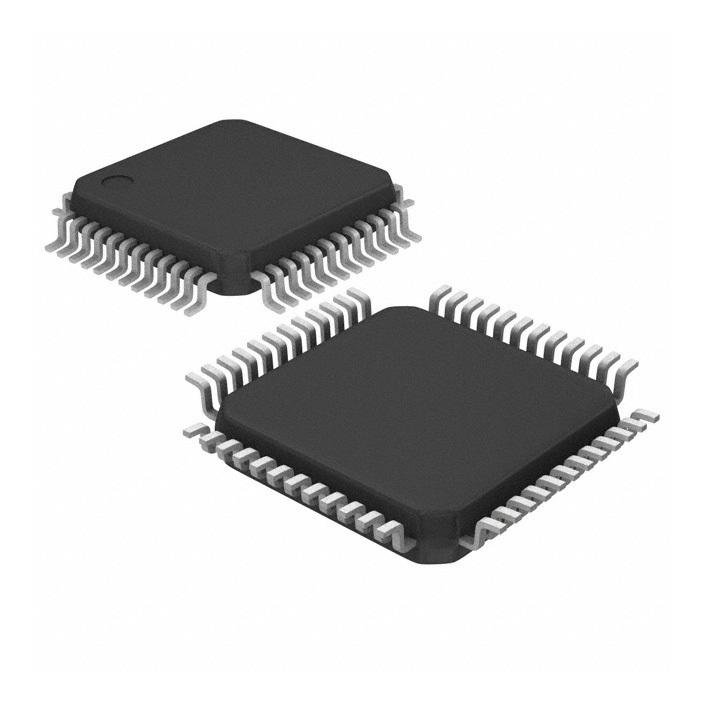
ADAU1701 product photo
1. Technical Specifications & Performance Analysis
1.1 Core Architecture (CPU/Logic/Power)
{{SECTION_1_OVERVIEW}} The core of the ADAU1701 is a 28-/56-bit digital audio processor capable of 50 MIPS at a 48 kHz sampling rate. The Double-Precision mode (56-bit) is particularly useful for generating low-frequency IIR filters where quantization noise can be problematic. The specialized SigmaDSP architecture allows for easy programming via graphic blocks rather than complex C code.
1.2 Key Electrical Characteristics
Ensuring correct power sequencing and voltage levels is critical for the ADAU1701's stability.
Core Voltage: 1.8 V (Generated internally via on-chip voltage regulator; requires simple bypass capacitor).
I/O Voltage: 3.3 V (Typical digital I/O level).
ADC SNR: 100 dB (A-weighted).
DAC SNR: 104 dB (A-weighted).
Processing Rate: 50 MIPS (Maximum at standard audio rates).
1.3 Interfaces and Connectivity
The chip is designed to integrate seamlessly into modern digital ecosystems or function standalone. - Control Interface: Supports both I2C and SPI.
Self-Boot: Can load its program directly from an I2C EEPROM on power-up.
GPIO: Multipurpose pins for volume control, LEDs, or switches.
Audio Data: Serial audio data ports (I2S, TDM) for connecting external converters if higher performance is needed.
2. Pinout, Package, and Configuration
2.1 Pin Configuration Guide
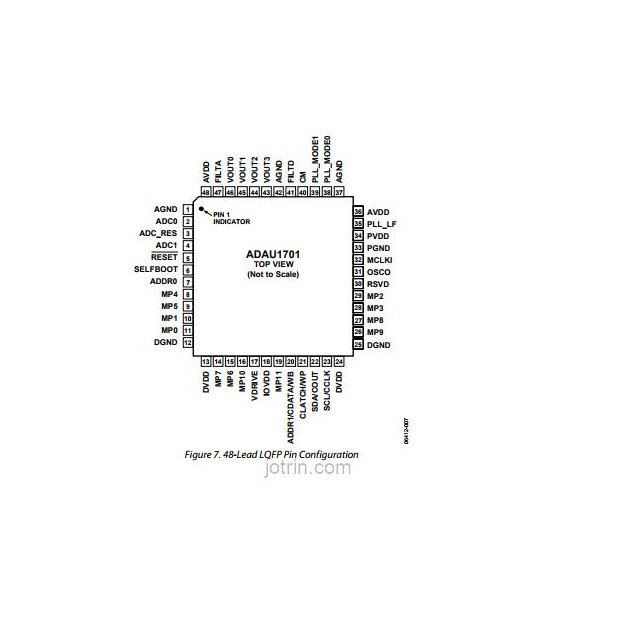
ADAU1701 pinout diagram
The ADAU1701 uses a standard arrangement effectively separating analog and digital domains. - Power Pins: DVDD (Digital), AVDD (Analog), PVDD (PLL). These must be decoupled properly. - Analog I/O: ADC0/1 inputs and DAC0-3 outputs. - Control: SDA/SCL (I2C) or SPI pins. - Crystal/Clock: MCLK input or crystal connection pins.
2.2 Naming Convention & Ordering Codes
Understanding the Part Numbers:Analog Devices uses specific suffixes to denote temperature range and packaging.
JSTZ: Commercial temperature range (0°C to +70°C).
WSTZ: Automotive temperature range (-40°C to +105°C), qualified for harsher environments.
Z: Indicates RoHS Compliant (Lead-free).
2.3 Available Packages
| Package Type | Dimensions | Common Use Case |
|---|---|---|
| LQFP-48 | 7mm x 7mm | Standard consumer electronics; relatively hand-solderable for prototyping. |
3. Design & Integration Guide (For Engineers & Makers)
Pro Tip: Always verify pin compatibility before migrating from older series. While the ADAU1701 is a standard, newer chips in the SigmaDSP family often have different footprints.
3.1 Hardware Implementation
Bypass Capacitors: Essential for the internal 1.8V regulator. Place a 10µF and 100nF capacitor as close to the VOUT pin as possible.
PCB Layout: strictly separate Analog Ground (AGND) and Digital Ground (DGND) planes, connecting them at a single point (star ground) under the chip to preserve the >100dB SNR performance.
Crystals: A 12.288 MHz crystal is standard for 48 kHz sampling rates.
3.2 Common Design Challenges
Below are frequent obstacles designers face, based on community data and datasheet notes:
1. Self-Boot EEPROM Timing Failures* Issue: The ADAU1701 may fail to boot from the external EEPROM if the RESET pin is released before power rails stabilize. * Fix: Do not rely on a simple RC circuit for the RESET pin. Use a dedicated reset supervisor IC (e.g., ADM811) to hold the reset low until VDD is stable.
2. SigmaStudio OS Limitation* Issue: SigmaStudio, the primary IDE, is natively Windows-only. * Fix: Mac/Linux users must use a Virtual Machine (VM) or Wine. Alternatively, investigate open-source projects like SigmaTCP for control, though design still requires the official IDE.
3. Processing Ceiling (50 MIPS)* Issue: Complex reverb algorithms or high-tap FIR filters can exhaust the 50 MIPS headroom quickly. * Fix: Optimize DSP flows by using IIR filters (biquads) instead of FIRs where possible. For heavier processing, upgrade to the ADAU1452 or ADAU1467.
4. Typical Applications & Use Cases
📺 Video Recommendation: ADAU1701 Guide
4.1 Real-World Example: Active Speaker Crossover
In a bi-amplified active speaker, the ADAU1701 replaces analog crossover components.
1. Input: Analog audio enters via the internal ADCs.
2. Processing: The DSP splits frequencies (Low Pass for woofer, High Pass for tweeter) and applies Time Alignment (delay) and EQ correction.
3. Output: Signals exit via the 4 internal DACs to separate power amplifiers. This significantly lowers cost compared to using discrete OpAmps and capacitors.
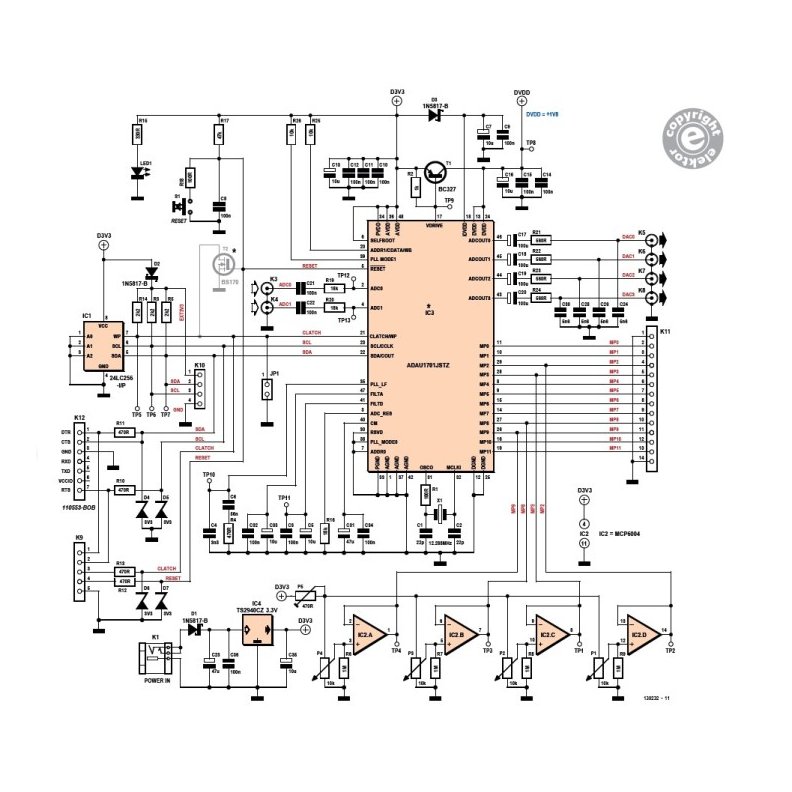
ADAU1701 application circuit schematic
5. Alternatives and Cross-Reference Guide
Direct Replacements:
There are few direct "pin-for-pin" drop-ins from other manufacturers due to the unique SigmaDSP architecture. However, internal variants like the ADAU1702 offer similar functionality with different memory/specs (check datasheets carefully).
Better Performance (Upgrade Path):
ADAU1452 / ADAU1467: If 50 MIPS is limiting, these offer vastly superior processing power (up to 295 MIPS) but require external codecs (they lack the built-in ADCs/DACs of the 1701).
Cost-Effective/Competitor Options:
Texas Instruments PCM3070: A similar audio codec with miniDSP processing blocks.
STMicroelectronics STA350BW: Integrates power stages, suitable for "all-in-one" digital amplifier solutions.
XMOS xCORE-AUDIO: For applications requiring high-channel-count USB audio interfaces alongside DSP.
6. Frequently Asked Questions (FAQ)
Q: What is the difference between ADAU1701 and ADAU1452? The ADAU1701 is an all-in-one SoC with built-in ADCs/DACs (approx 50 MIPS), ideal for cost-sensitive analog-in/analog-out devices. The ADAU1452 is a pure digital DSP powerhouse (approx 295 MIPS) requiring external audio converters.
Q: Can ADAU1701 be used in Automotive applications? Yes, but you must specify the ADAU1701WSTZ variant, which is qualified for the automotive temperature range (-40°C to +105°C).
Q: Where can I find the datasheet and library files for ADAU1701? The official datasheet is available from Analog Devices. Configuration files are generated via the SigmaStudio software tool.
Q: Is ADAU1701 suitable for battery-operated devices? Yes, but power consumption should be calculated based on the 1.8V core load. While it has an internal regulator, using an external high-efficiency switcher for the 3.3V supply is recommended for battery longevity.
Q: How do I program/configure the ADAU1701? It is programmed using SigmaStudio, a graphical drag-and-drop tool. The compiled program is then typically written to an I2C EEPROM for the chip to self-boot.
7. Datasheets & Resources
Official Datasheet: ADAU1701 Datasheet (PDF)
Development Tools & Software: Analog Devices SigmaStudio
Specifications
Datasheet PDF
- Datasheets :
- ConflictMineralStatement :
 SHA000001 Clock Oscillator: Pinout, Datasheet and Specification
19 July 20211928
 LM311N Voltage Comparator: Pinout, Package and Datasheet PDF
01 July 20213640
 ULN2803A Transistor Array: Pinout, Circuit, and Datasheet
15 June 202122009
 STM32F103RCT6 Microcontroller: 72MHz, 64-LQFP, Pinout and Datasheet
07 February 20229053
 BMA150 Acceleration Sensor: Pinout, Features and Specification
26 April 20212181
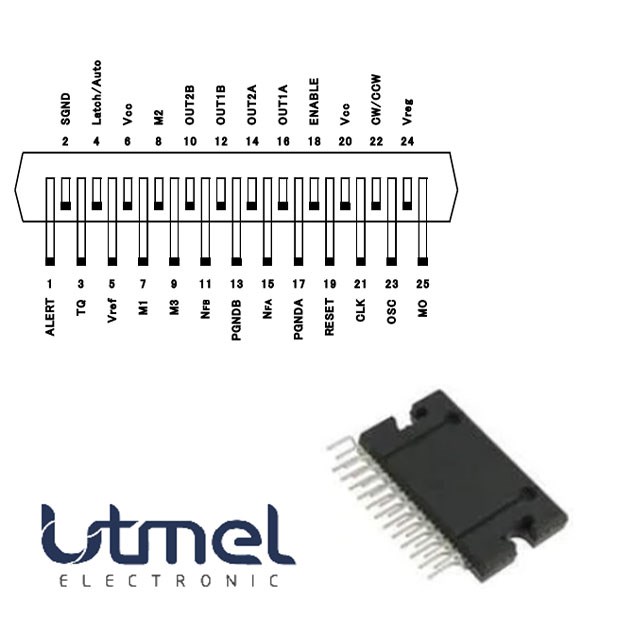 TB6600HG-Stepper Motor Controllers / Drivers
28 February 20221939
 BSH201 MOS Transistor: SOT-23, 60V, 0.3 A, Datasheet PDF
28 February 20222505
 LM4041 Bandgap Circuit: Pinout, Features and Datasheet
05 November 20211110
 UTMEL Showcases One-Stop Electronic Component Sourcing Services at electronica Shanghai 2026
07 July 2026367
 Latest MLPerf Results: NVIDIA H100 GPUs Ride to the Top
13 September 20224588
 Introduction to STM32 Microcontrollers
12 March 202125388
 Optical Transceiver Guide: How It Works, Types, Form Factors, and Selection
24 June 2026729
 Inductance Basis: Definition, Structure and Applications
18 April 202210017
 What is Regulated Power Supply?
08 January 202115524
 Automotive vs. Industrial Memory: How to Verify Grade Codes Before Sourcing In this guide
06 August 2026391
 Top 10 High-Performance End Mills for Metalworking in 2025
17 July 20255591
Analog Devices Inc.
In Stock: 2000
United States
China
Canada
Japan
Russia
Germany
United Kingdom
Singapore
Italy
Hong Kong(China)
Taiwan(China)
France
Korea
Mexico
Netherlands
Malaysia
Austria
Spain
Switzerland
Poland
Thailand
Vietnam
India
United Arab Emirates
Afghanistan
Åland Islands
Albania
Algeria
American Samoa
Andorra
Angola
Anguilla
Antigua & Barbuda
Argentina
Armenia
Aruba
Australia
Azerbaijan
Bahamas
Bahrain
Bangladesh
Barbados
Belarus
Belgium
Belize
Benin
Bermuda
Bhutan
Bolivia
Bonaire, Sint Eustatius and Saba
Bosnia & Herzegovina
Botswana
Brazil
British Indian Ocean Territory
British Virgin Islands
Brunei
Bulgaria
Burkina Faso
Burundi
Cabo Verde
Cambodia
Cameroon
Cayman Islands
Central African Republic
Chad
Chile
Christmas Island
Cocos (Keeling) Islands
Colombia
Comoros
Congo
Congo (DRC)
Cook Islands
Costa Rica
Côte d’Ivoire
Croatia
Cuba
Curaçao
Cyprus
Czechia
Denmark
Djibouti
Dominica
Dominican Republic
Ecuador
Egypt
El Salvador
Equatorial Guinea
Eritrea
Estonia
Eswatini
Ethiopia
Falkland Islands
Faroe Islands
Fiji
Finland
French Guiana
French Polynesia
Gabon
Gambia
Georgia
Ghana
Gibraltar
Greece
Greenland
Grenada
Guadeloupe
Guam
Guatemala
Guernsey
Guinea
Guinea-Bissau
Guyana
Haiti
Honduras
Hungary
Iceland
Indonesia
Iran
Iraq
Ireland
Isle of Man
Israel
Jamaica
Jersey
Jordan
Kazakhstan
Kenya
Kiribati
Kosovo
Kuwait
Kyrgyzstan
Laos
Latvia
Lebanon
Lesotho
Liberia
Libya
Liechtenstein
Lithuania
Luxembourg
Macao(China)
Madagascar
Malawi
Maldives
Mali
Malta
Marshall Islands
Martinique
Mauritania
Mauritius
Mayotte
Micronesia
Moldova
Monaco
Mongolia
Montenegro
Montserrat
Morocco
Mozambique
Myanmar
Namibia
Nauru
Nepal
New Caledonia
New Zealand
Nicaragua
Niger
Nigeria
Niue
Norfolk Island
North Korea
North Macedonia
Northern Mariana Islands
Norway
Oman
Pakistan
Palau
Palestinian Authority
Panama
Papua New Guinea
Paraguay
Peru
Philippines
Pitcairn Islands
Portugal
Puerto Rico
Qatar
Réunion
Romania
Rwanda
Samoa
San Marino
São Tomé & Príncipe
Saudi Arabia
Senegal
Serbia
Seychelles
Sierra Leone
Sint Maarten
Slovakia
Slovenia
Solomon Islands
Somalia
South Africa
South Sudan
Sri Lanka
St Helena, Ascension, Tristan da Cunha
St. Barthélemy
St. Kitts & Nevis
St. Lucia
St. Martin
St. Pierre & Miquelon
St. Vincent & Grenadines
Sudan
Suriname
Svalbard & Jan Mayen
Sweden
Syria
Tajikistan
Tanzania
Timor-Leste
Togo
Tokelau
Tonga
Trinidad & Tobago
Tunisia
Turkey
Turkmenistan
Turks & Caicos Islands
Tuvalu
U.S. Outlying Islands
U.S. Virgin Islands
Uganda
Ukraine
Uruguay
Uzbekistan
Vanuatu
Vatican City
Venezuela
Wallis & Futuna
Yemen
Zambia
Zimbabwe
![EVAL-ADUCM360QSPZ]() EVAL-ADUCM360QSPZ
EVAL-ADUCM360QSPZAnalog Devices Inc.
![DC2026C-KIT]() DC2026C-KIT
DC2026C-KITLinear Technology/Analog Devices
![ADZS-UCM3029EZLITE]() ADZS-UCM3029EZLITE
ADZS-UCM3029EZLITEAnalog Devices Inc.
![EVAL-ADUC845QSZ]() EVAL-ADUC845QSZ
EVAL-ADUC845QSZAnalog Devices Inc.
![EVAL-ADUC7020QSPZ]() EVAL-ADUC7020QSPZ
EVAL-ADUC7020QSPZAnalog Devices Inc.
![ADZS-BF609-EZBRD]() ADZS-BF609-EZBRD
ADZS-BF609-EZBRDAnalog Devices Inc.
![ADZS-21489-EZLITE]() ADZS-21489-EZLITE
ADZS-21489-EZLITEAnalog Devices Inc.
![ADZS-BF533-EZLITE]() ADZS-BF533-EZLITE
ADZS-BF533-EZLITEAnalog Devices Inc.
![ADZS-SC589-EZLITE]() ADZS-SC589-EZLITE
ADZS-SC589-EZLITEAnalog Devices Inc.


