

 Product
 Brand
Brand Articles
 Tools
Tools
AD831 500 MHz Active Mixer: High Dynamic Range Datasheet & Performance Review

HF, VHF DOUBLE BALANCED 500MHz 1-Mixer 20-Pin 14dB With Amplifier 20-LCC (J-Lead)
Unit Price: $22.828154
Ext Price: $22.83


HF, VHF DOUBLE BALANCED 500MHz 1-Mixer 20-Pin 14dB With Amplifier 20-LCC (J-Lead)
Master RF downconversion with the AD831 active mixer from Analog Devices. Explore specs, pinout, and thermal tips for your next HF/VHF design. Buy or design now!
- Executive Summary: What is the AD831?
- 1. Technical Specifications & Performance Analysis
- 2. Pinout, Package, and Configuration
- 3. Design & Integration Guide (For Engineers & Makers)
- 4. Typical Applications & Use Cases
- 5. Alternatives and Cross-Reference Guide
- 6. Frequently Asked Questions (FAQ)
- 7. Resources
- Specifications
- Parts with Similar Specs
- Datasheet PDF
Executive Summary: What is the AD831?
The AD831 is a low-distortion, monolithic active mixer designed for RF-to-IF downconversion, direct-to-baseband conversion, and quadrature modulation in high-performance communication systems. Unlike traditional passive mixers that require high-power LO drivers and complex termination, the AD831 integrates these components into a single silicon solution to simplify the RF signal chain.
Market Position: High-performance active mixer; a "gold standard" for legacy HF/VHF infrastructure requiring high linearity.
Top Features: Wide frequency range up to 500 MHz, integrated LO driver (requires only -10 dBm), and excellent port-to-port isolation.
Primary Audience: Ideal for RF design engineers working on base stations, medical imaging (ultrasound), and high-end software-defined radio (SDR).
Supply Status: Active (Note: Available primarily in PLCC packaging).
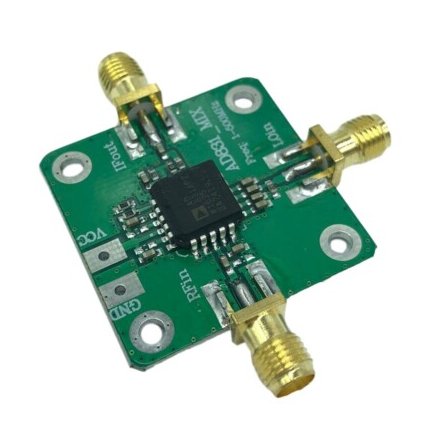
1. Technical Specifications & Performance Analysis
The AD831 stands out because it eliminates the need for a "diplexer" at the IF port, a common requirement in passive mixer designs to handle out-of-band reflections.
1.1 Core Architecture (Active vs. Passive)
The AD831 utilizes a "Gilbert Cell" architecture which provides conversion gain rather than loss. While many mixers suffer from 6-8 dB of conversion loss, the AD831 provides 0 dB (Unity Gain), ensuring the signal-to-noise ratio (SNR) is maintained without needing an immediate post-mixer amplifier stage.
1.2 Key Electrical Characteristics
For procurement and design planning, the following power specs are critical:
RF/LO Frequency Range: Up to 500 MHz.
Noise Figure: 10.3 dB (Typical at 70 MHz).
Supply Voltage: Flexible dual supply (±4.5V to ±5.5V) or single supply (9V to 11V).
Power Consumption: Approximately 100 mA to 120 mA per rail (roughly 1 Watt total).
1.3 Interfaces and Connectivity
The device features three primary RF interfaces:
RF Input: High-impedance input, typically used with a balun for differential drive.
LO Input: Low-power drive requirement (-10 dBm), significantly reducing the BOM cost for local oscillators.
IF Output: Capable of operating down to DC, making it perfect for direct conversion or ZIF (Zero-IF) architectures.
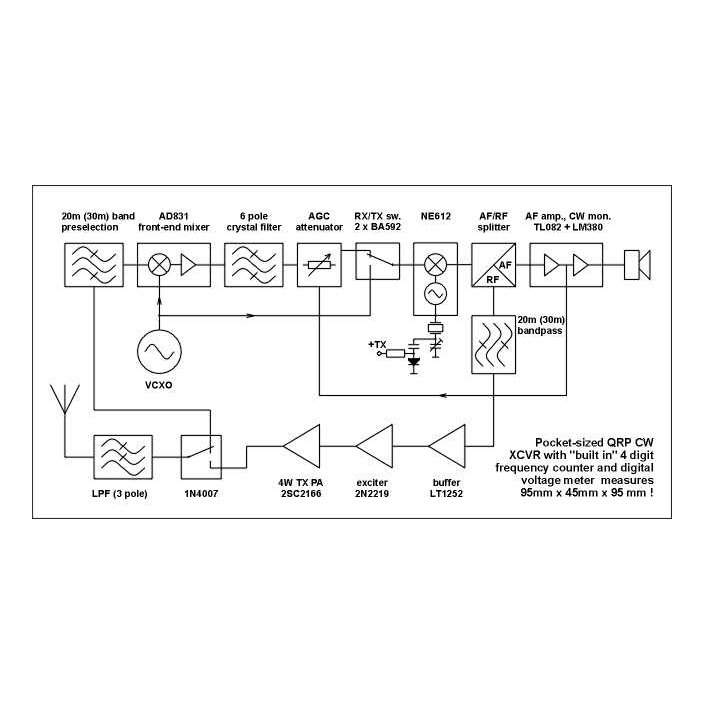
2. Pinout, Package, and Configuration
The AD831 uses a 20-pin Plastic Leaded Chip Carrier (PLCC), which is robust but requires specific layout considerations.
2.1 Pin Configuration Guide
VPOS / VNEG: Power supply pins. Ensure clean, decoupled rails.
RF HI / RF LO: Differential RF inputs.
LO HI / LO LO: Local oscillator inputs.
IF OUT: Low-impedance output for the IF signal.
BIAS: A critical pin used to set the internal current. Incorrect wiring here is a common cause of device failure.
2.2 Naming Convention & Ordering Codes
The most common ordering code is AD831APZ, where:
AD831: The base part number.
A: Performance grade/Temperature range (-40°C to +85°C).
P: Package code (PLCC).
Z: RoHS compliant (Lead-free).
2.3 Available Packages
| Package Type | Dimensions | Common Use Case |
|---|---|---|
| 20-Pin PLCC | 9mm x 9mm | Industrial Base Stations & Prototyping |
Note: The PLCC package is "socket-friendly," making it excellent for hobbyists and initial lab testing.
3. Design & Integration Guide (For Engineers & Makers)
Pro Tip: Because the AD831 consumes 1 Watt, thermal management is not optional. Use a large ground plane and consider a dedicated heatsink if operating in enclosed environments.
3.1 Hardware Implementation
Bypass Capacitors: Place 0.1 µF and 10 µF capacitors as close to the VPOS/VNEG pins as possible to prevent LO leakage into the power rails.
PCB Layout: Keep RF and LO traces symmetrical to maintain high isolation. Avoid running digital lines under the IF output.
3.2 Common Design Challenges
Issue: Excessive Heat.
Fix: Tie the BIAS pin to VPOS through a small resistor (refer to datasheet Table 1) to reduce the idle current if maximum dynamic range isn't required.
Issue: Bulky PLCC Footprint.
Fix: For modern, space-constrained designs, evaluate the AD8342 which offers similar performance in a much smaller LFCSP package.
4. Typical Applications & Use Cases
Watch Tutorial: AD831
4.1 Real-World Example: Ultrasound Imaging
In medical ultrasound, the AD831 is used for Doppler shift detection. It mixes the reflected high-frequency ultrasound waves down to the audio frequency range (Baseband). Its ability to operate the IF output at DC allows the system to capture very slow blood flow movements without signal clipping.
5. Alternatives and Cross-Reference Guide
If the AD831 is too power-hungry or the package is too large, consider these alternatives:
Direct Replacements: There are no drop-in, pin-compatible alternatives in the PLCC package from other vendors; however, the AD8342 is the modern functional successor.
Low-Cost Option: NXP SA602 / SA612. These are popular for simple radio projects but offer significantly lower dynamic range and IP3 performance.
Passive Alternative: Mini-Circuits SBL-1. A classic diode-ring mixer. It consumes no DC power but requires a high-power LO (+7 dBm) and has significant conversion loss.
6. Frequently Asked Questions (FAQ)
Q: What is the difference between AD831 and SA612?
A: The AD831 is a high-performance industrial mixer with higher linearity (IP3) and an integrated LO driver, whereas the SA612 is a low-cost, low-power consumer-grade IC with much lower dynamic range.
Q: Can AD831 be used in battery-operated devices?
A: It is generally not recommended unless the battery is large. The 1 Watt power draw will deplete small Li-Po or AA batteries very quickly.
Q: How do I reduce the noise figure?
A: The 10.3 dB noise figure is fixed by the internal architecture. To improve overall system sensitivity, use a Low Noise Amplifier (LNA) before the RF input.
7. Resources
Datasheet: Available via Analog Devices website.
Evaluation Boards: AD831-EVALZ for rapid prototyping.
CAD Models: Search for "AD831 PLCC-20 footprint" on Ultra Librarian or SnapEDA.
Specifications
Parts with Similar Specs
- ImagePart NumberManufacturerPackage / CaseNumber of PinsNoise FigureFrequencyRF/Microwave Device TypeMoisture Sensitivity Level (MSL)Number of MixersMax Power DissipationView Compare
![AD831APZ-REEL7]()
AD831APZ-REEL7
20-LCC (J-Lead)
20
14dB
500MHz
DOUBLE BALANCED
1 (Unlimited)
1
1.2 W
![AD831APZ]()
20-LCC (J-Lead)
20
14dB
-
DOUBLE BALANCED
1 (Unlimited)
1
1.2 W
![AD831AP-REEL7]()
20-LCC (J-Lead)
20
14dB
500MHz
DOUBLE BALANCED
1 (Unlimited)
1
1.2 W
![AD831AP-REEL]()
20-LCC (J-Lead)
20
14dB
500MHz
DOUBLE BALANCED
1 (Unlimited)
1
1.2 W
![AD831AP]()
20-LCC (J-Lead)
20
14dB
500MHz
DOUBLE BALANCED
1 (Unlimited)
1
1.2 W

Datasheet PDF
- Datasheets :
- ConflictMineralStatement :
 ATmega1284P (AVR) 16KB SRAM Microcontroller: Datasheet, Pinout, and Performance Review
10 February 2026566
 STM32F103CBT6 - STM - Microcontroller
29 April 20218072
 TIP120 NPN Transistor: Pinout, Datasheet, and Schematic Diagram
30 June 202110666
 A Comprehensive Guide to LTC6702HDC#TRMPBF Linear Comparator
06 March 2024269
 A Comprehensive Guide to LTC6947IUFD#TRPBF PLL Frequency Synthesizer
06 March 2024492
 max31855 Cold-Junction Converter:Pinout Benefits and Application
22 September 20214430
 TMP100 VS TMP101
12 July 20212289
 STLINKV2 In-Circuit Debugger: Pinout, Datasheet and Programming
21 July 202165756
 What is an Electromagnetic Relay?
13 October 202012407
 Toroidal transformer: Principles, Features, Types and Applications
13 November 20209687
 Optimizing Energy Management with Non-Isolated DC-DC Converters
04 February 20243508
 Introduction to Synchronous Counter and Asynchronous Counter
31 March 202518976
 State-of-Charge Estimation Techniques for Lithium-Ion Batteries
26 January 20242815
 What are the Types of Phone Displays?
07 July 20214614
 What is Semiconductor Package?
06 December 202113552
 Filters Explained: Principles, Parameters and Application Guide
09 April 202512947
Analog Devices Inc.
In Stock: 1
Minimum: 1 Multiples: 1
Qty
Unit Price
Ext Price
1
$22.828154
$22.83
10
$21.535994
$215.36
100
$20.316976
$2,031.70
500
$19.166958
$9,583.48
1000
$18.082036
$18,082.04
Not the price you want? Send RFQ Now and we'll contact you ASAP.
Inquire for More Quantity
![AD831AP-REEL7]() AD831AP-REEL7
AD831AP-REEL7Analog Devices Inc.
![HMC410AMS8GETR]() HMC410AMS8GETR
HMC410AMS8GETRAnalog Devices Inc.
![ADL5801ACPZ-R7]() ADL5801ACPZ-R7
ADL5801ACPZ-R7Analog Devices Inc.
![AD8342ACPZ-REEL7]() AD8342ACPZ-REEL7
AD8342ACPZ-REEL7Analog Devices Inc.
![ADL5350ACPZ-R7]() ADL5350ACPZ-R7
ADL5350ACPZ-R7Analog Devices Inc.
![LTC5549IUDB#TRMPBF]() LTC5549IUDB#TRMPBF
LTC5549IUDB#TRMPBFLinear Technology/Analog Devices
![AD831APZ]() AD831APZ
AD831APZAnalog Devices Inc.
![AD608AR]() AD608AR
AD608ARAnalog Devices Inc.
![ADL5356ACPZ-R7]() ADL5356ACPZ-R7
ADL5356ACPZ-R7Analog Devices Inc.


