

 Product
 Brand
Brand Articles
 Tools
Tools
LT1637 Over-The-Top Op Amp Integration Notes: High-Voltage Operation vs. Precision Tradeoffs

Linear Technology/Analog Devices
31.7mA per Channel 17nA 80 dB Instrumentational OP Amps 0.05μA 2.7V~44V ±1.35V~22V LT1637 8-DIP (0.300, 7.62mm)
Unit Price: $6.369270
Ext Price: $6.37


31.7mA per Channel 17nA 80 dB Instrumentational OP Amps 0.05μA 2.7V~44V ±1.35V~22V LT1637 8-DIP (0.300, 7.62mm)
Evaluate the LT1637 Over-The-Top operational amplifier for high-voltage battery systems. Compare specs, equivalents, and precision tradeoffs before BOM release.
- Analyzing the "Over-The-Top" Input Architecture
- Key Electrical Characteristics and Inherent Tradeoffs
- Application Fit: Where the LT1637 Excels
- LT1637 Alternatives and Drop-In Replacement Strategy
- Library Verification: Pinout, Packages, and Layout
- Cost vs. Performance Considerations for Procurement
- Situational Design FAQs
- Specifications
- Parts with Similar Specs
- Datasheet PDF
The LT1637 is a micropower, rail-to-rail input and output operational amplifier designed for robust operation in single and split supply systems ranging from 2.7V to 44V. Originally developed by Linear Technology (now part of Analog Devices), this component is engineered for harsh electrical environments where standard op-amps would fail or require extensive external protection circuitry.
Before committing this part to a final bill of materials, engineering and procurement teams must weigh its unique survival features against its speed, precision, and cost.
Core Selection Factors:
Over-The-Top Capability: Inputs can safely exceed the positive supply rail.
Wide Supply Range: Operates from 2.7V up to 44V.
Built-in Ruggedness: Reverse battery protection up to 25V.
Low Power: 250µA maximum supply current, dropping to 3µA in shutdown.
Output Drive: 25mA minimum output current.
Analyzing the "Over-The-Top" Input Architecture
The defining characteristic of the LT1637 is its "Over-The-Top" input stage. In standard operational amplifiers, applying a voltage to the inputs that exceeds the positive supply rail ($V+$) typically forward-biases internal ESD diodes, causing massive current draw, signal clipping, or catastrophic device failure.
The LT1637 bypasses this limitation. Its input stage is designed to remain high impedance even when the input voltage is forced above the positive supply. This is highly advantageous in high-side current sensing applications. If the main system supply drops or completely collapses, but the monitored battery line remains fully charged, the op-amp will not drag down the battery or destroy itself.
Additionally, the device features integrated reverse battery protection up to 25V. If a technician or user wires the power supply backward, the IC simply draws virtually zero current and survives the fault. For design engineers, this eliminates the need to place series Schottky diodes on the power pins, reclaiming PCB space and removing the diode voltage drop from the supply headroom calculations.
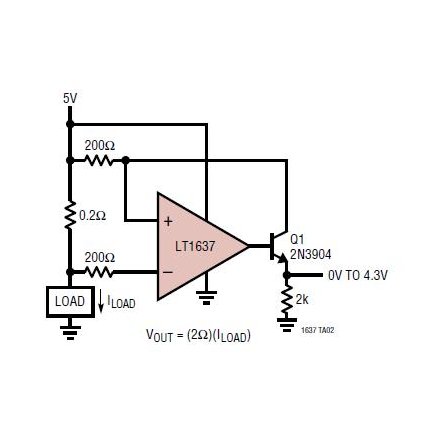
Key Electrical Characteristics and Inherent Tradeoffs
When integrating a specialized, ruggedized component, performance tradeoffs in other areas are inevitable. The LT1637 sacrifices high-speed dynamics and ultra-low offset to achieve its wide voltage tolerance and micropower footprint.
Supply and Quiescent Current: The 2.7V to 44V operating range makes it exceptionally versatile for both 3.3V logic rails and 24V/36V industrial buses. The 250µA maximum quiescent current is excellent for always-on battery monitors. The shutdown feature further reduces this to a mere 3µA, allowing the host microcontroller to power down the analog front end during sleep states.
Offset and Drift Limitations: With an Input Offset Voltage of 350µV (maximum), this is not an ultra-high precision amplifier. Users frequently note that the offset and drift characteristics are insufficient for microvolt-level sensor interfaces, such as high-accuracy load cells or precision thermocouples, without external correction. If you use this part in a precision measurement circuit, you must implement software calibration routines or hardware trimming networks.
Bandwidth and Speed Constraints: The 1.1MHz Gain-Bandwidth Product (GBWP) and 0.4V/µs slew rate restrict this component to DC and low-frequency AC signals. Attempting to use it for high-frequency signal processing or fast transient capture will result in severe distortion.
Application Fit: Where the LT1637 Excels
Because of its specific mix of ruggedness and micropower operation, the device is best deployed in environments where survival and power efficiency trump raw speed:
Battery or Solar Powered Systems: The wide voltage range handles the massive voltage swings of solar panels, while the 3µA shutdown state preserves energy during the night.
Sensor Signal Conditioning: Ideal for monitoring industrial sensors where overvoltage transients are common.
Portable Instrumentation: The rail-to-rail input and output maximize dynamic range on limited 3V or 5V battery supplies.
MUX Amplifiers: Useful in multiplexed data acquisition systems where inputs might temporarily float above the active supply rail during switching.
LT1637 Alternatives and Drop-In Replacement Strategy
The LT1637 carries premium pricing due to its specialized Over-The-Top and reverse-battery protection features. If your application does not strictly require these survival traits, you can significantly reduce BOM costs or improve high-frequency performance by selecting a different amplifier.
Lower-Cost General Purpose Equivalents:If your circuit operates well within the supply rails and does not face reverse-voltage risks, standard op-amps like the Texas Instruments LM358 or ON Semiconductor MC33171 are vastly more economical. They provide similar functional topologies (though often without rail-to-rail inputs or shutdown pins) at a fraction of the cost.
High-Speed Upgrades:If the 1.1MHz GBWP is choking your signal path, the Texas Instruments LM6171 is a logical alternative. It provides massive improvements in slew rate and bandwidth, though it will consume significantly more quiescent current and lacks the Over-The-Top input tolerance.
Precision Upgrades:For designs where the 350µV offset is a dealbreaker, consider the Analog Devices LT1468 or the Texas Instruments OPA192. The OPA192, in particular, offers a wide supply range and rail-to-rail I/O with exceptional precision, though it does not share the exact high-voltage input survival characteristics of the LT1637.
Note on Direct Replacements: Always verify if an alternative part includes a shutdown feature. Components lacking this will not be pin-to-pin compatible if your PCB layout routes a microcontroller GPIO to the LT1637's shutdown pin.
Library Verification: Pinout, Packages, and Layout
When capturing the schematic symbol for the LT1637, standard 8-pin single-op-amp footprints (like the industry-standard 741 pinout) may not fully apply due to the shutdown pin.
Ensure your EDA software library accurately maps the shutdown control. Leaving a shutdown pin floating can lead to unpredictable amplifier states, oscillation, or failure to power up. Since thermal resistance varies heavily by the specific package sub-variant (e.g., SOIC vs. DFN) and your PCB copper area, confirming the exact thermal derating curves in the latest manufacturer spec sheet is required before finalizing high-voltage, high-output-current designs.
Cost vs. Performance Considerations for Procurement
Procurement managers often flag the LT1637 during BOM audits due to its higher unit cost compared to jellybean op-amps. When justifying this cost to management, engineers should calculate the "hidden savings" the chip provides.
While the IC itself is more expensive, it eliminates the need for: 1. Series Schottky diodes for reverse battery protection. 2. TVS diodes or clamping networks for input overvoltage protection. 3. External load switches to cut power to the op-amp during sleep modes.
If the design naturally requires these protections, the LT1637 is cost-effective because it shrinks the total component count and reduces board area. If the design is safely enclosed and runs on a heavily regulated 5V rail, the LT1637 is over-specced, and a cheaper alternative should be sourced.
Situational Design FAQs
Can I replace the LT1637 directly with an LM358 to save money?
Only if your input common-mode voltage will never exceed the positive supply rail, you do not require reverse battery protection, and your layout does not utilize the LT1637's specific shutdown pin. The LM358 is not a drop-in replacement if those specific survival features are utilized.
How do I handle the offset voltage in precision sensor circuits using this op-amp?
Because the maximum input offset voltage is 350µV, direct amplification of microvolt signals (like those from a bridge sensor) will yield significant error. You must implement a baseline calibration routine in your system firmware to subtract the offset, use an external trim potentiometer, or switch to a precision-focused amplifier like the LT1468.
What happens to the LT1637 if the power supply is connected backward?
Thanks to its built-in reverse battery protection, the device can withstand up to 25V of reverse polarity. It will draw minimal current and prevent catastrophic thermal failure, resuming normal operation once the polarity is corrected.
Why is my high-frequency signal distorting through the LT1637?
The op-amp is intentionally designed for micropower operation, which heavily restricts its speed. With a Gain-Bandwidth Product of just 1.1MHz and a slew rate of 0.4V/µs, it cannot accurately track fast transients or high-frequency AC signals. You will need to migrate to a faster amplifier, such as the LM6171, if speed is required.
Watch Tutorial: LT1637
Specifications
Parts with Similar Specs
- ImagePart NumberManufacturerPackage / CaseNumber of PinsSlew RateGain Bandwidth ProductInput Offset Voltage (Vos)Power Supply Rejection Ratio (PSRR)Common Mode Rejection RatioSupply VoltageView Compare
![LT1637IN8#PBF]()
LT1637IN8#PBF
8-DIP (0.300, 7.62mm)
8
0.4V/μs
1.1MHz
350 μV
90 dB
80 dB
15 V
![LT1636IN8#PBF]()
8-DIP (0.300, 7.62mm)
8
0.5V/μs
1MHz
7.5 mV
70 dB
70 dB
15 V
![LM301AN]()
8-DIP (0.300, 7.62mm)
8
0.075V/μs
220kHz
225 μV
90 dB
84 dB
15 V
![LT1001ACN8]()
DIP
8
0.4 V/μs
-
20 μV
103 dB
97 dB
-


Datasheet PDF
- Datasheets :
- ConflictMineralStatement :
- Design Resources :
- Simulation Models :
 ADG202AKNZ Analog Switch: Feature, Specification, Datasheet
22 May 2021737
 Microchip PIC32MX Series: Technical Overview
29 February 2024424
 CD4011 Nand Gate IC: Alternative, Pinout and Datasheet
05 August 20219812
 DHT11 vs DHT22: Datasheet, Pinout, and Features
12 January 20225838
 ATMEGA328P-PU Microcontroller: Features, Pinout, and Datasheet
23 September 202327579
 MCP73832T-2ACI/OT Li-Polymer Charge Management Controllers: Diagram, Pinout, and Datasheet
07 March 20223270
![L293D Motor Driver IC: Pinout, Datasheet and Specification [Video]](https://res.utmel.com/Images/Article/e66f6222-c865-4d7a-afe1-33e0cbb859ff.png) L293D Motor Driver IC: Pinout, Datasheet and Specification [Video]
L293D Motor Driver IC: Pinout, Datasheet and Specification [Video]10 May 202113605
 ntd24n06lt4g:an N-channel Power MOSFET
12 March 2022802
 Beginner’s Handbook for Choosing Circular Connectors
14 July 20254333
 Humanoid Robot BOM Breakdown: Every Chip Inside a Physical AI Platform
28 July 20261830
 Semiconductor Equipment Industry Research
25 March 20245156
 An Overview of Common Mode Chokes
10 August 202015888
 LED Driver: Function, Types, and Application
01 September 202013768
 Enhancing Wi-Fi Security and Its Impacts on IoT Connectivity
25 October 20242819
 Analysis of Magnetic and Thermal Semiconductor Power Modules
13 March 20242322
 What is a variable capacitor?
16 April 202567338
Linear Technology/Analog Devices
In Stock: 2121
Minimum: 1 Multiples: 1
Qty
Unit Price
Ext Price
1
$6.369270
$6.37
10
$6.008745
$60.09
100
$5.668628
$566.86
500
$5.347762
$2,673.88
1000
$5.045058
$5,045.06
Not the price you want? Send RFQ Now and we'll contact you ASAP.
Inquire for More Quantity
![AD826AR-REEL7]() AD826AR-REEL7
AD826AR-REEL7Analog Devices Inc.
![AD8062ARM]() AD8062ARM
AD8062ARMAnalog Devices Inc.
![AD8532ARU-REEL]() AD8532ARU-REEL
AD8532ARU-REELAnalog Devices Inc.
![OP113ES]() OP113ES
OP113ESAnalog Devices Inc.
![SSM2142P]() SSM2142P
SSM2142PAnalog Devices, Inc.
![LTC1050CS8]() LTC1050CS8
LTC1050CS8Linear Technology/Analog Devices
![AMP02EPZ]() AMP02EPZ
AMP02EPZAnalog Devices Inc.
![AD822ARZ-REEL7]() AD822ARZ-REEL7
AD822ARZ-REEL7Analog Devices Inc.
![OP2177ARZ-REEL7]() OP2177ARZ-REEL7
OP2177ARZ-REEL7Analog Devices Inc.
![AD8066ARZ-R7]() AD8066ARZ-R7
AD8066ARZ-R7Analog Devices Inc.


