

 Product
 Brand
Brand Articles
 Tools
Tools
AD9826 Signal Processor: Pinout, Features and Datasheet

10 Weeks weeks 28-SSOP (0.209, 5.30mm Width) Tape & Reel (TR) Active Sensor & Detector Interface ICs Image Sensor Surface Mount 1 (Unlimited) ROHS3 Compliant


10 Weeks weeks 28-SSOP (0.209, 5.30mm Width) Tape & Reel (TR) Active Sensor & Detector Interface ICs Image Sensor Surface Mount 1 (Unlimited) ROHS3 Compliant
The AD9826 is a complete analog signal processor for imaging applications. It features a 3-channel architecture designed to sample and condition the outputs of trilinear color CCD arrays. Furthermore, Huge range of Semiconductors, Capacitors, Resistors and IcS in stock. Welcome RFQ.
AD9826 Pinout

Pinout
AD9826 CAD Model
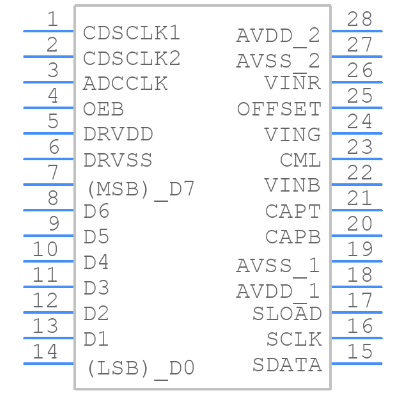
PCB Symbol
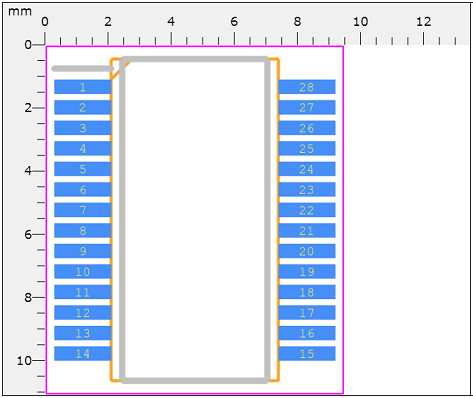
PCB Footprint
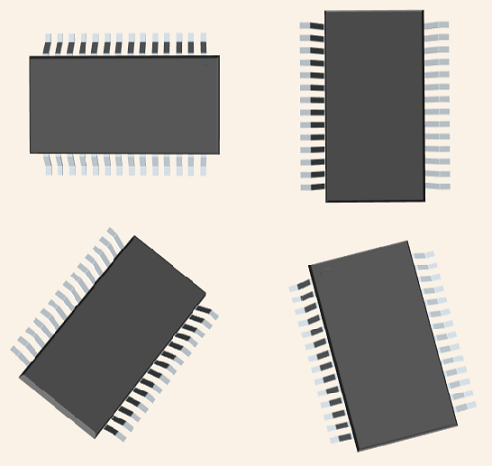
3D Model
AD9826 Overview
The AD9826 is a complete analog signal processor for imaging applications. It features a 3-channel architecture designed to sample and condition the outputs of trilinear color CCD arrays. Each channel consists of an input clamp, Correlated Double Sampler (CDS), offset DAC, and Programmable Gain Amplifier (PGA), multiplexed to a high-performance 16-bit A/D converter.
This article provides you with a basic overview of the AD9826, including its pin descriptions, features and specifications, etc., to help you quickly understand what AD9826 is.
AD9826 Features
● 16-Bit 15 MSPS A/D Converter
● 3-Channel 16-Bit Operation up to 15 MSPS
● 1-Channel 16-Bit Operation up to 12.5 MSPS
● 2-Channel Mode for Mono Sensors with Odd/Even Outputs Correlated Double Sampling
● 1~6× Programmable Gain
● ±300 mV Programmable Offset
● Input Clamp Circuitry
● Internal Voltage Reference
● Multiplexed Byte-Wide Output
● Optional Single Byte Output Mode
● 3-Wire Serial Digital Interface
● 3 V/5 V Digital I/O Compatibility
● 28-Lead SSOP Package
● Low Power CMOS: 400 mW (Typ)
● Power-Down Mode Available
AD9826 Advantage
The AD9826 can operate at speeds greater than 15 MSPS with reduced performance. The CDS amplifiers may be disabled for use with sensors that do not require CDS, such as Contact Image Sensors (CIS), CMOS active pixel sensors, and Focal Plane Arrays. The 16-bit digital output is multiplexed into an 8-bit output word, which is accessed using two read cycles. There is an optional single byte output mode. The internal registers are programmed through a 3-wire serial interface, and provide adjustment of the gain, offset, and operating mode.
The AD9826 operates from a single 5 V power supply, typically consumes 400 mW of power, and is packaged in a 28-lead SSOP. The AD9826 can be operated in six different modes: 3-Channel CDS Mode, 3-Channel SHA Mode, 2-Channel CDS Mode, 2-Channel SHA Mode, 1-Channel CDS Mode, and 1-Channel SHA Mode. Each mode is selected by programming the Configuration Registers through the serial interface.
Specifications
- TypeParameter
- Lifecycle Status
Lifecycle Status refers to the current stage of an electronic component in its product life cycle, indicating whether it is active, obsolete, or transitioning between these states. An active status means the component is in production and available for purchase. An obsolete status indicates that the component is no longer being manufactured or supported, and manufacturers typically provide a limited time frame for support. Understanding the lifecycle status is crucial for design engineers to ensure continuity and reliability in their projects.
PRODUCTION (Last Updated: 1 month ago) - Factory Lead Time10 Weeks
- Contact Plating
Contact plating (finish) provides corrosion protection for base metals and optimizes the mechanical and electrical properties of the contact interfaces.
Tin - Mount
In electronic components, the term "Mount" typically refers to the method or process of physically attaching or fixing a component onto a circuit board or other electronic device. This can involve soldering, adhesive bonding, or other techniques to secure the component in place. The mounting process is crucial for ensuring proper electrical connections and mechanical stability within the electronic system. Different components may have specific mounting requirements based on their size, shape, and function, and manufacturers provide guidelines for proper mounting procedures to ensure optimal performance and reliability of the electronic device.
Surface Mount - Mounting Type
The "Mounting Type" in electronic components refers to the method used to attach or connect a component to a circuit board or other substrate, such as through-hole, surface-mount, or panel mount.
Surface Mount - Package / Case
refers to the protective housing that encases an electronic component, providing mechanical support, electrical connections, and thermal management.
28-SSOP (0.209, 5.30mm Width) - Number of Pins28
- Operating Temperature
The operating temperature is the range of ambient temperature within which a power supply, or any other electrical equipment, operate in. This ranges from a minimum operating temperature, to a peak or maximum operating temperature, outside which, the power supply may fail.
-40°C~85°C - Packaging
Semiconductor package is a carrier / shell used to contain and cover one or more semiconductor components or integrated circuits. The material of the shell can be metal, plastic, glass or ceramic.
Tape & Reel (TR) - JESD-609 Code
The "JESD-609 Code" in electronic components refers to a standardized marking code that indicates the lead-free solder composition and finish of electronic components for compliance with environmental regulations.
e3 - Pbfree Code
The "Pbfree Code" parameter in electronic components refers to the code or marking used to indicate that the component is lead-free. Lead (Pb) is a toxic substance that has been widely used in electronic components for many years, but due to environmental concerns, there has been a shift towards lead-free alternatives. The Pbfree Code helps manufacturers and users easily identify components that do not contain lead, ensuring compliance with regulations and promoting environmentally friendly practices. It is important to pay attention to the Pbfree Code when selecting electronic components to ensure they meet the necessary requirements for lead-free applications.
no - Part Status
Parts can have many statuses as they progress through the configuration, analysis, review, and approval stages.
Active - Moisture Sensitivity Level (MSL)
Moisture Sensitivity Level (MSL) is a standardized rating that indicates the susceptibility of electronic components, particularly semiconductors, to moisture-induced damage during storage and the soldering process, defining the allowable exposure time to ambient conditions before they require special handling or baking to prevent failures
1 (Unlimited) - Number of Terminations28
- ECCN Code
An ECCN (Export Control Classification Number) is an alphanumeric code used by the U.S. Bureau of Industry and Security to identify and categorize electronic components and other dual-use items that may require an export license based on their technical characteristics and potential for military use.
EAR99 - TypeImage Sensor
- Max Power Dissipation
The maximum power that the MOSFET can dissipate continuously under the specified thermal conditions.
400mW - Terminal Position
In electronic components, the term "Terminal Position" refers to the physical location of the connection points on the component where external electrical connections can be made. These connection points, known as terminals, are typically used to attach wires, leads, or other components to the main body of the electronic component. The terminal position is important for ensuring proper connectivity and functionality of the component within a circuit. It is often specified in technical datasheets or component specifications to help designers and engineers understand how to properly integrate the component into their circuit designs.
DUAL - Terminal Form
Occurring at or forming the end of a series, succession, or the like; closing; concluding.
GULL WING - Peak Reflow Temperature (Cel)
Peak Reflow Temperature (Cel) is a parameter that specifies the maximum temperature at which an electronic component can be exposed during the reflow soldering process. Reflow soldering is a common method used to attach electronic components to a circuit board. The Peak Reflow Temperature is crucial because it ensures that the component is not damaged or degraded during the soldering process. Exceeding the specified Peak Reflow Temperature can lead to issues such as component failure, reduced performance, or even permanent damage to the component. It is important for manufacturers and assemblers to adhere to the recommended Peak Reflow Temperature to ensure the reliability and functionality of the electronic components.
260 - Number of Functions1
- Terminal Pitch
The center distance from one pole to the next.
0.65mm - Time@Peak Reflow Temperature-Max (s)
Time@Peak Reflow Temperature-Max (s) refers to the maximum duration that an electronic component can be exposed to the peak reflow temperature during the soldering process, which is crucial for ensuring reliable solder joint formation without damaging the component.
30 - Base Part Number
The "Base Part Number" (BPN) in electronic components serves a similar purpose to the "Base Product Number." It refers to the primary identifier for a component that captures the essential characteristics shared by a group of similar components. The BPN provides a fundamental way to reference a family or series of components without specifying all the variations and specific details.
AD9826 - Pin Count
a count of all of the component leads (or pins)
28 - Qualification Status
An indicator of formal certification of qualifications.
Not Qualified - Operating Supply Voltage
The voltage level by which an electrical system is designated and to which certain operating characteristics of the system are related.
5V - Number of Channels3
- Interface
In electronic components, the term "Interface" refers to the point at which two different systems, devices, or components connect and interact with each other. It can involve physical connections such as ports, connectors, or cables, as well as communication protocols and standards that facilitate the exchange of data or signals between the connected entities. The interface serves as a bridge that enables seamless communication and interoperability between different parts of a system or between different systems altogether. Designing a reliable and efficient interface is crucial in ensuring proper functionality and performance of electronic components and systems.
Parallel, Serial - Max Supply Voltage
In general, the absolute maximum common-mode voltage is VEE-0.3V and VCC+0.3V, but for products without a protection element at the VCC side, voltages up to the absolute maximum rated supply voltage (i.e. VEE+36V) can be supplied, regardless of supply voltage.
5.25V - Min Supply Voltage
The minimum supply voltage (V min ) is explored for sequential logic circuits by statistically simulating the impact of within-die process variations and gate-dielectric soft breakdown on data retention and hold time.
4.75V - Operating Supply Current
Operating Supply Current, also known as supply current or quiescent current, is a crucial parameter in electronic components that indicates the amount of current required for the device to operate under normal conditions. It represents the current drawn by the component from the power supply while it is functioning. This parameter is important for determining the power consumption of the component and is typically specified in datasheets to help designers calculate the overall power requirements of their circuits. Understanding the operating supply current is essential for ensuring proper functionality and efficiency of electronic systems.
80mA - Power Dissipation
the process by which an electronic or electrical device produces heat (energy loss or waste) as an undesirable derivative of its primary action.
400mW - Input Type
Input type in electronic components refers to the classification of the signal or data that a component can accept for processing or conversion. It indicates whether the input is analog, digital, or a specific format such as TTL or CMOS. Understanding input type is crucial for ensuring compatibility between different electronic devices and circuits, as it determines how signals are interpreted and interacted with.
Logic - Resolution
Resolution in electronic components refers to the smallest increment of measurement or change that can be detected or represented by the component. It is a crucial specification in devices such as sensors, displays, and converters, as it determines the level of detail or accuracy that can be achieved. For example, in a digital camera, resolution refers to the number of pixels that make up an image, with higher resolution indicating a greater level of detail. In analog-to-digital converters, resolution is the number of discrete values that can be represented in the digital output, determining the precision of the conversion process. Overall, resolution plays a significant role in determining the performance and capabilities of electronic components in various applications.
2 B - Sampling Rate
often described in the context of signal processing as the number of samples per time.
15 Msps - Number of A/D Converters1
- Differential Nonlinearity
Differential Nonlinearity (DNL) is a parameter used to measure the deviation of the actual step size between two adjacent digital output codes in an analog-to-digital converter (ADC) or digital-to-analog converter (DAC) from the ideal step size. It quantifies the accuracy of the converter in maintaining consistent step sizes across the entire range of digital codes. DNL is typically expressed in terms of least significant bits (LSBs) and is an important factor in determining the overall performance and linearity of the converter. A lower DNL value indicates better linearity and accuracy in the conversion process, while a higher DNL value suggests potential errors and nonlinearity in the output signal.
0.5 LSB - Height1.79mm
- Length10.34mm
- Width7.9mm
- RoHS Status
RoHS means “Restriction of Certain Hazardous Substances” in the “Hazardous Substances Directive” in electrical and electronic equipment.
ROHS3 Compliant - Lead Free
Lead Free is a term used to describe electronic components that do not contain lead as part of their composition. Lead is a toxic material that can have harmful effects on human health and the environment, so the electronics industry has been moving towards lead-free components to reduce these risks. Lead-free components are typically made using alternative materials such as silver, copper, and tin. Manufacturers must comply with regulations such as the Restriction of Hazardous Substances (RoHS) directive to ensure that their products are lead-free and environmentally friendly.
Contains Lead
AD9826 Functional Block Diagram

Functional Block Diagram
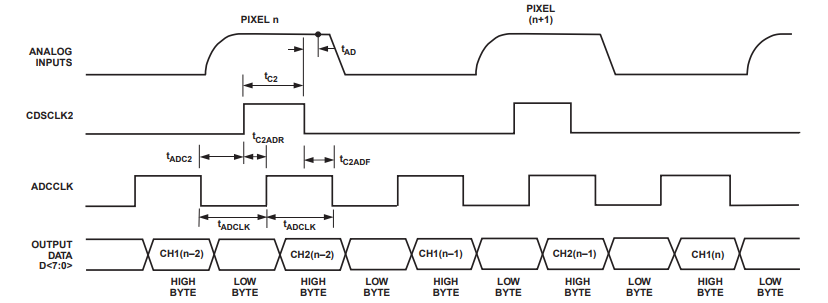
AD9826 Timing Diagrams
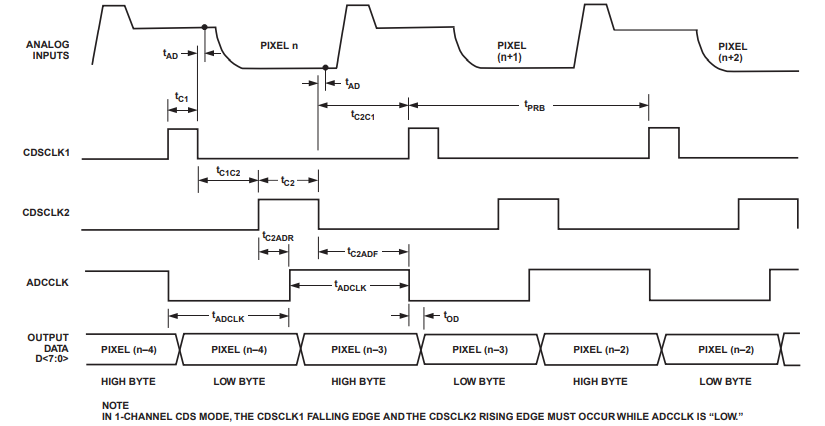
1-Channel CDS Mode Timing
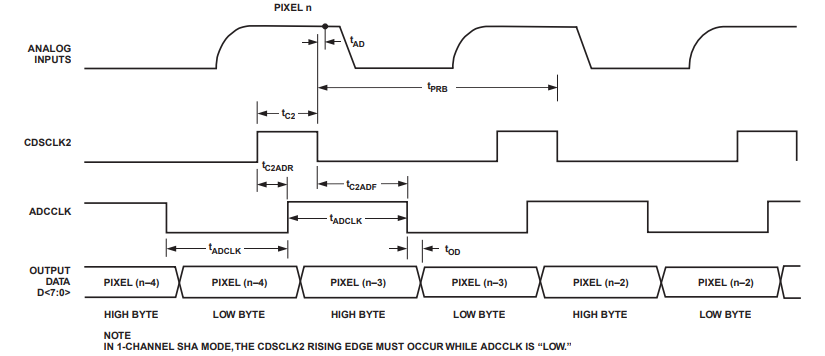
1-Channel SHA Mode Timing

2-Channel CDS Mode Timing
2-Channel SHA Mode Timing
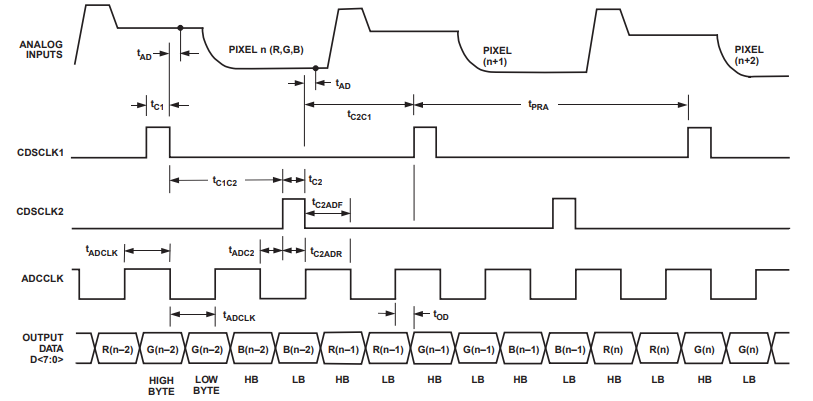
3-Channel CDS Mode Timing
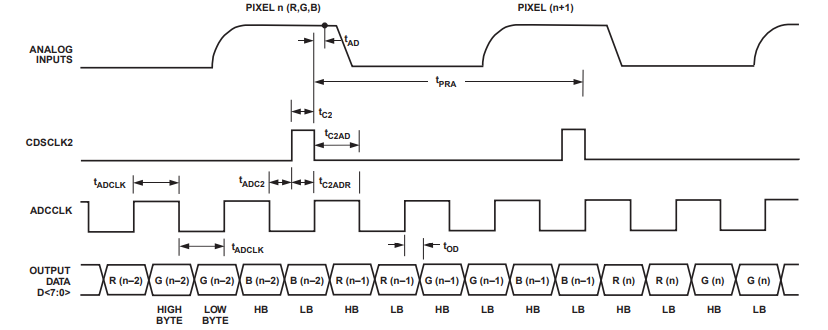
3-Channel SHA Mode Timing
AD9826 Equivalent
| Model number | Manufacturer | Description |
| AD9826KRSRL | Analog Devices Inc | IC SPECIALTY CONSUMER CIRCUIT, PDSO28, 5.30 MM, SSOP-28, Consumer IC:Other |
Parts with Similar Specs
- ImagePart NumberManufacturerPackage / CaseNumber of PinsMin Supply VoltageMax Supply VoltageOperating Supply CurrentRoHS StatusMountTerminal PositionView Compare
![AD9826KRSZRL]()
AD9826KRSZRL
28-SSOP (0.209, 5.30mm Width)
28
4.75 V
5.25 V
80 mA
ROHS3 Compliant
Surface Mount
DUAL
![AD9822JRSZRL]()
20-SSOP (0.209, 5.30mm Width)
20
-
-
5 mA
ROHS3 Compliant
Surface Mount
DUAL
![TPS2202AIDB]()
28-SSOP (0.209, 5.30mm Width)
28
4.75 V
5.35 V
90 mA
ROHS3 Compliant
Surface Mount
DUAL
![PCM2906DBR]()
28-SSOP (0.209, 5.30mm Width)
28
4.35 V
5.25 V
-
ROHS3 Compliant
Surface Mount
DUAL
![ADE7753ARSZ]()
30-SSOP (0.209, 5.30mm Width)
30
-
-
-
ROHS3 Compliant
Surface Mount
DUAL


AD9826 Applications
● Flatbed Document Scanners
● Digital Copier
● Multifunction Peripherals
● Infrared Imaging Applications
● Machine Vision
AD9826 Package
![28-Lead Shrink Small Outline Package [SSOP].png](https://res.utmel.com/Images/UEditor/da353ad2-83be-430a-a956-6d7b96d3feda.png "28-Lead Shrink Small Outline Package [SSOP].png")
28-Lead Shrink Small Outline Package [SSOP]
AD9826 Manufacturer
Analog Devices is an international market leader in the design, production, and commercialization of a large range of high-performance integrated circuits (ICs) for analog, mixed-signal, and digital signals (DSP) processing of almost all electronic systems. Since we started in 1965, the focus has been on the engineering challenge in electronic equipment related to signal to process. Our signal processing solutions, utilized by over 100,000 customers worldwide, play a key role in the conversion, conditioning, and processing of real-world events such as temperature, pressure, sonority, illumination, speed, and movement to electric signals for a wide range of electronic devices.
Datasheet PDF
- Datasheets :
- ConflictMineralStatement :
Trend Analysis
Can the AD9826 operate at lower performance than the 15 MSPS?
The AD9826 can operate at speeds greater than 15 MSPS with reduced performance.
What is the operating power supply of AD9826?
The AD9826 operates from a single 5 V power supply, typically consumes 400 mW of power.
How many different operating modes does the AD9826 have?
The AD9826 can be operated in six different modes: 3-Channel CDS Mode, 3-Channel SHA Mode, 2-Channel CDS Mode, 2-Channel SHA Mode, 1-Channel CDS Mode, and 1-Channel SHA Mode.
![LMR®-400 VS RG213[Video]: Pros and Cons of LMR400 VS RG213](https://res.utmel.com/Images/Article/d2dd0c09-f9bd-4cec-b315-54f693c0095f.jpg) LMR®-400 VS RG213[Video]: Pros and Cons of LMR400 VS RG213
LMR®-400 VS RG213[Video]: Pros and Cons of LMR400 VS RG21312 June 202417929
 An Introduction for Motor Driver IC ULN2003
25 April 202231540
 FT2232HL-REEL USB Controller: Pinout, Datasheet, Application
12 August 20214510
 Exploring the Renesas R5F21193SPU0 series Microcontrollers: An Extensive Analysis
29 February 2024294
 LM334Z Adjustable Current Sources
24 June 20213537
![A4988 VS DRV8825[Video]: What are the differences between them?](https://res.utmel.com/Images/Article/f171b290-e30c-4c91-bb39-5bea7b78c028.png) A4988 VS DRV8825[Video]: What are the differences between them?
A4988 VS DRV8825[Video]: What are the differences between them?27 April 202227964
![CR1216 3 V Battery Non-Rechargeable[Video]: Datasheet, CR1216 VS CR2016, and Equivalents](https://res.utmel.com/Images/Article/0b54a9ba-2bd8-4e1e-993a-827e6c746ece.png) CR1216 3 V Battery Non-Rechargeable[Video]: Datasheet, CR1216 VS CR2016, and Equivalents
CR1216 3 V Battery Non-Rechargeable[Video]: Datasheet, CR1216 VS CR2016, and Equivalents01 April 20224447
 AD9162 RF DAC Integration Notes: JESD204B Configuration and NCO Synchronization
04 July 2026429
 State-of-Charge Estimation Techniques for Lithium-Ion Batteries
26 January 20242816
 Is ON Semiconductor's Stock Overvalued? A Detailed Analysis
28 September 20233886
 Inductance Basis: Definition, Structure and Applications
18 April 202210045
 Manifold Absolute Pressure (MAP) Sensor: Working Principles, Structure, and Types
31 March 202549358
 Introduction to Temperature Sensors
24 October 202510928
 What is Server and Why does a Server Crash?
14 September 202119099
 The Ultimate Guide to AI Noise Reduction Translation Earbuds
24 September 202610200
 Explain in Detail the Three Sharp Weapons to Eliminate EMC: Capacitors/Inductors/Magnetic Beads
24 December 20215008
Analog Devices Inc.
In Stock: 7335
United States
China
Canada
Japan
Russia
Germany
United Kingdom
Singapore
Italy
Hong Kong(China)
Taiwan(China)
France
Korea
Mexico
Netherlands
Malaysia
Austria
Spain
Switzerland
Poland
Thailand
Vietnam
India
United Arab Emirates
Afghanistan
Åland Islands
Albania
Algeria
American Samoa
Andorra
Angola
Anguilla
Antigua & Barbuda
Argentina
Armenia
Aruba
Australia
Azerbaijan
Bahamas
Bahrain
Bangladesh
Barbados
Belarus
Belgium
Belize
Benin
Bermuda
Bhutan
Bolivia
Bonaire, Sint Eustatius and Saba
Bosnia & Herzegovina
Botswana
Brazil
British Indian Ocean Territory
British Virgin Islands
Brunei
Bulgaria
Burkina Faso
Burundi
Cabo Verde
Cambodia
Cameroon
Cayman Islands
Central African Republic
Chad
Chile
Christmas Island
Cocos (Keeling) Islands
Colombia
Comoros
Congo
Congo (DRC)
Cook Islands
Costa Rica
Côte d’Ivoire
Croatia
Cuba
Curaçao
Cyprus
Czechia
Denmark
Djibouti
Dominica
Dominican Republic
Ecuador
Egypt
El Salvador
Equatorial Guinea
Eritrea
Estonia
Eswatini
Ethiopia
Falkland Islands
Faroe Islands
Fiji
Finland
French Guiana
French Polynesia
Gabon
Gambia
Georgia
Ghana
Gibraltar
Greece
Greenland
Grenada
Guadeloupe
Guam
Guatemala
Guernsey
Guinea
Guinea-Bissau
Guyana
Haiti
Honduras
Hungary
Iceland
Indonesia
Iran
Iraq
Ireland
Isle of Man
Israel
Jamaica
Jersey
Jordan
Kazakhstan
Kenya
Kiribati
Kosovo
Kuwait
Kyrgyzstan
Laos
Latvia
Lebanon
Lesotho
Liberia
Libya
Liechtenstein
Lithuania
Luxembourg
Macao(China)
Madagascar
Malawi
Maldives
Mali
Malta
Marshall Islands
Martinique
Mauritania
Mauritius
Mayotte
Micronesia
Moldova
Monaco
Mongolia
Montenegro
Montserrat
Morocco
Mozambique
Myanmar
Namibia
Nauru
Nepal
New Caledonia
New Zealand
Nicaragua
Niger
Nigeria
Niue
Norfolk Island
North Korea
North Macedonia
Northern Mariana Islands
Norway
Oman
Pakistan
Palau
Palestinian Authority
Panama
Papua New Guinea
Paraguay
Peru
Philippines
Pitcairn Islands
Portugal
Puerto Rico
Qatar
Réunion
Romania
Rwanda
Samoa
San Marino
São Tomé & Príncipe
Saudi Arabia
Senegal
Serbia
Seychelles
Sierra Leone
Sint Maarten
Slovakia
Slovenia
Solomon Islands
Somalia
South Africa
South Sudan
Sri Lanka
St Helena, Ascension, Tristan da Cunha
St. Barthélemy
St. Kitts & Nevis
St. Lucia
St. Martin
St. Pierre & Miquelon
St. Vincent & Grenadines
Sudan
Suriname
Svalbard & Jan Mayen
Sweden
Syria
Tajikistan
Tanzania
Timor-Leste
Togo
Tokelau
Tonga
Trinidad & Tobago
Tunisia
Turkey
Turkmenistan
Turks & Caicos Islands
Tuvalu
U.S. Outlying Islands
U.S. Virgin Islands
Uganda
Ukraine
Uruguay
Uzbekistan
Vanuatu
Vatican City
Venezuela
Wallis & Futuna
Yemen
Zambia
Zimbabwe
![AD8497ARMZ]() AD8497ARMZ
AD8497ARMZAnalog Devices Inc.
![AD694JNZ]() AD694JNZ
AD694JNZAnalog Devices Inc.
![AD7150BRMZ]() AD7150BRMZ
AD7150BRMZAnalog Devices Inc.
![AD694ARZ]() AD694ARZ
AD694ARZAnalog Devices Inc.
![AD9845BJSTZRL]() AD9845BJSTZRL
AD9845BJSTZRLAnalog Devices Inc.
![AD8494ARMZ]() AD8494ARMZ
AD8494ARMZAnalog Devices Inc.
![AD8495ARMZ-R7]() AD8495ARMZ-R7
AD8495ARMZ-R7Analog Devices Inc.
![AD698APZ]() AD698APZ
AD698APZAnalog Devices Inc.
![AD598JRZ]() AD598JRZ
AD598JRZAnalog Devices Inc.
![AD8494ARMZ-R7]() AD8494ARMZ-R7
AD8494ARMZ-R7Analog Devices Inc.


