

 Product
 Brand
Brand Articles
 Tools
Tools
ADIS16470 6-DOF IMU: High-Precision Datasheet, Pinout, and Performance Analysis


EVAL BOARD FOR ADIS16470
Master the ADIS16470 IMU by Analog Devices. Features ±2000°/sec gyro and ±40g accel. Explore specs, pinouts, and design tips to optimize your navigation system today.
- Executive Summary: What is the ADIS16470?
- 1. Technical Specifications & Performance Analysis
- 2. Pinout, Package, and Configuration
- 3. Design & Integration Guide (For Engineers & Makers)
- 4. Typical Applications & Use Cases
- 5. Alternatives and Cross-Reference Guide
- 6. Frequently Asked Questions (FAQ)
- 7. Resources
- Specifications
- Datasheet PDF
Executive Summary: What is the ADIS16470?
The ADIS16470 is a miniature MEMS inertial measurement unit (IMU) designed for high-accuracy multiaxis sensing in industrial and autonomous systems. It integrates a triaxial gyroscope and a triaxial accelerometer, providing a factory-calibrated solution for complex motion tracking.
Market Position: High-performance industrial grade; sits between low-cost consumer sensors and tactical-grade fiber optic gyros.
Top Features: 8°/hr Gyro In-Run Bias Stability, ±40 g Accelerometer range, and 2000 g mechanical shock survivability.
Primary Audience: Ideal for UAV designers, robotics engineers, and industrial automation specialists requiring precision navigation.
Supply Status: Active; widely supported by Analog Devices with extensive documentation.
1. Technical Specifications & Performance Analysis
The ADIS16470 stands out in the crowded IMU market due to its rigorous factory calibration. Unlike consumer-grade sensors, each unit is tested across its temperature range for sensitivity, bias, and axial alignment.
1.1 Core Architecture (MEMS Logic)
The device utilizes a sophisticated signal processing chain that converts raw MEMS transducer signals into digital data accessible via a Serial Peripheral Interface (SPI). This architecture is specifically chosen to minimize "noise floor" and maximize "bias stability," which are critical for long-term dead-reckoning accuracy.
1.2 Key Electrical Characteristics
For the ADIS16470, power stability is directly linked to measurement precision.
- Input Voltage (VDD): 3.0 V to 3.6 V (3.3V nominal).
- Operating Temperature: -25°C to +85°C, ensuring reliability in outdoor industrial environments.
- Gyroscope Performance: Features a dynamic range of ±2000°/sec with an impressive 8°/hr in-run bias stability.
- Accelerometer Performance: Supports up to ±40 g, making it suitable for high-impact or high-vibration machinery.
1.3 Interfaces and Connectivity
The ADIS16470 uses a standard SPI-compatible interface for data communications. This allows for high-speed burst reads of inertial data, essential for real-time flight controllers or stabilization platforms.
2. Pinout, Package, and Configuration
The ADIS16470 is housed in a compact 44-ball BGA package, which provides excellent mechanical stability but requires precise PCB assembly.
2.1 Pin Configuration Guide
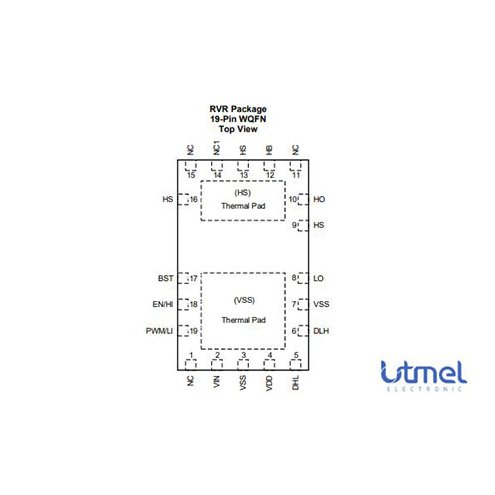
The pinout is optimized for SPI communication. Key groups include:
- Power Supply: VDD and GND pins must be decoupled locally to prevent switching noise from affecting the sensitive MEMS elements.
- SPI Interface: SCLK (Serial Clock), CS (Chip Select), DIN (Data In), and DOUT (Data Out).
- Control Pins: Includes RST (Reset) and DR (Data Ready) to signal the host processor when new samples are available.
2.2 Naming Convention & Ordering Codes
When sourcing the ADIS16470, procurement managers should look for the following suffixes:
- ADIS16470AMLZ: The standard industrial grade in the BGA package.
- Evaluation Boards: Look for ADIS16470/PCBZ to begin prototyping without custom PCB fabrication.
2.3 Available Packages
| Package Type | Dimensions | Common Use Case |
|---|---|---|
| 44-Ball BGA | 11 mm × 15 mm × 11 mm | Industrial Robotics, UAVs, and Stabilized Platforms |
Note: The BGA package is intended for machine assembly; hand-soldering is not recommended due to the high density of the ball grid.
3. Design & Integration Guide (For Engineers & Makers)
Pro Tip: Always verify SPI "Stall Time" requirements. This is the most common cause of communication failure during initial bring-up.
3.1 Hardware Implementation
Bypass Capacitors: Use a combination of 0.1 µF and 10 µF capacitors as close to the VDD pins as possible.
PCB Layout: Use a solid ground plane. Since this is a motion sensor, ensure the PCB is mounted securely to the frame of the vehicle or machine to avoid "parasitic vibrations."
Thermal Management: While the device operates up to 85°C, maintaining a stable temperature will further reduce bias drift.
3.2 Common Design Challenges
Issue: SPI Stall Time Violations: If you read data too quickly, the IMU may return 8-bit garbage or fail to respond.
Fix: Ensure the CS line remains HIGH for the minimum stall time (refer to the timing diagram in the datasheet) between 16-bit word transfers.
Issue: Yaw Drift: The ADIS16470 lacks a magnetometer (it is 6-DOF).
Fix: Use a Kalman Filter to fuse the ADIS16470 data with an external magnetometer or GPS for absolute heading reference.
4. Typical Applications & Use Cases
Watch Tutorial: ADIS16470
4.1 Real-World Example: Autonomous Mobile Robots (AMR)
In warehouse automation, an AMR uses the ADIS16470 to maintain a straight path between racks. The high accelerometer range allows the robot to handle sudden stops, while the low gyro bias ensures that the robot doesn't "veer" off course over long distances, even when wheel encoders slip on slick floors.
5. Alternatives and Cross-Reference Guide
If the ADIS16470 is out of stock or does not meet specific project constraints, consider these alternatives:
Direct Replacements: ADIS16475 or ADIS16477 (higher precision variants within the same family/pinout).
Consumer/Low-Cost Alternatives: TDK InvenSense ICM-42688 or Bosch BMI088. These are cheaper but offer significantly higher bias instability.
High-End Alternatives: Murata SCH16T for automotive-grade stability or STMicroelectronics ISM330DHCX for basic industrial IoT.
6. Frequently Asked Questions (FAQ)
Q: What is the difference between ADIS16470 and a standard consumer IMU?
A: The ADIS16470 is factory-calibrated for industrial environments, offering much lower "In-Run Bias Stability" (8°/hr), which means it drifts significantly less over time compared to consumer chips.
Q: Can ADIS16470 be used in Automotive applications?
A: While it is robust, it is primarily designed for industrial and UAV use. For safety-critical automotive systems, check for AEC-Q100 qualified parts from Analog Devices.
Q: Where can I find the datasheet and library files for ADIS16470?
A: The official datasheet is available on the Analog Devices website. For software, check the "allwpilib" or "iio-oscilloscope" repositories for existing driver support.
Q: Is ADIS16470 suitable for battery-operated devices?
A: Yes, with a 3.3V supply and relatively low current draw for its performance class, it is widely used in battery-powered drones and portable instrumentation.
7. Resources
Analog Devices Wiki: SPI Header and Driver Examples.
Evaluation Tools: ADIS16470/PCBZ Breakout Board.
Software: C++ and ROS (Robot Operating System) drivers for ADIS series IMUs.
Specifications
Datasheet PDF
- Datasheets :
- Other Related Documents :
- ConflictMineralStatement :
 Understanding MSP430G2x53 and MSP430G2x13 Mixed-Signal Microcontrollers
29 February 2024300
 BS170 N-Channel MOSFET: Pinout, Equivalent and Datasheet
03 September 202116012
 MMBT3906 PNP Switching Transistor: MMBT3906 Datasheet, Pinout, Alternatives
28 January 20225805
 LM7805 Voltage Regulator: Datasheet, Pinout, Circuit
28 December 202117704
 VHR-3N Rectangular Connector: JST VHR-3N, Equivalent, Datasheet
17 March 20222938
 TPS2051BDBVR Power-Distribution Switch: Diagram, Pinout, and Datasheet
01 April 20222877
 Guide to Reading the Toshiba 74HC245D Datasheet
18 August 2025305
 Atmel ATmega48/V, ATmega88/V, ATmega168/V: Unveiling the 8-bit Microcontroller with In-System Programmable Flash
28 February 2024302
 What are Types and Application of Gas Sensors?
18 November 202511324
 What is a Memory Controller?
12 August 202035417
 How do Solar Cells Work?
20 November 20203404
 Understanding Computer Memory: From SIMM and DIMM to DDR5
23 May 202523353
 RF Technology: Complete Guide to Specifications, Frequency Bands, Components, and Applications
22 June 2026643
 Intel Launches First-of-its-Kind Semiconductor Technician Certificate Program to Address Workforce Shortage
28 September 20233721
 VRLA Battery: Working Principle, Capacity and Maintenance
12 March 202111066
 How Big is the DV/DT and DI/DT of the Power Device?
24 April 202211854
Analog Devices Inc.
In Stock
United States
China
Canada
Japan
Russia
Germany
United Kingdom
Singapore
Italy
Hong Kong(China)
Taiwan(China)
France
Korea
Mexico
Netherlands
Malaysia
Austria
Spain
Switzerland
Poland
Thailand
Vietnam
India
United Arab Emirates
Afghanistan
Åland Islands
Albania
Algeria
American Samoa
Andorra
Angola
Anguilla
Antigua & Barbuda
Argentina
Armenia
Aruba
Australia
Azerbaijan
Bahamas
Bahrain
Bangladesh
Barbados
Belarus
Belgium
Belize
Benin
Bermuda
Bhutan
Bolivia
Bonaire, Sint Eustatius and Saba
Bosnia & Herzegovina
Botswana
Brazil
British Indian Ocean Territory
British Virgin Islands
Brunei
Bulgaria
Burkina Faso
Burundi
Cabo Verde
Cambodia
Cameroon
Cayman Islands
Central African Republic
Chad
Chile
Christmas Island
Cocos (Keeling) Islands
Colombia
Comoros
Congo
Congo (DRC)
Cook Islands
Costa Rica
Côte d’Ivoire
Croatia
Cuba
Curaçao
Cyprus
Czechia
Denmark
Djibouti
Dominica
Dominican Republic
Ecuador
Egypt
El Salvador
Equatorial Guinea
Eritrea
Estonia
Eswatini
Ethiopia
Falkland Islands
Faroe Islands
Fiji
Finland
French Guiana
French Polynesia
Gabon
Gambia
Georgia
Ghana
Gibraltar
Greece
Greenland
Grenada
Guadeloupe
Guam
Guatemala
Guernsey
Guinea
Guinea-Bissau
Guyana
Haiti
Honduras
Hungary
Iceland
Indonesia
Iran
Iraq
Ireland
Isle of Man
Israel
Jamaica
Jersey
Jordan
Kazakhstan
Kenya
Kiribati
Kosovo
Kuwait
Kyrgyzstan
Laos
Latvia
Lebanon
Lesotho
Liberia
Libya
Liechtenstein
Lithuania
Luxembourg
Macao(China)
Madagascar
Malawi
Maldives
Mali
Malta
Marshall Islands
Martinique
Mauritania
Mauritius
Mayotte
Micronesia
Moldova
Monaco
Mongolia
Montenegro
Montserrat
Morocco
Mozambique
Myanmar
Namibia
Nauru
Nepal
New Caledonia
New Zealand
Nicaragua
Niger
Nigeria
Niue
Norfolk Island
North Korea
North Macedonia
Northern Mariana Islands
Norway
Oman
Pakistan
Palau
Palestinian Authority
Panama
Papua New Guinea
Paraguay
Peru
Philippines
Pitcairn Islands
Portugal
Puerto Rico
Qatar
Réunion
Romania
Rwanda
Samoa
San Marino
São Tomé & Príncipe
Saudi Arabia
Senegal
Serbia
Seychelles
Sierra Leone
Sint Maarten
Slovakia
Slovenia
Solomon Islands
Somalia
South Africa
South Sudan
Sri Lanka
St Helena, Ascension, Tristan da Cunha
St. Barthélemy
St. Kitts & Nevis
St. Lucia
St. Martin
St. Pierre & Miquelon
St. Vincent & Grenadines
Sudan
Suriname
Svalbard & Jan Mayen
Sweden
Syria
Tajikistan
Tanzania
Timor-Leste
Togo
Tokelau
Tonga
Trinidad & Tobago
Tunisia
Turkey
Turkmenistan
Turks & Caicos Islands
Tuvalu
U.S. Outlying Islands
U.S. Virgin Islands
Uganda
Ukraine
Uruguay
Uzbekistan
Vanuatu
Vatican City
Venezuela
Wallis & Futuna
Yemen
Zambia
Zimbabwe
![EVAL-ADXL362Z-MLP]() EVAL-ADXL362Z-MLP
EVAL-ADXL362Z-MLPAnalog Devices Inc.
![ADXL213EB]() ADXL213EB
ADXL213EBAnalog Devices Inc.
![EVAL-ADXL362Z-S]() EVAL-ADXL362Z-S
EVAL-ADXL362Z-SAnalog Devices Inc.
![ADIS16203/PCBZ]() ADIS16203/PCBZ
ADIS16203/PCBZAnalog Devices Inc.
![EVAL-ADXL355Z]() EVAL-ADXL355Z
EVAL-ADXL355ZAnalog Devices Inc.
![EVAL-ADXL345Z-M]() EVAL-ADXL345Z-M
EVAL-ADXL345Z-MAnalog Devices Inc.
![EVAL-ADXL345Z-S]() EVAL-ADXL345Z-S
EVAL-ADXL345Z-SAnalog Devices Inc.
![ADXL05EM-1]() ADXL05EM-1
ADXL05EM-1Analog Devices Inc.
![EVAL-ADXL346Z-DB]() EVAL-ADXL346Z-DB
EVAL-ADXL346Z-DBAnalog Devices Inc.


