

 Product
 Brand
 Articles
 Tools

AD7768 24-Bit 8-Channel ADC: High-Speed Simultaneous Sampling Deep Dive


BOARD EVAL FOR AD7768
Explore the AD7768 24-bit ADC by Analog Devices. Features 8-channel simultaneous sampling and 256 kSPS. Ideal for high-precision DAQ. Buy or design today!
- Executive Summary: What is the AD7768?
- 1. Technical Specifications & Performance Analysis
- 2. Pinout, Package, and Configuration
- 3. Design & Integration Guide (For Engineers & Makers)
- 4. Typical Applications & Use Cases
- 5. Alternatives and Cross-Reference Guide
- 6. Frequently Asked Questions (FAQ)
- 7. Resources
- Specifications
- Datasheet PDF
Executive Summary: What is the AD7768?
The AD7768 is a high-performance, 8-channel and 4-channel, 24-bit simultaneous sampling sigma-delta (Σ-Δ) analog-to-digital converter (ADC) designed for high-density data acquisition systems. It provides a unique combination of high bandwidth, low power consumption, and exceptional dynamic range for precision instrumentation.
Market Position: High-performance flagship ADC for multi-channel synchronous systems.
Top Features: 24-bit resolution, 256 kSPS maximum output data rate (ODR), and 108 dB dynamic range.
Primary Audience: Ideal for industrial DAQ designers, medical imaging engineers, and power quality analysts.
Supply Status: Active (Current production).

1. Technical Specifications & Performance Analysis
The AD7768 series is engineered to bridge the gap between high-speed Nyquist-rate ADCs and high-precision Sigma-Delta converters.
1.1 Core Architecture (Σ-Δ Logic)
The device utilizes a simultaneous sampling architecture, which is critical for applications where phase relationship between channels must be preserved (e.g., 3-phase power or sonar). By using a Sigma-Delta core with selectable power scaling, designers can trade off power consumption against signal bandwidth and noise performance.
1.2 Key Electrical Characteristics
The AD7768 operates with a robust set of power and thermal requirements:
- Analog Supply (AVDD1): Fixed at 5.0 V for maximum linear range.
- Digital Supply (IOVDD): Flexible range from 1.8 V to 3.3 V, allowing direct interfacing with modern FPGAs and MCUs.
- Dynamic Performance: Typical Total Harmonic Distortion (THD) of -120 dB, ensuring minimal signal coloration.
- Operating Temperature: Rated for industrial environments from -40°C to +105°C.
1.3 Interfaces and Connectivity
The AD7768 supports versatile data output formats including TDM (Time Division Multiplexing) and SAI (Serial Audio Interface). It includes CRC error checking on the data interface to ensure high-integrity transmission in electrically noisy industrial environments.
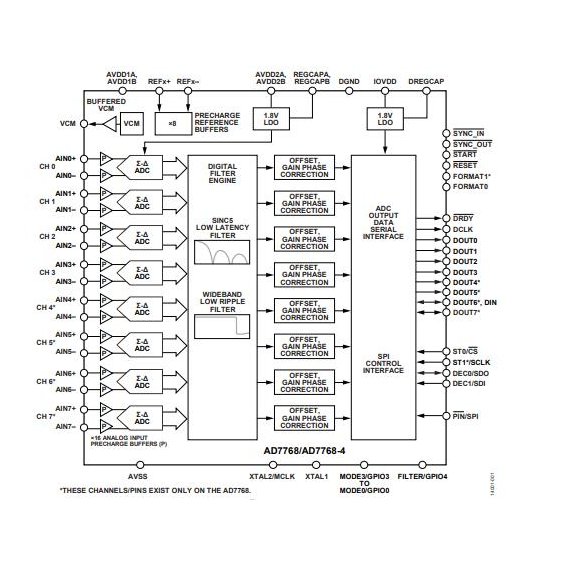
2. Pinout, Package, and Configuration
The AD7768 is designed for high-density layouts, requiring careful attention to pin grouping for signal integrity.
2.1 Pin Configuration Guide
Analog Inputs (AIN0+ to AIN7-): Differential inputs for the 8 channels.
Digital Interface Pins: Includes DCLK (Data Clock), DRDY (Data Ready), and DOUT pins for serial data transmission.
Control Pins: START for synchronization and RESET for hardware initialization.
Reference Pins: REF+ and REF- for the ADC voltage reference.
2.2 Naming Convention & Ordering Codes
Analog Devices uses specific suffixes to denote channel count and performance grades. For example, the AD7768 (8-channel) vs. AD7768-4 (4-channel). Always check the suffix for package type (e.g., BSTZ for LQFP) to ensure compatibility with your PCB assembly process.
2.3 Available Packages
| Package Type | Dimensions | Common Use Case |
|---|---|---|
| LQFP-64 | 10mm x 10mm | Standard PCB assembly, easy probing |
| BGA | Compact | Space-constrained high-density DAQ cards |
(Refer to the specific AD7768 datasheet for exact package dimensions and footprint patterns.)
3. Design & Integration Guide (For Engineers & Makers)
Pro Tip: Always use a dedicated low-noise LDO for the AVDD1 supply to maintain the 108 dB dynamic range.
3.1 Hardware Implementation
Bypass Capacitors: Place 0.1 µF ceramic capacitors as close as possible to every supply pin. Use a 10 µF tantalum capacitor at the entry point of the board.
PCB Layout: Use a solid ground plane. Keep digital traces (DCLK, DOUT) away from the sensitive analog input pairs to prevent crosstalk.
Thermal Management: While the AD7768 is efficient, the 8-channel version can generate heat at 256 kSPS. Ensure adequate copper pouring around the GND pins for heat dissipation.
3.2 Common Design Challenges
Issue: Data Alignment at High Frequencies: At 256 kSPS, Linux IIO drivers may experience FIFO overflows.
Fix: Monitor DMA controller overflow signals and ensure the MCLK is stable and jitter-free.
Issue: Complex TDM/SAI Configuration: Microcontrollers like STM32 may struggle to align with the TDM frame.
Fix: Explicitly synchronize DCLK and DRDY. Set the FORMAT pin correctly and utilize DMA for parallel synchronous transmission.
4. Typical Applications & Use Cases
Watch Tutorial: AD7768
4.1 Real-World Example: Vibration & Asset Monitoring
In industrial predictive maintenance, the AD7768 is used to sample high-frequency vibrations from multiple sensors simultaneously. Because it captures all 8 channels at the exact same instant, engineers can perform complex phase analysis to detect bearing failures or shaft misalignments before they lead to machine breakdown.
5. Alternatives and Cross-Reference Guide
If the AD7768 is not the perfect fit for your BOM, consider these alternatives:
Direct Replacements: Texas Instruments ADS1278 (8-channel, 24-bit) is the primary industry competitor with similar simultaneous sampling.
Better Performance/Single Channel: AD7768-1 for single-channel applications requiring the same high-end Σ-Δ performance.
Cost-Effective Options: Ruimeng Tech RM-ADH2000 or XINLUDA XL-AD24xx series for budget-sensitive consumer projects.
Successor/Alternative: Texas Instruments ADS1274 (4-channel version).
6. Frequently Asked Questions (FAQ)
Q: What is the difference between AD7768 and TI ADS1278?
A: Both are 24-bit, 8-channel ADCs. The AD7768 offers more flexible power scaling modes (Fast/Median/Low Power) and integrated digital filters.
Q: Can AD7768 be used in Automotive applications?
A: Yes, provided the operating temperature remains within the -40°C to +105°C range and the design meets AEC-Q100 if required by the specific sub-system.
Q: Where can I find the datasheet and library files for AD7768?
A: Official datasheets and IBIS models are available on the Analog Devices website.
Q: How do I program/configure the AD7768?
A: Configuration is typically done via the SPI interface by writing to internal registers to set ODR, filter types, and power modes.
7. Resources
Development Tools: EVAL-AD7768FMCZ Evaluation Board.
Software: Linux IIO drivers for AD7768.
Documentation: ADI Wiki for "Configuring TDM Modes on AD7768".
Specifications
Datasheet PDF
- Datasheets :
- Other Related Documents :
- ConflictMineralStatement :
- Software Download :
 LMR240 VS LMR400[Video]: Which one is better?
12 June 202414971
 TL431A Integrated Circuit: Pinout, Equivalent and Datasheet
12 November 20218591
 LD39200PUR Ultra Low Drop Linear Regulator: 2A, 6DFN, LD39200PUR Datasheet
22 January 20222123
 A Comprehensive Guide to LTC6953IUKG#TRPBF Clock Generator by Linear Technology/Analog Devices
06 March 2024325
 DS1820 Digital Thermometer: Pinout, Datasheet and Comparison
04 August 20216875
 LM1458N Operational Amplifier: Pinout, Datasheet, and Schematic Diagram
09 August 20214030
 CD4081 Quad 2 Input AND Gate IC: Pinout, Datasheet and Circuit
28 October 202111865
 LM5166DRCR: Datasheet, Pinout, 10-VFDFN, high efficiency
12 February 20221092
 An Overview of Thermal Overload Relays
12 October 202013848
 Comparison of Advantages and Disadvantages of Common Switch Mode Power Supply(SMPS)
21 January 20228601
 Decoding AEC-Q100: A Sourcing Guide to Automotive Grade Semiconductor Qualification and Temperature Ratings
11 August 2026749
 Ceramic Capacitors Explained: Dielectric Classes, MLCC Construction, and the Parameters That Actually Matter
14 July 20267635
 QUIC: The Next Generation Communication Protocol
22 February 20222239
 GlobalFoundries Unveils $4 Billion Expansion in Singapore to Meet Rising Chip Demand
13 September 20234192
 Detailed Explanation About Twenty Kinds of Capacitor
08 November 20219523
 What is CPLD (Complex Programmable Logic Device)?
15 October 202512624
Analog Devices Inc.
In Stock: 2239
United States
China
Canada
Japan
Russia
Germany
United Kingdom
Singapore
Italy
Hong Kong(China)
Taiwan(China)
France
Korea
Mexico
Netherlands
Malaysia
Austria
Spain
Switzerland
Poland
Thailand
Vietnam
India
United Arab Emirates
Afghanistan
Åland Islands
Albania
Algeria
American Samoa
Andorra
Angola
Anguilla
Antigua & Barbuda
Argentina
Armenia
Aruba
Australia
Azerbaijan
Bahamas
Bahrain
Bangladesh
Barbados
Belarus
Belgium
Belize
Benin
Bermuda
Bhutan
Bolivia
Bonaire, Sint Eustatius and Saba
Bosnia & Herzegovina
Botswana
Brazil
British Indian Ocean Territory
British Virgin Islands
Brunei
Bulgaria
Burkina Faso
Burundi
Cabo Verde
Cambodia
Cameroon
Cayman Islands
Central African Republic
Chad
Chile
Christmas Island
Cocos (Keeling) Islands
Colombia
Comoros
Congo
Congo (DRC)
Cook Islands
Costa Rica
Côte d’Ivoire
Croatia
Cuba
Curaçao
Cyprus
Czechia
Denmark
Djibouti
Dominica
Dominican Republic
Ecuador
Egypt
El Salvador
Equatorial Guinea
Eritrea
Estonia
Eswatini
Ethiopia
Falkland Islands
Faroe Islands
Fiji
Finland
French Guiana
French Polynesia
Gabon
Gambia
Georgia
Ghana
Gibraltar
Greece
Greenland
Grenada
Guadeloupe
Guam
Guatemala
Guernsey
Guinea
Guinea-Bissau
Guyana
Haiti
Honduras
Hungary
Iceland
Indonesia
Iran
Iraq
Ireland
Isle of Man
Israel
Jamaica
Jersey
Jordan
Kazakhstan
Kenya
Kiribati
Kosovo
Kuwait
Kyrgyzstan
Laos
Latvia
Lebanon
Lesotho
Liberia
Libya
Liechtenstein
Lithuania
Luxembourg
Macao(China)
Madagascar
Malawi
Maldives
Mali
Malta
Marshall Islands
Martinique
Mauritania
Mauritius
Mayotte
Micronesia
Moldova
Monaco
Mongolia
Montenegro
Montserrat
Morocco
Mozambique
Myanmar
Namibia
Nauru
Nepal
New Caledonia
New Zealand
Nicaragua
Niger
Nigeria
Niue
Norfolk Island
North Korea
North Macedonia
Northern Mariana Islands
Norway
Oman
Pakistan
Palau
Palestinian Authority
Panama
Papua New Guinea
Paraguay
Peru
Philippines
Pitcairn Islands
Portugal
Puerto Rico
Qatar
Réunion
Romania
Rwanda
Samoa
San Marino
São Tomé & Príncipe
Saudi Arabia
Senegal
Serbia
Seychelles
Sierra Leone
Sint Maarten
Slovakia
Slovenia
Solomon Islands
Somalia
South Africa
South Sudan
Sri Lanka
St Helena, Ascension, Tristan da Cunha
St. Barthélemy
St. Kitts & Nevis
St. Lucia
St. Martin
St. Pierre & Miquelon
St. Vincent & Grenadines
Sudan
Suriname
Svalbard & Jan Mayen
Sweden
Syria
Tajikistan
Tanzania
Timor-Leste
Togo
Tokelau
Tonga
Trinidad & Tobago
Tunisia
Turkey
Turkmenistan
Turks & Caicos Islands
Tuvalu
U.S. Outlying Islands
U.S. Virgin Islands
Uganda
Ukraine
Uruguay
Uzbekistan
Vanuatu
Vatican City
Venezuela
Wallis & Futuna
Yemen
Zambia
Zimbabwe
![LTC2157IUP-14#PBF]() LTC2157IUP-14#PBF
Analog Devices
![LTC2247IUH#PBF]() LTC2247IUH#PBF
Analog Devices
![LTC1608CG#PBF]() LTC1608CG#PBF
Analog Devices
![LTC2263IUJ-14#PBF]() LTC2263IUJ-14#PBF
Analog Devices
![LTC1407ACMSE]() LTC1407ACMSE
Linear Technology / Analog Devices
![LTC1598IG]() LTC1598IG
Linear Technology / Analog Devices
![LTC1594CS]() LTC1594CS
Linear Technology / Analog Devices
![LTC2358CLX-16#PBF]() LTC2358CLX-16#PBF
Analog Devices
![LTC2247CUH]() LTC2247CUH
Linear Technology / Analog Devices
![LTC2411CMS]() LTC2411CMS
Linear Technology / Analog Devices
